Listen to this Post
Introduction:
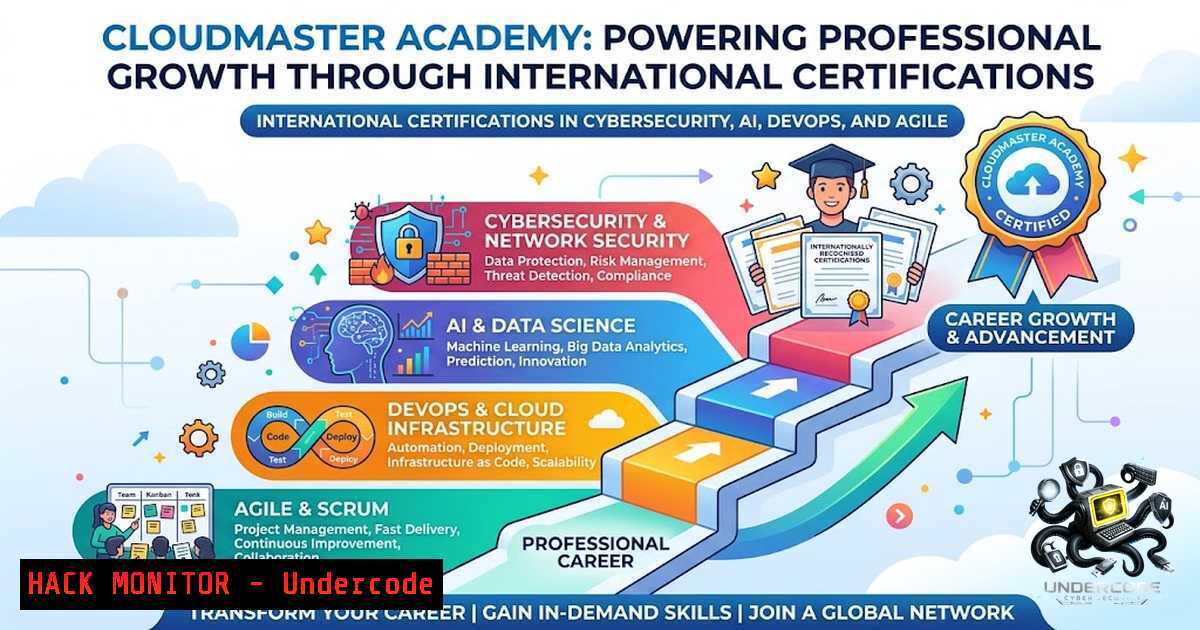
The rapid evolution of cybersecurity threats, artificial intelligence capabilities, and cloud-1ative architectures has created an unprecedented demand for verified technical expertise. CloudMaster Academy addresses this gap by offering internationally recognized certification programs across Scrum, DevOps, Cybersecurity, Artificial Intelligence, and ISO 27001 governance. These certifications provide professionals with the credentials needed to validate their skills in an increasingly competitive job market where employers prioritize demonstrable competence over informal experience.
Learning Objectives & Secrets:
- Objective 1: Master the Foundations of Cybersecurity and Ethical Hacking – Develop a comprehensive understanding of threat vectors, vulnerability assessment methodologies, and penetration testing techniques. The Cyber Security Foundation and Ethical Hacking Professional certifications equip learners with hands-on skills to identify, exploit, and mitigate security weaknesses in modern IT infrastructures.
-
Objective 2: Secret Tip – Leverage AI Governance for Competitive Advantage – Beyond technical AI skills, the ISO/IEC 42001系列 certifications (Foundation, Internal Auditor, Lead Auditor) provide a strategic edge. Organizations increasingly require AI risk management and governance frameworks to comply with emerging regulations. Mastering these standards positions you as a bridge between technical AI implementation and business compliance.
-
Objective 3: Secret Tip – Combine DevOps Culture with Security (DevSecOps) – The DevOps Foundation and DevOps Culture Practitioner certifications are most powerful when integrated with security principles. Modern organizations seek professionals who can automate secure software delivery pipelines. Understanding CI/CD security, infrastructure-as-code scanning, and container security transforms a DevOps practitioner into a DevSecOps specialist.
You Should Know:
- Cybersecurity Foundation & Ethical Hacking – Building Your Defense Arsenal
The Cyber Security Foundation and Ethical Hacking Professional certifications establish a strong baseline in information security principles. These programs cover network security, cryptography, access control, and incident response. The Ethical Hacking track takes learners deeper into offensive security—simulating real-world attacks to understand attacker methodologies.
Step‑by‑step guide – Basic Network Reconnaissance (Linux):
This process demonstrates how attackers gather intelligence about target systems, a critical skill for both ethical hackers and defenders.
 Step 1: Discover live hosts on a network segment
nmap -sn 192.168.1.0/24

Step 2: Perform a stealth SYN scan on a specific target
nmap -sS -p- -T4 192.168.1.100

Step 3: Enumerate open services and versions
nmap -sV -sC -p 22,80,443 192.168.1.100

Step 4: Check for common vulnerabilities using NSE scripts
nmap --script vuln -p 80,443 192.168.1.100
Step‑by‑step guide – Windows Security Hardening (PowerShell):
Defenders must implement baseline security controls to reduce attack surfaces.
 Step 1: Enable Windows Defender real-time protection
Set-MpPreference -DisableRealtimeMonitoring $false

Step 2: Enable Windows Firewall for all profiles
Set-1etFirewallProfile -All -Enabled True

Step 3: Disable insecure SMB v1 protocol
Disable-WindowsOptionalFeature -Online -FeatureName SMB1Protocol

Step 4: Enable verbose PowerShell logging for threat detection
Set-ItemProperty -Path "HKLM:\SOFTWARE\Policies\Microsoft\Windows\PowerShell\ScriptBlockLogging" -1ame "EnableScriptBlockLogging" -Value 1
- Artificial Intelligence & Generative AI – From Foundation to Expert
The AI certification track at CloudMaster Academy spans from AI Foundation Professional to AI Expert and Generative AI Professional. These programs address the full spectrum of AI competencies—from understanding neural network architectures to deploying production-grade generative AI systems. The Prompt Engineering Professional certification is particularly relevant as organizations seek specialists who can effectively interact with and optimize large language models.
Step‑by-step guide – Setting Up a Local AI Development Environment (Python):
 Step 1: Create a dedicated Python virtual environment
python -m venv ai_env
source ai_env/bin/activate  Linux/macOS
 ai_env\Scripts\activate  Windows

Step 2: Install core AI/ML libraries
pip install tensorflow torch transformers scikit-learn pandas numpy

Step 3: Install generative AI tools
pip install openai langchain huggingface-hub

Step 4: Set up API keys securely (Linux/macOS)
export OPENAI_API_KEY="your-api-key-here"
 Windows: set OPENAI_API_KEY=your-api-key-here

Step 5: Verify installation
python -c "import torch; print(torch.<strong>version</strong>)"
- ISO/IEC 27001 – The Gold Standard for Information Security Management
The ISO/IEC 27001 certification track (Foundation, Internal Auditor, Lead Auditor) provides professionals with the framework to establish, implement, maintain, and continually improve an information security management system (ISMS). These certifications are essential for security managers, compliance officers, and IT leaders responsible for organizational security posture.
Key components of ISO/IEC 27001 implementation:
- Context of the organization: Understanding internal and external issues affecting information security
- Leadership commitment: Top management must demonstrate active support for the ISMS
- Risk assessment and treatment: Systematic identification and mitigation of security risks
- Operational planning and control: Implementing security controls from Annex A
- Performance evaluation: Monitoring, measurement, analysis, and evaluation of ISMS effectiveness
- Continual improvement: Regularly updating the ISMS based on audit findings and changing threats
- DevOps Foundation & Culture – Automating the Software Delivery Lifecycle
DevOps certifications from CloudMaster Academy (DevOps Foundation, DevOps Essentials, DevOps Culture Practitioner) focus on breaking down silos between development and operations teams. These programs emphasize automation, continuous integration/continuous delivery (CI/CD), and cultural transformation.
Step‑by-step guide – Building a CI/CD Pipeline with Jenkins (Linux):
 Step 1: Install Jenkins on Ubuntu/Debian
wget -q -O - https://pkg.jenkins.io/debian-stable/jenkins.io.key | sudo apt-key add -
sudo sh -c 'echo deb https://pkg.jenkins.io/debian-stable binary/ > /etc/apt/sources.list.d/jenkins.list'
sudo apt update && sudo apt install jenkins

Step 2: Start Jenkins service
sudo systemctl start jenkins
sudo systemctl enable jenkins

Step 3: Retrieve initial admin password
sudo cat /var/lib/jenkins/secrets/initialAdminPassword

Step 4: Install recommended plugins via web interface (http://localhost:8080)

Step 5: Create a pipeline job with a Jenkinsfile
 Example Jenkinsfile (declarative pipeline):
pipeline {
agent any
stages {
stage('Build') {
steps {
echo 'Building the application...'
sh 'mvn clean compile'
}
}
stage('Test') {
steps {
echo 'Running tests...'
sh 'mvn test'
}
}
stage('Deploy') {
steps {
echo 'Deploying to staging...'
sh 'docker build -t myapp:latest .'
sh 'docker push myapp:latest'
}
}
}
}
- Agile & Scrum – Driving Business Agility Through Certified Practices
The Scrum Master, Scrum Product Owner, Scrum Developer, and Agile Coach Professional certifications establish a strong foundation in agile methodologies. These programs go beyond theory, teaching practical techniques for sprint planning, backlog management, and team facilitation.
Essential Scrum artifacts and events:
- Product Backlog: Prioritized list of features and requirements maintained by the Product Owner
- Sprint Backlog: Commitments for the current sprint, selected from the Product Backlog
- Increment: The sum of all completed Product Backlog items at the end of a sprint
- Sprint Planning: Time-boxed event (max 8 hours) to define what can be delivered
- Daily Scrum: 15-minute synchronization meeting for the Development Team
- Sprint Review: Demonstration of completed work to stakeholders
- Sprint Retrospective: Team reflection on process improvements
- ISO/IEC 42001 – AI Governance and Responsible Artificial Intelligence
The ISO/IEC 42001 certification track (Foundation, Internal Auditor, Lead Auditor) addresses the growing need for AI governance frameworks. As AI systems become more prevalent, organizations must ensure their AI implementations are ethical, transparent, and compliant with emerging regulations.
Key principles of AI governance under ISO/IEC 42001:
- Transparency: AI systems should be explainable and their decision-making processes understandable
- Fairness: AI models must avoid bias and discrimination
- Accountability: Clear ownership and responsibility for AI system outcomes
- Privacy: AI systems must respect data protection and privacy rights
- Robustness: AI systems should be secure against adversarial attacks and data poisoning
- Human oversight: Appropriate human intervention mechanisms must exist for critical AI decisions
What CloudMaster Academy Says:
- Key Takeaway 1: Certification preparation includes live instructor guidance, 100% online classes, study materials, exam preparation, vouchers for certification exams, and internationally recognized digital credentials. This comprehensive support structure significantly increases pass rates and reduces the time required to achieve certification.
-
Key Takeaway 2: The academy offers multiple exam attempts depending on the certification purchased, providing a safety net that reduces exam anxiety and allows candidates to focus on genuine learning rather than test-taking pressure.
Analysis: CloudMaster Academy’s certification portfolio strategically covers the intersection of security, AI, and agile methodologies—three domains experiencing critical skill shortages globally. The inclusion of ISO/IEC 42001 (AI governance) alongside ISO/IEC 27001 (information security) demonstrates forward-thinking curriculum design, anticipating that future security professionals will need to govern both traditional IT systems and AI-powered applications. The emphasis on verifiable digital credentials aligns with the growing trend of blockchain-based credential verification, adding an extra layer of trust for employers. However, professionals should supplement these certifications with hands-on lab experience and real-world project work to maximize their marketability.
Prediction:
- +1 The convergence of AI governance (ISO/IEC 42001) and information security (ISO/IEC 27001) certifications will create a new specialist role: the AI Security Governance Professional. Organizations will increasingly seek individuals who can simultaneously manage traditional security risks and AI-specific threats like model poisoning, prompt injection, and data leakage.
-
+1 The Prompt Engineering Professional certification addresses a skill gap that will only widen as generative AI tools become ubiquitous. Professionals with this credential will command premium salaries as organizations struggle to optimize their AI investments.
-
-1 The rapid pace of AI evolution means certification curricula may struggle to keep current with the latest developments. Professionals should treat certifications as a foundation and commit to continuous learning through research papers, conferences, and hands-on experimentation.
-
+1 The shift toward verified digital credentials will accelerate the decline of traditional resume-based hiring. Employers will increasingly rely on verifiable skill attestations, making these certifications even more valuable for career advancement.
-
-1 The proliferation of AI-related certifications may lead to market saturation and credential inflation. Professionals should differentiate themselves by combining multiple certifications (e.g., AI + Security + Agile) to demonstrate unique interdisciplinary capabilities.
-
+1 CloudMaster Academy’s integration with DocuClick—an electronic signature and document management platform—provides a unique competitive advantage. Students can learn about AI and security in the context of a real-world SaaS product, bridging the gap between theory and practice.
-
+1 The emphasis on agile transformation and business agility positions CloudMaster Academy graduates to lead organizational change initiatives, not just technical implementations. This business-centric approach increases their value to executive leadership.
-
-1 The certification landscape remains fragmented, with multiple competing bodies offering similar credentials. Professionals should research which certifications are most valued in their target industry and geographic region before committing to a specific track.
-
+1 The inclusion of OKR Professional certification alongside technical credentials demonstrates an understanding that modern IT leaders must align technical work with business objectives. This interdisciplinary approach produces well-rounded professionals capable of bridging the gap between engineering and strategy.
-
+1 As cyber threats and AI capabilities continue to evolve in tandem, the demand for professionals who understand both domains will grow exponentially. CloudMaster Academy’s integrated curriculum positions its graduates at the forefront of this emerging discipline.
🎯Let’s Practice For Free:
🎓 Live Courses & Certifications:
Join Undercode Academy for Verified Certifications
🚀 Request a Custom Project:
Secure, high-velocity infrastructure and disruptive technological engineering. Contact our engineering team for high-tier development and proprietary systems:
[email protected]
💎 Smart Architecture | 🛡️ Secure by Design | ⭐ Trusted by Thousands
IT/Security Reporter URL:
Reported By: https://lnkd.in/p/ejg2qW-5 – Hackers Feeds
Extra Hub: Undercode MoN
Basic Verification: Pass ✅


