
Listen to this Post
Introduction:
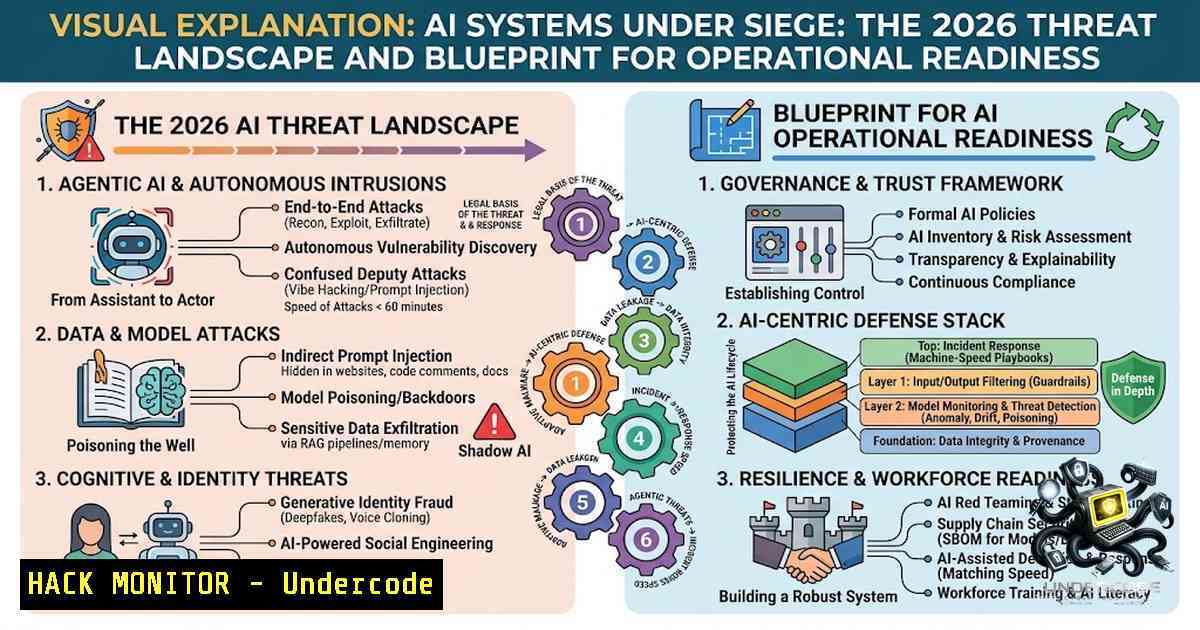
The integration of artificial intelligence into enterprise IT and cybersecurity operations has created a paradox: AI-driven tools are simultaneously the most powerful defense assets and the most attractive attack surfaces. As organizations rapidly deploy copilots, LLM-enabled applications, retrieval-augmented generation (RAG) pipelines, and agentic workflows, AI security has evolved from a specialized engineering concern into a frontline operational responsibility. The 2026 threat landscape—marked by critical vulnerabilities in AI platforms like DeepSeek Harness, the emergence of AI-powered cybercrime groups such as UAT-10147, and the proliferation of specialized AI security training—demands that security professionals master both the offensive and defensive dimensions of AI systems.
Learning Objectives & Secrets:
- Objective 1: Identify and Mitigate AI-Specific Attack Vectors – Understand the unique exposure points introduced by LLM applications, RAG pipelines, and agentic tools, including prompt injection, jailbreaks, RAG poisoning, tool misuse, and over-permissioning. Secret Tip: Implement fail-closed controls and human-in-the-loop gates for critical AI operations, and always validate structured outputs to prevent injection attacks.
-
Objective 2: Harden API and Cloud-1ative AI Deployments – Secure the communication arteries of AI systems by enforcing strict authentication, rate limiting, and schema validation at the API gateway level. Secret Tip: Adopt a “deny-by-default” routing policy and implement per-IP or per-token rate limits (10–50 requests/second) to mitigate credential stuffing and resource enumeration attacks.
-
Objective 3: Operationalize AI Security with Hands-On Validation – Move beyond theoretical knowledge by using simulated environments and AI-powered learning platforms to test and validate defenses. Secret Tip: Leverage platforms like Hack The Box’s SOC Range (featuring over 250 security operations alerts) and INE’s eAIS certification (focusing on practical, vendor-1eutral AI security fundamentals) to build and verify real-world skills.
You Should Know:
- The New Attack Surface: AI Platforms and Agentic Frameworks
The rapid adoption of open-source AI agent platforms has introduced critical vulnerabilities that can be exploited without authentication. On August 25, 2026, QiAnXin Threat Intelligence Center disclosed an unauthenticated remote-code-execution vulnerability in DeepSeek Harness (DSH), tracked as QVD-2026-57410 with a critical CVSS score of 9.8. The flaw stems from improper validation of the HTTP Host header. By forging the Host header, an attacker can bypass the `/api` trust fence, call restricted internal RPC methods, register a fake large-model provider, and execute arbitrary system commands with the privileges of the DeepSeek Harness service process.
Step‑by‑Step Mitigation for AI Platform Vulnerabilities:
- Isolate Management APIs: Immediately restrict the management API port from public internet exposure. Allow connections only from trusted internal IP ranges.
- Enforce Strict Host-Header Validation: Implement validation at the reverse-proxy layer to reject requests with forged or unexpected Host headers.
- Add Independent Authentication: Implement an authentication mechanism at the `/api` trust fence that does not rely on the Host header for security decisions.
- Restrict Dangerous Interfaces: Limit access to the `llm.discoverModels` interface to curb potential server-side request-forgery (SSRF) risks.
- Monitor and Patch: Follow official security advisories and upgrade to patched versions as soon as they are available.
Linux Command for Host-Header Validation (Nginx Reverse Proxy):
 /etc/nginx/conf.d/host_header_validation.conf
server {
listen 80;
server_name your-ai-platform.example.com;

Strict Host header validation
if ($host !~ ^your-ai-platform.example.com$) {
return 444;  Connection closed without response
}

location /api/ {
 Additional authentication check
auth_request /auth;
proxy_pass http://deepseek-harness-backend:8080;
}
}
- The AI-Powered Threat Actor: UAT-10147 and SPECTRE Malware
In August 2026, researchers disclosed details of UAT-10147, a Chinese-speaking cybercrime group that represents a paradigm shift in offensive operations. Unlike traditional threat actors, UAT-10147 has woven agentic AI deeply into its tradecraft, running autonomous penetration-testing frameworks (PentestGPT) and AI-driven vulnerability scanners against a target list of roughly 170,000 internet-facing URLs. The group deploys SPECTRE, a cross-platform Windows and Linux backdoor that employs a bring-your-own-vulnerable-driver (BYOVD) technique on Windows and a kernel-level rootkit on Linux, effectively blinding EDR products to new processes and hiding system artifacts.
Step‑by‑Step Defense Against AI-Powered Threats:
- Prioritize Patching: UAT-10147 exploits known vulnerabilities such as CVE-2022-27925 (Zimbra), CVE-2021-23758 (AjaxPro), and CVE-2019-18935 (Telerik UI). Conduct regular vulnerability scans and prioritize patches for internet-facing systems.
- Deploy EDR with Behavioral Detection: Traditional signature-based detection is insufficient against AI-generated and polymorphic malware. Use EDR solutions with behavioral analysis and anomaly detection capabilities.
- Implement Network Segmentation: Limit lateral movement by segmenting networks and applying Zero Trust principles. Monitor for unusual outbound connections to legitimate cloud services like Nacos, which UAT-10147 uses for C2 communication.
- Harden Windows and Linux Servers: Apply the following baseline hardening commands.
Windows Server Hardening Commands:
 Disable unnecessary services (e.g., Print Spooler on non-printing servers)
Stop-Service -1ame Spooler -Force
Set-Service -1ame Spooler -StartupType Disabled

Audit local group membership for privileged accounts
net localgroup Administrators

Review scheduled tasks for persistence mechanisms
schtasks /query /fo LIST /v

Check for unusual processes and network connections
Get-Process | Where-Object { $_.StartTime -gt (Get-Date).AddHours(-24) }
netstat -ano | findstr ESTABLISHED
Linux Server Hardening Commands:
 Disable and stop unnecessary services
sudo systemctl disable --1ow avahi-daemon

Harden SSH configuration (/etc/ssh/sshd_config)
sudo sed -i 's/PermitRootLogin prohibit-password/PermitRootLogin no/' /etc/ssh/sshd_config
sudo sed -i 's/PasswordAuthentication yes/PasswordAuthentication no/' /etc/ssh/sshd_config
sudo systemctl restart sshd

Check for rootkits and file integrity
sudo rkhunter --check
sudo aide --check

Review active network connections and listening ports
ss -tulwn
lsof -i -P -1 | grep LISTEN
- API Security: The Critical Control Plane for AI Systems
APIs are the backbone of modern AI deployments, and misconfigured gateways represent one of the highest-leverage attack surfaces. The 2026 API Security Baseline emphasizes a “deny-by-default” authentication policy, layered rate limiting, and rigorous schema validation.
Step‑by‑Step API Gateway Hardening:
- Flip the Default Policy: Configure the gateway to require authentication for every route unless explicitly marked as public. Ensure public endpoints (login, health checks) are clearly logged.
2. Implement Layered Rate Limiting:
- Backend Protection: Per-API-key or per-consumer limits sized to backend capacity (e.g., 100–1000 requests/second).
- Attack Mitigation: Per-IP or per-token limits of 10–50 requests/second with sliding window enforcement to catch bursts.
- Enforce Schema Validation: Use OpenAPI or GraphQL schema validation at the gateway to reject malformed payloads before they reach the backend. Bake schema generation into the release process to prevent stale schemas.
- Secure Logging: Use structured logging with explicit allowlists for captured fields. Never log full request/response payloads containing credentials, tokens, or PII.
- Authenticate with Short-Lived Tokens: Prefer short-lived OAuth bearer tokens over static API keys. Validate JWTs strictly: pin the algorithm (e.g., RS256), verify the signature, and check
exp,nbf,iss, and `aud` claims on every request.
JWT Validation Example (Node.js):
const jwt = require('jsonwebtoken');

// Verify a JWT with algorithm pinned and claims checked
try {
const payload = jwt.verify(token, publicKey, {
algorithms: ['RS256'], // Never accept a token's self-declared alg
issuer: 'https://auth.example.com',
audience: 'https://api.example.com',
});
// Token is valid; proceed with request
} catch (err) {
// Token validation failed; reject request
res.status(401).json({ error: 'Invalid token' });
}
- Building AI Security Skills: Training and Certification Landscape
The cybersecurity industry is responding to the AI threat with a wave of specialized training programs. INE launched the AI Systems Security Specialist (eAIS) certification in June 2026, focusing on practical AI security fundamentals, including prompt injection, RAG security, and safe operational use of AI. The Women in CyberSecurity (WiCyS) Just Hacking Program offers courses on AI-assisted cyber defense operations, script-based malware analysis, and web application penetration testing. Hack The Box expanded its platform with over 230 defensive security courses, a SOC Range with 250+ alerts, and HTB Coach, an AI-powered learning assistant.
Step‑by‑Step Guide to AI Security Skill Development:
- Assess Your Team’s Readiness: Use platforms like Hack The Box’s workforce intelligence tools to identify skills gaps across offensive, defensive, and AI-specific competencies.
- Pursue Vendor-1eutral Certifications: Consider the INE eAIS certification for a practical, tool-agnostic foundation in AI security. For offensive AI skills, explore the EC-Council Certified Offensive AI Security Professional (C|OASP) program.
- Engage in Simulated Training: Use SOC Range and Crisis Control simulations to validate incident response skills in a controlled environment.
- Leverage AI for Learning: Utilize AI-powered coaching tools like HTB Coach to receive real-time guidance and accelerate skill development.
- Participate in Hands-On Exercises: Practice identifying and mitigating AI-specific risks through repeatable, hands-on exercises that mimic real enterprise environments.
What Undercode Say:
- Key Takeaway 1: The convergence of AI and cybercrime has lowered the barrier to entry for sophisticated attacks. UAT-10147 demonstrates that mid-tier, financially motivated actors can now leverage agentic AI to automate post-compromise operations at scale, compressing the skill and time investment traditionally required for such intrusions.
-
Key Takeaway 2: AI security is no longer a niche discipline. The eAIS certification and similar programs highlight that IT support, system administrators, SOC analysts, and DevOps professionals must now understand AI-specific risks and apply foundational controls. Organizations that fail to invest in AI security training will struggle to defend against the next generation of threats.
Analysis: The 2026 threat landscape reveals a critical inflection point. The same AI capabilities that empower defenders—automated scanning, anomaly detection, and rapid response—are now being weaponized by adversaries with devastating efficiency. The UAT-10147 case is particularly concerning because it shows that AI is not just assisting in malware development but is being integrated into the entire attack lifecycle, from reconnaissance to data exfiltration. Meanwhile, the disclosure of critical vulnerabilities in AI platforms like DeepSeek Harness underscores the urgent need for organizations to apply traditional security principles—isolation, authentication, and validation—to their AI stacks. The training landscape is evolving rapidly to meet these challenges, but the gap between AI adoption and AI security readiness remains wide. Organizations must prioritize practical, hands-on training and adopt a security-first mindset for all AI initiatives.
Prediction:
- +1 The specialization of AI security training and certifications will create a new generation of professionals who can effectively secure AI systems, leading to a more resilient enterprise landscape by 2027.
-
-1 The speed of AI-powered exploitation will outpace the ability of organizations to patch vulnerabilities, leading to a surge in automated, large-scale breaches targeting AI platforms and APIs.
-
-1 The integration of AI into offensive frameworks will make traditional perimeter defenses obsolete, forcing a fundamental shift toward Zero Trust architectures and identity-centric security models.
▶️ Related Video (82% Match):
https://www.youtube.com/watch?v=-1FpFw_RXLM
🎯Let’s Practice For Free:
🎓 Live Courses & Certifications:
Join Undercode Academy for Verified Certifications
🚀 Request a Custom Project:
Secure, high-velocity infrastructure and disruptive technological engineering. Contact our engineering team for high-tier development and proprietary systems:
[email protected]
💎 Smart Architecture | 🛡️ Secure by Design | ⭐ Trusted by Thousands
IT/Security Reporter URL:
Reported By: https://lnkd.in/p/eSddAikU – Hackers Feeds
Extra Hub: Undercode MoN
Basic Verification: Pass ✅


