
Listen to this Post
Introduction:
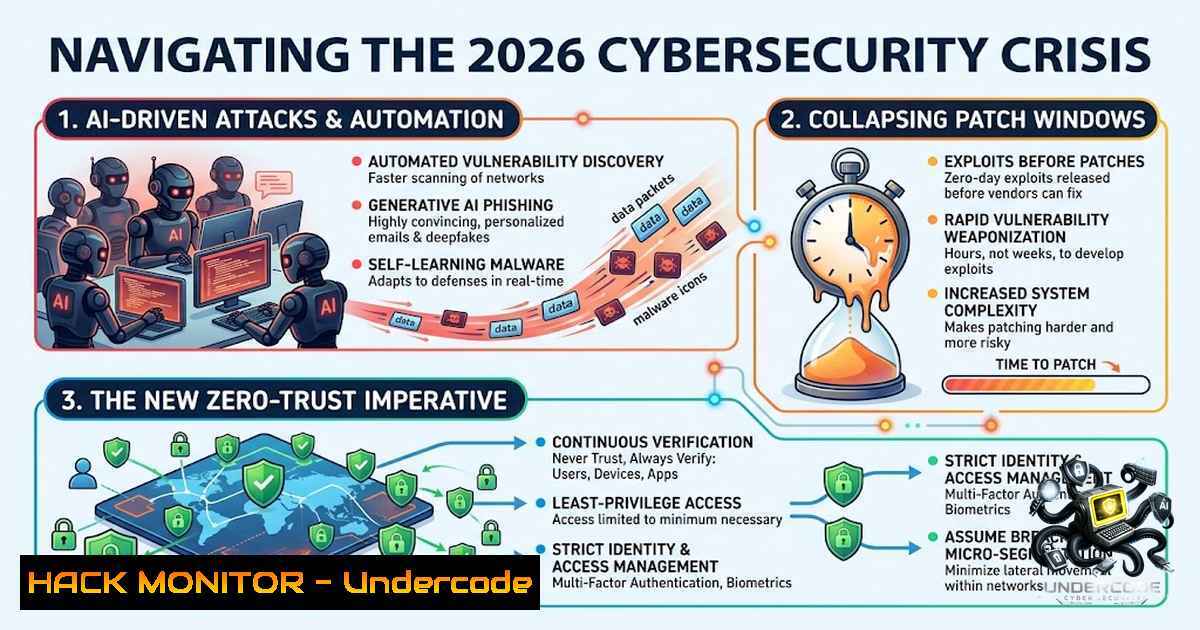
The cybersecurity landscape has undergone a fundamental shift in 2026, marked by a singular, disruptive force: the weaponization of artificial intelligence by adversaries. For the first time in history, vulnerability exploitation has overtaken stolen credentials and social engineering as the primary initial access vector. This change, documented across major reports from IBM, Verizon, and Rapid7, signals that attackers are no longer reliant on human error but are instead leveraging AI to identify and exploit software weaknesses at machine speed, rendering traditional, human-paced defenses obsolete.
Learning Objectives & Secrets:
- Objective 1: Master AI-Augmented Threat Intelligence. Understand how attackers use AI to automate reconnaissance and vulnerability discovery. The secret is to adopt “agentic-powered threat detection” that can match the speed of AI-driven attacks, moving from a reactive to a predictive security posture.
- Objective 2 Secret Tip: Implement “Zero-Trust” for AI. Secure enterprise AI systems, which can be compromised in as little as 16 minutes. The secret is to enforce strict conditional access controls and maintain a real-time inventory of all AI models and embedded features to prevent data exfiltration and prompt injection attacks.
- Objective 3 Secret Tip: Fortify the Software Supply Chain. With 87% of registry threats involving malicious npm packages, securing the CI/CD pipeline is paramount. The secret is to integrate Infrastructure-as-Code (IaC) security scanning (e.g., Checkov, tfsec) into pre-commit hooks to catch misconfigurations before they reach production.
You Should Know:
- The Collapse of the Patch Window and Proactive Defense
The most critical development in 2026 is the dramatic shortening of the vulnerability patch window. CrowdStrike’s Threat Hunting Report reveals that 88% of exploitation involving public proof-of-concept code now occurs within 48 hours of its release, with some state-aligned groups launching attacks within just 24 hours. This trend is accelerated by AI, which helps attackers develop exploits faster than ever. IBM’s X-Force report corroborates this, noting a 44% increase in attacks on public-facing applications, largely driven by AI-enabled vulnerability discovery.
To survive this new reality, organizations must abandon traditional patch cycles and adopt a proactive, intelligence-led approach. This means using AI-powered tools to predict which vulnerabilities are most likely to be exploited and prioritizing remediation based on real-world threat intelligence.
Step-by-Step Guide: Implementing a Predictive Patching Strategy
- Prioritize with CISA KEV: Integrate the CISA Known Exploited Vulnerabilities (KEV) catalog into your vulnerability management program. This list represents flaws that are actively being used in attacks.
- Automate Asset Discovery: Use cloud-1ative tools (e.g., AWS Config, Azure Policy, GCP Asset Inventory) to maintain a continuous, real-time inventory of all your assets and their software versions.
- Deploy AI-Driven Vulnerability Prioritization: Implement a solution that uses machine learning to analyze your asset inventory, threat intelligence feeds, and the KEV catalog. This will automatically score and prioritize vulnerabilities based on their exploitability and potential business impact.
- Accelerate Remediation: Set a Service Level Agreement (SLA) to patch critical and high-severity vulnerabilities within 24-48 hours of a patch being released. Use automated patching tools where possible to reduce manual overhead.
2. Hardening Cloud Identities and Infrastructure
Cloud misconfigurations and compromised credentials remain the two most common causes of breaches. Google Cloud reports that weak credentials (47%) and misconfigurations (29%) account for nearly 76% of compromises. Furthermore, with the rise of AI agents that can write code and provision infrastructure, the attack surface has expanded exponentially. The Verizon DBIR also highlights a concerning trend: Shadow AI, the use of unauthorized GenAI tools, has become a major insider risk, with a 400% increase in related DLP policy violations.
Step-by-Step Guide: Securing Cloud Identities and Infrastructure
- Enforce Least-Privilege Access: Remove any permissions that haven’t been used in the past 90 days. Enforce just-in-time (JIT) access for all production write roles.
- Eliminate Hardcoded Secrets: Scan all code repositories and CI/CD pipelines for secrets (passwords, API keys) and remove them. Use a dedicated secrets management solution like HashiCorp Vault or cloud-1ative services like AWS Secrets Manager.
- Implement Cloud Security Posture Management (CSPM): Use a CSPM tool to continuously monitor your cloud environment for misconfigurations and policy violations. Align your checks with established frameworks like the CIS Benchmarks or the Google Cloud recommended security checklist.
- Deploy Zero Trust Network Access (ZTNA): Adopt a Zero Trust architecture that verifies every access request, regardless of origin, and uses micro-segmentation to limit lateral movement.
Commands to Harden Cloud Infrastructure (Linux/Windows):
- Linux (Kernel Hardening): Add these settings to `/etc/sysctl.d/99-hardening.conf` to mitigate common network-based attacks:
net.ipv4.ip_forward=0
net.ipv4.conf.all.rp_filter=1
net.ipv4.conf.default.rp_filter=1
net.ipv4.conf.all.accept_source_route=0
net.ipv6.conf.all.accept_source_route=0
- Windows (PowerShell Hardening): Disable insecure legacy protocols like SMBv1:
Set-SmbServerConfiguration -EnableSMB1Protocol $false
3. Securing the API Attack Surface
APIs are the core building block of every enterprise’s digital strategy and the number one attack surface. The OWASP API Security Top 10 remains a critical guide, and NIST has released draft guidelines specifically for securing RESTful APIs (SP 800-228A). As reported by Rapid7, SQL injection has overtaken OS command injection as the most exploited vulnerability type, highlighting the continued prevalence of common web application flaws. Attackers are increasingly bypassing user interaction to directly exploit exposed infrastructure.
Step-by-Step Guide: Hardening Your APIs
- Use Strong Authentication and Authorization: Implement robust authentication (e.g., OAuth 2.0, JWT) and granular authorization. Enforce ownership checks on every backend request to prevent IDOR (Insecure Direct Object Reference) vulnerabilities.
- Validate All Input: Implement strict input validation on all API endpoints to block malicious payloads, including SQL injection and cross-site scripting (XSS) attempts.
- Encrypt All Traffic: Enforce TLS 1.2 or higher for all API communications.
- Implement Rate Limiting: Enforce rate limits to prevent API abuse, such as brute-force attacks or denial-of-service (DoS) attempts.
- Use Non-Predictable Identifiers: Use UUIDs instead of sequential numbers for resource IDs to prevent enumeration attacks.
Example: Mitigating SQL Injection in Code
- Vulnerable Code (Python):
query = "SELECT FROM users WHERE username = '" + user_input + "'"
- Secure Code (Python with parameterized query):
cursor.execute("SELECT FROM users WHERE username = %s", (user_input,))
4. Defending Against AI-Powered Threats
The adversary has gone “AI-1ative”. Google’s Threat Intelligence Group confirmed the discovery of the first zero-day exploit developed using AI. AI is now used to automate every phase of the attack lifecycle, from reconnaissance to malware development. Zscaler’s report found that 100% of enterprise AI systems analyzed were vulnerable to compromise. With AI adoption outpacing governance, organizations are dangerously exposed to threats like prompt injection and data poisoning.
Step-by-Step Guide: Building an AI-Secure Organization
- Create an AI Inventory: Identify all AI models, embedded AI features, and AI/ML applications in use across your organization.
- Implement AI-Specific Security Controls: Deploy an AI security platform that can monitor for data exfiltration, prompt injection attempts, and unsafe use of sensitive information.
- Enforce Strong Authentication for AI Services: Treat AI platforms like any other critical SaaS application. Enforce MFA and conditional access policies for all users.
- Fight AI with AI: Use AI-powered security tools to detect anomalies, correlate subtle signals, and respond to threats in real-time, matching the speed of AI-driven adversaries.
-
The New Era of Ransomware and Supply Chain Attacks
Ransomware remains a persistent threat, with nearly half of all incidents (48%) involving it in some form. The ecosystem is becoming more fragmented, with a 49% surge in active ransomware and extortion groups. Simultaneously, large supply chain and third-party compromises have nearly quadrupled since 2020. Attackers are exploiting trust relationships and CI/CD automation, often targeting open-source ecosystems. The use of AI by nation-state actors like North Korea to scale operations, including creating synthetic identities, further complicates the threat landscape.
Commands for Supply Chain Security:
- Linux (Find SUID/SGID Binaries): Identify potential privilege escalation vectors:
find / -perm -4000 -type f 2>/dev/null
find / -perm -2000 -type f 2>/dev/null
- Linux (Find World-Writable Files): Locate files that could be modified by any user:
find / -type f -perm -002 2>/dev/null
- Windows (Check Permissions): Check permissions on a sensitive folder:
Get-Acl -Path C:\SensitiveFolder | Format-List
What Undercode Say:
- Key Takeaway 1: The fundamental shift is that speed is the new battleground. Attackers are using AI to move from vulnerability discovery to exploitation in hours, not days. Defenders must adopt AI to match this pace and shift from reactive patching to predictive, intelligence-led defense.
- Key Takeaway 2: The fundamentals still matter more than ever. Despite the hype around AI, the most common entry points are still weak credentials, misconfigurations, and unpatched vulnerabilities. Mastering the basics of identity management, cloud hardening, and asset inventory is the prerequisite for any advanced AI-driven defense.
- Analysis: We are witnessing the maturation of a threat economy where AI dramatically lowers the barrier to entry for sophisticated attacks. This is not a future risk; it is the present reality. The most effective strategy is a hybrid one: double down on cybersecurity fundamentals while aggressively adopting AI-powered tools to detect and respond to threats at machine speed. Organizations that fail to adapt will find themselves overwhelmed by the volume, velocity, and sophistication of modern attacks.
Prediction:
- +1 The widespread adoption of AI in cybersecurity will lead to the development of fully autonomous “agentic” security systems that can detect, investigate, and remediate threats without human intervention, drastically reducing response times and the burden on overworked security teams.
- -1 The commoditization of AI-powered offensive tools will lead to a “democratization of hacking,” enabling a surge in attacks from less-skilled actors. This will result in a higher volume of attacks and a broader range of threats, making it even harder for organizations to prioritize and defend against them.
- -1 The rise of Shadow AI and the exfiltration of sensitive data to unauthorized GenAI models will cause a wave of significant data breaches in 2027, as organizations struggle to gain visibility and control over AI usage within their workforce.
▶️ Related Video (80% Match):
https://www.youtube.com/watch?v=2jU-mLMV8Vw
🎯Let’s Practice For Free:
🎓 Live Courses & Certifications:
Join Undercode Academy for Verified Certifications
🚀 Request a Custom Project:
Secure, high-velocity infrastructure and disruptive technological engineering. Contact our engineering team for high-tier development and proprietary systems:
[email protected]
💎 Smart Architecture | 🛡️ Secure by Design | ⭐ Trusted by Thousands
IT/Security Reporter URL:
Reported By: https://lnkd.in/p/e-aFMJPc – Hackers Feeds
Extra Hub: Undercode MoN
Basic Verification: Pass ✅


