
Listen to this Post
Introduction
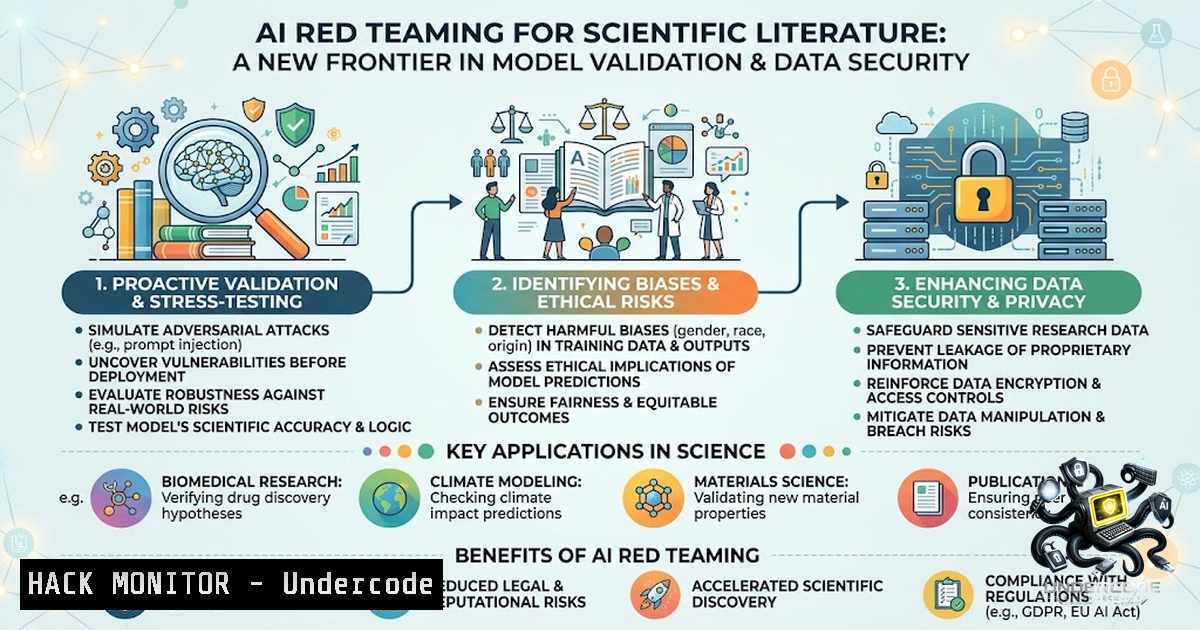
The integration of large language models (LLMs) into specialized domains like biochemistry and life sciences is accelerating, demanding a new class of cybersecurity and data validation professionals. As organizations like Cincinnatus LLC (via Mercor) seek domain experts to evaluate AI-generated research outputs, the underlying infrastructure requires robust security frameworks to protect proprietary models and sensitive intellectual property. This intersection of scientific expertise and AI security introduces critical considerations for data governance, adversarial AI resilience, and secure model training pipelines.
Learning Objectives & Secrets
- Objective 1: Understand the data governance and security protocols required when handling sensitive scientific data in AI training pipelines, including access control and encryption standards.
- Objective 2 Secret Tip: Leverage containerized environments (e.g., Docker) to isolate evaluation tools and prevent data leakage between the AI model’s training set and evaluation benchmarks.
- Objective 3 Secret Tip: Implement rigorous prompt injection detection mechanisms to ensure that adversarial inputs from scientific literature cannot corrupt model reasoning or training data.
You Should Know
1. Securing the AI Evaluation Pipeline
Evaluating AI-generated life sciences outputs involves more than just scientific acumen; it requires a secure architecture to protect both the proprietary AI model and the golden datasets used for training and benchmarking. The evaluation environment must be isolated from production networks, with strict audit trails for all interactions.
Step‑by‑Step Guide for Creating a Secure Evaluation Environment (Linux):
– Step 1: Set up a dedicated virtual private cloud (VPC) with no internet access except for necessary update repositories.
 Example: Create a network namespace for isolation
sudo ip netns add eval-1s
sudo ip netns exec eval-1s ip link set lo up
– Step 2: Deploy the evaluation tools within a Docker container with read-only file systems to prevent persistent changes.
 Run a container with read-only root filesystem and specific capabilities dropped
docker run --read-only --cap-drop=ALL --cap-add=NET_BIND_SERVICE -it ubuntu:22.04 /bin/bash
– Step 3: Implement file integrity monitoring (FIM) on evaluation scripts and golden datasets to detect unauthorized modifications.
 Using AIDE to initialize a database and check integrity
sudo aideinit
sudo aide --check
– Step 4: Use `gpg` for symmetric encryption of sensitive communication logs between the domain expert and AI researchers.
 Encrypt a file
gpg --symmetric --cipher-algo AES256 evaluation_report.txt
 Decrypt a file
gpg --decrypt evaluation_report.txt.gpg > evaluation_report_decrypted.txt
– Step 5: Configure `auditd` to monitor access to `/data/sensitive_models/` and /data/golden_datasets/.
sudo auditctl -w /data/sensitive_models/ -p rwxa -k model_access
sudo auditctl -w /data/golden_datasets/ -p rwxa -k dataset_access
2. Protecting API Endpoints and Model Interfaces
The platform (Mercor) and the hiring employer (Cincinnatus LLC) rely on secure APIs to connect domain experts with the AI lab’s infrastructure. Securing these APIs against enumeration, injection, and rate-limiting attacks is paramount.
Step‑by‑Step Guide for API Security Hardening (Linux/Windows WSL):
- Step 1: Validate all inputs against a strict allowlist of expected scientific terms and structures using regex or libraries like
pydantic.Python example for input validation from pydantic import BaseModel, validator class ScientificInput(BaseModel): query: str @validator('query') def no_sql_injection(cls, v): if any(keyword in v for keyword in ['SELECT', 'DROP', 'INSERT']): raise ValueError('Invalid input') return v - Step 2: Implement rate limiting on all endpoints to prevent brute-force access to evaluation results.
Using iptables to limit connections per IP per minute
sudo iptables -A INPUT -p tcp --dport 443 -m state --state NEW -m recent --set
sudo iptables -A INPUT -p tcp --dport 443 -m state --state NEW -m recent --update --seconds 60 --hitcount 10 -j DROP
- Step 3: Enforce mutual TLS (mTLS) for all service-to-service communication between the expert’s evaluation server and the AI lab’s backend.
- Step 4: Use a Web Application Firewall (WAF) like ModSecurity with an OWASP core rule set to filter out malicious payloads embedded in scientific queries.
3. Cloud Hardening for Hybrid Workflows
The position is hybrid, requiring secure data transfer between on-premise evaluation workstations and cloud-based AI training environments in the Bay Area. Cloud security misconfigurations can expose sensitive model weights and benchmark datasets.
Step‑by‑Step Guide for Cloud Hardening (AWS/Azure Example):
- Step 1: Restrict access to S3 buckets or Azure Blob Storage using IAM policies and pre-signed URLs with short expiration times.
// Example AWS IAM Policy for least privilege { "Version": "2012-10-17", "Statement": [ { "Effect": "Deny", "Action": "s3:", "Resource": "arn:aws:s3:::sensitive-data/", "Condition": { "Bool": {"aws:SecureTransport": "false"} } } ] } - Step 2: Enable VPC Flow Logs to monitor all network traffic and detect unauthorized data exfiltration attempts.
Azure CLI command to enable NSG flow logs
az network nsg flow-log create --1sg myNSG --1ame myFlowLog --storage-account myStorageAccount --workspace myWorkspace
- Step 3: Rotate access keys and API tokens every 30 days using automated scripts or HashiCorp Vault.
4. Vulnerability Exploitation and Mitigation in AI Models
Domain experts must be aware of common AI vulnerabilities, such as model inversion or membership inference attacks, which could reveal sensitive training data (e.g., genomic sequences). Understanding these threats helps in designing evaluation criteria that assess the model’s robustness.
Step‑by‑Step Guide for Testing Adversarial Robustness:
- Step 1: Use tools like `Foolbox` or `CleverHans` to generate adversarial examples from scientific text inputs.
Pseudocode for an adversarial text attack
from foolbox import PyTorchModel, attacks
Load model and create adversarial input that changes a correct biological conclusion
attack = attacks.FGSM()
adversarial = attack(model, input_data, label, eps=0.01)
- Step 2: Evaluate the model’s response to ‘poisoned’ golden datasets that contain subtle factual errors to test its reasoning mechanisms.
- Step 3: Monitor the model’s output confidence scores; a sudden drop can indicate an adversarial input.
- Secure Data Transfer and Storage for Scientific Datasets
Handling peer-reviewed publications and proprietary research data requires encryption both at rest and in transit. The use of SFTP, SSH tunneling, or VPNs is necessary for hybrid workers.
Step‑by‑Step Guide for Secure Data Transfer (Windows/Linux):
- Step 1: Set up an SSH tunnel to securely forward evaluation reports.
Linux/Windows WSL: Forward local port 8080 to remote server
ssh -L 8080:localhost:80 [email protected] -1 -v
- Step 2: Use `rsync` over SSH for differential backups with encryption.
rsync -avz -e ssh /path/to/evaluation_data/ user@backup-server:/backup/path/
- Step 3: On Windows, use BitLocker for drive encryption and ensure that all USB ports are disabled for unauthorized data copying.
What Undercode Say:
- Key Takeaway 1: The role of a domain expert transcends traditional scientific analysis, morphing into a critical component of AI red-teaming, where security against data poisoning and adversarial inputs is as important as scientific accuracy.
- Key Takeaway 2: The opportunity highlights a growing need for “AI Security Scientists”—professionals who understand both the intricacies of molecular biology and the threat landscape of machine learning pipelines, including prompt engineering and model security.
Analysis: The position is a microcosm of a larger trend where AI labs are hiring experts to secure their models by identifying reasoning gaps and biases, which can be seen as a form of security vulnerability. This requires a paradigm shift in how we view data scientists; they are now security gatekeepers. The emphasis on a hybrid model in the Bay Area underscores the sensitivity of the data, necessitating physical proximity to secure on-premise environments, a move that reflects the “zero-trust” architecture being adopted in corporate IT security. The $65–$105/hour rate reflects the high demand for this specialized cybersecurity-adjacent skill set. Professionals in this field must become proficient in Linux security, API hardening, and cloud governance, making this more than a pure research job—it’s a bastion for AI safety.
Prediction:
- +1: This trend will catalyze the creation of a new cybersecurity certification specifically for AI model validation and data security in scientific domains, elevating professional standards.
- -1: Increased reliance on domain expert evaluators could become a single point of failure; if an expert’s machine is compromised, it can lead to massive intellectual property theft and model extraction.
- +1: Organizations will invest heavily in automated red-teaming tools that simulate domain expert attacks, thereby creating a lucrative market for AI security automation products.
- -1: The intersection of high salaries and sensitive data makes these roles prime targets for social engineering and espionage, requiring robust physical and digital countermeasures.
- +1: Secure multi-party computation (MPC) will be adopted to allow experts to evaluate models without ever seeing the actual data, preserving privacy and mitigating data leakage risks.
- -1: Smaller AI labs may fail to afford such experts, leading to a “security divide” where only major players like the leading AI lab mentioned can produce reliably secure models, potentially stifling competition and innovation in AI safety.
▶️ Related Video (78% Match):
🎯Let’s Practice For Free:
🎓 Live Courses & Certifications:
Join Undercode Academy for Verified Certifications
🚀 Request a Custom Project:
Secure, high-velocity infrastructure and disruptive technological engineering. Contact our engineering team for high-tier development and proprietary systems:
[email protected]
💎 Smart Architecture | 🛡️ Secure by Design | ⭐ Trusted by Thousands
IT/Security Reporter URL:
Reported By: https://lnkd.in/p/eX9iveds – Hackers Feeds
Extra Hub: Undercode MoN
Basic Verification: Pass ✅


