
Listen to this Post
Introduction:
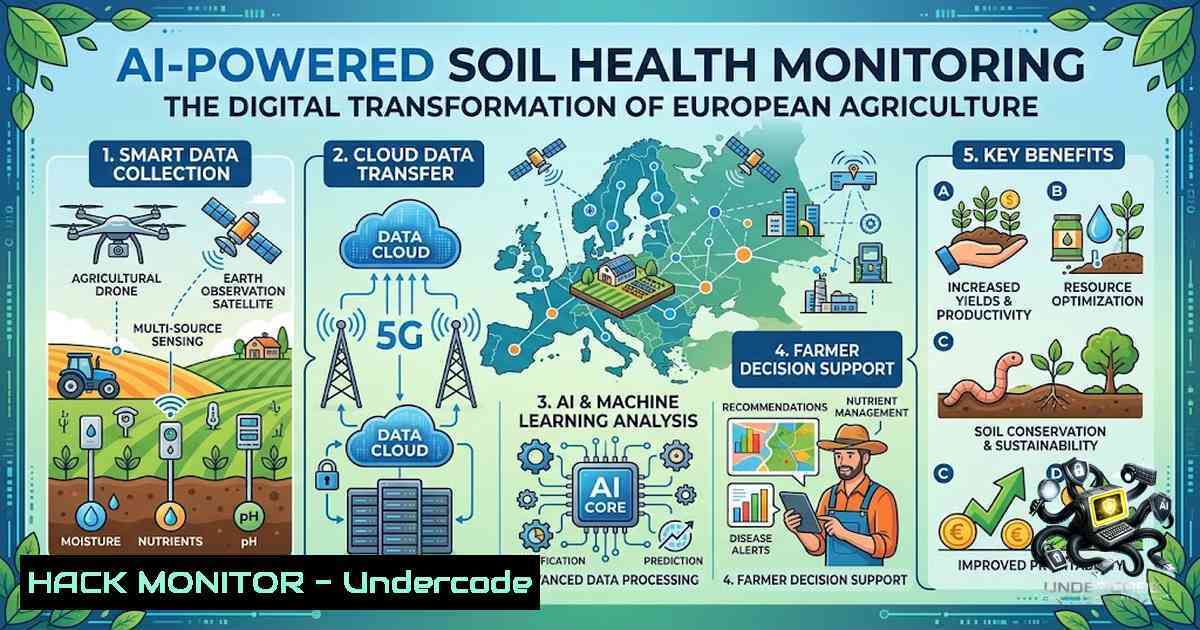
The European Union’s Mission Soil initiative is driving a paradigm shift in agricultural and environmental management, leveraging artificial intelligence, IoT sensor networks, and remote sensing technologies to monitor and restore soil health across the continent. As the NBSOIL Project and AI4SoilHealth initiative demonstrate, the convergence of digital twins, machine learning, and open-source data platforms is creating unprecedented capabilities for real-time soil assessment. This article explores the technical infrastructure, implementation strategies, and security considerations behind Europe’s soil health revolution.
Learning Objectives & Secrets:
- Objective 1: Deploy IoT-Based Soil Sensor Networks – Learn how to configure multi-sensor arrays (measuring moisture, temperature, pH, NPK, and electrical conductivity) with edge computing capabilities for continuous soil health monitoring.
-
Objective 2 Secret Tips: Integrate Machine Learning for Predictive Analytics – Implement Random Forest and clustering algorithms to classify soil conditions and predict optimal habitats for soil organisms like earthworms, which serve as key bioindicators.
-
Objective 3 Secret Tips: Leverage Copernicus Satellite Data – Access and process free remote sensing datasets through platforms like Copernicus and ARIES semantic web services to create high-resolution soil health maps at 30-meter resolution.
You Should Know:
- Setting Up a Soil Health IoT Monitoring System
The foundation of modern soil health monitoring begins with hardware deployment and data ingestion pipelines. A typical system integrates 7-in-1 soil sensors measuring NPK nutrients, pH, moisture, temperature, and electrical conductivity. Below is a practical implementation guide:
Step‑by‑step guide:
- Hardware Configuration: Deploy IoT sensors (e.g., ESP32 or Raspberry Pi-based nodes) with multi-sensor arrays across stratified field sites. Ensure power management (solar panels + battery backup) for continuous operation.
-
Data Ingestion Pipeline: Configure MQTT brokers to collect sensor data. Example Mosquitto configuration:
/etc/mosquitto/mosquitto.conf
listener 1883
allow_anonymous false
password_file /etc/mosquitto/passwd
Publish sensor data: `mosquitto_pub -h broker.ip -t “soil/sensor1” -m ‘{“moisture”:42.5,”temp”:18.3,”pH”:6.8,”N”:12,”P”:8,”K”:15}’`
- Cloud Storage Setup: Use InfluxDB (time-series database) for efficient storage:
CREATE DATABASE soil_health
CREATE RETENTION POLICY one_year ON soil_health DURATION 365d REPLICATION 1 DEFAULT
Ingest data via Telegraf with MQTT consumer plugin.
-
Data Processing with Python: Implement real-time anomaly detection:
import pandas as pd
from sklearn.ensemble import IsolationForest
model = IsolationForest(contamination=0.05)
predictions = model.fit_predict(sensor_data[['moisture','temp','pH']])
-
Visualization Dashboard: Deploy Grafana with InfluxDB datasource to create real-time dashboards for field operators.
2. Machine Learning for Soil Health Prediction
AI models transform raw sensor data into actionable intelligence. The NBSOIL Soil Health Index Tool aggregates multi-unit laboratory measurements into standardized scores across four ecosystem pillars.
Step‑by‑step guide:
- Data Preprocessing: Normalize sensor readings using Min-Max scaling:
from sklearn.preprocessing import MinMaxScaler
scaler = MinMaxScaler()
normalized = scaler.fit_transform(sensor_data)
-
Feature Engineering: Create derived features such as soil moisture deficit, nutrient ratios (N:P:K), and temporal trends.
-
Model Training – Random Forest Classifier:
from sklearn.ensemble import RandomForestClassifier
from sklearn.model_selection import train_test_split
X_train, X_test, y_train, y_test = train_test_split(features, labels, test_size=0.2)
rf = RandomForestClassifier(n_estimators=100, max_depth=10)
rf.fit(X_train, y_train)
Feature importance
importances = rf.feature_importances_
-
Model Deployment: Export model using joblib and deploy as REST API with Flask:
from flask import Flask, request, jsonify app = Flask(<strong>name</strong>) @app.route('/predict', methods=['POST']) def predict(): data = request.json prediction = model.predict([data['features']]) return jsonify({'soil_health_class': int(prediction[bash])}) -
Continuous Learning: Implement feedback loops where field validation data retrains models weekly using Apache Airflow for orchestration.
- Remote Sensing Integration with Copernicus and GIS Tools
The NBSOIL project utilizes Copernicus satellite data alongside platforms like ARIES and the Agrisat GIS Tool for broad-scale soil monitoring.
Step‑by‑step guide:
- Access Copernicus Data: Register for Copernicus Open Access Hub and use `sentinelhub` Python package:
from sentinelhub import SHConfig, BBox, CRS, DataCollection, SentinelHubRequest
config = SHConfig()
config.sh_client_id = 'YOUR_CLIENT_ID'
config.sh_client_secret = 'YOUR_CLIENT_SECRET'
-
Download Satellite Imagery: Request Sentinel-2 data for specific bounding boxes:
evalscript = """ // Normalized Difference Vegetation Index return [((B08 - B04) / (B08 + B04 + 1e-5)) 2.5 + 0.5]; """ request = SentinelHubRequest(evalscript=evalscript, input_data=[...], responses=[SentinelHubRequest.output_response('default', MimeType.TIFF)]) images = request.get_data() -
Soil Health Index Calculation: Combine NDVI, soil moisture indices (from SAR data), and thermal bands to derive composite soil health indicators.
-
GIS Mapping with QGIS: Import processed rasters and create layered maps showing soil health variability across regions:
Command-line QGIS processing qgis_process run native:rastercalculator \ --INPUT=ndvi.tif --BAND=1 \ --FORMULA='IF("ndvi@1" > 0.3, 1, 0)' \ --OUTPUT=health_mask.tif -
ARIES Semantic Web Services: Query ARIES–NBSOIL Open Library for precomputed soil health variables:
curl -X GET "https://aries.integratedmodelling.org/api/models/soil_health" \
-H "Authorization: Bearer YOUR_TOKEN"
4. Digital Twin Infrastructure and Data Security
The EU’s Soil Digital Twin represents a virtual replica of physical soil systems, integrating massive datasets while maintaining compliance with the EU AI Act.
Step‑by‑step guide:
- Data Lake Architecture: Set up a data lake using MinIO (S3-compatible object storage) for raw satellite and sensor data:
Install MinIO
wget https://dl.min.io/server/minio/release/linux-amd64/minio
chmod +x minio
./minio server /data --console-address ":9001"
-
API Security Hardening: Implement OAuth2 authentication for all data access endpoints using Keycloak:
docker-compose.yml for Keycloak
keycloak:
image: quay.io/keycloak/keycloak:latest
environment:
KEYCLOAK_ADMIN: admin
KEYCLOAK_ADMIN_PASSWORD: admin
ports:</p></li>
<li><p>"8080:8080"
-
Encryption at Rest and in Transit: Configure TLS for MQTT and API endpoints:
Generate certificates
openssl req -1ew -1ewkey rsa:2048 -days 365 -1odes -x509 -keyout server.key -out server.crt
Mosquitto TLS config
listener 8883
cafile /etc/mosquitto/ca.crt
certfile /etc/mosquitto/server.crt
keyfile /etc/mosquitto/server.key
require_certificate true
-
Vulnerability Mitigation: Regularly scan container images for CVEs using Trivy:
trivy image --severity HIGH,CRITICAL your-image:latest
-
Compliance Logging: Implement audit trails with ELK Stack (Elasticsearch, Logstash, Kibana) to track all data access and model predictions for EU AI Act compliance.
5. Soil Ecoacoustics: Emerging Bioacoustic Monitoring
Soil ecoacoustics is an emerging field that uses sound and vibration to detect belowground biological activity. This non-invasive technique captures acoustic signatures from earthworm movement, burrowing, and feeding.
Step‑by‑step guide:
- Hardware Setup: Deploy contact microphones or piezoelectric sensors buried at 10-30cm depth with low-1oise preamplifiers.
-
Audio Capture: Record in PCM format at 44.1kHz sampling rate using Raspberry Pi with audio HAT:
arecord -D plughw:1,0 -f S16_LE -r 44100 -d 600 -t wav soil_audio.wav
-
Acoustic Index Calculation: Compute indices using `scipy` and
librosa:import librosa import numpy as np y, sr = librosa.load('soil_audio.wav') Acoustic Complexity Index spectrogram = np.abs(librosa.stft(y)) ACI = np.mean(np.diff(np.log(spectrogram + 1e-10), axis=0), axis=0) Bioacoustic Index from scipy import signal freqs, psd = signal.welch(y, sr) BI = np.sum(psd[(freqs >= 2000) & (freqs <= 8000)]) -
Machine Learning Classification: Train CNNs to classify soil fauna activity from spectrograms:
import tensorflow as tf
model = tf.keras.Sequential([
tf.keras.layers.Conv2D(32, (3,3), activation='relu', input_shape=(128,128,1)),
tf.keras.layers.MaxPooling2D((2,2)),
tf.keras.layers.Flatten(),
tf.keras.layers.Dense(64, activation='relu'),
tf.keras.layers.Dense(num_classes, activation='softmax')
])
model.compile(optimizer='adam', loss='categorical_crossentropy')
-
Data Integration: Correlate acoustic biodiversity indices with sensor and satellite data to create multi-modal soil health assessments.
What Undercode Say:
-
Key Takeaway 1: The convergence of IoT, AI, and remote sensing is democratizing soil health monitoring, enabling real-time, field-scale assessments that were previously impossible with traditional laboratory methods.
-
Key Takeaway 2: Open-source platforms like the NBSOIL Soil Health Index Tool and ARIES semantic web services are critical for scaling soil health solutions across Europe, but require robust API security and compliance frameworks to protect sensitive agricultural data.
The NBSOIL Project’s four-year Horizon Europe initiative represents a watershed moment in agricultural technology, bridging the gap between cutting-edge research and practical farming innovation. By creating learning pathways for soil advisors and deploying Living Labs across eight European countries, the project is building human capital alongside technical infrastructure. The integration of digital twins, machine learning, and ecoacoustics offers a holistic view of soil health that extends beyond chemical analysis to include biological and physical dimensions. However, the success of these initiatives hinges on addressing data sovereignty concerns, ensuring interoperability across diverse platforms, and maintaining transparent, explainable AI models that farmers and policymakers can trust. The Soils for Europe 2026 conference in Coimbra will serve as a critical milestone for knowledge exchange and standardization efforts.
Prediction:
- +1 Widespread adoption of AI-driven soil monitoring will reduce synthetic fertilizer use by 20-30% within five years through precision nutrient management, significantly lowering agricultural carbon footprints.
-
+1 The Soil Digital Twin infrastructure will become a blueprint for other environmental monitoring domains (water, air, biodiversity), creating a unified European environmental data ecosystem by 2030.
-
-1 Without standardized API security protocols and GDPR-compliant data governance, the aggregation of farm-level soil data could expose sensitive agricultural operations to competitive intelligence risks and cyber threats.
-
-1 The digital divide between technologically advanced farms and smallholders may widen, as IoT sensor deployment and AI platform access require significant upfront investment and technical expertise.
-
+1 Open-source soil health tools like the NBSOIL index will lower barriers to entry, enabling startups and research institutions to build innovative applications on top of EU-funded data infrastructure.
-
-1 Over-reliance on satellite and sensor data without adequate ground-truthing could lead to misclassification of soil health, potentially undermining policy decisions and farmer trust in digital advisory systems.
▶️ Related Video (88% Match):
https://www.youtube.com/watch?v=0L4mGsF0P1s
🎯Let’s Practice For Free:
🎓 Live Courses & Certifications:
Join Undercode Academy for Verified Certifications
🚀 Request a Custom Project:
Secure, high-velocity infrastructure and disruptive technological engineering. Contact our engineering team for high-tier development and proprietary systems:
[email protected]
💎 Smart Architecture | 🛡️ Secure by Design | ⭐ Trusted by Thousands
IT/Security Reporter URL:
Reported By: https://lnkd.in/p/egX5gvPA – Hackers Feeds
Extra Hub: Undercode MoN
Basic Verification: Pass ✅


