Listen to this Post
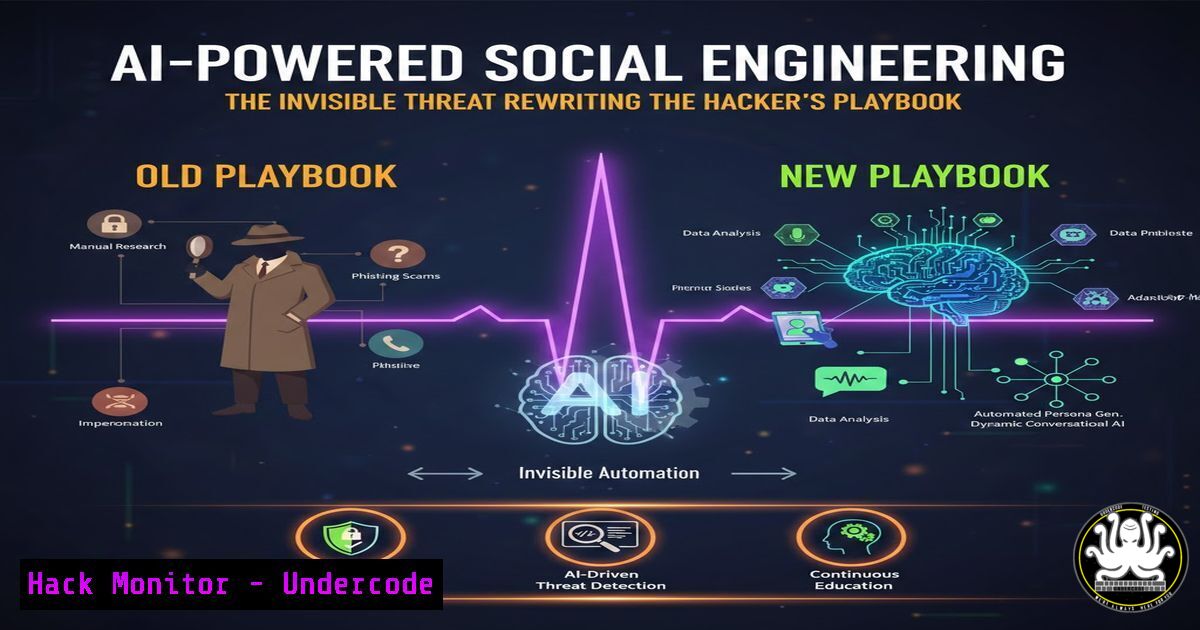
Introduction:
The cybersecurity landscape is undergoing a seismic shift, moving beyond traditional brute-force attacks to a new era of highly personalized, AI-driven social engineering. This sophisticated threat vector leverages large language models (LLMs) to craft convincing, context-aware phishing campaigns at an unprecedented scale, making human error the primary vulnerability for organizations worldwide. Defending against this invisible enemy requires a fundamental evolution in security awareness and technical controls.
Learning Objectives:
- Understand the technical mechanisms behind AI-powered phishing and vishing (voice phishing) attacks.
- Learn to implement advanced email security controls, including DMARC, DKIM, and SPF, to mitigate domain impersonation.
- Develop strategies for conducting next-generation security awareness training that simulates AI-generated attacks.
You Should Know:
1. The Anatomy of an AI-Phishing Email
AI-powered phishing is no longer characterized by poor grammar and generic greetings. Attackers use LLMs to analyze public data from LinkedIn, social media, and company websites to create highly personalized lures. A model can generate a perfectly written email that appears to be from a CEO, referencing a recent project or conference they attended, and instructing a finance employee to process an urgent wire transfer.
Step‑by‑step guide explaining what this does and how to use it.
Step 1: Reconnaissance. The attacker uses automated scripts to scrape employee data from professional networks.
Command Example (using `curl` for reconnaissance simulation):
 This is a conceptual example. Actual scraping may violate ToS.
curl -s "https://api.linkedin.com/v2/people/(id:$PROFILE_ID)" -H "Authorization: Bearer $ACCESS_TOKEN" | jq '.firstName, .lastName, .headline'
Step 2: Content Generation. The scraped data is fed into an LLM API (e.g., OpenAI, Claude) with a prompt to generate a convincing phishing email.
Code Example (Python using OpenAI API – Malicious Use Case):
 ILLUSTRATIVE PURPOSES ONLY - This demonstrates the attacker's workflow.
import openai

client = openai.OpenAI(api_key='YOUR_API_KEY')
prompt = f"""
Write a concise, urgent email from a CEO named {ceo_name} to {employee_name}, a financial officer.
Reference the recent {project_name} project and request an immediate wire transfer of ${amount} to a new vendor for a critical deadline.
Sound authoritative and stressed. Provide a bank routing and account number.
"""
response = client.chat.completions.create(
model="gpt-4",
messages=[{"role": "user", "content": prompt}]
)
phishing_email_body = response.choices[bash].message.content
Step 3: Deployment. The AI-generated email is sent from a spoofed or lookalike domain, bypassing traditional spam filters that check for keywords but not semantic coherence.
- Fortifying Your Defenses with DMARC, DKIM, and SPF
To combat domain spoofing, a core technique in AI-phishing, you must implement a strict email authentication policy. DMARC (Domain-based Message Authentication, Reporting & Conformance) works with SPF (Sender Policy Framework) and DKIM (DomainKeys Identified Mail) to ensure emails are genuinely from your domain.
Step‑by‑step guide explaining what this does and how to use it.
Step 1: Implement SPF. SPF lists the IP addresses authorized to send email for your domain.
DNS Record Example (TXT Record):
"v=spf1 ip4:192.0.2.0/24 include:spf.protection.outlook.com -all"
This record authorizes the IP range `192.0.2.0/24` and Outlook’s servers (include) to send email. The `-all` flag tells receiving servers to reject all other sources.
Step 2: Configure DKIM. DKIM adds a digital signature to your outgoing emails, verifying they weren’t tampered with in transit.
Process: This is typically done within your email service provider (e.g., Office 365, Google Workspace). They will generate a public/private key pair. You publish the public key in a DNS TXT record, and your email server signs outgoing messages with the private key.
Step 3: Enforce DMARC. DMARC tells receiving servers what to do with emails that fail SPF or DKIM checks.
DNS Record Example (TXT Record for `_dmarc.yourdomain.com`):
"v=DMARC1; p=reject; rua=mailto:[email protected]; ruf=mailto:[email protected];"
The `p=reject` policy is the goal; it commands servers to reject emails that fail authentication. Start with `p=quarantine` and monitor reports (rua/ruf) before moving to reject.
3. Simulating AI-Phishing for Employee Training
Traditional training with template-based phishing simulations is no longer sufficient. Your defense must evolve to match the threat. Use customized, AI-assisted simulations to train employees to recognize the hallmarks of a sophisticated attack.
Step‑by‑step guide explaining what this does and how to use it.
Step 1: Use Open-Source Intelligence (OSINT). Gather real data about your company and employees from public sources, just as an attacker would.
Step 2: Craft a Believable Scenario. Use a safe, controlled LLM (or a dedicated security awareness platform with AI features) to generate a variety of phishing lures based on the OSINT data. Scenarios should include urgent financial requests, fake IT support tickets, and impersonation of senior leadership.
Step 3: Deploy and Analyze. Send the simulation to employees. A high failure rate is a critical data point, not a failure of the program. It highlights the need for continuous, adaptive training focused on critical thinking and verification processes (e.g., using a secondary channel to confirm a wire transfer).
4. The Rise of AI-Vishing and Deepfakes
The threat extends beyond text. AI-powered voice cloning (vishing) can create a convincing audio message from a “CEO” instructing an action. Deepfake video technology is also becoming more accessible, posing a future threat for video conference impersonation.
Step‑by‑step guide explaining what this does and how to use it.
Step 1: Understand the Technology. Tools like ElevenLabs and other voice synthesis engines can clone a voice from a short sample (e.g., a public speech or a YouTube video).
Step 2: Mitigation via Process. Technical controls are limited. The primary defense is a strict, non-bypassable verification process for any sensitive action.
Policy Example: “Any request for a fund transfer, password change, or data access from a senior executive must be verified through a pre-established, out-of-band communication channel, such as a confirmed phone call to a known number not provided in the request itself.”
Step 3: Employee Education. Train staff to be skeptical of unusual urgency and to recognize that a familiar voice is no longer proof of identity.
5. Hardening Cloud APIs Against AI-Driven Reconnaissance
APIs are a rich source of information for AI-powered attackers. Misconfigured or verbose APIs can leak data about your infrastructure, employees, and technologies, which can be fed into an LLM to plan a targeted attack.
Step‑by‑step guide explaining what this does and how to use it.
Step 1: Audit API Endpoints. Use scanning tools to discover all your external-facing APIs.
Command Example (using `curl` to check for information disclosure):
curl -X GET https://api.yourcompany.com/v1/users/me -H "Authorization: Bearer $TOKEN"
Check the response for excessive data like internal IPs, server versions, or full user details.
Step 2: Implement Rate Limiting and WAF. Protect your APIs from being scraped by automated tools.
AWS WAFv2 Rule Example (CloudFormation snippet):
Rules:
- Name: RateLimitRule
Priority: 1
Action:
Block: {}
Statement:
RateBasedStatement:
Limit: 1000
AggregateKeyType: IP
VisibilityConfig:
SampledRequestsEnabled: true
CloudWatchMetricsEnabled: true
MetricName: RateLimitRule
Step 3: Adopt a Zero-Trust Model. Never trust any request, whether from inside or outside the network. Enforce strict authentication (OAuth 2.0, mTLS) and principle of least privilege for all API access.
What Undercode Say:
- The attack surface has fundamentally shifted from systems to human psychology, amplified by AI. Patching the human layer requires continuous, realistic training, not annual checkbox exercises.
- Defense is no longer just about building higher walls; it’s about creating a culture of verification and resilient processes that assume some sophisticated attacks will always get through.
The core analysis is that AI has democratized advanced social engineering. What was once the domain of highly skilled nation-state actors is now accessible to script kiddies with an API key. This flattens the threat landscape, making every organization a potential target. The only sustainable defense is a multi-layered strategy that combines stringent technical controls (like strict DMARC policies) with a human-centric security culture that embraces skepticism and verification as core tenets. Relying on legacy training and simple technical filters is a recipe for a catastrophic breach.
Prediction:
Within the next 18-24 months, we will see the first major corporate breach directly caused by a deepfake video conference call, leading to eight-figure financial losses. This event will trigger a wave of new regulations around digital identity verification and legally mandated security training standards. Insurance underwriters will begin requiring proof of AI-phishing simulation programs and strict DMARC enforcement as a precondition for cyber liability coverage, making these controls not just best practice, but a business necessity.
🎯Let’s Practice For Free:
IT/Security Reporter URL:
Reported By: Lisa Goldenthal – Hackers Feeds
Extra Hub: Undercode MoN
Basic Verification: Pass ✅


