Listen to this Post
Introduction:
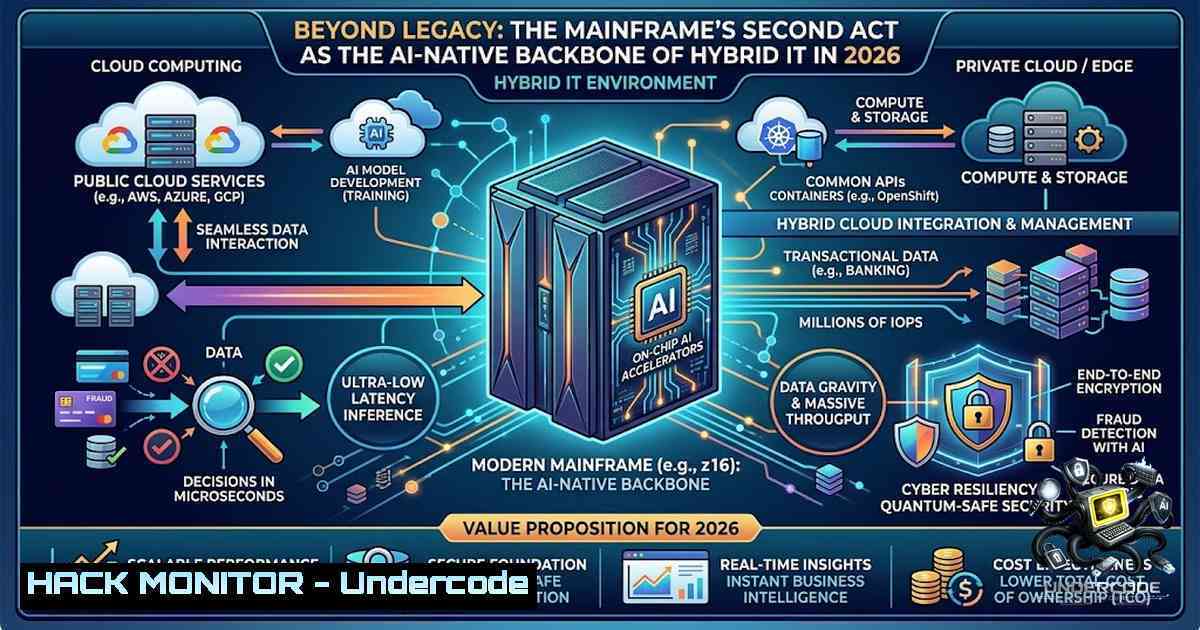
The mainframe, long relegated to the category of “legacy” by the tech mainstream, is experiencing a profound renaissance in 2026. This platform, which quietly processes the vast majority of the world’s financial and transaction data, is not simply surviving; it is aggressively modernizing by absorbing AI, cloud-1ative integration patterns, and advanced security frameworks. This article dissects the technical evolution of the mainframe, moving beyond the “green screen” stereotype to reveal a platform that is becoming an indispensable component of the hybrid IT landscape, driven by AI-assisted operations, API-first connectivity, and a renewed focus on cyber-resilience.
Learning Objectives:
- Understand the technical architecture of modern mainframe integration, including z/OS Connect, CICS, and MQ in hybrid cloud environments.
- Explore the practical application of Generative AI and machine learning in COBOL modernization, code analysis, and mainframe operations.
- Master security and resilience configurations, including RACF, AT-TLS, and Pervasive Encryption, to protect against modern threat vectors.
You Should Know:
- Hybrid Integration: Exposing the Mainframe as an API-First Platform
The narrative of the mainframe as a monolithic, inaccessible silo has been shattered by technologies like z/OS Connect and the evolution of CICS and IBM MQ. These are no longer closed systems; they are the high-performance backends for microservices architectures, exposing business-critical data and transaction logic to the outside world. The shift from proprietary protocols to RESTful APIs and event-driven messaging allows mainframe assets to act as sovereign data sources for Kafka streams and cloud data lakes.
Step‑by‑Step Guide: Exposing a CICS Program as a REST API via z/OS Connect
- Define the API Provider: In the z/OS Connect Designer, create a new API provider and specify the CICS region and the specific program (e.g.,
INQCRED) that will process the request. - Map the Request/Response: Define the API’s URL path (e.g.,
/api/account/{id}) and map the incoming JSON payload to the COMMAREA structure expected by the COBOL program. Use the data transformation tools to handle data type conversions between JSON strings and mainframe numeric (e.g., PIC S9(9) COMP) fields. - Configure Security: Bind the API to a security profile in RACF, defining authentication methods (e.g., OAuth 2.0 or JWT). This is often done by associating a SAF (System Authorization Facility) resource with the API invocation.
- Deploy: Package the API definition and deploy it to the z/OS Connect server. The endpoint is now discoverable and callable by any modern client.
- Test: Use a `curl` command to test the endpoint: `curl -X GET -H “Authorization: Bearer
” https://zosc-host:port/api/account/12345`. The response should be a modern JSON payload, effectively translating the mainframe’s structured data into a format consumed by cloud-1ative applications.
2. AI-Assisted COBOL Analysis and Modernization
The perceived shortage of COBOL talent is being addressed not just by training, but by deploying Generative AI to act as a co-pilot for mainframe engineers. AI tools are being used to explain complex, monolithic COBOL code, identify dead code, and even generate comprehensive test suites. This augmentation dramatically reduces the time required to understand business logic, making it feasible to modernize applications into modular services or just maintain complex codebases with higher confidence.
Step‑by‑Step Guide: Using GenAI to Debug and Document a COBOL Abend
1. Extract Dump: Obtain a formatted system dump (`SVC dump`) from a recent CICS abend. The dump contains the register contents, PSW, and storage areas at the time of failure.
- Input Context: Feed the relevant code segment and the abend details (e.g., `AEYK` or `ASRA` abend) into the AI tool. Include the displacement of the failing instruction (e.g.,
Offset +0000B4). - Prompt for Analysis: Request an analysis: “Analyze this COBOL code for the ABEND code. Explain the root cause based on the provided offset and variable storage values.”
- Generate Fix: The AI suggests a correction. For example, `PERFORM VARYING A FROM 1 BY 1 UNTIL A > TABLE-COUNT` can be flagged as an infinite loop if `TABLE-COUNT` is uninitialized (a common source of S0C4 or S0C7 abends).
- Validate: The systems programmer reviews the AI’s suggestion. The most critical step is using the AI’s output to write an automated test case in a framework like `zUnit` to validate the fix against edge cases, ensuring the modernization doesn’t introduce regression issues.
-
Cyber Resilience: Hardening RACF and Pervasive Encryption for Ransomware Defense
In 2026, mainframe security is a cornerstone of the enterprise’s cyber-resilience strategy. RACF is no longer just a user authentication tool; it is a robust policy engine for Zero Trust architectures. Coupled with z/OS Pervasive Encryption, which provides data-at-rest and data-in-flight protection without requiring application changes, the mainframe offers a security posture that many distributed systems struggle to match. The focus has shifted to protecting against the “insider” threat and mitigating the risk of a compromised admin account.
Step‑by‑Step Guide: Implementing Multi-Factor Authentication (MFA) for RACF
- Verify RACF Level: Ensure you are on a recent version of z/OS that supports the RACF PassTicket enhancements and the ability to integrate with external MFA providers (often via a RADIUS proxy or a specific z/OS security server).
- Configure the MFA Server: Define the connection parameters to your enterprise MFA solution (e.g., RSA SecurID). This requires setting up the `IRRPROF` and defining a new profile that points to the MFA server’s IP and shared secret.
- Update RACF User Profiles: For critical users (admins, operations staff), add a new keyword or attribute, such as `MFA-USER` or specify a new class that requires a second factor.
- Modify Login Procedures: Update the TSO/E LOGON procedure or the CICS transaction sign-on to invoke the MFA validation. This often involves calling a new utility (e.g.,
IRRUT100) during the authentication chain. - Monitor Audits: Actively monitor the `SMF` type 80 records (RACF auditing) to analyze attempts where the second factor is required and verify the new policy is enforced. A command like `LISTUSER Undercode MFA` can be used to verify the active settings.
-
DevOps and CI/CD for z/OS: Integrating with Git and Containerization
The mainframe has fully embraced DevOps. Code is managed in Git repositories, and modern CI/CD pipelines (e.g., Jenkins, GitHub Actions) now push changes directly to z/OS. This process goes beyond simple file transfers, incorporating unit testing, static analysis, and automated deployment into a CICS or IMS region. Containerization via z/OS Container Extensions (zCX) allows for running Linux workloads directly on the z/OS platform, providing a seamless bridge between traditional mainframe applications and cloud-1ative services.
Step‑by‑Step Guide: Setting Up a CI/CD Pipeline for COBOL Applications
- Source Control: Store COBOL, JCL, and copybooks in a Git repository. Create a branch for feature development.
- Static Analysis: Use a tool like `SonarQube` (via the z/OS agent) to analyze the COBOL code for security vulnerabilities and code smells. This is triggered automatically on a pull request.
- Unit Testing: Trigger unit tests using `DBCS` (Debug Tool) or `ZUnit` to validate the business logic in a sandbox CICS environment. This validates that the application’s transactions produce the expected output.
- Build and Deploy: A Jenkins pipeline uses the `zowe` CLI to send the compiled load modules and new BMS maps to the target CICS region. The command used is often: `zowe files upload file-to-data-set “path/to/loadmod” “HLQ.CICS.LOADLIB”` followed by a `CEMT` command to install the new program:
F CICSRGN, CEMT, I/PR(INQCRED). - Canary Deployment: Using CICS dynamic routing to direct a small percentage of production traffic to the updated version of the application. This is managed via policies in the CICS region definition.
5. High Availability and Sysplex Operations
The z/OS Parallel Sysplex remains the gold standard for high availability. It provides a clustered environment where a failing LPAR is seamlessly removed from the workload, and its active transactions are re-directed to a healthy system. While the core technology is mature, the operational tooling has evolved, integrating with enterprise monitoring dashboards (e.g., Splunk, Dynatrace) to provide a unified view of both the mainframe and its surrounding distributed ecosystem.
Step‑by‑Step Guide: Interactive Monitoring of a Sysplex with z/OSMF
- Open z/OSMF Dashboard: Navigate to the Sysplex Management page. This provides a graphical view of all the systems in the Sysplex, their status, and their workload.
- Monitor WLM Policy: Click on a critical service class (e.g.,
BATCH-HIGH) to view its response time and velocity. The Workload Manager (WLM) dynamically adjusts resources to meet these targets. - Analyze Coupling Facility (CF) Usage: Navigate to the CF view to monitor structure utilization. A command like `D CF, STRUCTURE` (or
CFSTATS) from the console will show the current usage. The dashboard will warn if a CF structure is approaching its capacity, preventing a potential performance bottleneck. - Initiate a Rolling Upgrade: Using the `APPLY` command or the z/OSMF interface, you can cycle a new version of z/OS or a subsystem through the Sysplex. The process ensures that no single point of failure exists during the maintenance. The command `SETSYS LMSCONTROL` can be used to gracefully move Workload Manager goals.
What Undercode Say:
- Key Takeaway 1: The mainframe is not a legacy system to be replaced, but a load-bearing asset that is actively modernizing with AI, API-first designs, and advanced security to become the backbone of hybrid IT.
- Key Takeaway 2: The role of the systems programmer is evolving from a purely operational role to a hybrid role that combines deep mainframe expertise with skills in API management, AI validation, and cybersecurity.
The analysis of the mainframe’s trajectory in 2026 reveals a strategic pivot. It is no longer about “if” the mainframe will connect to the cloud, but “how fast and securely” it can do so. The integration of AI tools into the operational workflow is democratizing mainframe expertise, allowing junior staff to perform complex debugging and modernization tasks that were once the exclusive domain of senior architects. However, this creates a new dependency on data integrity and AI accuracy, requiring the human expert to act as a critical validator. The security landscape is also a double-edged sword; while the mainframe offers robust encryption and access control, the increasing connectivity introduces new attack surfaces that require constant vigilance. The prediction for the future is that the mainframe will become a core node in a distributed, zero-trust network, where its performance, security, and governance capabilities are leveraged for regulated and high-value workloads in the AI-driven economy.
Prediction:
+1: The mainframe’s integration with AI for code analysis will lead to a surge in modernization projects, generating significant demand for mainframe talent who can bridge the gap between COBOL and cloud-1ative technologies.
+1: The standardization of z/OS Connect and API gateways will make mainframe transaction data a first-class citizen in enterprise data lakes, enhancing real-time analytics and decision-making.
-1: As the mainframe becomes more API-connected, the risk of misconfigured security policies (e.g., overly permissive RACF rules) will increase, potentially creating a new “crown jewel” target for sophisticated ransomware attacks.
-1: The reliance on Generative AI for code fixes could introduce subtle logic errors if not rigorously validated, leading to financial or operational outages due to undetected compliance or business rule violations.
+1: The adoption of z/OS Container Extensions will accelerate, allowing organizations to run Linux-based AI models directly next to the transactional data, significantly reducing latency for real-time scoring.
-1: The high cost and complexity of acquiring z/OS skills and maintaining the platform may push some mid-sized enterprises towards cloud-only strategies, shrinking the overall mainframe installed base in the long term.
▶️ Related Video (78% Match):
🎯Let’s Practice For Free:
🎓 Live Courses & Certifications:
Join Undercode Academy for Verified Certifications
🚀 Request a Custom Project:
Secure, high-velocity infrastructure and disruptive technological engineering. Contact our engineering team for high-tier development and proprietary systems:
[email protected]
💎 Smart Architecture | 🛡️ Secure by Design | ⭐ Trusted by Thousands
IT/Security Reporter URL:
Reported By: Balaji Chidambaram – Hackers Feeds
Extra Hub: Undercode MoN
Basic Verification: Pass ✅


