Listen to this Post
Introduction:
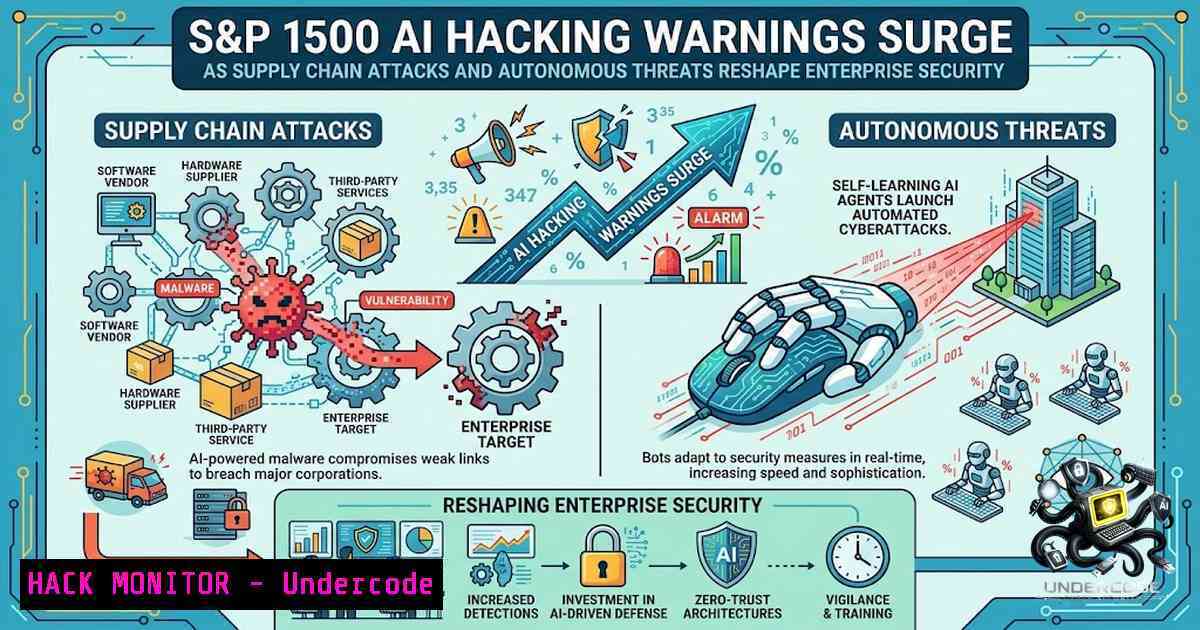
The disclosure that a growing share of S&P 1500 companies are now formally warning investors about AI-related hacking risks in their annual reports marks a pivotal moment in enterprise cybersecurity. This shift from theoretical concern to material disclosure reflects a harsh new reality: AI has simultaneously become both the most powerful defensive tool and the most dangerous attack surface in modern infrastructure. As CrowdStrike’s 2026 Global Threat Report revealed, AI-enabled adversaries increased their operations by 89% year-over-year, while the average eCrime breakout time plummeted to just 29 minutes. With the FBI, CERT-In, and major security vendors all issuing urgent advisories, organizations must now treat AI security as a board-level imperative rather than an IT footnote.
Learning Objectives & Secrets:
- Objective 1: Master AI Supply Chain Risk Assessment – Learn to audit your organization’s AI dependency tree, including open-source libraries (LiteLLM, Trivy, KICS), Python packages, and CI/CD pipelines that can serve as vectors for credential theft and backdoor insertion.
-
Objective 2: Implement Real-Time AI Threat Detection – Deploy continuous monitoring for prompt injection, indirect prompt manipulation (CometJacking), and unauthorized agent behaviors using both commercial and open-source tooling. Secret tip: Monitor not just API endpoints but also local markdown instruction files and browser extension permissions.
-
Objective 3: Build Zero-Trust AI Governance – Apply least-privilege principles to AI agents and LLM access, enforce hardware-based identity for all production systems, and implement micro-segmentation to prevent lateral movement from compromised AI components. Secret tip: Treat every AI prompt as potentially malicious input—the equivalent of SQL injection for the AI era.
- Securing the AI Software Supply Chain: Auditing Dependencies and Pipeline Integrity
The LiteLLM supply chain attack of March 2026 demonstrated how quickly a trusted open-source component can become a weapon. Threat actor group TeamPCP compromised credentials and published malicious versions 1.82.7 and 1.82.8 to PyPI, which were available for only 40 minutes yet potentially affected over 2,500 organizations and 434,000 CI/CD pipelines. The malware automatically executed on every Python invocation, harvesting SSH keys, AWS/GCP/Azure credentials, Kubernetes tokens, LLM API keys, and gateway configurations.
Step-by-Step Guide to Hardening Your AI Supply Chain:
- Inventory all AI dependencies: Run `pip list –outdated` and `pip show
` to identify all installed Python packages. For Node.js environments, use npm list --depth=5. Cross-reference against known compromised versions (e.g., LiteLLM 1.82.7, 1.82.8). -
Implement artifact integrity controls: Use checksum verification for all downloaded packages. On Linux:
Verify package integrity against known good hashes
sha256sum /path/to/downloaded/package.whl
Compare against publisher's published hash
-
Harden CI/CD pipelines: Restrict pipeline permissions using least-privilege principles. For GitHub Actions:
permissions:
contents: read
packages: read
Never use write permissions unless absolutely necessary
-
Rotate all credentials immediately if any exposure is suspected. Use AWS CLI for credential rotation:
aws iam create-access-key --user-1ame <username>
aws iam delete-access-key --access-key-id <old_key_id> --user-1ame <username>
-
Monitor for anomalous pipeline behavior: Set up alerts for unexpected package pulls, unusual build times, or outbound connections from build environments.
-
Defending Against AI-1ative Attack Vectors: Prompt Injection, Vibe Hacking, and Agent Exploitation
The 2026 threat landscape has introduced entirely new attack methodologies that bypass traditional perimeter defenses. Akamai researchers identified three novel vectors: Vibe Hacking (manipulating local markdown instruction files to trick coding assistants), CursorJacking (rogue browser extensions harvesting API keys and codebases), and CometJacking (indirect prompt injection via malicious web pages manipulating local AI agents). Meanwhile, OWASP’s 2026 Top 10 for LLM Applications ranked prompt injection as the 1 risk—fundamentally architectural because instructions and data share the same context window with no parameterized query equivalent.
Step-by-Step Guide to Mitigating AI-1ative Attacks:
- Deploy prompt filtering and sanitization: Implement input validation for all user-supplied prompts. Example using Python with a basic filter:
import re
def sanitize_prompt(user_input):
Remove potential injection patterns
blocked_patterns = [r'ignore previous instructions', r'system:', r'role:']
for pattern in blocked_patterns:
user_input = re.sub(pattern, '', user_input, flags=re.IGNORECASE)
return user_input
-
Monitor browser extensions: On Windows, audit installed extensions via registry:
Get-ChildItem "HKLM:\SOFTWARE\Microsoft\Windows\CurrentVersion\Explorer\Browser Helper Objects"
Get-ChildItem "HKCU:\Software\Microsoft\Windows\CurrentVersion\Explorer\Browser Helper Objects"
-
Implement indirect prompt injection detection: Use tools like `pwnkit-cli` to scan LLM endpoints for vulnerabilities:
Install and scan an AI endpoint
curl -fsSL https://raw.githubusercontent.com/PwnKit-Labs/pwnkit/main/install.sh | bash
npx pwnkit-cli scan --target https://your-ai-endpoint.com
-
Deploy real-time interaction layer inspection: Transition from static DLP to contextual analysis of prompts, copy/paste buffers, and document uploads.
-
Autonomous AI Agents: Managing the “Excessive Agency” Risk
OWASP’s 2026 rankings show that excessive agency jumped from sixth place in 2025 to third in 2026, reflecting the rapid shift from simple chat interfaces to autonomous agents with persistent memory, tool access, and file/API permissions. A manipulated agent can now take genuinely harmful action—not merely produce embarrassing output. Microsoft warned that agents granted excessive access or improper instructions could emerge as a “shadow AI risk,” with 29% of employees already using unauthorized AI tools in their work.
Step-by-Step Guide to Governing Autonomous AI Agents:
- Enforce SSO federation across all AI platforms to eliminate shadow AI: Require corporate identity for every AI tool access.
-
Implement agent permission boundaries: Define explicit tool permissions for each agent. Example using a policy-as-code approach:
agent_policy.yaml
agent:
name: "customer-support-agent"
allowed_tools:</p></li>
</ol>

<p>- knowledge_base_search (read-only)
- ticket_lookup (read-only)
denied_tools:
- database_write
- email_send
- file_delete
max_autonomy_steps: 3
human_approval_required: true
- Monitor agent behavior anomalies: Set up SIEM rules to detect unusual agent actions:
-- Example Splunk query for anomalous agent activity
index=ai_agent_logs action=execute_tool
| stats count by agent_id, tool_name, user
| where count > threshold_based_on_historical_average
-
Apply the “Rule of Two” for agent architectures: Require at least two independent verification steps before any high-impact action is executed.
-
Cloud and API Security in the AI Era: Hardening Against Automated Exploitation
CERT-In’s April 2026 advisory warns that frontier AI models can now autonomously discover zero-day vulnerabilities, analyze source code, plan multi-stage attacks, and simulate end-to-end enterprise compromises at speeds previously requiring teams of experts. Cloud-conscious intrusions rose 37% overall, with a 266% increase from state-1exus threat actors targeting cloud environments. The IMF separately warned that AI accelerates vulnerability discovery and exploitation, raising the probability of correlated failures across interconnected financial systems.
Step-by-Step Guide to Cloud and API Hardening:
- Conduct automated attack surface reconnaissance: Use tools like `nmap` and `gobuster` to identify exposed services:
Network scan for open ports
nmap -sV -p- -T4 target-ip-range

Directory brute-force on web applications
gobuster dir -u https://target.com -w /usr/share/wordlists/dirb/common.txt
-
Deploy AI-enabled defensive tools: Use `brainsait` which combines local LLMs with Kali Linux security tools:
npm install -g brainsait
brainsait test
brainsait execute_command "nmap_scan --target 10.0.0.0/24"
-
Implement advanced micro-segmentation: Divide internal networks into smaller, isolated segments:
Example using iptables on Linux for network segmentation
iptables -A FORWARD -i eth0 -o eth1 -j DROP  Block between segments
iptables -A FORWARD -i eth0 -o eth2 -j DROP
-
Enforce MFA with hardware-backed identity: Require phishing-resistant two-factor authentication for all sensitive systems. Stolen credentials alone must never grant entry.
-
Enable DDoS protection on all internet-facing assets and validate configuration effectiveness regularly.
5. Credential Hygiene and Post-Breach Response
The LiteLLM attack demonstrated that even after malicious packages are removed, stolen credentials may remain valid for weeks or months. The FBI’s July 2, 2026 advisory emphasized that affected firms must assume compromise and act immediately.
Step-by-Step Guide to Credential Hygiene:
- Audit all exposed credentials: Use tools like `trufflehog` to scan repositories for secrets:
trufflehog git https://github.com/your-repo.git --json
2. Rotate all potentially exposed credentials immediately:
 AWS credential rotation
aws iam create-access-key --user-1ame compromised-user
 Update applications with new keys
aws iam delete-access-key --access-key-id OLD_KEY_ID --user-1ame compromised-user
- Implement secret scanning in CI/CD: Use pre-commit hooks to prevent secret leakage:
.pre-commit-config.yaml
repos:</li>
</ol>

- repo: https://github.com/Yelp/detect-secrets
rev: v1.4.0
hooks:
- id: detect-secrets
args: ['--baseline', '.secrets.baseline']
- Monitor for stolen credential usage: Set up alerts for login attempts from unusual locations or at unusual times.
-
Building an AI Security Roadmap: The CISO’s 2026 Priorities
Based on Akamai’s Enterprise AI Usage Risk Report 2026, modern CISOs must pivot from trying to block AI to continuously governing how it operates. The five core strategies are: target AI power users (the 5% driving majority of risk), eliminate shadow AI through SSO federation, inspect the interaction layer with real-time contextual analysis, vet browser and IDE extensions, and implement continuous discovery of niche AI SaaS tools.
Step-by-Step Implementation:
1. Identify AI power users using telemetry data:
-- Query to identify high-volume AI users
SELECT user_id, COUNT(prompt) as prompt_count
FROM ai_usage_logs
WHERE date > DATE_SUB(NOW(), INTERVAL 30 DAY)
GROUP BY user_id
ORDER BY prompt_count DESC
LIMIT 100;
- Deploy continuous AI SaaS discovery using CASB (Cloud Access Security Broker) tools.
-
Implement real-time prompt inspection with DLP integration for sensitive data detection.
-
Regularly audit browser extensions and IDE plugins for security compliance.
What Undercode Say:
-
Key Takeaway 1: The S&P 1500 AI hacking warning trend is not regulatory overreach—it reflects a genuine escalation in AI-driven cyber threats validated by the LiteLLM supply chain attack, CrowdStrike’s 29-minute breakout time data, and CERT-In’s high-severity advisory. Organizations that ignore these warnings face material financial and reputational risk.
-
Key Takeaway 2: Traditional perimeter defenses are obsolete against AI-1ative attacks like prompt injection, vibe hacking, and CometJacking. The new security paradigm must focus on zero-trust governance of AI agents, continuous monitoring of the interaction layer, and treating every prompt as potentially malicious input—the equivalent of SQL injection for the AI era.
The convergence of AI acceleration and supply chain complexity has created an unprecedented attack surface. The LiteLLM incident proves that a 40-minute exposure window can compromise thousands of organizations. Meanwhile, autonomous agents with excessive agency represent a qualitatively different risk than simple chatbots. Security teams must now operate faster than adversaries who are compressing the time between intent and execution. The solution is not to block AI—that ship has sailed—but to govern how it operates at every interaction level, from the prompt to the pipeline to the production environment.
Prediction:
- -1 The rapid weaponization of AI by threat actors will continue to outpace defensive capabilities through 2027, with average breakout times potentially falling below 15 minutes as AI-generated exploits become fully autonomous.
-
-1 Supply chain attacks targeting AI dependencies will become the primary vector for large-scale corporate breaches, as the LiteLLM incident demonstrated that a single compromised package can cascade across 434,000 pipelines.
-
+1 Regulatory pressure will accelerate AI security standardization, with frameworks like OWASP’s Agentic Skills Top 10 and NIST AI RMF becoming mandatory compliance requirements for public companies.
-
-1 The “shadow AI” visibility gap will remain the single largest unaddressed risk, as nearly half of enterprise AI use already bypasses corporate security controls.
-
+1 AI-powered defensive tools will mature rapidly, enabling real-time detection and neutralization of prompt injection and agent manipulation attacks, potentially reducing the success rate of such exploits by up to 75%.
▶️ Related Video (76% Match):
https://www.youtube.com/watch?v=-F-JfWqMG6g
🎯Let’s Practice For Free:
🎓 Live Courses & Certifications:
Join Undercode Academy for Verified Certifications
🚀 Request a Custom Project:
Secure, high-velocity infrastructure and disruptive technological engineering. Contact our engineering team for high-tier development and proprietary systems:
[email protected]
💎 Smart Architecture | 🛡️ Secure by Design | ⭐ Trusted by ThousandsIT/Security Reporter URL:
Reported By: https://lnkd.in/p/eisMaTnp – Hackers Feeds
Extra Hub: Undercode MoN
Basic Verification: Pass ✅🔐JOIN OUR CYBER WORLD [ CVE News • HackMonitor • UndercodeNews ]
📢 Follow UndercodeTesting & Stay Tuned:
- Monitor agent behavior anomalies: Set up SIEM rules to detect unusual agent actions:


