Listen to this Post
Introduction
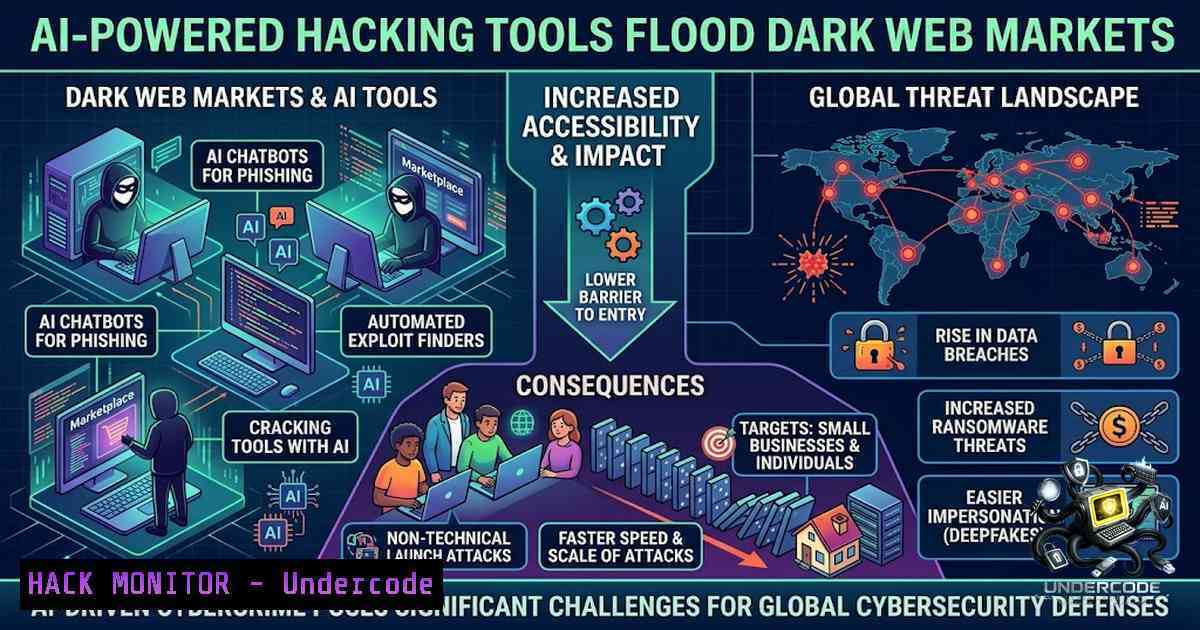
The commoditization of artificial intelligence has reached a new and dangerous frontier: underground cybercrime forums. Trellix researchers have uncovered a thriving marketplace where AI-powered hacking tools and related services are being sold to criminal actors, effectively democratizing sophisticated cyberattacks. From reconnaissance tools to credential markets and AI-as-a-service platforms, these offerings are dramatically lowering the technical expertise required to launch nation-state-level attacks. As Trellix security researcher Jambul Tologonov noted, “Traditionally, hacking required a deep, manual understanding of how network defenses interact with an exploit… An early-stage hacker can now take a tool like APEX AI and execute the same attack with only a single prompt”.
Learning Objectives & Secrets
- Objective 1: Understand the current threat landscape of AI-powered cybercrime tools. Recognize the specific tools and services being sold on underground forums, including APEX AI, Metamorphic Crypter, and MessiahGPT, and comprehend how each lowers the barrier to entry for threat actors.
-
Objective 2: Master detection and mitigation strategies against AI-generated threats. Learn to identify indirect prompt injection attacks targeting enterprise AI agents, implement defensive controls against metamorphic malware, and deploy countermeasures to protect against AI-assisted reconnaissance.
-
Objective 3: Implement proactive security measures to counter AI-driven attacks. Deploy advanced endpoint detection and response (EDR) solutions capable of identifying signature-bypassing techniques, conduct regular red-team exercises simulating AI-powered attack scenarios, and establish robust API security and cloud hardening practices.
You Should Know
1. APEX AI: Nation-State-Level Attack Planning for Beginners
APEX AI, offered by an actor known as Shadowx007 on underground forums, represents one of the most concerning developments in AI-powered cybercrime. After inputting a target domain, the service provides a complete attack plan enabling ransomware deployment, including step-by-step commands. This means an individual with minimal technical knowledge can execute sophisticated attacks that previously required advanced persistent threat (APT)-level expertise.
Step-by-step guide to defending against AI-assisted reconnaissance and attack planning:
- Implement domain monitoring and threat intelligence feeds to detect reconnaissance attempts against your organization’s infrastructure before they escalate.
-
Deploy deception technology such as honeypots and decoy assets that can identify and track automated reconnaissance patterns typical of AI-powered scanning tools.
-
Configure network segmentation to limit lateral movement even if an attacker gains initial access through AI-generated attack vectors.
4. Linux command for monitoring suspicious reconnaissance activity:
 Monitor for unusual port scanning or reconnaissance patterns
sudo tcpdump -i eth0 'tcp[bash] & (tcp-syn) != 0' | awk '{print $3}' | sort | uniq -c | sort -1r
 Check for unusual login attempts
sudo grep "Failed password" /var/log/auth.log | awk '{print $9}' | sort | uniq -c | sort -1r
- Windows PowerShell command for detecting suspicious network connections:
Identify established outbound connections to suspicious IPs
Get-1etTCPConnection | Where-Object {$<em>.State -eq "Established"} | Select-Object LocalAddress, LocalPort, RemoteAddress, RemotePort
Review security event logs for failed login attempts
Get-EventLog -LogName Security -InstanceId 4625 | Select-Object TimeGenerated, @{Name="User";Expression={$</em>.ReplacementStrings[bash]}}, @{Name="Source";Expression={$_.ReplacementStrings[bash]}}
2. Metamorphic Crypter: The End of Signature-Based Detection
A threat actor known as ImpactSolutions is offering Metamorphic Crypter on the Exploit forum, a commercial crypting service designed to help attackers bypass any signature-based detection technology. The actor claims the service cannot be detected by Windows Defender and most other antivirus products. By generating unique binary files during compilation, this AI-enhanced tool renders traditional signature-based detection methods ineffective.
Step-by-step guide to defending against metamorphic and polymorphic malware:
- Transition from signature-based to behavior-based detection by implementing next-generation antivirus (NGAV) and endpoint detection and response (EDR) solutions that analyze behavioral patterns rather than static signatures.
-
Enable application whitelisting to prevent execution of unauthorized binaries, regardless of their signature status.
-
Implement memory scanning and heuristic analysis to detect malicious code attempting to execute in memory without writing to disk.
4. Linux command for monitoring suspicious process behavior:
 Monitor for unexpected process executions
sudo auditctl -w /usr/bin/ -p x -k process-execution
 Check for processes with unusual network connections
sudo netstat -tunap | grep ESTABLISHED
 Monitor system calls for suspicious activity
sudo strace -p [bash] -e trace=network,file,process
- Windows PowerShell command for detecting malicious process behavior:
Monitor for suspicious process creations
Get-WinEvent -FilterHashtable @{LogName='Security'; ID=4688} | Select-Object TimeCreated, @{Name='Process';Expression={$<em>.Properties[bash].Value}}, @{Name='CommandLine';Expression={$</em>.Properties[bash].Value}}
Check for unsigned processes running in memory
Get-Process | Where-Object {$<em>.MainModule -and $</em>.MainModule.FileName -1otlike "C:\Windows\"} | Select-Object Name, Id, @{Name='Path';Expression={$_.MainModule.FileName}}
3. MessiahGPT: Unrestricted AI for Malware Generation
MessiahGPT, advertised on BreachForums, claims to be an AI model with zero ethical constraints, unlike leading commercial models in the U.S.. The service is marketed as a custom-built model without Reinforcement Learning from Human Feedback (RLHF) or Constitutional AI, allowing it to generate exploits, payloads, proof-of-concept code, and even write and refactor malware. Paid plans start at $8 per month, with cryptocurrency accepted and no identity verification required.
Step-by-step guide to protecting against AI-generated malware and exploits:
- Deploy AI-powered security tools that can detect and block AI-generated malicious content using advanced pattern recognition and anomaly detection.
-
Implement secure development practices including code signing, static code analysis, and regular security testing to identify vulnerabilities before they can be exploited.
-
Establish an incident response playbook specifically for AI-generated threats, including procedures for isolating affected systems and analyzing attack vectors.
4. API security hardening commands:
 Implement rate limiting on API endpoints to prevent automated exploitation
 Using Nginx rate limiting configuration
limit_req_zone $binary_remote_addr zone=api_limit:10m rate=10r/s;
location /api/ {
limit_req zone=api_limit burst=20 nodelay;
}
 Monitor API logs for suspicious patterns
sudo grep "POST /api/" /var/log/nginx/access.log | awk '{print $1}' | sort | uniq -c | sort -1r | head -20
5. Cloud hardening commands for AWS:
 Enable AWS CloudTrail for API activity monitoring
aws cloudtrail create-trail --1ame security-trail --s3-bucket-1ame [bucket-1ame] --is-multi-region-trail
 Configure AWS Config for compliance monitoring
aws configservice put-configuration-recorder --configuration-recorder name=default,roleARN=arn:aws:iam::[account-id]:role/config-role
 Enable GuardDuty for threat detection
aws guardduty create-detector --enable
- Indirect Prompt Injection: Manipulating AI Agents at Scale
Proofpoint researchers have identified indirect prompt injection tools designed to manipulate AI agents. Because malicious commands are hidden within PDFs, emails, web pages, and calendar invites, the AI interprets the commands as legitimate and executes them as if they were part of the correct decision-making process. These tools are being offered on underground forums for approximately $150 per month. AI agents at the user level, such as those processing emails or summarizing calendar invites, are particularly vulnerable to such attacks.
Step-by-step guide to preventing indirect prompt injection attacks:
- Sanitize all inputs to AI agents, including emails, documents, and web content, using content filtering and validation mechanisms.
-
Implement strict privilege controls for AI agents, limiting their ability to execute commands or access sensitive data based on the context of the request.
-
Deploy monitoring solutions that can detect anomalous behavior patterns in AI agent outputs, indicating potential prompt injection attempts.
-
Linux command for monitoring email and document processing:
Monitor email server logs for suspicious patterns
sudo grep -E "From:|Subject:" /var/log/mail.log | grep -i "inject|exploit|malware"
Monitor file system for unusual document access
sudo inotifywait -m -r /home/ -e access,modify --format '%w%f %e %T' --timefmt '%Y-%m-%d %H:%M:%S'
5. Windows command for monitoring suspicious file access:
 Enable and monitor PowerShell script block logging
Set-ItemProperty -Path "HKLM:\SOFTWARE\Policies\Microsoft\Windows\PowerShell\ScriptBlockLogging" -1ame "EnableScriptBlockLogging" -Value 1
 Monitor for suspicious PowerShell activity
Get-WinEvent -FilterHashtable @{LogName='Microsoft-Windows-PowerShell/Operational'; ID=4104} | Select-Object TimeCreated, Message
5. AI-Powered Reconnaissance and Credential Markets
The Trellix report highlights that AI-based tools being sold range from reconnaissance tools to credential markets. The explosion in AI-powered cybercrime tooling is not hype—analysts counted 38 dark web forum posts about AI hacking tools in December 2025, which grew to nearly 1,500 by February 2026. This represents a staggering increase of nearly 4,000% in just two months, demonstrating the rapid adoption of AI capabilities by cybercriminals.
Step-by-step guide to defending against AI-powered reconnaissance:
- Implement continuous vulnerability assessment using automated scanning tools to identify and patch vulnerabilities before they can be discovered by AI-powered reconnaissance.
-
Deploy network intrusion detection systems (NIDS) configured to identify automated scanning patterns characteristic of AI-powered tools.
-
Implement credential hygiene practices including multi-factor authentication (MFA), regular password rotation, and monitoring for credential leaks on dark web markets.
4. Linux commands for detecting reconnaissance activity:
 Monitor for port scanning attempts
sudo iptables -A INPUT -m state --state NEW -m recent --set
sudo iptables -A INPUT -m state --state NEW -m recent --update --seconds 60 --hitcount 4 -j DROP
 Check for suspicious SSH connection attempts
sudo grep "sshd" /var/log/auth.log | grep "Failed password" | awk '{print $11}' | sort | uniq -c | sort -1r
5. Windows commands for detecting credential theft attempts:
 Monitor for suspicious credential access using Sysmon (requires installation)
 Check for Mimikatz-like behavior
Get-WinEvent -FilterHashtable @{LogName='Microsoft-Windows-Sysmon/Operational'; ID=10} | Where-Object {$<em>.Message -match "lsass.exe"} | Select-Object TimeCreated, Message
 Monitor for unusual scheduled tasks that might indicate persistence
Get-ScheduledTask | Where-Object {$</em>.State -1e "Disabled"} | Select-Object TaskName, State, @{Name="Actions";Expression={$_.Actions.Execute}}
- Container and Kubernetes Security in the Age of AI Attacks
As AI-powered attacks become more sophisticated, containerized environments and Kubernetes clusters present attractive targets. Attackers are increasingly using AI tools to identify misconfigurations and vulnerabilities in cloud-1ative deployments.
Step-by-step guide to hardening container and Kubernetes environments:
- Implement pod security policies and admission controllers to enforce security standards across your Kubernetes clusters.
-
Scan container images for vulnerabilities before deployment using tools like Trivy or Clair.
-
Implement network policies to restrict pod-to-pod communication and limit lateral movement.
4. Kubernetes security commands:
 Apply a network policy to restrict ingress traffic
kubectl apply -f - <<EOF
apiVersion: networking.k8s.io/v1
kind: NetworkPolicy
metadata:
name: deny-all-ingress
spec:
podSelector: {}
policyTypes:
- Ingress
EOF
 Scan container image for vulnerabilities
trivy image [image-1ame]:[bash] --severity HIGH,CRITICAL
 Enable audit logging for Kubernetes API server
kubectl create -f - <<EOF
apiVersion: audit.k8s.io/v1
kind: Policy
rules:
- level: Metadata
resources:
- group: ""
resources: ["pods", "secrets", "configmaps"]
EOF
5. Docker security commands:
 Run containers with least privilege
docker run --cap-drop=ALL --cap-add=NET_BIND_SERVICE [bash]
 Scan Docker images for vulnerabilities
docker scan [image-1ame]:[bash]
 Monitor Docker daemon logs for suspicious activity
sudo journalctl -u docker.service -f
What Undercode Say
- Key Takeaway 1: AI is democratizing cybercrime at an unprecedented scale. The ability to launch sophisticated attacks with minimal technical expertise means the threat landscape is expanding to include less-skilled actors who can now execute APT-grade attacks.
-
Key Takeaway 2: Traditional security controls are rapidly becoming obsolete. Signature-based detection, perimeter defenses, and conventional antivirus solutions are no longer sufficient against AI-powered tools like Metamorphic Crypter that generate unique, undetectable binaries.
-
Key Takeaway 3: The security industry must evolve its defensive capabilities. Organizations must invest in AI-powered security tools, behavior-based detection, and continuous monitoring to keep pace with the rapidly evolving threat landscape.
The emergence of these AI-powered hacking tools represents a fundamental shift in the cybercrime ecosystem. What was once the domain of highly skilled hackers is now accessible to anyone willing to pay a subscription fee. MessiahGPT’s $8-per-month pricing model exemplifies how cybercrime has become commoditized, following the software-as-a-service model that legitimate businesses have perfected. Organizations must recognize that the barrier to entry for launching sophisticated cyberattacks has effectively collapsed. The only viable defense is a proactive, multi-layered security approach that combines AI-powered detection, continuous monitoring, robust access controls, and regular security testing. The time to act is now—before your organization becomes the next victim of an AI-powered attack.
Prediction
- +1 Security vendors will increasingly integrate AI-powered defensive capabilities into their products, creating an arms race between AI-powered attacks and AI-powered defenses that will drive significant innovation in the cybersecurity industry.
-
-1 Small and medium-sized businesses without the resources to invest in advanced AI-powered security solutions will become increasingly vulnerable to attacks, potentially leading to a wave of devastating breaches targeting the “low-hanging fruit” of the economy.
-
-1 The commoditization of AI hacking tools will lead to a surge in ransomware attacks, data breaches, and supply chain compromises as more actors gain access to sophisticated attack capabilities.
-
+1 Regulatory frameworks will likely evolve to address the challenge of AI-powered cybercrime, potentially including international cooperation agreements and new standards for AI safety and ethical development.
-
-1 The traditional cybersecurity workforce may struggle to keep pace with the rapid evolution of AI-powered threats, creating a critical skills gap that will take years to address.
▶️ Related Video (80% Match):
https://www.youtube.com/watch?v=2-hO_QFj29E
🎯Let’s Practice For Free:
🎓 Live Courses & Certifications:
Join Undercode Academy for Verified Certifications
🚀 Request a Custom Project:
Secure, high-velocity infrastructure and disruptive technological engineering. Contact our engineering team for high-tier development and proprietary systems:
[email protected]
💎 Smart Architecture | 🛡️ Secure by Design | ⭐ Trusted by Thousands
IT/Security Reporter URL:
Reported By: https://lnkd.in/p/ejf6VH2Y – Hackers Feeds
Extra Hub: Undercode MoN
Basic Verification: Pass ✅


