Listen to this Post
Introduction:
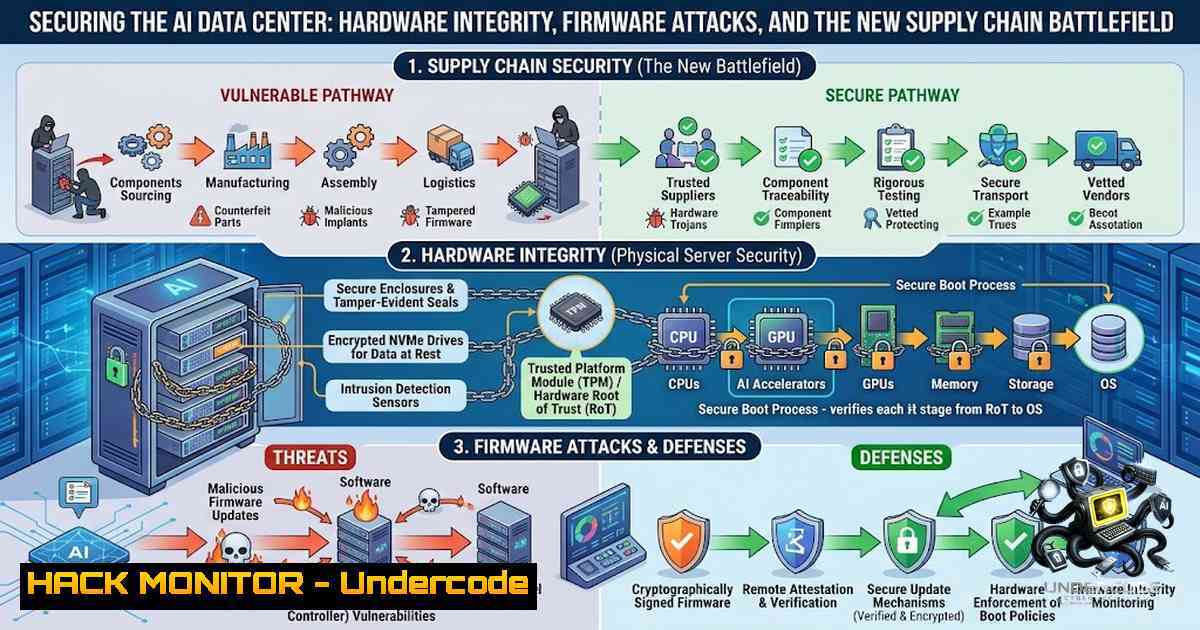
As the global AI arms race accelerates, AI data centers have become critical national infrastructure, with over a trillion dollars in pledged investment. However, the foundational hardware and firmware layers—the GPUs, servers, routers, and network devices that power AI workloads—remain a massive blind spot for most enterprise security stacks. Attackers, including sophisticated nation-state groups, are no longer just targeting models and applications; they are going after the infrastructure beneath them. This article distills best practices for verifying hardware integrity, securing the supply chain, and hardening the AI attack surface, drawing on insights from Eclypsium’s platform and real-world cloud provider case studies.
Learning Objectives & Secrets:
- Objective 1: Master Hardware Integrity Verification. Learn to baseline and continuously monitor firmware across GPU servers, network devices, and components to detect tampering, implants, and configuration drift.
-
Objective 2 Secret Tip: Audit the “Gold” Firmware Binaries. Do not just scan for vulnerabilities—establish known-good “gold” firmware images and verify that every device matches these trusted baselines. This catches supply chain manipulations that vulnerability scans alone miss.
-
Objective 3 Secret Tip: Implement Attestation Before Workload Execution. Validate GPU and accelerator integrity using hardware-based attestation mechanisms (TPM, DRTM, or NVIDIA Remote Attestation) before running any AI workload on shared or newly provisioned hardware.
You Should Know:
- The AI Infrastructure Attack Surface: Beyond the Model
The security community has focused heavily on OWASP Top 10 risks for LLMs, but the hardware, firmware, and supply chain layers have been largely ignored. AI data centers are uniquely challenging to secure because they process high volumes of sensitive data on complex, rapidly changing infrastructure where capacity is swapped between different customers. Attacks at this level can cause data loss, intellectual property leakage, or poisoning of model weights.
Key risk categories include:
- Firmware implants and backdoors in GPUs, routers, and servers
- Counterfeit or tampered components entering the supply chain
- Configuration drift and loss of integrity between workload runs
- Attacks on Baseboard Management Controllers (BMCs) as an attack surface
- Vulnerability exploitation against network edge devices (nearly eight-fold increase year-over-year)
Step‑by‑step: Mapping Your AI Attack Surface
- Inventory all AI infrastructure assets: Document every GPU server, network switch, router, load balancer, and BMC across your data centers.
- Identify firmware dependencies: For each asset, list all firmware components (UEFI, GPU firmware, NIC firmware, BMC firmware).
- Check for known vulnerabilities: Use tools like `fwupdmgr` (Linux) to query firmware versions and cross-reference with CVE databases.
- Establish integrity baselines: Capture cryptographic hashes of known-good firmware binaries for each device type.
- Deploy continuous monitoring: Implement a platform (e.g., Eclypsium) that continuously scans and alerts on any deviations from these baselines.
Linux Commands for Firmware Inventory:
 List UEFI firmware variables
sudo efivar -l

Query firmware updates available (fwupd)
fwupdmgr get-devices
fwupdmgr get-updates

Check kernel integrity messages
dmesg | grep -i integrity

Verify UEFI Secure Boot status
sbverify --cert /path/to/cert.cer /boot/efi/EFI/BOOT/BOOTX64.EFI
2. Supply Chain Security: Verifying Every Component
Complex IT supply chains are being actively targeted by attack groups. AI servers rely on thousands of distinct components from hundreds of partners. Organizations must verify that every piece of code—from UEFI firmware to GPU drivers—is valid, unaltered, and free of threats or implants.
Real-world case study: A leading AI cloud provider used Eclypsium to validate that all systems were running the expected “gold” firmware binaries across their fleet of NVIDIA GPUs, Intel CPUs, and UEFI bootloaders. This enabled them to proactively verify supply chain integrity while scaling rapidly without overburdening security staff.
Step‑by‑step: Implementing Supply Chain Integrity Checks
- Define “gold” firmware baselines: Work with vendors to obtain known-good firmware images and their cryptographic signatures.
- Scan before deployment: Verify integrity of every GPU, server, and network device before it enters production.
- Detect counterfeits: Use platform capabilities to identify counterfeit components by comparing firmware signatures and hardware identifiers against vendor databases.
- Sanitize between tenants: For multi-tenant AI infrastructure, ensure secure firmware and configuration of shared resources before releasing to subsequent customers.
- Continuous monitoring: Proactively alert on any changes to firmware, configurations, or components.
Windows Commands for Firmware Verification (Server Environments):
 Get firmware information via WMI
Get-WmiObject -Class Win32_BIOS

Check UEFI Secure Boot status
Confirm-SecureBootUEFI

Get TPM information
Get-Tpm

List all devices and their drivers (check for unsigned drivers)
Get-WindowsDriver -Online | Where-Object { $_.IsSigned -eq $false }
3. GPU Firmware Integrity: The New Frontline
GPUs are the crown jewels of AI infrastructure, yet they are also a prime target for firmware-based attacks. NVIDIA vulnerabilities have been disclosed repeatedly, and the ability to detect vulnerabilities in AI infrastructure lags behind the pace of GPU compute capacity growth.
Step‑by‑step: GPU Firmware Integrity Verification
- Query GPU firmware versions: Use vendor tools to extract current firmware information.
- Validate against known-good hashes: Compare firmware versions and cryptographic hashes against vendor-provided baselines.
- Run attestation: Use attestation toolkits to verify that GPU firmware, drivers, and configuration are authentic and untampered.
- Check InfoROM integrity: For NVIDIA GPUs, validate the InfoROM checksum to ensure configuration consistency.
- Monitor for changes: Continuously monitor for unauthorized firmware updates or configuration drift.
NVIDIA GPU Firmware Commands:
 NVIDIA Firmware Tools (MFT) - query firmware on device
flint -d <device> q

Query firmware image in a file
flint -i <image_file> q

NVIDIA System Management Interface - get GPU info
nvidia-smi -q | grep -i firmware

Attestation toolkit for confidential GPUs (H100/H200/Blackwell)
cgpu-attest --gpu-family H200
AMD GPU Firmware Commands:
 AMD System Management Interface
amd-smi list
amd-smi firmware
amd-smi metric
4. Cloud Hardening: Multi-Tenancy and Bare Metal Risks
The performance demands of AI workloads have led many organizations to adopt bare metal infrastructure, particularly through neocloud providers. However, bare metal environments eliminate hypervisor-based isolation, creating both security benefits and challenges. Multi-tenancy security requires comprehensive isolation mechanisms.
Key risks in multi-tenant AI environments:
- GPUHammer vulnerabilities: RowHammer-style attacks in GPU memory can enable cross-tenant access
- Firmware persistence: Malicious firmware can survive tenant resets and persist across workloads
- Incomplete sanitization: Recycled or shared AI hardware may retain prior tenant data or implants
Step‑by‑step: Hardening Multi-Tenant AI Infrastructure
- Implement hardware-based attestation: Before each workload execution, validate accelerator integrity using TPM, DRTM, or equivalent mechanisms.
- Enforce GPU memory isolation: Verify that accelerator memory is isolated between workloads through partitioning mechanisms with memory sanitization between jobs.
- Sanitize between tenants: Use platform capabilities to securely sanitize bare metal resources and GPUs between training runs.
- Continuous runtime monitoring: Deploy runtime threat detection that provides real-time visibility across the AI factory.
- Zero Trust architecture: Implement constant checks, least privilege access, and attribute-based access control (ABAC).
Linux Commands for Bare Metal Security:
 Check TPM status and PCR values
tpm2_pcrread

Verify Secure Boot status
mokutil --sb-state

Check for kernel integrity (IMA)
cat /sys/kernel/security/ima/ascii_runtime_measurements

Audit loaded kernel modules for unsigned modules
lsmod | while read mod; do modinfo $mod | grep -i signature; done
5. API Security and Configuration Hardening
AI infrastructure platforms expose extensive REST APIs for fleet management, vulnerability remediation, and security operations. These APIs must be secured against token theft, rate-limiting bypasses, and configuration drift.
Step‑by‑step: API Security Hardening
- Implement token rotation: Rotate API client secrets and access tokens regularly.
- Add scope-based permissions: Restrict API access based on least-privilege principles.
- Audit token storage: Store tokens in secure secret managers, never in public repositories.
- Implement rate limiting: Prevent abuse and DoS attacks through API rate limiting.
- Enforce HTTPS with certificate validation: Verify SSL certificates for all API connections.
- Add security headers: Implement CORS properly and add security headers to all API responses.
API Security Commands and Configuration:
 Test API endpoint with rate limiting headers
curl -I https://api.eclypsium.com/v1/devices -H "Authorization: Bearer $TOKEN"

Validate SSL certificate chain
openssl s_client -connect api.eclypsium.com:443 -showcerts

Check for security headers
curl -I https://api.eclypsium.com/v1/health | grep -i "strict-transport-security"
Windows PowerShell for API Security:
 Test API with Invoke-RestMethod (enforces TLS)
Invoke-RestMethod -Uri "https://api.eclypsium.com/v1/devices" -Headers @{Authorization = "Bearer $env:ECLYPSIUM_TOKEN"} -Method Get

Check TLS configuration
What Undercode Say:
- Key Takeaway 1: The AI infrastructure arms race has created a massive security blind spot below the OS layer. Firmware and hardware integrity are now the new frontline, yet most enterprise security stacks were never built to address this attack surface. Organizations must shift left and implement integrity verification from procurement through deployment and runtime.
-
Key Takeaway 2: Continuous monitoring is non-1egotiable. Static vulnerability scans are insufficient—attackers are implanting backdoors and tampering with firmware in ways that traditional tools miss. The ability to baseline “gold” firmware binaries and continuously alert on drift is the difference between proactive defense and reactive incident response.
Analysis: The security community has spent years perfecting application-layer and OS-layer security, but the hardware and firmware layers remain largely unmonitored. This is not just a technical gap—it’s a strategic vulnerability. Nation-state adversaries are already exploiting this blind spot. The trillion-dollar AI infrastructure buildout is creating an unprecedented attack surface, and the window to secure it proactively is closing rapidly. Organizations that treat AI infrastructure security as an afterthought will find themselves playing catch-up against sophisticated, well-resourced adversaries. The good news is that solutions exist—platforms like Eclypsium provide continuous monitoring, integrity verification, and supply chain protection at scale. The challenge is adoption and prioritization.
Prediction:
- +1 Organizations that implement hardware integrity verification and supply chain security early will gain a significant competitive advantage, as they will be able to offer verifiably secure AI infrastructure to customers—a key differentiator in the neocloud market.
-
+1 Regulatory frameworks (e.g., NIST SP 800-223, OpenAI’s secure infrastructure guidance) will increasingly mandate hardware attestation and firmware integrity monitoring, driving widespread adoption of platforms like Eclypsium.
-
-1 The gap between AI infrastructure growth and security investment will continue to widen, leading to a major breach of an AI data center within the next 12-18 months—likely involving firmware-level persistence that goes undetected for months.
-
-1 Supply chain attacks targeting AI hardware will become more sophisticated, with adversaries inserting backdoors at the manufacturing or distribution stage, making detection significantly more challenging.
-
-1 The shortage of security professionals with expertise in hardware and firmware security will create a skills gap that leaves many organizations exposed, particularly mid-market AI companies that cannot afford dedicated hardware security teams.
-
+1 The emergence of attestation-as-a-service and GPU integrity verification tools (e.g.,
cgpu-attest) will democratize access to hardware security, enabling even smaller AI labs to verify their infrastructure. -
-1 As AI data centers become designated critical national infrastructure, the geopolitical stakes will rise, making them prime targets for state-sponsored cyber operations seeking to disrupt rival nations’ AI capabilities.
-
+1 The integration of AI into firmware analysis and reverse engineering workflows will accelerate vulnerability discovery and patch development, helping to close the gap between vulnerability disclosure and remediation.
-
-1 Bare metal AI infrastructure will remain a significant security challenge, as the performance benefits of eliminating hypervisor isolation will continue to justify security trade-offs for specific workloads.
-
+1 The NVIDIA Inception program and partnerships with supply chain security platforms signal that major hardware vendors are beginning to prioritize security as a first-class feature, which will drive industry-wide improvements over the next 3-5 years.
▶️ Related Video (78% Match):
https://www.youtube.com/watch?v=1K6hGT6QpXQ
🎯Let’s Practice For Free:
🎓 Live Courses & Certifications:
Join Undercode Academy for Verified Certifications
🚀 Request a Custom Project:
Secure, high-velocity infrastructure and disruptive technological engineering. Contact our engineering team for high-tier development and proprietary systems:
[email protected]
💎 Smart Architecture | 🛡️ Secure by Design | ⭐ Trusted by Thousands
IT/Security Reporter URL:
Reported By: https://lnkd.in/p/eCpW7FF3 – Hackers Feeds
Extra Hub: Undercode MoN
Basic Verification: Pass ✅


