Listen to this Post
Introduction
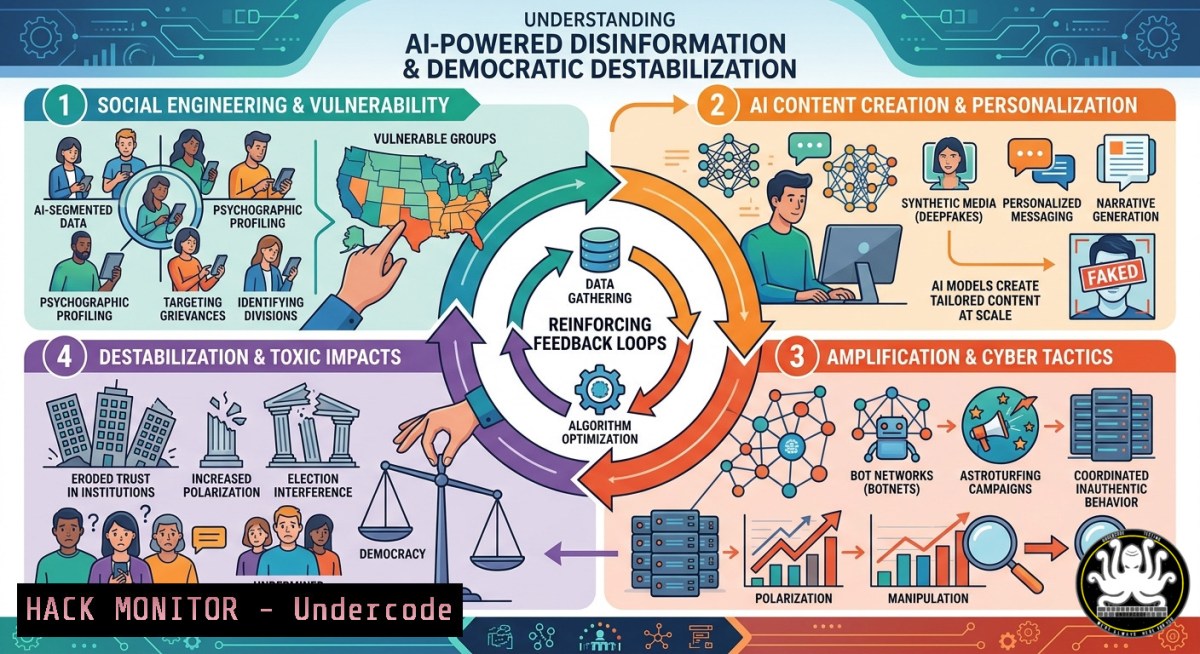
Disinformation campaigns no longer rely solely on fake news—they are now fueled by AI-generated content, coordinated botnets, and psychological operations (psyops) that target local vulnerabilities. As seen in the recent political shifts in Poland, Germany, Canada, and the US, extremist groups leverage data-driven manipulation to fracture democratic institutions. Understanding these cyber-enabled influence operations is critical for cybersecurity professionals, IT auditors, and risk analysts who must defend not only networks but also the information ecosystems they support.
Learning Objectives
- Identify and analyze disinformation tactics using open-source intelligence (OSINT) and network forensics.
- Deploy Linux/Windows commands to detect botnet activity, social media manipulation, and coordinated inauthentic behavior.
- Implement countermeasures including API security hardening, cloud-based threat intelligence feeds, and AI-driven content verification.
You Should Know
1. OSINT Harvesting of Targeted Local Narratives
Attackers first map cultural, ethnic, and local political fault lines by scraping social media, forums, and news comments. This phase often uses automated crawlers and AI summarization tools to identify divisive topics. To replicate or defend against this, security teams can use the following OSINT commands and scripts.
Linux Commands for Social Media Monitoring (Ethical Use Only):
 Use twint (archive) or snscrape to collect tweets about a specific region
snscrape --jsonl twitter-search "Kraków mayor lang:en" > krakow_tweets.json

Extract geolocated Reddit posts from Polish subreddits
snscrape reddit-subreddit r/Poland > poland_reddit.json

Analyze keyword frequency over time
cat krakow_tweets.json | jq '.content' | grep -i "right-wing|liberal" | wc -l
Windows PowerShell for Sentiment Analysis:
 Download a list of known disinformation domains from a threat feed
Invoke-WebRequest -Uri "https://raw.githubusercontent.com/blocklistproject/lists/master/disinformation.txt" -OutFile "disinfo_domains.txt"

Check if local news URLs are in the blocklist
$url = "https://www.politico.eu/article/poland-right-wing-krakow-mayor-aleksander-miszalski-donald-tusk/"
Get-Content disinfo_domains.txt | Where-Object {$url -like "$_"}
Step‑by‑Step Guide to OSINT Collection:
- Set up a Python virtual environment and install
snscrape,pandas, andtextblob. - Target a specific locality (e.g., Kraków) with keywords like
"mayor","immigration","LGBT","EU".
3. Run daily crawls and store JSON outputs.
- Use `textblob` for sentiment polarity; spikes in negative sentiment often precede coordinated disinformation drops.
- Correlate with known botnet IPs (e.g., from abuse.ch) using `grep` on log files.
2. Botnet Detection and C2 Infrastructure Mapping
Right-wing disinformation campaigns frequently deploy low-cost botnets on compromised IoT devices or cloud VPS (e.g., from Russian or Saudi hosting providers). These bots amplify hashtags, reply to local politicians, and manufacture consensus. Detecting them requires analyzing network traffic and social media API patterns.
Linux Commands to Identify Suspicious Traffic:
 Monitor real-time connections to known malicious IPs (feed from threatfox)
sudo tcpdump -i eth0 -n 'dst host 185.130.5.253 or src host 185.130.5.253' -c 100

Use netstat to find established connections from unusual user agents
netstat -tnp | grep ESTABLISHED | while read line; do echo $line; ss -tnp | grep -i "python|node|curl"; done

Analyze Twitter API rate-limit violations (sign of bot scraping)
sudo grep "rate limit" /var/log/nginx/access.log | awk '{print $1}' | sort | uniq -c | sort -nr
Windows Command Line for Process Anomalies:
 List all processes with network activity and their associated user agents
netstat -ano | findstr ESTABLISHED
tasklist /FI "PID eq 1234" /FO TABLE

Check scheduled tasks for malicious persistence (common for bot payloads)
schtasks /query /fo LIST /v | findstr "BOT|DISINFO"
Step‑by‑Step Botnet Mitigation:
- Deploy a honeypot using `t-pot` or `Cowrie` on a low-cost VPS to catch automated disinformation posting scripts.
- Extract source IPs and correlate with Shodan or Censys to identify hosting providers.
- Use `iptables` to drop traffic from those IP ranges:
sudo iptables -A INPUT -s 185.130.5.0/24 -j DROP. - On Windows, use `New-NetFirewallRule` in PowerShell to block outbound connections to known C2 domains.
- Report abuse to the hosting provider with evidence (timestamps, payloads, user-agent strings).
3. AI-Generated Content Detection and Deepfake Forensics
Modern disinformation includes AI-written articles, synthetic voice clips, and deepfake videos of local politicians. Detecting these requires statistical analysis and forensic tools. For example, the Politico article about Kraków’s mayoral election could be amplified by AI-generated comments on Facebook or Telegram.
Python Script to Detect AI-Generated Text (Burrows’ Delta):
from transformers import pipeline
import numpy as np

classifier = pipeline("text-classification", model="roberta-base-openai-detector")
sample_text = "The radical left is destroying our city with woke policies..."
result = classifier(sample_text)
print(f"Fake probability: {result[bash]['score']:.2f}")  >0.8 indicates likely AI
Linux Command for Image Metadata Forensics:
 Extract EXIF data from a suspected deepfake image
exiftool -all suspicious_image.jpg | grep -E "Create Date|Software|Comment"

Use identify to check for compression artifacts common in GAN-generated images
identify -verbose suspicious_image.jpg | grep "Pixel intensity"
Step‑by‑Step Deepfake Verification Workflow:
- Install `exiftool` and `ffmpeg` on Linux or use
Windows Subsystem for Linux (WSL). - For videos, extract frames:
ffmpeg -i suspect.mp4 -vf "fps=1" frame_%04d.png. - Run frames through `DeepFaceLab` or `Microsoft Video Authenticator` (limited availability).
4. For audio, use `speechbrain`’s spoof detection model.
- Publish findings with SHA-256 hashes of original media to create a verifiable chain of custody.
-
API Security Hardening for Social Media Monitoring Tools
To counter disinformation, organizations often build custom scrapers or purchase access to Twitter/X, Facebook, or Reddit APIs. These APIs are themselves targets for attackers who want to steal credentials or manipulate rate limits. Hardening API integrations is essential.
Linux Command to Rotate API Keys Securely:
 Store API keys in environment variables (never in code)
export TWITTER_BEARER_TOKEN="abcd1234"
export REDDIT_CLIENT_SECRET="efgh5678"

Use curl with masked headers
curl -X GET "https://api.twitter.com/2/tweets/search/recent?query=Kraków" \
-H "Authorization: Bearer $TWITTER_BEARER_TOKEN" --silent --show-error
Windows PowerShell for API Key Vault Integration:
 Fetch keys from Azure Key Vault or HashiCorp Vault
$vaultSecret = Get-AzKeyVaultSecret -VaultName "DisinfoDefense" -Name "TwitterBearer"
$bearerToken = $vaultSecret.SecretValueText

Use in Invoke-RestMethod
$headers = @{ Authorization = "Bearer $bearerToken" }
Invoke-RestMethod -Uri "https://api.twitter.com/2/tweets/search/recent?query=Poland" -Headers $headers
Step‑by‑Step API Hardening:
- Never embed secrets in scripts; use HashiCorp Vault or AWS Secrets Manager.
- Implement IP whitelisting on the API provider’s dashboard for all monitoring endpoints.
- Rotate tokens every 24 hours using a cron job (Linux) or Task Scheduler (Windows).
- Monitor API logs for unusual patterns (e.g., `429` rate limit errors followed by a spike in `200` responses—indicates token theft).
- Use mutual TLS (mTLS) where supported to authenticate machine-to-machine calls.
5. Cloud Hardening for Disinformation Defense Platforms
Many threat intelligence platforms run on AWS, Azure, or GCP. Misconfigured cloud storage (e.g., public S3 buckets) can leak sensitive OSINT data or internal alerts. Attackers scan for these weaknesses to learn defensive strategies.
Linux Command to Scan for Open Cloud Buckets:
 Install AWS CLI and test bucket permissions
aws s3 ls s3://disinfo-defense-logs/ --no-sign-request
 If successful, bucket is public → breach

Use bucket-stream tool for bulk enumeration
git clone https://github.com/eth0izzle/bucket-stream.git
cd bucket-stream && pip install -r requirements.txt
python bucket-stream.py --wordlist common-bucket-names.txt
Windows Command to Audit Azure Blob ACLs:
 List all storage accounts and their public access levels
az storage account list --query "[].{Name:name, PublicAccess:allowBlobPublicAccess}" --output table

Remediate: disable public access
az storage account update --name mydisinfobucket --allow-blob-public-access false
Step‑by‑Step Cloud Hardening:
- Enable S3 Block Public Access at the account level.
- Use AWS Config rules to detect publicly exposed buckets (e.g.,
s3-bucket-public-read-prohibited). - In Azure, enable “Storage account default to Azure Active Directory authorization” to kill SAS tokens.
- Set up VPC endpoints for API calls to prevent data exfiltration over the public internet.
- Deploy a WAF (AWS WAF or Azure Front Door) to block malicious user-agents and known botnet IPs from reaching your intelligence dashboards.
What Undercode Say
- Disinformation is a full-stack cyber threat: From OSINT collection to AI-generated content and botnet amplification, the lifecycle mirrors sophisticated APT campaigns. Treat it as such—assign CVE-like identifiers to influence operations.
- Localized targeting bypasses national defenses: Attackers pivot from country to country (US → UK → Poland → Canada) using recycled tactics but tailored narratives. Defenders must build local-language OSINT pipelines and train community-level incident responders.
Analysis: The political commentary in the source post highlights a critical gap in cybersecurity education. Most CISSP or CEH courses ignore disinformation as a “soft” problem, yet it directly enables ransomware, election interference, and insider threats. Security teams must integrate social media forensics, API abuse detection, and AI-generated text classifiers into their standard toolkits. Moreover, the shift toward “Autocracy Inc.” mentioned by the poster implies nation-state backing of disinformation botnets—meaning defenders should hunt for C2 infrastructure using the same threat intelligence feeds used for Emotet or Trickbot. Finally, the failure of liberal mayors in Kraków mirrors the 2016 US election targeting of local news ecosystems; without proactive monitoring of regional subreddits, Facebook groups, and Telegram channels, organizations will remain blind to the earliest stages of a coordinated attack.
Expected Output: Prediction
Over the next 12–24 months, disinformation campaigns will adopt generative AI for real-time, personalized micro-targeting—e.g., deepfake voicemails from a “neighbor” about local zoning issues. To counter this, cybersecurity firms will release “influence detection” SOC playbooks, and governments will mandate API logging for all major social platforms. However, the lack of attribution standards means most attacks will go unpunished until a major breach (e.g., deepfake video of a prime minister declaring war) triggers a global treaty. Linux and Windows forensic tools will add dedicated “narrative anomaly” modules, and cloud providers will offer disinformation-specific WAF rules. The arms race has only just begun.
▶️ Related Video (80% Match):
🎯Let’s Practice For Free:
IT/Security Reporter URL:
Reported By: Shari Gribbin – Hackers Feeds
Extra Hub: Undercode MoN
Basic Verification: Pass ✅


