Listen to this Post
Introduction:
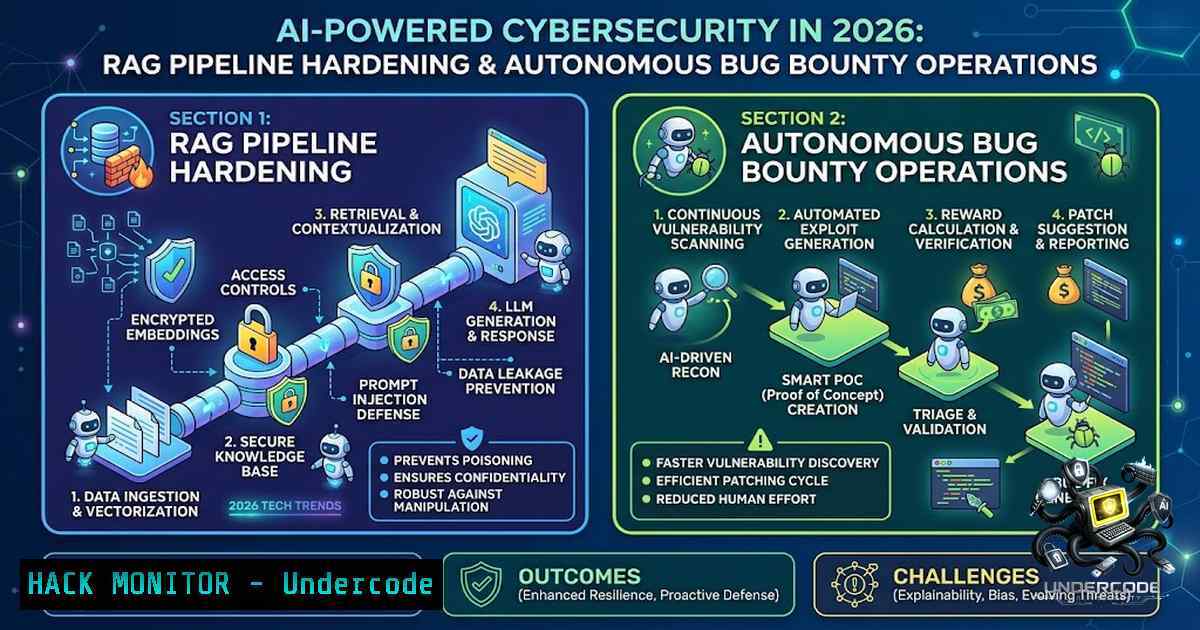
The cybersecurity landscape is undergoing a paradigm shift as artificial intelligence ceases to be merely a defensive tool and becomes an active attack surface in its own right. As organizations rush to integrate Large Language Models (LLMs) and Retrieval-Augmented Generation (RAG) into their operations, security professionals must now defend not only traditional infrastructure but also the AI pipelines that power modern applications. From indirect prompt injection attacks that hijack AI assistants through poisoned documents to embedding inversion techniques that recover sensitive training data from vector databases, the attack surface has expanded dramatically. This article explores the convergence of AI and cybersecurity, providing hands-on techniques for securing AI systems, leveraging AI for penetration testing, and building the skills that will define the next generation of security professionals.
Learning Objectives & Secrets:
- Objective 1: Master RAG Pipeline Security — Understand how Retrieval-Augmented Generation systems are vulnerable to indirect prompt injection, knowledge base poisoning, and data leakage. Learn to implement retrieval filtering, context sanitization, and source provenance tagging to harden RAG pipelines against adversarial document injection.
-
Objective 2 Secret Tip: AI-Powered Penetration Testing with MCP — Leverage the Model Context Protocol (MCP) to give AI assistants direct access to 88 industry-standard penetration testing tools including Nmap, Nuclei, SQLMap, and ffuf. Use natural language commands to orchestrate complex security assessments while maintaining strict scope enforcement and input validation.
-
Objective 3 Secret Tip: OWASP LLM Top 10 as Your AI Security Baseline — Treat the OWASP Top 10 for LLM Applications (2026 edition) as your foundational threat model. Prioritize mitigation of Prompt Injection (LLM01), Sensitive Information Disclosure (LLM02), and Unbounded Consumption (LLM10), which account for the majority of AI security incidents in production deployments.
You Should Know:
- Hardening RAG Pipelines: Defending Against Indirect Prompt Injection
Retrieval-Augmented Generation systems operate in three stages: ingestion (chunking and embedding documents), retrieval (finding top relevant chunks), and generation (LLM producing answers from chunks). The vulnerability resides in the generation phase: retrieved document text and system instructions are concatenated into a single prompt, and the LLM cannot distinguish between them. An attacker who injects a booby-trapped document into your knowledge base can hijack the assistant, exfiltrate secrets, or force malicious actions.
Research presented at USENIX Security 2025 demonstrated that injecting just five carefully crafted documents into a knowledge base containing millions of entries was sufficient to manipulate an AI system’s responses with over 90% success.
Step-by-Step Guide to RAG Security Hardening:
Step 1: Implement Source Provenance Tagging
Tag each document chunk with its source metadata and enforce source-level access control at retrieval time.
 Python example: Tagging chunks with provenance metadata
def tag_chunk(document_id, chunk_text, source_metadata):
return {
"chunk_id": f"{document_id}_{hash(chunk_text)}",
"text": chunk_text,
"source": source_metadata,  e.g., {"author": "user", "permission": "public"}
"timestamp": datetime.utcnow().isoformat()
}
Step 2: Implement Retrieval Filtering and Context Sanitization
Treat retrieved content as untrusted data and segregate it with explicit delimiters before it reaches the model context.
 Linux: Using jq to sanitize JSON output from vector database queries
curl -X POST http://localhost:8000/retrieve \
-H "Content-Type: application/json" \
-d '{"query": "user question"}' | jq '.results[] | {text: .text, source: .source}' > sanitized_results.json
Step 3: Deploy Anomaly Detection for Malicious Embeddings
Monitor and audit inserts into vector databases to detect embedding inversion attacks and poisoned vectors.
 Linux: Monitor vector database insert logs for anomalies
tail -f /var/log/chroma/inserts.log | grep -E "(suspicious|anomaly|malicious)" | while read line; do
echo "[bash] Potential vector poisoning detected: $line"
 Trigger alert to SIEM
done
Step 4: Use Hardened RAG Configurations
Toggle security modes in RAG pipelines to test defenses. For example, the InjectionRange project provides a `RAG_SECURITY_MODE` environment variable that switches between naive (vulnerable) and hardened (defended) modes.
 Linux: Enable hardened RAG security mode
export RAG_SECURITY_MODE="hardened"
 Or via API
curl -X POST http://localhost:8000/api/admin/security-mode \
-H "Authorization: Bearer $API_KEY" \
-d '{"mode": "hardened"}'
- AI-Powered Bug Bounty and Penetration Testing with MCP
The Model Context Protocol (MCP) enables AI assistants to directly invoke security tools, transforming natural language into executable penetration testing actions. Tools like PentestMCP Server package 88 industry-standard security tools inside a containerized Kali Linux environment, with built-in scope enforcement and input validation.
Step-by-Step Guide to AI-Powered Security Testing:
Step 1: Deploy PentestMCP Server
 Linux/macOS: Clone and build the PentestMCP container
git clone https://github.com/chfle/Pentest-MCP-Server.git
cd Pentest-MCP-Server
docker build -t pentestmcp .
docker run -d --1ame pentestmcp -p 8080:8080 pentestmcp
Step 2: Configure AI Assistant (Claude Code / Cursor)
Add the MCP server configuration to your AI client. The server runs as an unprivileged `pentester` user with only `NET_RAW` and `NET_ADMIN` capabilities for raw-socket scanning.
{
"mcpServers": {
"pentestmcp": {
"command": "docker",
"args": ["exec", "-i", "pentestmcp", "python", "-m", "pentestmcp"]
}
}
}
Step 3: Use Workflow Slash Commands
Professional pentest methodology is built into the system with 11 workflow slash commands:
– `/recon` — Port scanning, service enumeration, subdomain discovery (nmap, nuclei, httpx, subfinder, amass)
– `/hunt` — Bug bounty hunting with automated vulnerability discovery
– `/finding` — Document and track discovered vulnerabilities
– `/report` — Generate professional penetration test reports
 Linux: Example reconnaissance command via AI assistant
/recon target example.com --ports 1-1000 --threads 50
Step 4: Run HackingGPT for Terminal-Based AI-Assisted Pentesting
HackingGPT integrates OpenAI and DeepSeek APIs to assist security researchers with command execution and analysis directly from the terminal.
 Linux: Install and run HackingGPT
git clone https://github.com/DouglasRao/HackingGPT.git
cd HackingGPT
pip install -r requirements.txt
export OPENAI_API_KEY="your-key"
export DEEPSEEK_API_KEY="your-key"
python hackingGPT.py
The tool detects commands in responses (presented in markdown code blocks) and allows execution in an interactive terminal, with output captured for analysis.
Step 5: Use AI-Powered CLI Assistants with RAG Intelligence
Helix is an AI-powered command-line assistant that converts natural language to commands using 450+ system commands, with multi-layer safety including directory sandboxing.
 Linux: Install Helix
git clone https://github.com/Nibir1/Helix.git && cd Helix && ./scripts/install.sh

Windows (PowerShell as Administrator)
git clone https://github.com/Nibir1/Helix.git; cd Helix; .\scripts\install.ps1

Go Install (Cross-Platform)
go install github.com/Nibir1/Helix/cmd/helix@latest
Helix operates on a local-first architecture, downloading and indexing the National Vulnerability Database (NVD), CISA KEV, Exploit-DB, and MITRE ATT&CK directly into a local SQLite knowledge base.
 Query vulnerability information offline
/vuln CVE-2024-12345
/explain --cve CVE-2024-12345
- OWASP LLM Top 10: The AI Security Threat Model
The OWASP Top 10 for LLM Applications (2026 edition) is the definitive community-driven guide to the most critical security risks facing applications powered by large language models. Developed by hundreds of AI security experts, it maps risks to NIST, MITRE ATLAS, CWE, and the OWASP Top 10 for Agentic Applications.
Critical Risks and Mitigations:
LLM01: Prompt Injection (Top Priority)
Attacker-controlled text changes the model’s behavior. Direct injection comes through user input; indirect injection hides instructions in retrieved content. Mitigation: Treat every model output influenced by untrusted content as untrusted itself. Enforce permissions outside the model. Run CI gates with known injection payloads using tools like Garak and PromptInject.
 Linux: Run Garak for prompt injection testing
garak --model_type openai --model_name gpt-4 --probes prompt_injection
LLM02: Sensitive Information Disclosure
The model reveals PII, secrets, or other users’ data. Mitigation: Data hygiene before the model, scoped retrieval per user, and output filtering after.
 Python: PII redaction using Microsoft Presidio
from presidio_analyzer import AnalyzerEngine
from presidio_anonymizer import AnonymizerEngine

analyzer = AnalyzerEngine()
anonymizer = AnonymizerEngine()

def redact_pii(text):
results = analyzer.analyze(text=text, language='en')
return anonymizer.anonymize(text=text, analyzer_results=results).text
LLM06: Excessive Agency
The model has more tools or permissions than needed. Mitigation: Scope tool access per use case, require human approval for irreversible actions, and give the agent its own least-privilege identity.
LLM08: Vector and Embedding Weaknesses
Vector databases are now a recognized attack surface. Threats include embedding inversion (recovering sensitive text from embeddings) and vector poisoning (malicious entries steering model outputs). Mitigation: Encrypted/access-controlled vector stores, retrieval filtering, anomaly detection for malicious embeddings, and per-tenant namespaces.
4. Building an AI-Powered SOC Triage Pipeline
Automating Security Operations Center (SOC) triage with AI enables faster threat detection and response. An AI-powered SOC triage pipeline can simulate network attacks, capture malicious traffic automatically, generate structured alerts, and deliver MITRE ATT&CK-mapped triage reports.
Step-by-Step Guide to AI-Powered SOC Automation:
Step 1: Set Up Virtualized Attack/Defense Lab
Deploy Kali Linux (attacker) and Ubuntu Server (victim) in VMware with NAT networking.
Step 2: Capture Network Traffic with tshark
 Linux (Ubuntu Server): Capture ICMP traffic
sudo tshark -i eth0 -f "icmp" -T json -e ip.src -e ip.dst -e icmp.type -e icmp.code > traffic.json
Step 3: Generate Structured JSON Alerts with Python
 Python: Automated traffic capture and alert generation
import subprocess
import json
import datetime

def capture_traffic(duration=60):
cmd = ["tshark", "-i", "eth0", "-a", f"duration:{duration}", "-T", "json"]
output = subprocess.check_output(cmd)
return json.loads(output)

def generate_alert(packet):
return {
"timestamp": datetime.utcnow().isoformat(),
"src_ip": packet["_source"]["layers"]["ip"]["ip.src"],
"dst_ip": packet["_source"]["layers"]["ip"]["ip.dst"],
"protocol": packet["_source"]["layers"]["ip"]["ip.proto"],
"alert_type": "SUSPICIOUS_TRAFFIC",
"mitre_attack": "T1498"  Network Denial of Service
}
Step 4: Integrate with AI Agent for Automated Triage
Send structured alerts to an AI agent trained on SOC playbooks for automated analysis and risk scoring.
 Linux: Send alert to AI agent
curl -X POST http://localhost:8000/analyze \
-H "Content-Type: application/json" \
-d @alert.json
5. Securing AI APIs and Cloud Infrastructure
AI agents with operational autonomy to access databases, call external APIs, and execute business logic become high-value targets. Implementing defense-in-depth protection requires multiple layers of security controls.
Step-by-Step Guide to AI API and Cloud Hardening:
Step 1: Implement API Gateway Permission Guards
Enforce policies at the API Gateway level across all agent interactions.
 Linux: Configure API Gateway with ACL policies
curl -X POST http://localhost:8000/consumers \
-d '{"username": "ai-agent-staging", "custom_id": "agent-001"}'
Step 2: Deploy Inline Guardrail Layers
Inspect inbound payloads for prompt injection and PII, and outbound responses for data leakage.
Step 3: Enforce Environment Variable Security
Never commit API keys to version control. Use environment variables and rotate keys regularly.
 Linux/macOS: Set API keys as environment variables
export OPENAI_API_KEY="your-key"
export DEEPSEEK_API_KEY="your-key"

Windows (PowerShell)
$env:OPENAI_API_KEY="your-key"
$env:DEEPSEEK_API_KEY="your-key"
Step 4: Implement Command Validation and Input Sanitization
Validate all commands against an allowlist and sanitize all user inputs before processing.
 Python: Command allowlist validation
ALLOWED_COMMANDS = ["nmap", "ping", "curl", "whois", "dig"]

def validate_command(cmd):
base_cmd = cmd.split()[bash]
if base_cmd not in ALLOWED_COMMANDS:
raise ValueError(f"Command {base_cmd} not in allowlist")
return True
What Undercode Say:
- Key Takeaway 1: AI is Both Shield and Sword — The same AI technologies that defenders use for threat detection and SOC automation are being weaponized by attackers through prompt injection, knowledge base poisoning, and embedding inversion. Security professionals must adopt a dual mindset: defend AI systems while leveraging AI for offensive security testing. The OWASP LLM Top 10 provides the essential threat model for this new frontier.
-
Key Takeaway 2: Hands-On Skills Trump Theory — The cybersecurity industry is moving beyond textbooks. Practical skills in RAG pipeline hardening, AI-powered penetration testing with MCP, and AI-assisted SOC automation are becoming the differentiators for security professionals. Tools like PentestMCP, Helix, and HackingGPT demonstrate that AI can significantly accelerate security workflows when properly controlled and scoped. The future belongs to practitioners who can build, break, and defend AI systems in equal measure.
The convergence of AI and cybersecurity is not a distant trend—it is happening now. Organizations that fail to secure their AI pipelines will face data breaches through vector database compromises, prompt injection attacks, and model poisoning. Conversely, security teams that embrace AI-powered tools will achieve unprecedented efficiency in threat detection, penetration testing, and incident response. The key is to treat AI systems as critical infrastructure requiring the same rigorous security controls applied to traditional systems—with the added complexity of understanding the unique vulnerabilities of LLMs, RAG, and agentic workflows.
Prediction:
- +1 AI-powered autonomous penetration testing will become standard practice by 2028, with MCP-based agents conducting continuous security assessments alongside human researchers, reducing time-to-exploit discovery by 70%.
-
-1 RAG pipeline attacks will become the primary vector for enterprise data breaches within 18 months, as attackers increasingly target knowledge bases rather than application code directly.
-
-1 The shortage of professionals with combined AI and cybersecurity expertise will create a critical skills gap, leaving most organizations underprepared to defend against AI-specific threats.
-
+1 OWASP LLM Top 10 compliance will become a mandatory requirement for enterprise AI deployments by 2027, driving widespread adoption of AI security guardrails and red-teaming practices.
-
+1 Open-source AI security tools (Garak, PromptInject, PyRIT, InjectionRange) will mature into enterprise-grade solutions, democratizing AI security testing for organizations of all sizes.
▶️ Related Video (82% Match):
https://www.youtube.com/watch?v=1_D3hExVVBM
🎯Let’s Practice For Free:
🎓 Live Courses & Certifications:
Join Undercode Academy for Verified Certifications
🚀 Request a Custom Project:
Secure, high-velocity infrastructure and disruptive technological engineering. Contact our engineering team for high-tier development and proprietary systems:
[email protected]
💎 Smart Architecture | 🛡️ Secure by Design | ⭐ Trusted by Thousands
IT/Security Reporter URL:
Reported By: https://lnkd.in/p/eM5Dfdc7 – Hackers Feeds
Extra Hub: Undercode MoN
Basic Verification: Pass ✅


