Listen to this Post
Introduction
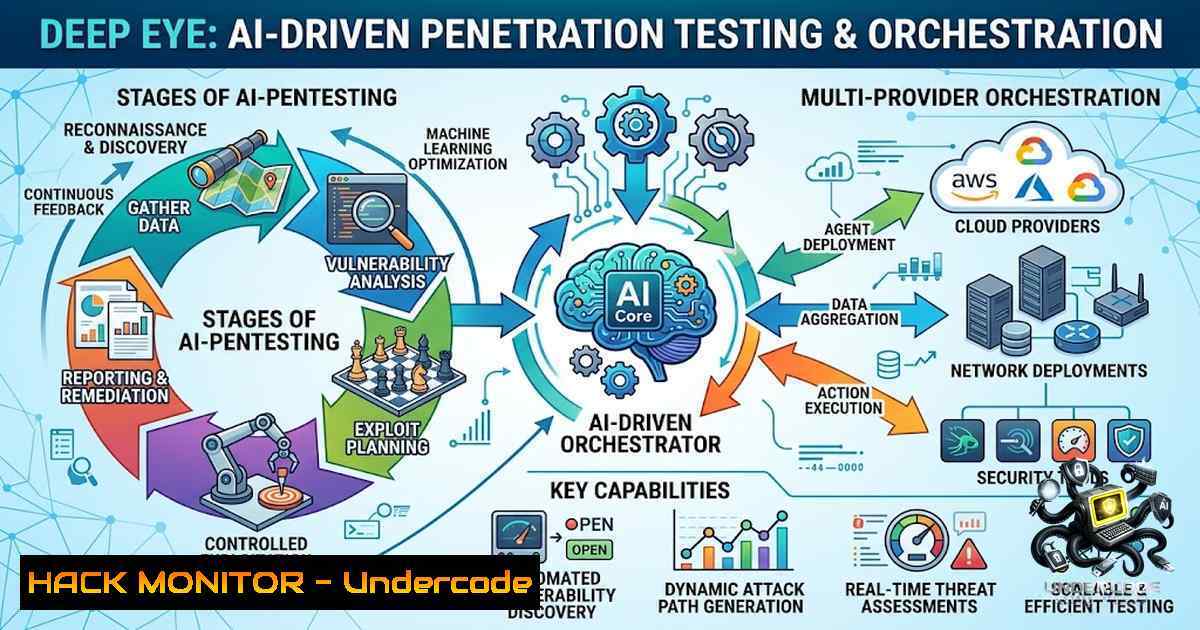
Deep Eye represents a paradigm shift in automated security testing—an open-source Python framework that orchestrates multiple AI providers to generate context-aware payloads, scan targets for 50+ vulnerability types, and produce professional compliance-mapped reports. As traditional vulnerability scanners increasingly struggle against modern WAFs and complex application logic, Deep Eye’s AI-powered approach dynamically adapts payloads based on technology stack fingerprints, WAF signatures, and CVE intelligence, transforming how security professionals conduct authorized penetration tests and bug bounty hunts.
Learning Objectives & Secrets
- Objective 1: Master Multi-AI Provider Orchestration – Configure failover across 11+ AI providers (OpenAI, Claude, Gemini, Grok, Ollama, Groq, Mistral, OpenRouter, LiteLLM, LM Studio) with a unified `generate()` abstraction, enabling intelligent payload generation that adapts to target context. Secret tip: Leverage local Ollama instances for air-gapped testing environments where external API calls are prohibited—simply set `provider: ollama` in your config and run `ollama pull mistral` to get started.
-
Objective 2: Context-Aware Payload Generation with CVE Intelligence – Deep Eye’s payload engine analyzes WAF fingerprints, detected technology stacks, and a RAG-indexed CVE database (NVD/MITRE/Exploit-DB patterns) to generate attack strings that bypass signature-based detection. Secret tip: Use `–cve CVE-2024-XXXXX` to force the engine to prioritize exploitation paths for specific vulnerabilities, dramatically reducing scan time in patch-validation scenarios.
-
Objective 3: Automated Triage and Professional Reporting – AI-powered false-positive filtering with evidence summaries, FP replay, and HackerOne-style bug bounty report generation—all exportable in HTML, PDF, JSON, SARIF, JUnit, CSV, and XLSX formats. Secret tip: Enable `–ai-triage` to have the LLM analyze each finding’s exploitability and business impact, producing remediation recommendations tailored to your compliance framework (PCI-DSS v4, SOC 2, ISO 27001:2022).
You Should Know
1. Installation and Environment Setup
Deep Eye requires Python 3.8+ and at least one AI provider API key (or a local Ollama instance). The installation process is streamlined across platforms:
Linux / macOS:
chmod +x scripts/install.sh && ./scripts/install.sh
source .deep-venv/bin/activate
Windows (PowerShell):
.\scripts\install.ps1
.deep-venv\Scripts\Activate
Manual installation:
pip install -r requirements.txt
cp config/config.example.yaml config/config.yaml
 Edit config.yaml with your API keys
Optional browser automation (for CAPTCHA solving and JavaScript-heavy targets):
pip install playwright && playwright install chromium
First launch without a configuration file runs the interactive wizard, guiding you through provider selection and API key entry. For teams, consider storing API keys in environment variables rather than the config file to avoid accidental credential leakage:
export OPENAI_API_KEY="sk-..."
export ANTHROPIC_API_KEY="sk-ant-..."
2. Basic Scanning and Target Discovery
The core scanning workflow begins with reconnaissance, followed by vulnerability checks, and concludes with AI-powered triage. Here’s how to execute a basic scan:
Standard scan:
python deep_eye.py -u https://target.com
Scan with configuration file:
python deep_eye.py -c config/config.yaml
Verbose output for debugging:
python deep_eye.py -u https://target.com -v
Multi-format report export:
python deep_eye.py -u https://target.com --formats junit,csv,xlsx
The scanner progresses through three primary phases:
- Passive OSINT & DNS enumeration – Gathers subdomains, technology fingerprints, and publicly exposed endpoints
- Active vulnerability scanning – Executes 50+ attack modules including SQLi, XSS, SSRF, IDOR, JWT deep-dive, GraphQL injection, CORS/CSP misconfigurations, and supply-chain JavaScript analysis
- AI triage & reporting – Filters false positives, generates evidence summaries, and produces professional reports
3. Natural-Language Scope Controls
One of Deep Eye’s most innovative features is natural-language scope definition, allowing testers to specify targets in plain English:
python deep_eye.py -u https://target.com --scope-1l "only /api/ no /logout host target.com"
This eliminates the need for complex regex patterns and reduces the risk of accidentally scanning out-of-scope endpoints. For bug bounty hunters, this is particularly valuable when dealing with programs that have strict scope boundaries—simply describe the allowed paths and the tool respects them automatically.
4. Advanced API Testing with OpenAPI/Swagger Ingestion
Modern applications increasingly expose GraphQL and REST APIs, making API security a critical testing vector. Deep Eye supports OpenAPI/Swagger ingestion to seed its crawl:
python deep_eye.py -u https://target.com --openapi https://target.com/swagger.json
This feature:
- Parses API specifications to identify all endpoints, parameters, and authentication requirements
- Generates context-aware payloads for each endpoint based on expected data types
- Tests for GraphQL deep injection, IDOR, JWT weaknesses, and business logic flaws
For GraphQL-specific testing, Deep Eye can introspect the schema and generate attack vectors targeting nested queries and mutations that traditional scanners often miss.
5. Scan Diffing and Retest Workflows
Continuous security testing requires the ability to compare scan results over time and focus only on new findings. Deep Eye provides robust diffing capabilities:
 Generate baseline and current scan results
python deep_eye.py -u https://target.com -o baseline.json
python deep_eye.py -u https://target.com -o current.json

Diff the results
python deep_eye.py --diff baseline.json current.json --diff-format html --diff-output diff_report.html

Retest only new findings
python deep_eye.py --retest-1ew
The `–retest-1ew` flag is particularly useful in CI/CD pipelines where you want to verify that newly introduced code doesn’t regress security posture without re-running the entire scan suite. Finding deduplication uses fingerprint collapse to eliminate redundant entries, keeping reports clean and actionable.
6. Browser Automation and CAPTCHA Handling
Many modern applications rely on JavaScript-heavy frontends and CAPTCHA challenges that traditional scanners cannot navigate. Deep Eye integrates Playwright for browser automation:
 Enable browser automation
python deep_eye.py -u https://target.com --browser

With optional Browser Use AI for intelligent navigation
python deep_eye.py -u https://target.com --browser --browser-use-ai
CAPTCHA detection and solving supports reCAPTCHA, hCaptcha, Cloudflare Turnstile, and Arkose challenges. The tool can either:
– Automatically detect CAPTCHA presence and skip those flows, or
– Integrate with challenge solvers when configured
For authentication-heavy applications, Deep Eye’s auth helpers support login macro replay and multi-role session storage, enabling testing across different privilege levels:
python deep_eye.py -u https://target.com --auth-login "https://target.com/login" --auth-cred "user:pass"
7. Intercepting Proxy Integration and Compliance Mapping
For advanced testers who want to inspect and modify traffic in real-time, Deep Eye integrates with mitmproxy/mitmweb:
python deep_eye.py -u https://target.com --proxy
This launches an intercepting proxy that captures all traffic between the scanner and target, allowing manual inspection and modification of requests.
Compliance mapping automatically aligns findings with regulatory frameworks:
- PCI-DSS v4 – Maps findings to specific DSS requirements (e.g., SQLi → Requirement 6.5.1)
- SOC 2 CC – Aligns with Trust Services Criteria
- ISO 27001:2022 – Maps to Annex A controls
This feature is invaluable for organizations producing compliance evidence or undergoing audits—the generated reports include explicit references to control numbers, saving hours of manual mapping work.
8. Nuclei-Style YAML Templates for Custom Checks
Deep Eye supports Nuclei-style YAML templates under the `templates/` directory, enabling custom vulnerability checks:
id: custom-sqli
info:
name: Custom SQL Injection Check
severity: high
requests:
- method: GET
path:
- "{{BaseURL}}/api/users?id={{payload}}"
payloads:
payload:
- "' OR '1'='1"
- "' UNION SELECT NULL--"
matchers:
- type: word
words:
- "error in your SQL syntax"
- "mysql_fetch"
This extensibility allows security teams to codify organization-specific vulnerability patterns and integrate them into the automated scanning pipeline.
9. Notifications and CI/CD Integration
Deep Eye supports real-time notifications via Email, Slack, and Discord:
python deep_eye.py -u https://target.com --1otify slack --webhook https://hooks.slack.com/...
For CI/CD pipelines, the SARIF and JUnit export formats enable seamless integration with GitHub Advanced Security, GitLab SAST, and Jenkins. Example Jenkins pipeline stage:
stage('Security Scan') {
steps {
sh '''
python deep_eye.py -u https://staging.target.com --formats junit,sarif
 Upload results to Jenkins or security dashboard
'''
}
post {
always {
junit '/junit.xml'
}
}
}
What Undercode Say
- Key Takeaway 1: Deep Eye’s multi-AI orchestration is not just about redundancy—it’s about intelligence synthesis. By consulting multiple LLMs with different training distributions, the tool generates payloads that are more diverse and contextually appropriate than any single-model approach could achieve. This “ensemble” strategy mirrors how human penetration testers collaborate, each bringing unique perspectives to complex problems.
-
Key Takeaway 2: The integration of RAG-based CVE intelligence with context-aware payload generation addresses the fundamental weakness of traditional scanners—they test for known vulnerabilities but lack the ability to adapt to application-specific defenses. Deep Eye’s ability to fingerprint WAFs, detect technology stacks, and incorporate CVE data in real-time means it doesn’t just find vulnerabilities; it finds exploitable vulnerabilities.
Analysis: The emergence of tools like Deep Eye signals a maturation of AI in offensive security. While early AI pentesting tools were largely experimental or proof-of-concept, Deep Eye demonstrates production-ready capabilities: multi-provider failover, professional reporting, compliance mapping, and CI/CD integration. However, this power comes with responsibility—the tool is explicitly designed for authorized testing only. Security teams should treat Deep Eye as an force multiplier, not a replacement for human expertise. The AI excels at pattern recognition, payload generation, and triage, but strategic thinking, business context, and creative exploitation paths remain firmly in the human domain. Organizations adopting AI-driven pentesting should establish clear governance around API key management, scope definitions, and result validation to avoid over-reliance on automated findings.
Prediction
-1 The democratization of AI-powered pentesting will inevitably lower the barrier to entry for malicious actors. While Deep Eye requires authorized use, the underlying techniques—multi-provider orchestration, context-aware payload generation, automated CAPTCHA solving—can be repurposed for offensive campaigns. Organizations must accelerate defensive AI adoption to counterbalance this asymmetry.
+1 Deep Eye’s open-source nature and extensible template system will foster a community-driven vulnerability knowledge base, similar to how Nuclei transformed bug bounty hunting. Expect to see specialized template repositories emerge for specific industries (healthcare, finance, critical infrastructure) and rapid adaptation to newly disclosed CVEs.
+1 The compliance mapping feature (PCI-DSS v4, SOC 2, ISO 27001) positions Deep Eye as a governance tool, not just a technical scanner. Organizations can use it to generate audit-ready evidence, potentially reducing the cost and friction of compliance certification—a significant competitive advantage in regulated industries.
-1 As AI-generated payloads become more sophisticated, WAF and RASP vendors will respond with AI-powered defenses, sparking an arms race. This will increase the complexity and cost of security operations, particularly for smaller organizations that cannot afford cutting-edge defensive AI.
+1 The integration of natural-language scope controls and browser automation suggests a future where penetration testing is increasingly accessible to non-specialists—developers, QA engineers, and security champions. This shift could embed security testing earlier in the SDLC, reducing the cost of fixing vulnerabilities and improving overall software quality.
▶️ Related Video (84% Match):
🎯Let’s Practice For Free:
🎓 Live Courses & Certifications:
Join Undercode Academy for Verified Certifications
🚀 Request a Custom Project:
Secure, high-velocity infrastructure and disruptive technological engineering. Contact our engineering team for high-tier development and proprietary systems:
[email protected]
💎 Smart Architecture | 🛡️ Secure by Design | ⭐ Trusted by Thousands
IT/Security Reporter URL:
Reported By: https://lnkd.in/p/ethkpsFr – Hackers Feeds
Extra Hub: Undercode MoN
Basic Verification: Pass ✅


