Listen to this Post
Introduction:
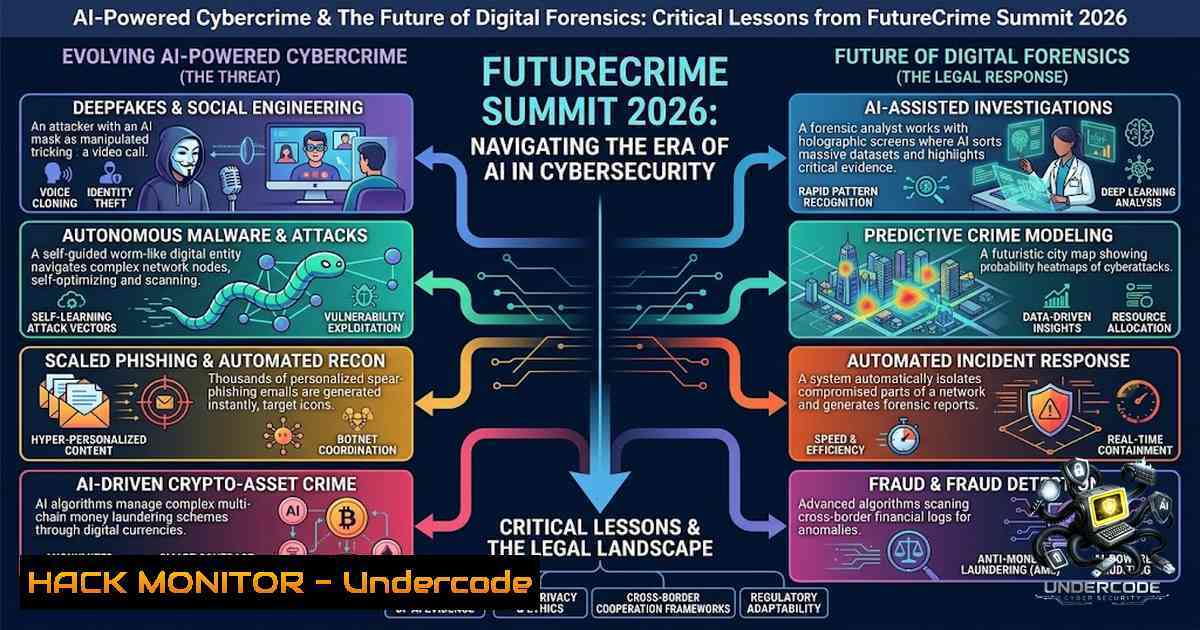
The cybersecurity landscape is undergoing a paradigm shift where artificial intelligence is no longer just a defensive tool—it has become the weapon of choice for sophisticated threat actors. As highlighted at the FutureCrime Summit 2026, the convergence of AI-driven cybercrime, digital forensics, threat intelligence, and cyber law demands a unified response that transcends traditional technical boundaries【0†L5-L7】. This article distills the summit’s core insights into actionable technical knowledge, bridging the gap between high-level strategy and hands-on implementation for security professionals, investigators, and policymakers.
Learning Objectives:
- Understand the mechanics of AI-powered cyberattacks and their implications for digital forensics and incident response.
- Acquire practical skills in threat intelligence gathering, log analysis, and API security hardening using open-source tools.
- Learn to implement collaborative defense frameworks that integrate law enforcement, industry, and technical teams.
You Should Know:
- The AI Attack Surface: How Adversaries Exploit Machine Learning
Artificial intelligence has lowered the barrier to entry for cybercriminals while simultaneously increasing the scale and sophistication of attacks. At FutureCrime Summit 2026, experts demonstrated how generative AI is used to craft highly convincing phishing campaigns, automate vulnerability scanning, and even generate polymorphic malware that evades signature-based detection【0†L5-L7】. The traditional defense-in-depth model is no longer sufficient; organizations must adopt AI-aware security postures.
Step‑by‑step guide: Detecting AI‑generated phishing emails
- Step 1: Extract email headers using `python -c “import email; msg=email.message_from_file(open(’email.eml’)); print(msg[‘Received’])”` to trace the origin.
- Step 2: Analyze linguistic patterns with `python -c “import language_tool_python; tool=language_tool_python.LanguageTool(‘en-US’); print(tool.check(open(’email.txt’).read()))”` to identify unnatural phrasing common in AI-generated text.
- Step 3: Verify domain reputation using `dig -t TXT _dmarc.example.com` and `dig -t TXT _spf.example.com` to check SPF/DKIM/DMARC records.
- Step 4: Submit suspicious URLs to VirusTotal via API:
curl -X GET "https://www.virustotal.com/api/v3/urls/{url_id}" -H "x-apikey: YOUR_API_KEY".
Linux/Windows Commands for Email Analysis:
- Linux: `grep -E “Received: from” email.eml | tail -1` – Extract the first received header.
- Windows (PowerShell):
Get-Content email.eml | Select-String -Pattern "Received: from" | Select-Object -Last 1.
- Threat Intelligence Integration: From Data to Actionable Defense
Threat intelligence is most effective when it is operationalized. The summit emphasized the need for real-time sharing of indicators of compromise (IoCs) between organizations and law enforcement【0†L7】. This requires setting up automated pipelines that consume, normalize, and act upon threat feeds.
Step‑by‑step guide: Setting up a lightweight threat intelligence pipeline
- Step 1: Install MISP (Malware Information Sharing Platform) using Docker:
docker run -d -p 80:80 -p 443:443 -v /var/lib/misp:/var/lib/misp misp/misp. - Step 2: Configure a feed from AlienVault OTX: navigate to `https://otx.alienvault.com/api/v1/pulses/subscribed` and extract the JSON feed using `curl -H “X-OTX-API-KEY: YOUR_KEY” https://otx.alienvault.com/api/v1/pulses/subscribed > pulses.json`.
- Step 3: Parse IoCs using `jq ‘.results[].indicators[] | {type: .type, value: .indicator}’ pulses.json` and ingest into MISP via its REST API.
- Step 4: Automate blocking with firewall rules: for Linux, use
iptables -A INPUT -s {ip} -j DROP; for Windows, useNew-1etFirewallRule -DisplayName "Block IP" -Direction Inbound -RemoteAddress {ip} -Action Block.
Windows Commands for Firewall Automation:
netsh advfirewall firewall add rule name="Block_IoC" dir=in action=block remoteip={ip}.
- Digital Forensics in the AI Era: Adapting Investigation Techniques
Digital forensics must evolve to handle AI-generated artifacts and adversarial machine learning. Investigators now face challenges such as deepfake audio/video, AI-manipulated logs, and anti-forensic techniques that use generative models to create false trails【0†L5】. The summit highlighted the importance of maintaining chain of custody while employing AI-assisted analysis tools.
Step‑by‑step guide: Forensic imaging and analysis of a compromised system
- Step 1: Create a forensic image using `dd if=/dev/sda of=/mnt/evidence/image.dd bs=4M status=progress` (Linux) or use FTK Imager (Windows) for a GUI-based approach.
- Step 2: Verify hash integrity: `sha256sum /mnt/evidence/image.dd > image.hash` and compare with the original.
- Step 3: Mount the image read-only: `mount -o loop,ro /mnt/evidence/image.dd /mnt/analysis` (Linux).
- Step 4: Analyze system logs for anomalies: `grep -i “error\|fail\|attack” /var/log/auth.log` and cross-reference with known IoCs.
- Step 5: Use `volatility` for memory forensics: `volatility -f /mnt/evidence/memory.dmp imageinfo` followed by `volatility -f /mnt/evidence/memory.dmp –profile=Win10x86_19041 pslist` to list processes.
Linux/Windows Commands for Log Analysis:
- Linux: `journalctl –since “2026-08-01” –until “2026-08-08” | grep -i “failed password”` – Extract failed login attempts.
- Windows (PowerShell): `Get-WinEvent -LogName Security | Where-Object { $_.Id -eq 4625 } | Select-Object TimeCreated, Message` – List failed logon events.
4. API Security Hardening: Protecting the Digital Backbone
With the proliferation of microservices and cloud-1ative architectures, APIs have become prime targets. The summit underscored the need for robust API security, particularly in financial and national security contexts【0†L7】. Attackers use AI to fuzz APIs and discover hidden endpoints, making proactive hardening essential.
Step‑by‑step guide: Hardening REST APIs against common attacks
- Step 1: Implement rate limiting using NGINX: add `limit_req_zone $binary_remote_addr zone=mylimit:10m rate=10r/s;` and `limit_req zone=mylimit burst=20 nodelay;` to your configuration.
- Step 2: Enforce strong authentication with OAuth2 and JWT: use `openssl rand -base64 32` to generate a secure secret and validate tokens with `pyjwt` in Python:
import jwt; jwt.decode(token, SECRET, algorithms=['HS256']). - Step 3: Scan for vulnerabilities using OWASP ZAP: `zap-cli quick-scan –self-contained –start-options “-config api.disablekey=true” https://api.example.com`.
– Step 4: Monitor for anomalous requests with `tail -f /var/log/nginx/access.log | awk ‘{print $1}’ | sort | uniq -c | sort -1r` to identify IPs with excessive requests.
Linux Commands for API Monitoring:
– `ss -tulpn | grep :443` – Check which services are listening on HTTPS port.
– `netstat -an | grep :80 | wc -l` – Count active HTTP connections.
5. Cloud Hardening: Securing Multi-Cloud Environments
As organizations migrate to multi-cloud architectures, misconfigurations remain the leading cause of breaches. The summit emphasized the need for continuous compliance monitoring and automated remediation【0†L7】.
Step‑by‑step guide: Hardening AWS and Azure environments
- Step 1: Enable AWS Config and Azure Policy to monitor resource configurations.
- Step 2: Use `aws s3api get-bucket-acl –bucket your-bucket` to check public access and `aws s3api put-bucket-acl –bucket your-bucket –acl private` to restrict it.
- Step 3: For Azure, use `az storage account show –1ame your-storage –query “networkRuleSet”` to review network restrictions and `az storage account update –1ame your-storage –default-action Deny` to block public access.
- Step 4: Implement CloudTrail and Azure Monitor for audit logging: `aws cloudtrail create-trail –1ame my-trail –s3-bucket-1ame my-bucket` and
az monitor activity-log list --max-events 10.
Linux/Windows Commands for Cloud CLI:
- Linux: `aws configure` – Set up AWS CLI credentials.
- Windows (PowerShell): `Set-AzContext -Subscription “YourSubscriptionId”` – Switch Azure subscription context.
6. Vulnerability Exploitation and Mitigation: Practical Patching Strategies
The summit highlighted that AI-driven reconnaissance allows attackers to find and exploit vulnerabilities faster than ever【0†L5】. Organizations must adopt a risk-based patching approach complemented by virtual patching where immediate fixes are unavailable.
Step‑by‑step guide: Prioritizing and applying patches
- Step 1: Scan for vulnerabilities using `nmap -sV –script vuln target.com` to identify exposed services and their versions.
- Step 2: Cross-reference with CVE databases: `searchsploit Apache 2.4.49` to find known exploits.
- Step 3: Apply patches using package managers: `apt update && apt upgrade -y` (Debian/Ubuntu) or `yum update` (RHEL/CentOS).
- Step 4: If patching is not immediately possible, implement virtual patching using WAF rules: for ModSecurity, add `SecRule ARGS “@contains ../” “id:1000,deny,status:403″` to block path traversal attempts.
Linux/Windows Commands for Patching:
- Linux: `dpkg -l | grep apache2` – Check installed package versions.
- Windows: `wmic qfe list brief /format:texttable` – List installed hotfixes.
- Collaborative Defense Frameworks: Bridging Technical and Legal Frontiers
The most powerful takeaway from FutureCrime Summit 2026 was the necessity of collaboration—between cybersecurity professionals, law enforcement, policymakers, and industry【0†L7】. Technical solutions alone are insufficient; legal frameworks and information-sharing mechanisms must keep pace with technological advancements.
Step‑by‑step guide: Establishing an information-sharing and analysis organization (ISAO)
- Step 1: Define the scope and objectives of the ISAO, focusing on specific sectors (e.g., finance, healthcare).
- Step 2: Set up a secure communication channel using encrypted messaging (e.g., Signal or Matrix) and a shared threat intelligence platform like MISP.
- Step 3: Develop standardized procedures for reporting and disseminating IoCs, including templates for incident reports.
- Step 4: Conduct regular tabletop exercises simulating AI-driven attacks to test coordination and response times.
- Step 5: Engage legal counsel to ensure compliance with data protection regulations (e.g., GDPR, CCPA) when sharing threat data.
What Undercode Say:
- Key Takeaway 1: AI is a double-edged sword; defenders must adopt AI-1ative security tools to counter AI-powered attacks.
- Key Takeaway 2: Collaboration across technical, legal, and policy domains is not optional—it is the foundation of effective cyber defense.
Analysis: The summit’s emphasis on collaboration reflects a maturing understanding of cybercrime as a systemic challenge rather than a purely technical one【0†L5-L7】. While AI accelerates attack speed and complexity, it also offers unprecedented opportunities for automating threat detection and response. However, the human element—investigators, analysts, and policymakers—remains irreplaceable. The integration of digital forensics with threat intelligence and legal frameworks will define the next generation of cybersecurity. Organizations that invest in cross-functional teams and continuous training will be better positioned to withstand the evolving threat landscape.
Prediction:
- +1 The adoption of AI-driven defensive tools will accelerate, leading to more proactive and predictive security postures.
- +1 Collaborative frameworks like ISAO will become industry standards, reducing response times and improving threat intelligence sharing.
- -1 The sophistication of AI-generated deepfakes and synthetic identities will outpace current detection capabilities, leading to a surge in identity fraud and disinformation campaigns.
- -1 Regulatory fragmentation across jurisdictions will hinder international cooperation, creating safe havens for cybercriminals.
▶️ Related Video (80% Match):
🎯Let’s Practice For Free:
🎓 Live Courses & Certifications:
Join Undercode Academy for Verified Certifications
🚀 Request a Custom Project:
Secure, high-velocity infrastructure and disruptive technological engineering. Contact our engineering team for high-tier development and proprietary systems:
[email protected]
💎 Smart Architecture | 🛡️ Secure by Design | ⭐ Trusted by Thousands
IT/Security Reporter URL:
Reported By: Tanvi Jindal – Hackers Feeds
Extra Hub: Undercode MoN
Basic Verification: Pass ✅


