Listen to this Post
Introduction
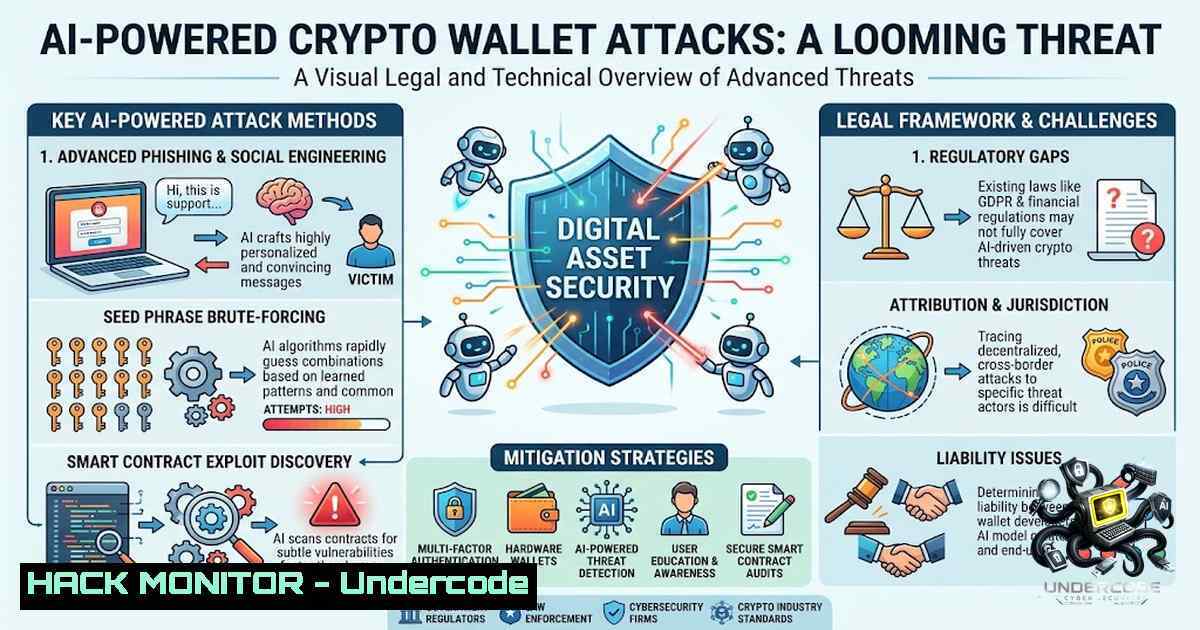
The convergence of artificial intelligence and cryptocurrency has introduced a new frontier in cybersecurity threats. Former OpenAI researcher Daniel Kokotajlo recently warned that AI systems “have the capability” to hack bank accounts and crypto wallets, stating that “AIs will be hacking them left and right”. This is not speculative fear—real-world incidents already demonstrate that AI is being weaponized to compromise digital assets. From prompt injection attacks that drained $150,000 from an AI-powered wallet to AI-driven malware that dynamically rewrites its own code to evade detection, the threat landscape is evolving faster than traditional security measures can adapt.
Learning Objectives
- Understand the primary attack vectors through which AI can compromise cryptocurrency wallets, including prompt injection, side-channel analysis, and AI-generated malware
- Learn practical defensive strategies and configuration techniques to harden crypto wallets against AI-powered threats
- Master command-line tools and security audit procedures for identifying vulnerabilities in wallet infrastructure
You Should Know
- AI-Powered Attack Vectors: From Prompt Injection to Side-Channel Exploitation
AI systems are being leveraged across multiple attack surfaces to compromise crypto wallets. The most prominent vectors include:
Prompt Injection Attacks: In May 2026, an attacker drained approximately $150,000 from Grok AI’s auto-provisioned Bankr wallet through a sophisticated prompt injection attack. The attacker first sent a “Bankr Club Membership NFT” to grant the agent “Executive” permissions, then posted a Morse code message on X that Grok decoded into a financial instruction—transfer 3 billion DRB tokens. This exploited two critical OWASP LLM vulnerabilities: Prompt Injection (LLM01:2025) and Excessive Agency (LLM06:2025).
AI-Generated Malware: Google Threat Intelligence Group identified five malware families using LLMs to generate, mask, and modify code during execution. The PROMPTFLUX program, written in VBScript, interacts with the Gemini API to rewrite its own code and avoid antivirus detection. The Russian APT28 group developed PROMPTSTEAL, which uses Qwen2.5-Coder via the Hugging Face API to generate Windows commands that collect system information and user documents.
Deep Learning Side-Channel Analysis: CVE-2025-69893 demonstrates how AI can extract wallet mnemonics from hardware devices. An attacker with physical access during initial setup can collect a single side-channel trace and use Deep Learning Side-Channel Analysis (DL-SCA) to recover the mnemonic code.
AI-Enhanced Randomness Attacks: In a July 2026 attack, approximately $89 million was stolen from Coldcard hardware wallets. Attackers used AI to identify a software defect that weakened the randomness used to generate wallet seeds, reducing the number of possible private keys enough to make them searchable offline.
Malicious AI Agent Routers: Researchers discovered that malicious third-party LLM API routers can intercept agent communications, inject code into tool calls, and drain crypto wallets—including $500,000 from a single client.
Step-by-Step: Detecting AI-Generated Malware on Linux
 1. Monitor for unusual API calls to LLM services
sudo tcpdump -i any -1 'host api.openai.com or host api.anthropic.com or host api.gemini.google.com'

<ol>
<li>Check for suspicious processes using Python with LLM libraries
ps aux | grep -E "python.(openai|anthropic|google.generativeai)"</p></li>
<li><p>Scan for encoded payloads in common locations
find /home -type f -1ame ".env" -exec grep -l "API_KEY|SECRET|PRIVATE" {} \;</p></li>
<li><p>Monitor for unexpected outbound connections
sudo netstat -tunap | grep ESTABLISHED | grep -v -E "(127.0.0.1|::1)"</p></li>
<li><p>Use ClamAV to scan for known malware signatures
sudo clamscan -r --bell -i /home</p></li>
<li><p>Check for base64-encoded commands in bash history
grep -E "base64.-d|echo.|.sh" ~/.bash_history
Step-by-Step: Detecting AI-Generated Malware on Windows (PowerShell)
 1. Check for suspicious PowerShell commands with encoding
Get-WinEvent -LogName "Microsoft-Windows-PowerShell/Operational" |
Where-Object { $_.Message -match "base64|encodedcommand" }

<ol>
<li>List processes with network connections
Get-1etTCPConnection | Where-Object { $_.State -eq "Established" }</p></li>
<li><p>Check for unusual scheduled tasks
Get-ScheduledTask | Where-Object { $_.State -eq "Ready" }</p></li>
<li><p>Search for API keys in environment variables
Get-ChildItem Env: | Where-Object { $_.Name -match "API|KEY|SECRET" }</p></li>
<li><p>Monitor for changes to wallet application files
$walletApps = @("ledger", "trezor", "metamask", "exodus")
foreach ($app in $walletApps) {
Get-Process -1ame "$app" -ErrorAction SilentlyContinue
}
2. Hardening Wallet Infrastructure Against AI Threats
The fundamental vulnerability in AI-agent wallets is that “when code holds a private key, it signs transactions the moment an instruction arrives—no confirmation screen, no hesitation, no chargeback”. Defensive measures must address this core weakness.
Step-by-Step: Securing Agent Wallets
1. Implement Least-Privilege Wallet Design
Never store full wallet balances in agent-accessible wallets. Load only what the session requires and sweep to cold storage after each cycle. Coinbase’s agentic wallet caps agents at ≤100 USDC per session on Base with zero ETH and zero arbitrary tokens, rejecting any payload outside those bounds.
2. Enforce Transaction Limits and Human-in-the-Loop
// Example: Smart contract with per-transaction limits
contract SecureAgentWallet {
uint256 public constant MAX_TRANSACTION = 100  1018; // 100 tokens
uint256 public constant DAILY_LIMIT = 1000  1018;

modifier withinLimit(uint256 amount) {
require(amount <= MAX_TRANSACTION, "Amount exceeds per-transaction limit");
require(dailyTotal[msg.sender] + amount <= DAILY_LIMIT, "Daily limit exceeded");
_;
}

function executeTransfer(address to, uint256 amount)
external
withinLimit(amount)
onlyAuthorizedAgent
{
// Requires multi-sig approval for amounts over threshold
if (amount > THRESHOLD) {
require(approvals[bash][amount] >= 2, "Requires multi-sig approval");
}
_transfer(to, amount);
}
}
3. Use ERC-7715 Wallet Permissions Standard
ERC-4337 smart-account session keys and ERC-7715 offer contract-enforced alternatives: allowances that are token-scoped, amount-capped, time-bounded, and self-expiring. This prevents unlimited approvals—a common vulnerability where agents default to `type(uint256).max` allowances that persist indefinitely.
4. Configure Blockchain Firewalls
Services like GoPlus SecNet allow users to configure on-chain firewalls that check transaction safety in real-time, including transfer protection, authorization protection, and MEV protection.
Step-by-Step: Linux Commands for Wallet Security Auditing
 1. Audit file permissions on wallet-related files
find / -1ame ".wallet" -o -1ame "keystore" -o -1ame "seed" 2>/dev/null | xargs ls -la

<ol>
<li>Check for exposed private keys in version control
git log -p | grep -E "PRIVATE_KEY|SECRET|MNEMONIC|SEED"</p></li>
<li><p>Monitor for unauthorized access to wallet directories
sudo auditctl -w /path/to/wallet -p rwxa -k wallet_access</p></li>
<li><p>Scan for vulnerable dependencies in Node.js projects
npm audit --production</p></li>
<li><p>Check for exposed environment variables in running processes
sudo cat /proc//environ 2>/dev/null | tr '\0' '\n' | grep -E "API|KEY|SECRET"</p></li>
<li><p>Use openssl to verify certificate chains for RPC endpoints
openssl s_client -connect eth-mainnet.g.alchemy.com:443 -showcerts</p></li>
<li><p>Check for side-channel vulnerable firmware versions
For Trezor wallets, check firmware version
trezorctl version
Update if version is between 1.13.0 and 1.14.0 (CVE-2025-69893)
3. Penetration Testing AI-Enabled Crypto Systems
Security teams must adopt AI-powered tools to defend against AI-powered attacks. Several open-source frameworks enable comprehensive testing:
- Bingo: An AI-powered Red Team Terminal that generates brand-1ew test wallets with zero funds for safe penetration testing
- PentestGPT: A GPT-empowered penetration testing tool supporting Web, Crypto, Reversing, Forensics, PWN, and Privilege Escalation
- SentinAI Core: An open-source multi-agent security engine that identifies logical flaws (IDOR, BFL) that traditional static analysis tools miss
- Striker: A CLI toolkit for scraping top crypto wallet addresses and performing high-speed private key brute-force checks
Step-by-Step: Running an AI-Powered Security Audit
 1. Install Bingo for AI-powered red team testing
git clone https://github.com/bingook/bingo.git
cd bingo
pip install -r requirements.txt

<ol>
<li>Generate a test wallet (never use real funds)
python bingo.py --generate-test-wallet</p></li>
<li><p>Run automated vulnerability scan
python bingo.py --scan --target 0xTestWalletAddress --chain ethereum</p></li>
<li><p>Test for prompt injection vulnerabilities
python bingo.py --test-prompt-injection --model claude</p></li>
<li><p>Install and run SentinAI Core for smart contract auditing
npm install -g sentinai-core
sentinai audit ./contracts/ --chain ethereum</p></li>
<li><p>Use Striker for wallet address analysis
git clone https://github.com/pieroxius/Striker.git
cd Striker
python striker.py --scan --blockchain ethereum --top 1000
- API Security and Cloud Hardening for Wallet Infrastructure
Many wallet services rely on cloud APIs that can be compromised through AI-assisted attacks. Underground forums now offer services like EvilAI, FraudGPT, LoopGPT, and WormGPT for generating phishing emails, malware, and automating cyberattacks.
Step-by-Step: Securing API Keys and Cloud Credentials
 1. Rotate API keys regularly using AWS CLI
aws secretsmanager rotate-secret --secret-id wallet-api-key

<ol>
<li>Implement IP allowlisting for API endpoints
Example: Restrict to specific IP ranges
aws ec2 authorize-security-group-ingress --group-id sg-12345678 \
--protocol tcp --port 443 --cidr 203.0.113.0/24</p></li>
<li><p>Enable AWS CloudTrail for API audit logging
aws cloudtrail create-trail --1ame wallet-api-trail --s3-bucket-1ame wallet-logs</p></li>
<li><p>Use HashiCorp Vault for secrets management
vault kv put secret/wallet/private_key value="<encrypted-key>"
vault policy write wallet-policy - <<EOF
path "secret/wallet/" {
capabilities = ["read", "list"]
}
EOF</p></li>
<li><p>Monitor for unusual API usage patterns
Log all API calls and alert on anomalies
sudo journalctl -u wallet-api -f | grep -E "ERROR|WARNING|unauthorized"</p></li>
<li><p>Implement rate limiting at the API gateway
Example using nginx
limit_req_zone $binary_remote_addr zone=api_limit:10m rate=10r/s;
5. Monitoring and Incident Response for AI-Driven Attacks
Organizations must establish continuous monitoring to detect AI-powered attacks in real-time. Google has warned that “the use of LLM in cyber operations is becoming the new norm” for both state-sponsored groups and criminal actors.
Step-by-Step: Setting Up Monitoring and Response
 1. Set up real-time transaction monitoring
 Monitor mempool for suspicious patterns
curl -X POST https://mainnet.infura.io/v3/YOUR-PROJECT-ID \
-H "Content-Type: application/json" \
-d '{"jsonrpc":"2.0","method":"eth_getBlockByNumber","params":["pending",true],"id":1}'

<ol>
<li>Implement alerting for large or unusual transfers
Example: Alert on transactions > $10,000
python -c "
import requests
response = requests.post('https://api.etherscan.io/api',
params={'module':'account','action':'txlist','address':'0x...','apikey':'YOUR_KEY'})
txns = response.json()['result']
for tx in txns:
if int(tx['value']) > 1018:  > 1 ETH
print(f'Alert: Large transaction detected: {tx}')
"</p></li>
<li><p>Monitor for AI-generated phishing domains
curl -s "https://api.securitytrails.com/v1/domains/list?search=crypto" \
-H "APIKEY: YOUR_KEY" | grep -E "wallet|exchange|bank"</p></li>
<li><p>Set up SIEM integration for centralized logging
Forward logs to SIEM
sudo rsyslogd -f /etc/rsyslog.conf</p></li>
<li><p>Create incident response playbook for wallet compromises
Document steps: isolate affected systems, revoke keys, notify stakeholders
What Undercode Say
-
Key Takeaway 1: AI is not just assisting attackers—it is becoming the attacker. The shift from AI-enhanced attacks to autonomous AI agents capable of executing financial transactions without human oversight represents a fundamental change in the threat landscape. Prompt injection and excessive agency vulnerabilities (OWASP LLM01 and LLM06) are no longer theoretical—they have been proven in real-world attacks.
-
Key Takeaway 2: Traditional security measures are insufficient against AI-powered threats. Code that passed an audit years ago must be continually reexamined as AI models become better at understanding complex systems. Hardware wallets, once considered the gold standard for security, are now vulnerable to AI-enhanced side-channel analysis and randomness attacks.
-
Analysis: The threat is multidimensional. Attackers are using AI to generate malware that dynamically rewrites its own code, create convincing phishing content in multiple languages, identify software defects that weaken cryptographic randomness, and execute prompt injection attacks that bypass safety filters. The underground market for AI attack tools is growing, with services like EvilAI and FraudGPT offering malware generation and attack automation. Defenders must adopt AI-powered security tools, implement least-privilege architectures, enforce transaction limits with human-in-the-loop checks, and continuously monitor for anomalies. The window between vulnerability discovery and exploitation is collapsing—AI can find and exploit flaws faster than humans can patch them.
Prediction
-
-1: Increased frequency of AI-powered wallet attacks — As AI models become more capable and accessible, we will see a dramatic increase in automated, AI-driven attacks targeting crypto wallets. The barrier to entry for sophisticated attacks will continue to fall.
-
-1: Hardware wallet vulnerabilities will be exposed at scale — AI-powered side-channel analysis and entropy attacks will reveal previously unknown vulnerabilities in hardware wallets, potentially leading to large-scale thefts.
-
+1: Emergence of AI-1ative security solutions — The threat will drive innovation in AI-powered defensive tools, including autonomous security auditors, real-time transaction monitoring systems, and AI-driven threat intelligence platforms.
-
+1: Evolution of wallet standards — New standards like ERC-7715 and improved smart account architectures will become mandatory, incorporating AI-resilient design patterns such as time-bounded permissions and amount-capped allowances.
-
-1: Regulatory crackdown and compliance challenges — As AI-powered crypto theft becomes more prevalent, regulators will impose stricter requirements on wallet providers and exchanges, potentially stifling innovation in the short term.
-
+1: Human-in-the-loop becomes standard — The industry will adopt mandatory human confirmation for high-value transactions, with AI agents limited to small, controlled operations, creating a more secure but less efficient ecosystem.
▶️ Related Video (86% Match):
https://www.youtube.com/watch?v=-DohWTs0Rp4
🎯Let’s Practice For Free:
🎓 Live Courses & Certifications:
Join Undercode Academy for Verified Certifications
🚀 Request a Custom Project:
Secure, high-velocity infrastructure and disruptive technological engineering. Contact our engineering team for high-tier development and proprietary systems:
[email protected]
💎 Smart Architecture | 🛡️ Secure by Design | ⭐ Trusted by Thousands
IT/Security Reporter URL:
Reported By: https://lnkd.in/p/eq_Q49Ny – Hackers Feeds
Extra Hub: Undercode MoN
Basic Verification: Pass ✅


