Listen to this Post
Introduction
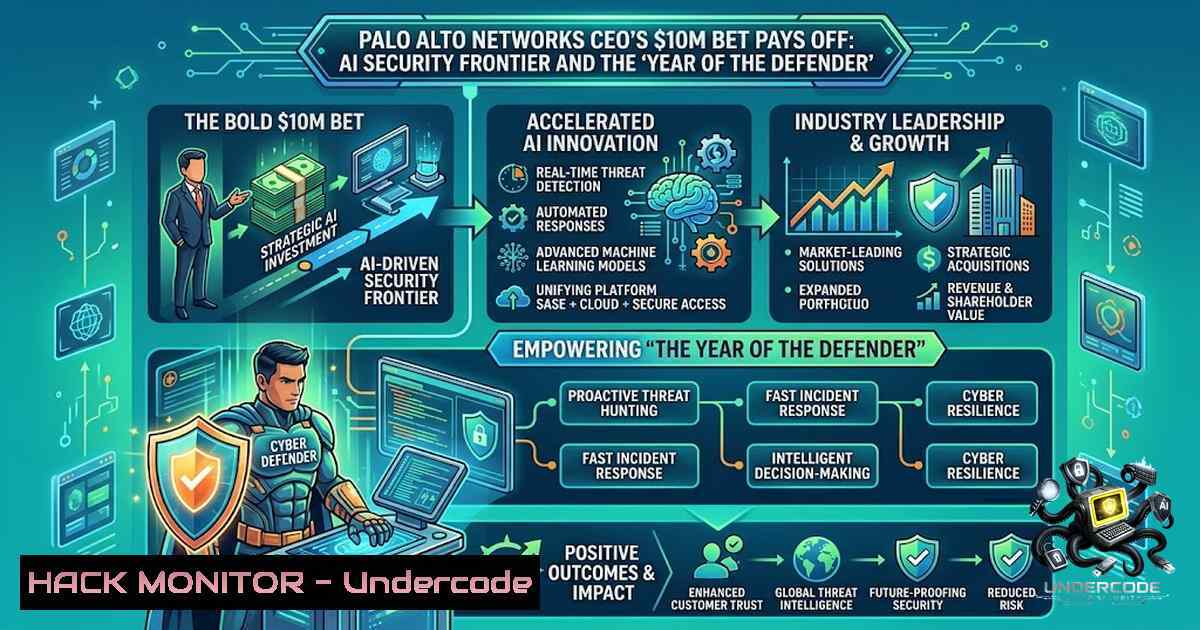
When Palo Alto Networks CEO Nikesh Arora spent roughly $10 million buying company shares in late March 2026, investors were questioning whether artificial intelligence could disrupt the cybersecurity industry itself. Palo Alto’s stock had fallen more than 20% since the start of the year amid growing concerns that increasingly capable AI models—particularly Anthropic’s “Mythos”—would render traditional security vendors obsolete. Five months later, his $10 million bet is worth $26 million, and the broader cybersecurity sector has been turbocharged by AI hacking fears, with top names surging +60% to +103% year-to-date. This article explores the technical, strategic, and market implications of this pivotal moment in cybersecurity.
Learning Objectives
- Understand the impact of frontier AI models on the cybersecurity industry and the shift toward AI-1ative defense architectures
- Learn how Palo Alto Networks’ platformization strategy and Cortex XSIAM enable autonomous security operations
- Master practical commands and configurations for AI-driven threat detection, API security, and cloud hardening
You Should Know
- The “Zero-Day Clock” Has Collapsed: Autonomous AI Attacks Are Here
The emergence of autonomous AI models like Anthropic’s Mythos has fundamentally altered the threat landscape. According to joint research from the Cloud Security Alliance (CSA), SANS Institute, and OWASP GenAI Security Project, these models can autonomously discover vulnerabilities and launch chained exploits so quickly that the time between discovery and active exploitation has shrunk from months to mere minutes. Traditional security tools, operating in isolation, now struggle to see the connective tissue between seemingly unrelated events—a “silo tax” that costs organizations critical detection time.
Step‑by‑step guide: Detecting chained exploits with integrated threat intelligence
- Deploy a unified security platform that correlates data across network, endpoint, and cloud. Palo Alto Networks’ Precision AI® uses machine learning for scaled detection, deep learning to prevent unknown attacks, and generative AI to continuously create attack simulations and train defense models.
-
Enable Threat Insights in Strata Cloud Manager (currently in early access) to gain a strategic view of how integrated defenses detect and block threats across the full attack lifecycle.
-
Automate remediation by configuring AI agents that automatically contextualize threats and execute responses. The goal is to transform the dashboard from a visualization tool into an active workspace.
Linux Command: Monitoring for suspicious process chains
 Monitor for anomalous process executions that may indicate chained exploits
sudo auditctl -a always,exit -F arch=b64 -S execve -k process_chain

Search for suspicious parent-child process relationships
sudo ausearch -k process_chain --format raw | grep -E "(wget|curl|python|perl|bash).-e"

Use ps to identify processes with unusual parent-child relationships
ps -eo ppid,pid,comm | awk '$1 != 1 && $1 != 2 {print}'
Windows Command: Detecting suspicious process chains
 Get process tree to identify unusual parent-child relationships
Get-WmiObject Win32_Process | Select-Object ProcessId, ParentProcessId, Name |
Format-Table -AutoSize

Monitor for suspicious command-line invocations
Get-WinEvent -LogName "Microsoft-Windows-Sysmon/Operational" |
Where-Object {$<em>.Id -eq 1 -and $</em>.Message -match "cmd.exe|powershell.exe"} |
Select-Object TimeCreated, Message
- The SOC Is Now Agentic: Cortex XSIAM and AI-1ative Security Operations
Palo Alto Networks has designated 2026 as the “Year of the Defender”. This reflects a fundamental shift from AI-assisted to AI-1ative security operations. Traditional security tools in AI attack environments now have拦截 rates of only about 80%, while AI-1ative tools can achieve 97% to 99% protection. Cortex XSIAM (Extended Security Intelligence and Automation Management) is rapidly becoming the gold standard for AI-driven security operations centers (SOCs), integrating SIEM, XDR, and SOAR into a single interface.
Step‑by‑step guide: Implementing AI-1ative SOC operations with Cortex XSIAM
- Deploy Cortex XSIAM 3.5 or later to leverage proactive AI agents, stronger governance controls, and Idira integration for privilege-aware response.
-
Enable natural language querying—analysts can simply ask “tell me the context of this case and recommended actions” rather than writing complex scripts.
-
Configure autonomous playbooks for immediate threat response. Cortex XSIAM autonomous playbooks revolutionize incident response by automating workflows and reducing mean time to respond (MTTR).
-
Integrate frontier AI models including Claude Sonnet 4.6, Claude Opus 4.8, and Gemini 3.5 Flash across the Cortex platform for enhanced threat intelligence.
API Security Configuration: Securing AI agent API calls
 Using curl to test API endpoint security with authentication
curl -X GET "https://api.example.com/v1/agents/status" \
-H "Authorization: Bearer ${API_KEY}" \
-H "X-API-Version: 2026-03-01" \
--cacert /etc/ssl/certs/ca-certificates.crt

Validate JWT tokens for agent identity
python3 -c "
import jwt
token = '${JWT_TOKEN}'
try:
decoded = jwt.decode(token, options={'verify_signature': False})
print(f'Token claims: {decoded}')
except Exception as e:
print(f'Token validation failed: {e}')
"
- Browser as the Last Line of Defense: AI Agent DLP
Modern work increasingly relies on browsers to access AI tools and SaaS applications. GenAI traffic has grown over 890%, and AI传输并非完整檔案加密—network layers cannot detect the actual content. Because data must ultimately be assembled in the browser to be displayed, the browser has become the only endpoint that can see complete data flows.
Step‑by‑step guide: Implementing browser-based DLP for AI agents
- Deploy Prisma SASE for the Agentic Era with Enterprise Browser integrated into the SASE architecture.
-
Configure DLP policies at the browser level to inspect data in motion. Since most generative AI services use WebSocket protocols with multiple streams that reassemble in the browser, network-layer TLS interception cannot see actual content.
-
Enable Agent Identity Security to distinguish between human and agent operations. Every AI agent executing API actions carries an identity—sometimes inheriting employee credentials, sometimes with broader or narrower privileges.
Browser Security Configuration: Hardening enterprise browsers
 Linux: Configure Chrome enterprise policies for DLP
sudo mkdir -p /etc/opt/chrome/policies/managed
sudo tee /etc/opt/chrome/policies/managed/dlp_policy.json << EOF
{
"DataLeakPreventionRulesList": [
{
"url": "",
"restrictions": [
{
"class": "BROWSER",
"level": "BLOCK"
}
]
}
]
}
EOF

Windows: Set registry policies for Edge browser DLP
reg add "HKLM\Software\Policies\Microsoft\Edge" /v "DLPRuleSet" /t REG_SZ /d "enabled" /f
reg add "HKLM\Software\Policies\Microsoft\Edge" /v "DLPAction" /t REG_SZ /d "block" /f
4. Quantum Threat Acceleration: “Harvest Now, Decrypt Later”
The quantum threat timeline has shortened from an estimated ten years to just three years. Attackers are already employing a “Harvest Now, Decrypt Later” strategy—大量竊取加密流量等待量子電腦成熟後破解.
Step‑by‑step guide: Preparing for post-quantum cryptography
- Deploy PAN-OS 12.1 Orion or later which includes Cipher Translation technology to protect传输流量 even before endpoints are upgraded.
-
Enable PQC-ready configurations on firewalls and VPN gateways. Palo Alto Networks has declared itself PQC Ready.
-
Audit cryptographic assets to identify systems using vulnerable algorithms (RSA-2048, ECC-256) that may be broken by quantum computers within 3-5 years.
Firewall Command: Configuring quantum-safe TLS
 PAN-OS CLI: Enable post-quantum cipher suites
set deviceconfig system ciphersuite "TLS_AES_256_GCM_SHA384:TLS_CHACHA20_POLY1305_SHA256:TLS_AES_128_GCM_SHA256"

Linux: Generate quantum-safe certificates using OpenSSL (hybrid mode)
openssl req -x509 -1ewkey ec -pkeyopt ec_paramgen_curve:prime256v1 \
-keyout hybrid_key.pem -out hybrid_cert.pem -days 90 -1odes \
-subj "/CN=quantum-safe.example.com"

Verify certificate chain against known quantum-vulnerable algorithms
openssl s_client -connect example.com:443 -tls1_3 -cipher "ECDHE+AESGCM" 2>&1 | grep "Cipher"
- AI Model Security: Protecting the AI Supply Chain
Data poisoning (資料汙染) is an emerging threat—attackers can contaminate AI training data from the source, causing models to make fundamentally incorrect judgments. Palo Alto Networks has introduced Prisma AIRS 3.0 to provide complete AI lifecycle protection across models, data, APIs, and code.
Step‑by‑step guide: Securing AI models and training pipelines
- Deploy Prisma AIRS 3.0 to protect generative AI models, applications, and data.
-
Implement model validation to detect data poisoning attempts. Monitor training data sources for anomalies and unauthorized modifications.
-
Configure API security for AI model endpoints—AI agents now perform most tasks independently, with bots, service accounts, and AI agents outnumbering humans by as much as 82:1.
API Security: Validating AI model inputs
 Python: Input validation for AI model API endpoints
import re
import json

def validate_model_input(payload):
 Check for prompt injection attempts
if re.search(r'(system|instruction|ignore previous|override)', payload.get('prompt', ''), re.I):
raise ValueError("Potential prompt injection detected")

Validate JSON structure
try:
json.loads(payload.get('data', '{}'))
except json.JSONDecodeError:
raise ValueError("Invalid JSON payload")

Check for excessive length (potential DoS)
if len(payload.get('prompt', '')) > 10000:
raise ValueError("Input exceeds maximum length")

return True
6. Platformization: The Consolidator-in-Chief Strategy
Palo Alto Networks has positioned itself as the “consolidator-in-chief” of the security industry. By providing a “free bridge” to customers transitioning from legacy point products, the company locks in long-term contracts that smaller competitors struggle to break. This strategy is supported by major acquisitions including CyberArk (identity security) and Chronosphere (AI observability).
Step‑by‑step guide: Implementing platformized security architecture
- Consolidate point products onto a unified platform—Strata, Cortex, and Prisma—to eliminate the “silo tax”.
-
Deploy Next-Generation Trust Security (NGTS) integrating CyberArk’s credential and identity capabilities.
-
Enable automated certificate management—with SSL certificate validity shortened to 90 days and 30-day advance warning requirements, manual annual certificate operations are no longer viable.
Cloud Hardening: Securing multi-cloud environments
 AWS CLI: Audit IAM roles for unused permissions (potential privilege escalation)
aws iam list-roles --query 'Roles[?RoleName!=<code>AWSServiceRole</code>]' | \
jq '.[] | select(.PermissionsBoundary == null) | .RoleName'

Azure CLI: Check for overly permissive role assignments
az role assignment list --all --query "[?principalType=='ServicePrincipal']" | \
jq '.[] | select(.roleDefinitionId | contains("Owner"))'

GCP: Audit service account keys (AI agents often use these)
gcloud iam service-accounts keys list --format="json" | \
jq '.[] | select(.keyType=="USER_MANAGED")'
What Undercode Say
Key Takeaway 1: AI is not disrupting cybersecurity—it is redefining it. The fear that AI would render traditional security vendors obsolete has proven unfounded. Instead, AI has created a massive new demand for cybersecurity, with Palo Alto Networks’ next-generation security ARR growing 60% year-over-year to $8.1 billion. The “SaaSpocalypse” is dead.
Key Takeaway 2: Insider confidence signals matter. Arora’s $10 million purchase—his first since November 2019—was not just a financial bet but a strategic message. It signaled that Palo Alto Networks’ platformization strategy and AI-1ative approach are not just intact but accelerating. Five months later, PANW shares are up nearly 80% year-to-date.
Analysis: The cybersecurity sector is undergoing a fundamental transformation. The emergence of autonomous AI attackers has created a “defender’s dilemma”—traditional tools can no longer keep pace. Organizations must adopt AI-1ative security platforms that can fight autonomous attacks with autonomous defenses. The companies that succeed will be those that consolidate point products into unified platforms, securing the entire attack continuum from reconnaissance to exfiltration. For security practitioners, this means upskilling in AI-1ative SOC operations, understanding agentic AI threats, and preparing for post-quantum cryptography sooner than expected. The window to act is open, and the stakes could not be higher.
Prediction
+1 The cybersecurity sector will continue to outperform broader technology markets as AI-driven threats create persistent, multi-year budget expansion for defenders.
+1 AI-1ative security platforms like Cortex XSIAM will become the standard for SOC operations, with traditional SIEM solutions being phased out within 3-5 years.
-1 Organizations that fail to adopt AI-1ative defenses will face increasingly severe breach incidents, as the gap between AI-assisted and AI-1ative protection (80% vs. 97-99%) represents a critical vulnerability.
+1 The quantum threat timeline acceleration will drive significant investment in post-quantum cryptography, creating new market opportunities for vendors with PQC-ready solutions.
-1 The 82:1 machine-to-human identity ratio will lead to a wave of AI agent compromise incidents, as organizations struggle to distinguish between legitimate agents and attackers.
🎯Let’s Practice For Free:
🎓 Live Courses & Certifications:
Join Undercode Academy for Verified Certifications
🚀 Request a Custom Project:
Secure, high-velocity infrastructure and disruptive technological engineering. Contact our engineering team for high-tier development and proprietary systems:
[email protected]
💎 Smart Architecture | 🛡️ Secure by Design | ⭐ Trusted by Thousands
IT/Security Reporter URL:
Reported By: https://lnkd.in/p/e7MhiA4r – Hackers Feeds
Extra Hub: Undercode MoN
Basic Verification: Pass ✅


