
Listen to this Post
Introduction:
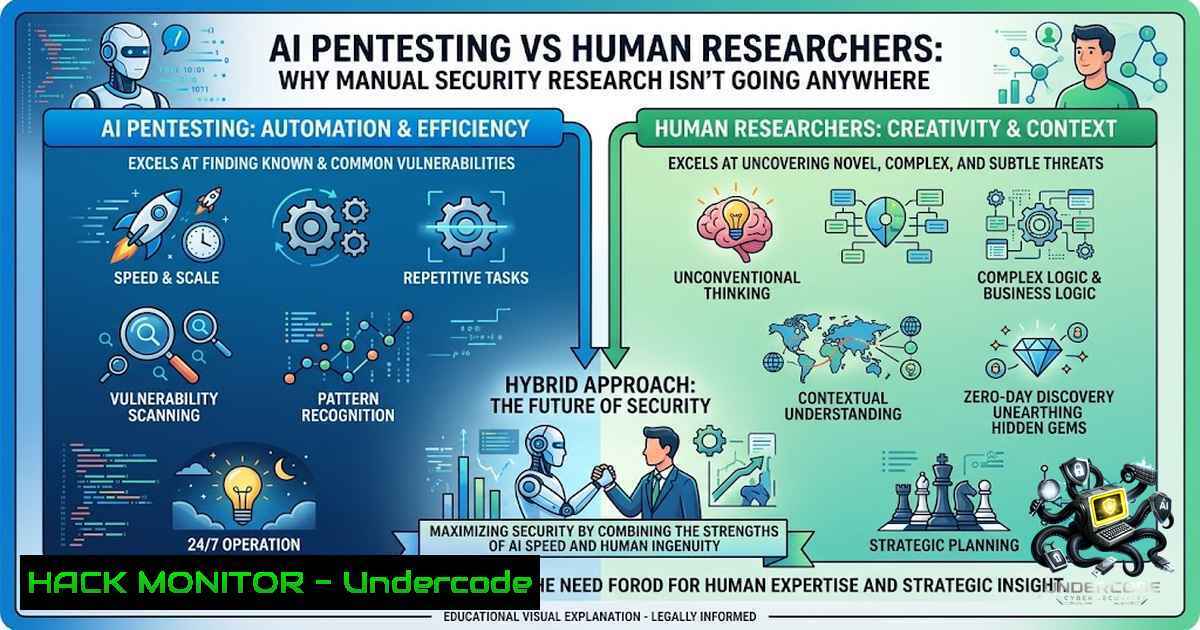
The cybersecurity industry is currently captivated by the capabilities of agentic AI for penetration testing. While these tools are becoming more sophisticated and can effectively automate the discovery of common vulnerabilities and handle extensive reconnaissance, there is a growing concern that they will render human security researchers obsolete. However, real-world data from active bug bounty programs and internal red team exercises suggests that AI is not a replacement but a powerful force multiplier, significantly increasing the efficiency of skilled manual testers rather than diminishing their value.
Learning Objectives & Secrets:
- Objective 1: Understand the current limitations of AI pentesting and why it fails to capture complex business logic flaws that require human intuition.
- Objective 2: Leverage AI as a force multiplier for reconnaissance and automation to prioritize high-value targets for manual testing.
- Objective 3: Integrate AI-assisted findings with manual validation to achieve comprehensive security coverage and uncover new critical vulnerabilities.
You Should Know:
1. Reconnaissance and Target Prioritization Using AI
In modern pentesting, the reconnaissance phase is often the most time-consuming. AI excels at automating this, allowing a manual tester to focus on the core aspects of the attack surface. Instead of spending hours enumerating subdomains or analyzing JavaScript files, researchers can use AI tools to aggregate and correlate data.
Step‑by‑step guide:
- Linux Recon Command: Use `subfinder` combined with `httpx` to quickly discover live assets.
subfinder -d target.com -silent | httpx -silent -title -status-code -tech-detect
- AI-Assisted Analysis: Feed the output of your initial scan into an AI prompt asking for a summary of technologies used and potential attack vectors. This provides a prioritized list of targets.
- Windows Tooling: For Windows environments, utilize tools like `BloodHound` to map AD attack paths. AI can help parse the massive JSON data to suggest the most efficient route to Domain Admin.
2. Manual Verification of AI-Generated Findings
AI is excellent at identifying low-hanging fruit—like outdated SSL certificates, common misconfigurations, or default credentials. However, it often suffers from high false positive rates. A human eye is still necessary to verify if a reported vulnerability is genuinely exploitable in the context of the application’s logic. This manual validation stage is where the real expertise comes into play and ensures that development teams aren’t wasting time on irrelevant findings.
Step‑by‑step guide:
- Verify XSS: If AI reports a Cross-Site Scripting (XSS) vulnerability, validate it manually by checking if the application has a Content Security Policy (CSP) that might block the execution.
- Command Injection: Test for command injection by attempting a benign ping command. For Linux:
; ping -c 2 attacker.com. For Windows:& ping -1 2 attacker.com. - Authentication Bypass: Manually review the API endpoints using Burp Suite to replicate the attack AI is suggesting.
3. Advanced Business Logic Exploitation
The most critical vulnerabilities often reside in business logic errors. These are flaws in the application’s design and workflow that AI cannot typically reason about. For example, an AI might find a price parameter in a shopping cart, but a human needs to understand the discount eligibility rules to manipulate the price in a way that bypasses the server-side checks. This deep understanding of context is currently exclusively a human domain.
Step‑by‑step guide:
- Scenario Analysis: Map out the state machine of the application. Identify the role hierarchy and look for privilege escalation points.
- Methodology: Use tools like `ffuf` or `Burp Intruder` to test for IDORs (Insecure Direct Object References).
- Expert Tip: A skilled hacker will use AI to identify the parameters (e.g., UUIDs or incrementing IDs) and then use manual Burp Repeater requests to test if other users’ data can be accessed by simply changing the ID.
4. Augmenting the Pentest Lifecycle with AI Agents
Integrating Agentic AI into your workflow should be structured. Rather than a one-off test, run AI pentesting throughout the CI/CD pipeline to catch regression vulnerabilities. Then, schedule human-led, focused “Deep Dive” sessions before major releases. This “Shift-Left” approach combined with human-led right-shift validation is the new industry standard.
Step‑by‑step guide:
- AI Pipeline: Integrate `Semgrep` or `CodeQL` in your CI/CD pipeline for static analysis.
- Human Review: Use the SAST findings generated by these tools to guide manual penetration testing.
- Code Review: Use tools like `GitGuardian` or `TruffleHog` to automatically scan for secrets.
5. Bugcrowd and Crowdsourced Security Perspective
The post highlights a key metric: submissions to Bugcrowd did not decrease post-AI pentesting; they increased. This indicates that AI helps researchers get a baseline quickly, but the “lived experience” of a human tester is irreplaceable. This reinforces that companies should not rely solely on AI and should diversify their security testing strategies to include crowdsourced models.
Step‑by‑step guide:
- Setting up a Program: Define clear scope and out-of-scope rules.
- Integration: Utilize Bugcrowd’s API to funnel human findings directly into your ticketing system.
- Analysis: Correlate AI findings with Bugcrowd reports to identify coverage gaps.
- API Security and Cloud Hardening in the AI Era
Modern applications are heavily reliant on APIs and cloud infrastructure. AI tools often miss complex misconfigurations in cloud IAM roles (e.g., overprivileged Lambda roles). A manual pentester will test for parameter pollution, OAuth misconfigurations, and JWT weaknesses using tools like jwt_tool.
Step‑by‑step guide:
- IAM Analysis: Use `Pacu` (AWS) or `Scout Suite` to scan for misconfigurations.
- JWT Testing: Decode JWT tokens and test for algorithm confusion or weak secrets.
- Command: `jwt_tool -t token -algo none` to test the “none” algorithm bypass.
- The Defensive Side: Integrating AI into Blue Teaming
It’s not just about attack. AI can be used defensively to parse logs and look for indicators of compromise (IoC). Attackers are using AI to generate polymorphic malware; defenders must use AI to detect anomalies. This creates a symbiotic relationship where the human analyst validates AI alerts and investigates the contextual nuance of an attack.
Step‑by‑step guide:
- Log Analysis: Use `grep` and `awk` on Linux to extract meaningful data from logs.
- AI Analysis: Feed suspicious shell commands into an AI model to determine if it’s malicious.
- Windows PowerShell: Use `Get-WinEvent` to filter Event Viewer logs for specific event IDs (e.g., 4624 for logons).
What Undercode Say:
- Key Takeaway 1: AI pentesting should be viewed as a high-priced, continuous “initial assessment” that handles the heavy lifting of reconnaissance and basic compliance checks, but it does not replace the need for a human brain.
- Key Takeaway 2: For security researchers, this is a golden era. By integrating AI into your workflow, you can become significantly more efficient, clearing the path for you to focus on complex, critical, and high-payout vulnerabilities that AI cannot touch.
The analysis of the original post reveals a critical economic and technical truth: manual security research is the most valuable asset in the cybersecurity industry. AI reduces the time to identify common vulnerabilities, but the complex, business-impacting flaws are found through human “bug hunting” intuition. The author of the post has validated this through real-world metrics from Bugcrowd and his own internal red teaming experience. The idea that AI will replace humans is a fallacy that stems from misunderstanding the nature of security as a “problem of reasoning” rather than a “problem of pattern recognition.”
Prediction:
- +1 The market for hybrid testing (AI + Human) will explode, leading to a premium for security firms offering “Human-Assisted AI” reports that combine speed with deep contextual analysis.
- +1 The role of the security researcher will evolve into an “AI Handler” where the primary skill is not knowing how to run a tool, but how to prompt an AI and validate its outputs to discover complex logic errors.
- -1 Organizations that solely rely on AI pentesting will face significant security breaches due to their inability to adapt to dynamic attack surfaces and advanced persistent threats.
- -1 The rapid adoption of AI will create a new wave of sophisticated AI-generated malware, making the role of the human analyst more critical for anomaly detection and incident response, not less.
- +1 Bug bounty programs will increasingly integrate AI as a first pass, saving budget for human rewards on genuinely critical findings, thereby increasing payouts and researcher motivation.
▶️ Related Video (84% Match):
🎯Let’s Practice For Free:
🎓 Live Courses & Certifications:
Join Undercode Academy for Verified Certifications
🚀 Request a Custom Project:
Secure, high-velocity infrastructure and disruptive technological engineering. Contact our engineering team for high-tier development and proprietary systems:
[email protected]
💎 Smart Architecture | 🛡️ Secure by Design | ⭐ Trusted by Thousands
IT/Security Reporter URL:
Reported By: https://lnkd.in/p/ewKETFQT – Hackers Feeds
Extra Hub: Undercode MoN
Basic Verification: Pass ✅


