Listen to this Post
Introduction
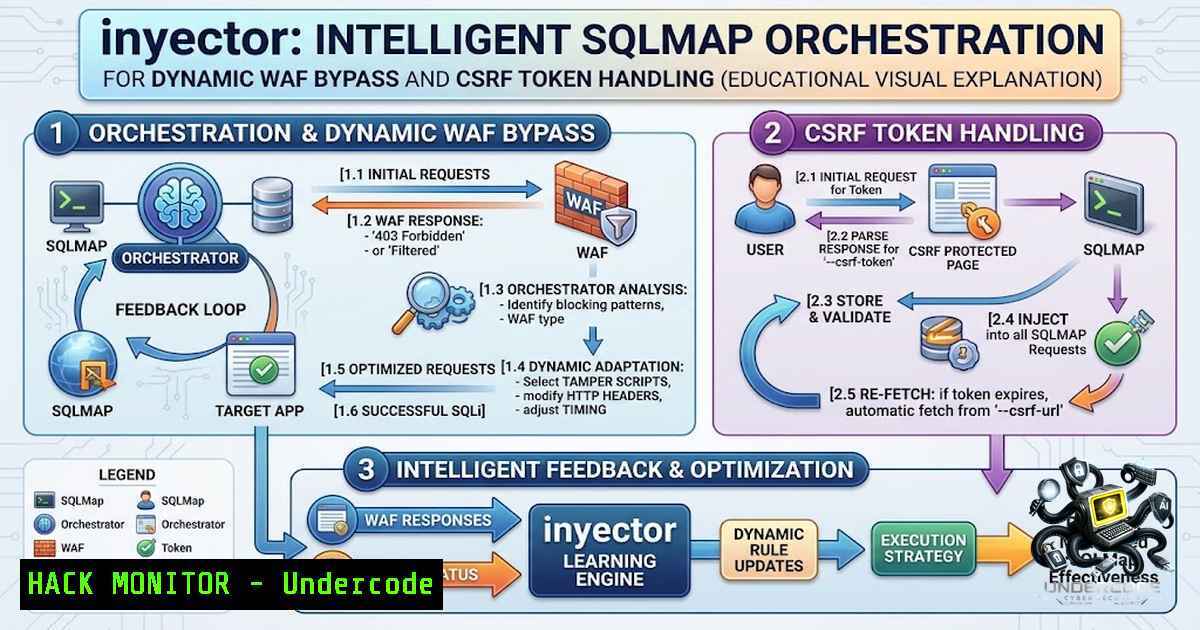
SQL injection remains one of the most critical vulnerabilities in web applications, yet the gap between identifying potential entry points and successfully exploiting them continues to widen due to evolving Web Application Firewalls (WAFs) and complex session management mechanisms. Traditional approaches like running sqlmap with generic configurations often fail against modern defenses, wasting valuable penetration testing time and potentially alerting security teams prematurely. The newly released open-source tool “inyector” addresses this challenge by implementing intelligent reconnaissance and dynamic configuration orchestration, transforming sqlmap from a powerful but often-misconfigured utility into a precision instrument that adapts to each target’s unique security posture before launching any attack.
Learning Objectives & Secrets
- Objective 1: Automated WAF Fingerprinting and Bypass Strategy Selection – Learn how inyector performs real-time WAF detection through behavioral analysis, testing multiple mutation techniques against the target’s specific response patterns rather than relying on generic bypass lists, dramatically increasing success rates against both known and unknown WAF vendors.
-
Objective 2: Dynamic CSRF and Session Token Management – Master the tool’s ability to automatically identify and refresh single-use tokens like __VIEWSTATE, anti-CSRF tokens, and session identifiers before each request, solving the primary failure point that breaks most automated SQL injection attempts against authenticated applications.
-
Objective 3: Intelligent Data Enumeration with Automatic Retry Logic – Understand how inyector transitions from vulnerability confirmation to systematic data extraction, implementing exponential backoff retry mechanisms when rate limiting is detected, ensuring complete data recovery even from unstable or heavily protected targets.
You Should Know
1. WAF Discovery and Bypass Through Behavioral Analysis
The core differentiator of inyector lies in its approach to WAF bypass. Instead of maintaining a static list of WAF signatures or relying on community-updated fingerprints, the tool actively probes the target using controlled payloads to map the WAF’s behavior pattern. This live discovery process tests multiple mutation strategies—including case randomization, comment insertion, encoding variations (URL, Unicode, Hex), and HTTP parameter pollution—observing which combinations successfully evade detection for that specific endpoint.
Step‑by‑step guide to understanding the WAF bypass discovery process:
- Initial Reconnaissance: Inyector begins by sending benign requests to establish baseline responses, collecting HTTP headers, cookies, and response times. This baseline becomes the reference point for detecting WAF interference.
-
Fingerprinting Phase: The tool injects known benign test vectors like “AND 1=1” variations, each with different encoding schemes and structural mutations, monitoring which are blocked and which pass through.
-
Mutation Mapping: For each successful bypass discovered, inyector documents the specific mutation technique and applies it systematically to subsequent attack payloads. If a WAF vendor is identified (e.g., Cloudflare, AWS WAF, ModSecurity), the tool references known bypass patterns for that specific vendor as an initial seed set.
-
Configuration Optimization: Using the successful bypass techniques, sqlmap is configured with appropriate `–tamper` options, `–delay` settings to avoid rate limiting, and `–random-agent` parameters that match the observed target environment.
Docker command to launch inyector with WAF detection:
docker run -it --rm -v $(pwd)/output:/output inyector \
--url "https://target.com/vulnerable.php?id=1" \
--waf-discovery \
--output-format html
Linux/WSL command to monitor network traffic during testing:
sudo tcpdump -i eth0 -w capture.pcap host target.com
Windows PowerShell equivalent for network monitoring:
Start-1etEventSession -1ame "Capture" -CaptureMode SaveToFile -LocalFilePath "capture.etl"
2. Automatic CSRF and Session Token Refresh Mechanism
Modern web applications frequently implement anti-CSRF tokens and dynamic session identifiers that change with each request, rendering traditional static parameter approaches ineffective. Inyector solves this through intelligent field detection and dynamic token refresh logic.
Step‑by‑step guide to understanding token handling:
- Field Detection: The tool scans target HTML responses for common token patterns including
__VIEWSTATE,__EVENTVALIDATION,csrf_token,authenticity_token, and variations ofsession_id. Custom regular expressions can be user-defined for proprietary implementations. -
Token Extraction Pipeline: For each detected field, inyector creates a pre-request hook that executes before every sqlmap payload delivery, fetching fresh tokens from the target and injecting them into the request parameters.
-
State Management: The tool maintains session state across requests, handling cookie rotation and referrer headers appropriately to mimic legitimate user behavior, reducing the likelihood of triggering behavioral WAF rules.
-
Advanced Filtering: For complex applications, inyector can parse JavaScript-generated tokens through headless browser integration, ensuring even the most sophisticated client-side token generation mechanisms are supported.
Configuration example for custom token extraction:
token_detection:
fields:
- name: "csrf_token"
selector: "input[name='csrf_token']"
attribute: "value"
- name: "viewstate"
selector: "input[name='__VIEWSTATE']"
attribute: "value"
refresh_interval: 2
max_retries: 5
3. Data Enumeration with Automatic Retry and Recovery
Unlike traditional sqlmap execution that halts on timeout or error, inyector implements robust error handling and retry logic with exponential backoff, ensuring complete data extraction even from unstable or heavily protected targets. The tool distinguishes between transient failures (rate limiting, temporary timeouts, connection resets) and permanent failures (no injection path exists), retrying only the former while reporting accurate results.
Step‑by‑step guide to data enumeration configuration:
- Vulnerability Confirmation: After a successful injection point is identified, the tool confirms the vulnerability by extracting a small sample like database version or current user.
-
Enumeration Strategy Selection: Based on the database backend (MySQL, PostgreSQL, Oracle, SQL Server) and ORM detected, the tool selects optimal sqlmap enumeration techniques—UNION query, error-based, boolean-blind, time-blind, or stacked queries.
-
Adaptive Threading: Inyector dynamically adjusts thread count and delay intervals based on observed response times and rate limit detection, implementing a sliding window approach to maintain persistence without overwhelming the target.
-
Incremental Extraction: Data is extracted in chunks, with each chunk validated before proceeding, and partial results are saved incrementally, preventing data loss from unexpected interruptions.
Basic sqlmap execution via inyector with automatic retry:
docker run -it --rm -v $(pwd)/output:/output inyector \
--url "https://target.com/vulnerable.php?id=1" \
--enumerate \
--database-target "mysql" \
--retry-attempts 10 \
--backoff-factor 1.5
Manual sqlmap command for comparison (without orchestration):
sqlmap -u "https://target.com/vulnerable.php?id=1" \
--dbms=mysql \
--level=3 \
--risk=2 \
--threads=5 \
--tamper=space2comment \
--random-agent \
--batch
4. Executive Reporting and Remediation Guidance
One of inyector’s most valuable features is its comprehensive reporting system, generating actionable remediation recommendations based on the detected technology stack and identified vulnerabilities.
Step‑by‑step guide to generating and interpreting reports:
- Stack Detection: Through HTTP headers, HTML meta tags, and error response analysis, inyector identifies the underlying technology stack including web server, programming language, framework, ORM, and database system.
-
Vulnerability Correlation: For each detected vulnerability, the tool maps it to known CWE identifiers and provides specific remediation guidance tailored to the detected stack, such as parameterized query examples in PHP, Java, Python, or Node.js.
-
Report Formats: HTML reports include visual summaries with severity scoring, Markdown reports are suitable for technical documentation, and JSON outputs enable integration with CI/CD pipelines and dashboards.
Example JSON report structure:
{
"target": "https://target.com/vulnerable.php",
"timestamp": "2026-08-18T10:00:00Z",
"detected_stack": {
"web_server": "Apache 2.4.54",
"backend": "PHP 7.4.33",
"framework": "Laravel 8.x",
"database": "MySQL 5.7",
"orm": "Eloquent"
},
"vulnerabilities": [
{
"type": "SQL Injection",
"parameter": "id",
"technique": "boolean_blind",
"cwe": "CWE-89",
"severity": "Critical",
"remediation": "Use Laravel's parameterized queries: DB::select('SELECT  FROM users WHERE id = ?', [$id])"
}
],
"waf_detected": "Cloudflare",
"bypass_techniques_used": ["space2comment", "chardoubleencode", "user_agent_tamper"]
}
Linux command to parse JSON reports and extract critical findings:
cat output/report.json | jq '.vulnerabilities[] | select(.severity=="Critical") | .parameter, .remediation'
5. Docker Deployment and Isolation
Inyector’s containerized approach eliminates dependency conflicts and ensures consistent execution across environments, making it particularly valuable for penetration testing teams working with strict compliance requirements.
Step‑by‑step guide to deploying and running inyector:
- Container Setup: Ensure Docker is installed and running on your system. For Linux systems, verify with
docker --version; for Windows, ensure WSL2 integration is enabled. -
Image Pull: The inyector image is available from the official repository, automatically pulled on first execution.
-
Volume Mounting: Mount a local directory to `/output` within the container to preserve reports and captured data.
-
Execution Parameters: Specify target URL, authentication methods (cookies, headers, basic auth), and operational flags (waf-discovery, enumerate, report-only).
-
Dry-run Mode: For validation without exploitation, use the `–dry-run` flag to test configuration and token handling without executing actual injection payloads.
Full example with authentication and advanced options:
docker run -it --rm -v $(pwd)/output:/output inyector \
--url "https://target.com/dashboard" \
--cookie "PHPSESSID=abc123; csrf_token=xyz789" \
--header "X-API-Key: secret_key_here" \
--method POST \
--data "username=admin&password=test&id=1" \
--waf-discovery \
--enumerate \
--threads 3 \
--delay 2 \
--output-format html,json \
--generate-remediation \
--verbose
Docker cleanup command after testing:
docker system prune -f
6. Operational Security and Responsible Use
Inyector explicitly warns against unauthorized use and implements no “universal bypass” promises—a refreshing honesty in the penetration testing tool market. Understanding the ethical and legal boundaries is paramount for security professionals.
Step‑by‑step guide to responsible deployment:
- Authorization Verification: Before executing any scan, confirm you have explicit written permission from the target organization, specifying scope and testing windows.
-
Environment Configuration: Configure inyector with –scope flag to limit testing to authorized IP ranges and domains, preventing accidental scanning of out-of-scope assets.
-
Rate Limiting: Implement reasonable delay values (default 2 seconds) and thread counts (default 3) to avoid service degradation that could affect production environments.
-
Logging and Audit: Enable detailed logging to maintain audit trails of all activities conducted during the test, essential for compliance with frameworks like PCI-DSS, SOC2, and ISO 27001.
Recommended production testing configuration:
docker run -it --rm -v $(pwd)/output:/output inyector \
--url "https://authorized-target.com/endpoint" \
--scope "authorized-target.com" \
--threads 1 \
--delay 5 \
--max-retries 3 \
--output-format html \
--audit-log /output/audit.log \
--respect-robots
What Undercode Say
- Key Takeaway 1: The shift from static WAF bypass lists to dynamic behavioral discovery represents a significant evolution in automated SQL injection testing, acknowledging that modern WAFs require adaptive, target-specific strategies rather than brute-force shotgun approaches.
-
Key Takeaway 2: Inyector’s honest stance—promising no universal bypass and transparently documenting what works—sets a valuable precedent in the penetration testing ecosystem, encouraging security professionals to prioritize methodology over magic bullets and fostering realistic expectations about tool capabilities.
Analysis: Marco Isidro’s contribution addresses a critical pain point in penetration testing: the disconnect between sqlmap’s raw power and real-world target diversity. By wrapping sqlmap with intelligent reconnaissance, dynamic token management, and adaptive configuration, inyector effectively democratizes advanced SQL injection testing techniques that previously required years of experience to master. The Docker-first approach ensures accessibility across skill levels, while the open-source model promotes community contributions that will likely accelerate WAF bypass innovation. However, the tool’s sophistication also raises concerns about script-kiddie abuse—increased accessibility to advanced injection techniques without corresponding understanding of ethical boundaries. The explicit licensing warnings and responsible use emphasis are crucial mitigations, but the security community must remain vigilant about potential misuse. The remediation-focused reporting adds significant value by moving beyond vulnerability identification toward actionable security improvements, aligning with modern DevSecOps practices where developers need clear, stack-specific guidance to fix issues efficiently.
Prediction
- +1 The open-source nature and community-driven development model will likely accelerate WAF bypass technique discovery, benefiting defensive teams through earlier identification of attack patterns and more robust security testing.
-
+1 The remediation-focused reporting paradigm will foster tighter collaboration between pentesters and development teams, reducing the friction typically associated with vulnerability remediation in CI/CD pipelines.
-
+1 Inyector’s dynamic token handling will become a template for other security testing tools, driving innovation across automated vulnerability assessment tools and improving overall penetration testing efficiency.
-
-1 The sophistication and accessibility of inyector may lower the barrier for malicious actors, potentially increasing the volume of automated SQL injection attacks against unprepared web applications in the short term.
-
-1 Over-reliance on automated tools like inyector without fundamental understanding of SQL injection mechanics could lead to “tool-driven testing” where false positives or improper bypass techniques create security theater rather than genuine security improvements.
▶️ Related Video (84% Match):
https://www.youtube.com/watch?v=2OPVViV-GQk
🎯Let’s Practice For Free:
🎓 Live Courses & Certifications:
Join Undercode Academy for Verified Certifications
🚀 Request a Custom Project:
Secure, high-velocity infrastructure and disruptive technological engineering. Contact our engineering team for high-tier development and proprietary systems:
[email protected]
💎 Smart Architecture | 🛡️ Secure by Design | ⭐ Trusted by Thousands
IT/Security Reporter URL:
Reported By: https://lnkd.in/p/ejkEtMgd – Hackers Feeds
Extra Hub: Undercode MoN
Basic Verification: Pass ✅


