
Listen to this Post
Introduction
Legal drafting represents one of the oldest continuous professional practices, yet it has received remarkably little systematic attention as a discipline in its own right. While law students are taught to think, argue, and research law, they are rarely taught to draft—the skill is absorbed through apprenticeship, imitation, and gradual internalization of conventions. The arrival of artificial intelligence disrupts this architecture at every level, as large language models now generate text that is grammatically correct, stylistically coherent, and superficially indistinguishable from the work of competent lawyers, raising fundamental questions about whether AI is truly “drafting” or performing something entirely different: sophisticated text production that mimics surface features while lacking the underlying legal reasoning that gives legal text its meaning and force.
Learning Objectives
- Understand the architectural nature of legal drafting and how AI disrupts traditional risk allocation methodologies
- Master prompt engineering techniques for AI-assisted contract generation while maintaining legal rigor
- Implement security and validation frameworks for AI-generated legal documents in compliance environments
You Should Know
- Understanding Legal Drafting as Architecture: Risk Allocation and Decision Chains
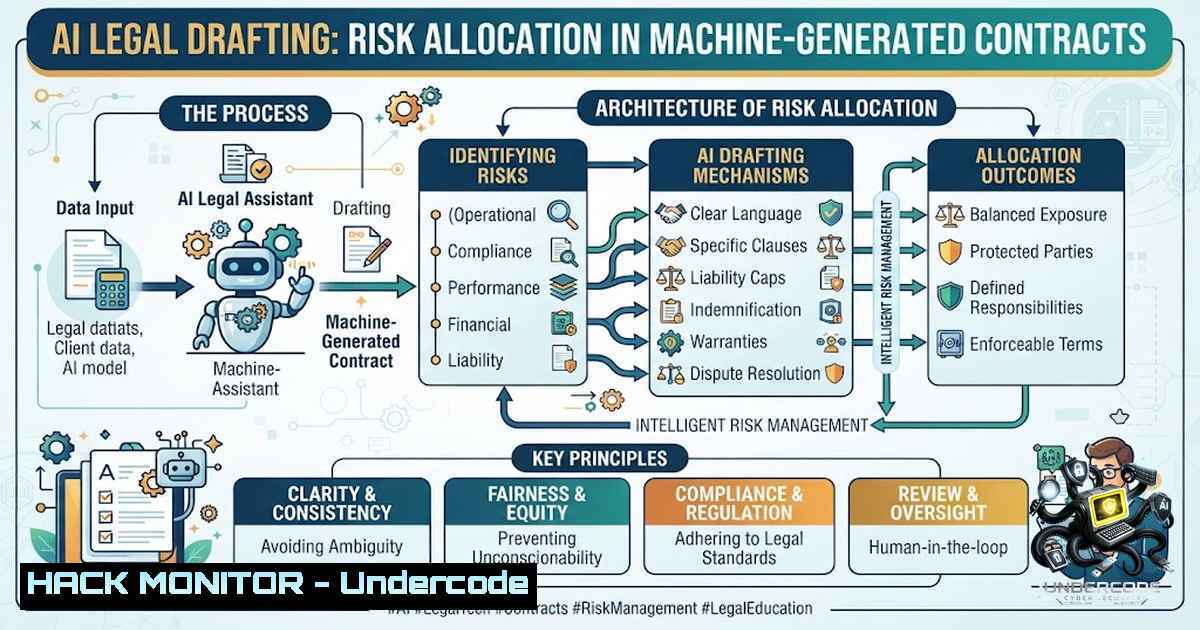
Every clause in a legal document represents a chain of interconnected decisions: which risk to allocate, which scenario to anticipate, which interpretation to foreclose, which default rule to override, and which ambiguity to preserve. The text of a contract is merely the surface of a deep structure of legal reasoning, and the quality of that reasoning determines whether the document will withstand performance, negotiation, and dispute.
When AI generates legal text, it performs pattern recognition and statistical prediction rather than substantive legal analysis. To bridge this gap, practitioners must implement structured validation processes:
Step-by-Step Guide for AI Contract Validation:
- Extract Decision Points: Identify all risk allocation decisions in the generated text and map them to specific clauses
- Apply Default Rule Analysis: Compare AI-generated provisions against applicable default rules using comparative analysis
- Implement Ambiguity Audit: Review all defined terms, cross-references, and conditional language for potential interpretive conflicts
Linux Command for Document Comparison:
 Compare AI-generated contract against template repository
diff -u contract_ai_v1.txt contract_template_2024.txt > contract_changes.diff

Generate hash for document integrity verification
sha256sum contract_final.docx

Extract all defined terms using grep
grep -E '"[A-Z][A-Z_]+"' contract_draft.txt | sort -u > defined_terms.txt
Windows PowerShell Command:
 Compare document versions
Compare-Object -ReferenceObject (Get-Content contract_ai_v1.txt) -DifferenceObject (Get-Content contract_template_2024.txt)

Generate document hash
Get-FileHash contract_final.docx -Algorithm SHA256

Extract defined terms with regex
Select-String -Path contract_draft.txt -Pattern '"[A-Z][A-Z_]+"' | ForEach-Object { $_.Matches.Value } | Sort-Object -Unique > defined_terms.txt
- AI Prompt Engineering for Legal Drafting: Security-First Approaches
Large language models excel at text generation but lack contextual understanding of legal consequences, regulatory compliance, and jurisdictional variations. Effective prompt engineering must incorporate security considerations, data protection requirements, and validation frameworks.
Step-by-Step Security-First Prompt Engineering:
- Sanitize Input Data: Remove all personally identifiable information (PII), confidential business terms, and proprietary data before submitting to AI
- Implement Prompt Templates: Create structured prompts that include jurisdiction, governing law, and mandatory clause requirements
- Apply Context Windows: Provide limited, relevant context rather than full document histories to minimize data exposure
- Validate Output Structure: Implement automated checks for required clauses, definitions, and signature blocks
Example Secure Prompt Template:
[ROLE: Senior Commercial Contracts Lawyer specializing in [bash] law]
[TASK: Draft a [CONTRACT TYPE] agreement for [bash] sector]
[REQUIREMENTS: Include indemnity clause, limitation of liability, confidentiality, termination, and dispute resolution]
[CONSTRAINTS: Maximum liability capped at [bash], jurisdiction [bash], governing law [bash]]
[SECURITY: All data processed in accordance with [DATA PROTECTION STANDARD]]
Python Script for Prompt Sanitization:
import re
import hashlib

def sanitize_legal_prompt(input_text):
 Remove PII patterns
pii_patterns = [
r'\b\d{3}-\d{2}-\d{4}\b',  SSN
r'\b[A-Za-z0-9._%+-]+@[A-Za-z0-9.-]+.[A-Z|a-z]{2,}\b',  Email
r'\b\d{3}.\d{3}.\d{4}\b',  Phone
]

sanitized = input_text
for pattern in pii_patterns:
sanitized = re.sub(pattern, '[bash]', sanitized)

Generate content hash for audit trail
content_hash = hashlib.sha256(sanitized.encode()).hexdigest()

return sanitized, content_hash
- AI Model Selection and Infrastructure Security for Legal Operations
Selecting appropriate AI models for legal drafting requires understanding their security posture, data handling practices, and compliance certifications. Organizations must evaluate model capabilities against requirements for confidentiality, integrity, and availability.
Step-by-Step Model Selection and Security Hardening:
- Conduct Security Assessment: Evaluate model vendor security practices, encryption standards, and data retention policies
- Implement Access Controls: Configure role-based access control (RBAC) for AI drafting tools
- Deploy API Security: Implement API key rotation, rate limiting, and request validation
- Configure Monitoring and Logging: Enable comprehensive audit logging for all AI interactions
Linux Security Hardening Commands:
 Configure firewall rules for AI API access
sudo ufw allow out 443/tcp  Allow HTTPS outbound
sudo ufw deny out 80/tcp  Block unencrypted HTTP

Set up audit logging
sudo auditctl -w /var/log/ai_prompts/ -p wa -k ai_prompt_changes

Monitor API key usage
grep "API_KEY" /var/log/application.log | awk '{print $1, $3, $5}' > api_usage_report.csv

Configure SSL/TLS for internal AI tools
openssl req -x509 -1odes -days 365 -1ewkey rsa:2048 -keyout ai_tool.key -out ai_tool.crt
Windows Security Configuration:
 Configure Windows Firewall for AI tools
New-1etFirewallRule -DisplayName "AI Drafting Tool Outbound" -Direction Outbound -Protocol TCP -LocalPort 443 -Action Allow
New-1etFirewallRule -DisplayName "Block HTTP for AI Tools" -Direction Outbound -Protocol TCP -LocalPort 80 -Action Block

Enable PowerShell logging for security auditing
Set-ItemProperty -Path "HKLM:\SOFTWARE\Policies\Microsoft\Windows\PowerShell\ScriptBlockLogging" -1ame "EnableScriptBlockLogging" -Value 1

Monitor event logs for unauthorized access
Get-WinEvent -LogName Security | Where-Object { $_.Message -match "AI" } | Export-Csv ai_security_events.csv
- API Security and Cloud Hardening for AI Legal Services
Modern AI legal drafting tools often operate through cloud-based APIs, requiring robust security configurations to protect sensitive legal data in transit and at rest.
Step-by-Step API Security Implementation:
- Configure API Authentication: Implement OAuth 2.0 or API key authentication with scope limitations
- Enable Encryption in Transit: Require TLS 1.3 for all API communications
- Implement Request Validation: Validate all incoming requests for schema compliance and data size limits
- Configure Rate Limiting: Implement rate limiting to prevent abuse and denial-of-service attacks
- Enable Audit Trails: Log all API requests with timestamp, user ID, and request size
API Configuration Commands:
 Configure Nginx for API security
location /api/v1/draft {
limit_req zone=ai_api_zone burst=10;
proxy_set_header X-Real-IP $remote_addr;
proxy_set_header X-Forwarded-For $proxy_add_x_forwarded_for;
proxy_set_header X-Forwarded-Proto $scheme;
proxy_ssl_verify on;
proxy_ssl_verify_depth 2;
proxy_ssl_protocols TLSv1.3;
}

Set up API key rotation script
!/bin/bash
API_KEY=$(openssl rand -base64 32)
echo "New API Key: $API_KEY" | openssl enc -aes-256-cbc -salt -out api_key_encrypted.txt
Python Script for API Validation:
import json
import hashlib
import hmac
import time

class SecureLegalAPI:
def <strong>init</strong>(self, api_key, secret_key):
self.api_key = api_key
self.secret_key = secret_key
self.rate_limit = 100  requests per minute
self.request_count = 0
self.timestamp = int(time.time())

def validate_request(self, request_data):
 Validate schema
required_fields = ['prompt', 'template_type', 'jurisdiction']
for field in required_fields:
if field not in request_data:
raise ValueError(f"Missing required field: {field}")

Size limitation (max 10KB prompts)
if len(json.dumps(request_data)) > 10240:
raise ValueError("Prompt exceeds 10KB limit")

Generate HMAC for request integrity
signature = hmac.new(
self.secret_key.encode(),
json.dumps(request_data).encode(),
hashlib.sha256
).hexdigest()

return signature
5. Vulnerability Exploitation and Mitigation in AI-Generated Contracts
AI-generated contracts can introduce vulnerabilities through hallucinated clauses, incorrect citations, or inconsistent risk allocations. Understanding these vulnerabilities is essential for effective mitigation.
Step-by-Step Vulnerability Assessment:
- Conduct Clause Completeness Audit: Verify all mandatory clauses are present and properly structured
- Implement Cross-Reference Validation: Check that all defined terms are used consistently
- Perform Regulatory Compliance Check: Validate against applicable laws, regulations, and industry standards
- Execute Stress Testing: Review contract under multiple interpretation scenarios
Linux Commands for Vulnerability Scanning:
 Extract and audit clauses
awk '/Indemnity/,/Limitation/' contract_draft.txt > indemnity_clause.txt

Check for undefined terms
grep -oE '[A-Z][A-Z_]+' contract_draft.txt | sort -u > all_defined_terms.txt
diff defined_terms.txt all_defined_terms.txt | grep ">" > undefined_terms.txt

Scan for regulatory references
grep -E 'GDPR|CCPA|HIPAA|FERPA' contract_draft.txt | sort -u > regulatory_mentions.txt

Check for contradictory provisions
grep -A5 -B5 "notwithstanding" contract_draft.txt | grep -v "notwithstanding" > surrounding_text.txt
Python Script for Clause Validation:
import re
from typing import List, Dict

class ContractVulnerabilityScanner:
def <strong>init</strong>(self, contract_text: str):
self.text = contract_text
self.vulnerabilities = []

def check_mandatory_clauses(self, required_clauses: List[bash]) -> Dict[str, bool]:
clause_presence = {}
for clause in required_clauses:
pattern = re.compile(rf'\b{clause}\b', re.IGNORECASE)
clause_presence[bash] = bool(pattern.search(self.text))
if not clause_presence[bash]:
self.vulnerabilities.append(f"Missing mandatory clause: {clause}")
return clause_presence

def check_defined_terms(self) -> List[bash]:
 Extract definitions
definition_pattern = r'"([A-Z][A-Z_]+)"\s+means\s+([^;]+);'
definitions = re.findall(definition_pattern, self.text)
defined_terms = [term for term, _ in definitions]

Check usage of defined terms
undefined_terms = []
for term in re.findall(r'"([A-Z][A-Z_]+)"', self.text):
if term not in defined_terms:
undefined_terms.append(term)

if undefined_terms:
self.vulnerabilities.append(f"Undefined terms detected: {undefined_terms}")
return undefined_terms

def check_contradictory_provisions(self) -> List[bash]:
contradictory_patterns = [
r'\b(exclusive|sole)\s+jurisdiction\b.?',
r'\b(non-exclusive|alternative)\s+jurisdiction\b.?'
]
 Implementation would scan for contradictory provisions
return []
6. AI Data Protection and Privacy Compliance
Legal drafting with AI involves processing sensitive information that may include trade secrets, personal data, and privileged communications. Implementing data protection measures is critical for compliance and risk management.
Step-by-Step Data Protection Implementation:
- Classify Data Sensitivity: Implement data classification framework for legal documents
- Configure Data Masking: Implement automated data masking for sensitive information
- Enable Encryption at Rest: Implement full-disk encryption for storage systems
- Configure Retention Policies: Implement automated document retention and deletion
Linux Commands for Data Protection:
 Implement data classification labels
find /legal_documents -type f -1ame ".docx" -exec chattr +i {} \;

Configure encrypted filesystem
sudo cryptsetup luksFormat /dev/sdb1
sudo cryptsetup open /dev/sdb1 legal_encryption
sudo mkfs.ext4 /dev/mapper/legal_encryption
sudo mount /dev/mapper/legal_encryption /mnt/legal_documents

Set up automated encryption
echo "0 0    /usr/bin/find /legal_documents -type f -mtime +30 -exec openssl enc -aes-256-cbc -in {} -out {}.enc -kfile /etc/keyfile \; " | crontab -

Configure secure deletion
shred -v -z -1 3 sensitive_document.pdf
Windows PowerShell for Data Protection:
 Enable BitLocker encryption
Enable-BitLocker -MountPoint "C:" -RecoveryPasswordProtector

Set up filesystem permissions
icacls "C:\LegalDocuments" /grant "LegalTeam:(OI)(CI)F" /inheritance:e

Configure data retention policies
Set-FileRetentionPolicy -Path "C:\LegalDocuments" -RetentionPeriod 1095  3 years

Secure deletion using cipher
cipher /w:C:\LegalDocuments
- Implementation and Integration of AI Legal Drafting Workflows
Successful integration of AI into legal drafting workflows requires careful planning, training, and validation processes.
Step-by-Step Workflow Implementation:
- Define Use Cases: Identify appropriate use cases for AI drafting (NDAs, service agreements, employment contracts)
- Configure Integration: Implement secure API integration with existing document management systems
3. Establish Validation Protocols: Implement multi-tier validation processes
- Train Legal Teams: Develop training programs on AI capabilities and limitations
- Monitor and Optimize: Implement continuous monitoring and improvement processes
Integration Script Example:
import requests
import json
from typing import Dict, Optional

class LegalAIIntegration:
def <strong>init</strong>(self, api_endpoint: str, api_key: str):
self.endpoint = api_endpoint
self.headers = {
'Authorization': f'Bearer {api_key}',
'Content-Type': 'application/json'
}

def generate_contract(self, prompt: str, template: str, jurisdiction: str) -> Dict:
payload = {
'prompt': prompt,
'template_type': template,
'jurisdiction': jurisdiction,
'security': {
'encryption': 'TLSv1.3',
'data_masking': True,
'audit_log': True
}
}

response = requests.post(
f"{self.endpoint}/api/v1/draft",
headers=self.headers,
json=payload,
timeout=30
)

if response.status_code == 200:
return response.json()
else:
raise Exception(f"API Error: {response.status_code} - {response.text}")

def validate_generated_contract(self, contract_text: str) -> Dict:
payload = {
'contract_text': contract_text,
'validation_level': 'full',
'check_mandatory_clauses': True,
'check_undefined_terms': True,
'check_regulatory_compliance': True
}

response = requests.post(
f"{self.endpoint}/api/v1/validate",
headers=self.headers,
json=payload,
timeout=60
)

return response.json()
What Undercode Say:
- AI is not drafting; it’s performing sophisticated text production that mimics legal writing while lacking the underlying reasoning, creating a fundamental distinction that legal professionals must understand and address
- The architecture of legal drafting—risk allocation, scenario anticipation, interpretation foreclosure, default rule override, and ambiguity preservation—requires human judgment that current AI systems cannot replicate
- Security and validation frameworks are essential for AI-generated legal documents, requiring multi-layered approaches including encryption, access controls, and automated validation
- The legal profession must reorganize around AI’s capabilities, recognizing it as a powerful tool for efficiency while maintaining human oversight and accountability
- Hybrid approaches combining AI efficiency with human judgment represent the most promising path forward for legal drafting
The integration of AI into legal drafting presents both unprecedented opportunities and significant challenges. While AI can dramatically improve efficiency and consistency in contract generation, it cannot replace the deep legal reasoning, risk assessment, and strategic judgment that define expert legal practice. The future of legal drafting lies not in choosing between human and AI capabilities, but in developing sophisticated workflows that leverage each effectively. Organizations must invest in comprehensive security frameworks, validation protocols, and training programs to ensure AI-generated documents meet professional standards and regulatory requirements.
Prediction:
- +1 AI will transform legal drafting from an art to a science, with standardized frameworks and validation protocols becoming industry standard, reducing transaction costs and improving contract quality
- +1 The demand for hybrid legal professionals—combining traditional legal expertise with AI literacy and cybersecurity knowledge—will grow significantly over the next five years
- -1 Organizations that fail to implement robust security frameworks for AI legal tools will face increased exposure to data breaches, contract disputes, and regulatory penalties
- +1 AI-powered legal drafting will democratize access to sophisticated legal documents, potentially reducing the cost of legal services for small businesses and individuals
- -1 The risk of AI-generated contracts with undetected vulnerabilities, regulatory non-compliance, or inconsistent risk allocations may lead to increased litigation and liability exposure
- +1 Legal education will need to evolve to include AI literacy, drafting technologies, and cybersecurity competencies as core curriculum requirements
- -1 Over-reliance on AI-generated contracts without proper validation may lead to degradation of core legal drafting skills among junior lawyers, creating long-term capability gaps
- +1 Integration of AI drafting with blockchain-based document verification and smart contract execution may create entirely new legal service delivery models
- -1 The legal profession’s current unpreparedness for AI integration may lead to competitive advantages for early adopters and significant disadvantages for laggards
- +1 The development of industry-specific AI drafting templates and validation frameworks will create new market opportunities for legal technology providers
▶️ Related Video (84% Match):
🎯Let’s Practice For Free:
🎓 Live Courses & Certifications:
Join Undercode Academy for Verified Certifications
🚀 Request a Custom Project:
Secure, high-velocity infrastructure and disruptive technological engineering. Contact our engineering team for high-tier development and proprietary systems:
[email protected]
💎 Smart Architecture | 🛡️ Secure by Design | ⭐ Trusted by Thousands
IT/Security Reporter URL:
Reported By: Jana Ayman – Hackers Feeds
Extra Hub: Undercode MoN
Basic Verification: Pass ✅


