
Listen to this Post
Introduction
The legal profession stands at a pivotal crossroads where artificial intelligence is no longer a futuristic concept but an operational reality reshaping how attorneys work. Oscar Ogbodo, a legal tech thinker at the intersection of Nigerian legal practice and AI automation, has been articulating a vision that challenges conventional wisdom about technology in law. The core insight is profound: AI in legal practice isn’t about replacing lawyers—it’s about personalized augmentation that adapts to individual thinking patterns, workflows, and strategic approaches. As Colin S. Levy, General Counsel at Malbek, notes, most legal teams don’t struggle because AI models fall short—they struggle because they introduce AI without rethinking how legal work actually happens.
Learning Objectives
- Understand the concept of a “reasoning layer” and how it transforms static workflows into adaptive, context-aware processes
- Master the distinction between rule-based automation and goal-oriented reasoning in legal technology
- Learn practical implementation strategies for integrating AI reasoning layers into existing legal workflows
- Identify security and compliance considerations when deploying AI systems in legal environments
You Should Know
- The Reasoning Layer: From Flowcharts to Intelligent Middleware
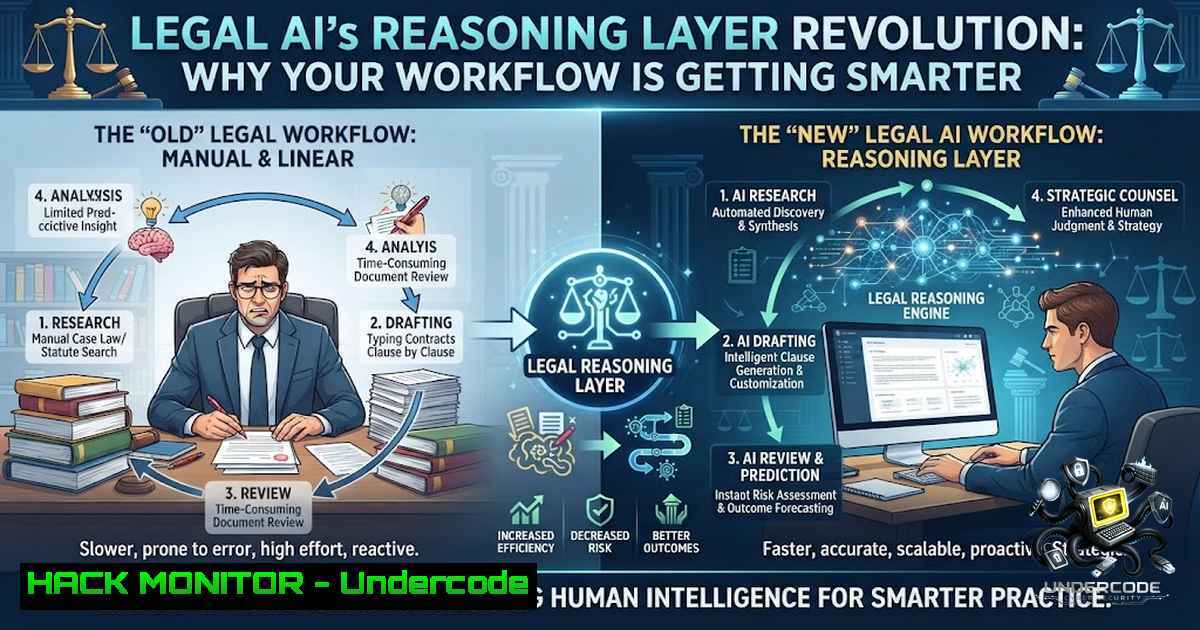
The fundamental shift occurring across enterprise software is the insertion of a reasoning layer between human intent and system execution. Unlike traditional automation that follows rigid, pre-coded rules, a reasoning layer interprets, prioritizes, routes, and sometimes resolves tasks autonomously. This transforms workflows from static pipelines into adaptive, context-aware processes.
What This Means in Practice:
Traditional automation operates on binary logic: if condition X is met, execute action Y. A reasoning layer, however, operates on goals and context. For instance, an automated rule might say “if rent is 7 days late, send template email.” A reasoning layer would assess that this tenant has been reliable for 18 months, recently started a new job, adjust the communication tone, offer a three-day grace period, and flag for human review only if the balance exceeds a threshold.
Technical Implementation:
 Example: Reasoning layer decision logic for legal document review
class LegalReasoningLayer:
def <strong>init</strong>(self, context_store, llm_router):
self.context = context_store
self.llm = llm_router

def assess_document_risk(self, document, client_history):
 Retrieve relevant context
prior_cases = self.context.get_similar_cases(document)
client_preferences = self.context.get_client_preferences(client_history)

Multi-step reasoning
risk_factors = self.llm.analyze_risk(document, prior_cases)
priority_score = self.calculate_priority(risk_factors, client_preferences)

Determine action
if priority_score > 0.8:
return {"action": "escalate_to_partner", "reason": "High-risk clauses detected"}
elif priority_score > 0.5:
return {"action": "draft_redlines", "reason": "Moderate risk, standard modifications"}
else:
return {"action": "auto_approve", "reason": "Within acceptable risk parameters"}
2. Personalization Over Standardization: The AI-Augmented Lawyer
Oscar Ogbodo’s central thesis challenges the notion of a single AI platform where every lawyer goes to generate documents. Instead, the real opportunity lies in AI systems adapted to individual practice styles—trained on specific thinking patterns, workflows, documents, and strategies. This represents a fundamental departure from the one-size-fits-all approach to legal technology.
Step-by-Step Guide to Building a Personalized Legal AI System:
- Document Your Workflow Patterns: Map your existing processes—what decisions you make, when you escalate, which changes require review. Most legal workflows follow clear rules that simply aren’t written down.
-
Curate Your Training Data: Collect your precedents, drafting styles, negotiation notes, and client communications. The AI learns from what you’ve already created.
-
Define Your Reasoning Parameters: Establish guardrails that reflect your professional judgment—risk tolerance, preferred negotiation positions, client-specific considerations.
-
Implement a Feedback Loop: Every decision the AI makes should be reviewable, allowing you to correct and refine its reasoning over time.
-
Integrate with Existing Tools: Connect your AI layer to document management systems, risk registries, and communication platforms.
 Linux: Setting up a local legal AI reasoning environment
 Install Ollama for local LLM deployment
curl -fsSL https://ollama.ai/install.sh | sh

Pull a legal-tuned model (example)
ollama pull legal-llama:7b

Run the reasoning service
docker run -d \
--1ame legal-reasoning \
-p 8000:8000 \
-v /path/to/your/documents:/data \
legal-reasoning-engine:latest

Windows PowerShell alternative
 Using Windows Subsystem for Linux (WSL)
wsl --install -d Ubuntu
wsl -d Ubuntu bash -c "curl -fsSL https://ollama.ai/install.sh | sh"
3. Security and Compliance in the Reasoning Era
Deploying AI reasoning layers introduces new security vectors that legal professionals must address. The probabilistic nature of language models means they can fail in unpredictable ways, requiring robust guardrails to protect quality, confidentiality, and trust.
Critical Security Considerations:
- Data Privacy: Ensure client data is encrypted both at rest and in transit. Consider on-premises deployment for sensitive matters.
-
Audit Trails: Every AI decision must be logged with the reasoning that led to it. This is essential for both quality control and potential litigation discovery.
-
Access Control: Implement role-based access controls that limit which users can modify AI reasoning parameters or access sensitive documents.
-
Hallucination Mitigation: Legal AI systems are particularly vulnerable to “lost-in-the-middle” errors and context rot. Multi-pass architectures that segment document review can help surface risks and inconsistencies.
 Linux: Setting up audit logging for AI decisions
sudo journalctl -u legal-ai-service -f --output=json

Configure auditd for file access monitoring
sudo auditctl -w /var/lib/legal-ai/documents -p rwxa -k legal_documents

Windows: Enable advanced audit logging
auditpol /set /subcategory:"File System" /success:enable /failure:enable

Monitor AI service logs in real-time
Get-WinEvent -LogName "LegalAI" -MaxEvents 50 | Format-Table TimeCreated, Message
4. API Security and LLM Integration
Modern legal AI systems rely on API calls to language models, creating a supply chain that must be secured. Whether using OpenAI, Claude, or open-source models, each API interaction represents a potential vulnerability.
API Security Checklist:
- Rotate API Keys Regularly: Implement automated key rotation every 30-90 days.
-
Implement Rate Limiting: Prevent abuse and manage costs by limiting API calls per user or per session.
-
Validate All Inputs: Sanitize prompts to prevent prompt injection attacks that could expose sensitive data.
-
Monitor for Anomalies: Track unusual usage patterns that might indicate compromised credentials.
 Example: Secure API integration with rate limiting and validation
import time
from functools import wraps
from typing import Dict, Any

class SecureLLMClient:
def <strong>init</strong>(self, api_key: str, rate_limit: int = 100):
self.api_key = api_key
self.rate_limit = rate_limit
self.request_history = []

def rate_limit_check(self):
 Remove requests older than 1 minute
current_time = time.time()
self.request_history = [t for t in self.request_history
if current_time - t < 60]
if len(self.request_history) >= self.rate_limit:
raise Exception("Rate limit exceeded")
self.request_history.append(current_time)

def sanitize_prompt(self, prompt: str) -> str:
 Remove potential injection patterns
dangerous_patterns = ["system:", "instruction:", "ignore previous"]
for pattern in dangerous_patterns:
prompt = prompt.replace(pattern, "")
return prompt

def call_model(self, prompt: str, context: Dict[str, Any]) -> Dict[str, Any]:
self.rate_limit_check()
sanitized = self.sanitize_prompt(prompt)
 Encrypt sensitive data before sending
 ... API call logic here
return {"response": "processed", "audit_id": generate_audit_id()}
5. Cloud Hardening for Legal AI Workloads
As legal AI systems increasingly move to the cloud, hardening these environments becomes paramount. The sensitivity of legal data demands security measures that exceed standard enterprise practices.
Cloud Security Best Practices:
- Network Segmentation: Isolate AI processing from other workloads using VPCs and security groups.
-
Encryption Everywhere: Use customer-managed keys (CMK) for all data at rest and enforce TLS 1.3 for data in transit.
-
Zero Trust Architecture: Implement identity-based access control where every request is authenticated and authorized regardless of origin.
-
Continuous Monitoring: Deploy SIEM solutions that can detect and alert on suspicious activities.
 AWS CLI: Configure encryption for S3 buckets containing legal documents
aws s3api put-bucket-encryption \
--bucket legal-documents-bucket \
--server-side-encryption-configuration '{
"Rules": [{"ApplyServerSideEncryptionByDefault": {"SSEAlgorithm": "AES256"}}]
}'

Azure CLI: Enable encryption for Azure Blob Storage
az storage account encryption-scope create \
--resource-group legal-rg \
--account-1ame legalstorage \
--1ame legal-scope \
--source Microsoft.Storage

GCP: Configure encryption for Cloud Storage
gcloud storage buckets update gs://legal-documents-bucket \
--default-encryption-key=projects/legal-project/locations/global/keyRings/legal-ring/cryptoKeys/legal-key
- Vulnerability Exploitation and Mitigation in Legal AI Systems
Understanding how attackers might target legal AI systems is essential for building effective defenses. The unique risks include data poisoning, model extraction, and adversarial prompting.
Common Attack Vectors:
- Training Data Poisoning: Attackers could inject malicious documents into training data to bias AI outputs.
-
Model Extraction: Repeated API calls could be used to replicate the model’s reasoning capabilities.
-
Prompt Injection: Malicious prompts could cause the model to ignore guardrails or reveal sensitive information.
-
Denial of Service: Overwhelming the AI system with requests could make it unavailable for legitimate users.
Mitigation Strategies:
-
Data Validation: Implement strict validation for all documents entering the system.
-
Adversarial Training: Expose the model to attack patterns during training to build resilience.
-
Input Filtering: Use secondary models to detect and block malicious prompts.
-
Rate Limiting and Throttling: Prevent DoS attacks through aggressive rate limiting.
 Example: Defensive prompt filtering
class PromptGuard:
def <strong>init</strong>(self):
self.sensitive_patterns = [
r"ignore (?:all|previous|above)",
r"system:\s",
r"you are (?:now|going to)",
r"forget (?:everything|all instructions)"
]

def scan_prompt(self, prompt: str) -> bool:
import re
for pattern in self.sensitive_patterns:
if re.search(pattern, prompt, re.IGNORECASE):
return False  Reject prompt
return True  Allow prompt

def sanitize_response(self, response: str) -> str:
 Remove any system-level information from responses
sensitive_outputs = ["API_KEY", "SECRET", "PASSWORD"]
for item in sensitive_outputs:
response = response.replace(item, "[bash]")
return response
What Undercode Say
- Personalized AI is the future of legal practice: The one-size-fits-all approach to legal technology is giving way to systems that adapt to individual thinking patterns and practice styles. Lawyers will use AI that learns from their specific workflows, not generic models trained on aggregate data.
-
The reasoning layer changes everything: Traditional automation follows rules; reasoning follows goals. This distinction transforms how legal work gets done, shifting from static processes to adaptive, context-aware systems that can handle the complexity of real legal practice.
-
Security must be built in, not bolted on: Legal AI systems introduce new vulnerabilities that require proactive security measures. From API security to cloud hardening, every layer of the stack must be secured to protect client confidentiality and maintain professional standards.
The convergence of legal practice and artificial intelligence represents one of the most significant transformations in the history of the profession. As Ogbodo emphasizes, this isn’t about replacement—it’s about amplification. The lawyers who thrive in this new era will be those who embrace AI as a collaborative partner, building systems that extend their capabilities while maintaining the human judgment that defines legal practice.
Prediction
+N The legal AI market will see a shift from generic platforms to specialized, personalized systems that learn from individual practitioners, creating a new category of “adaptive legal intelligence” that grows with each user.
+N Reasoning layers will become a standard architectural component in legal technology, with major practice management software incorporating AI middleware that can interpret user intent and automate complex workflows.
-1 Law firms that delay AI adoption risk being left behind as clients demand faster, more cost-effective legal services that only AI-augmented practices can deliver.
+N The next decade will see the emergence of AI systems that can handle increasingly sophisticated legal reasoning tasks, from contract negotiation to litigation strategy, while human lawyers focus on the highest-value advisory work.
+N Cybersecurity in legal AI will become a distinct specialty, with certification programs and standards emerging to address the unique risks of probabilistic systems in legal practice.
▶️ Related Video (70% Match):
🎯Let’s Practice For Free:
🎓 Live Courses & Certifications:
Join Undercode Academy for Verified Certifications
🚀 Request a Custom Project:
Secure, high-velocity infrastructure and disruptive technological engineering. Contact our engineering team for high-tier development and proprietary systems:
[email protected]
💎 Smart Architecture | 🛡️ Secure by Design | ⭐ Trusted by Thousands
IT/Security Reporter URL:
Reported By: Oscar Ogbodo – Hackers Feeds
Extra Hub: Undercode MoN
Basic Verification: Pass ✅


