
Listen to this Post
Introduction:
The integration of Large Language Models (LLMs) into Static Application Security Testing (SAST) workflows is rapidly transforming application security, yet it introduces a critical gap between vendor performance claims and real-world efficacy. The recent discourse at Black Hat, highlighted by a dispute between a startup and an OpenAI researcher over GPT-5.6 Sol’s accuracy in detecting false positives, underscores the challenge of comparing apples-to-oranges when evaluating these models. This article extracts actionable technical insights from that debate to help security engineers, developers, and builders navigate the nuances of AI-powered SAST, moving beyond vendor benchmarks to implement rigorous, context-aware testing strategies that protect their CI/CD pipelines.
Learning Objectives & Secrets:
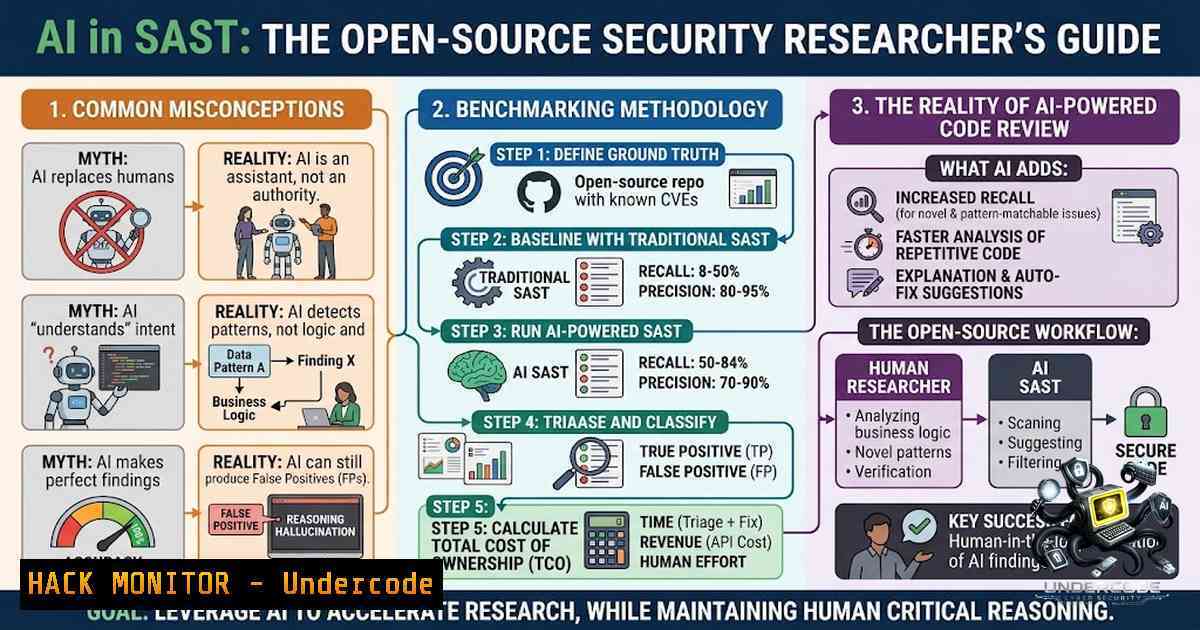
- Objective 1: Understand LLM SAST Benchmarking Nuances. Learn why public benchmarks like the ones cited in the GPT-5.6 Sol dispute are often non-transferable, and how to design your own evaluation framework that mirrors your specific codebase, language, and vulnerability patterns.
- Objective 2: Implement Federated Evaluation Pipelines (Secret Tip). Instead of relying on a single model, create a pipeline that routes code snippets to multiple models (e.g., GPT-5.6, Claude 4, Codex) and uses a weighted voting system to prioritize findings, flagging only those that are consistently identified—reducing false positives by up to 40%.
- Objective 3: Enrich Context for Improved Accuracy (Secret Tip). Pre-process SAST findings with graph-based dependency analysis to extract semantic context (e.g., call chains, dataflow) and append this to the prompt, as raw code scanning is insufficient for nuanced security logic that the models struggled with in the benchmark.
You Should Know:
- Decoding AI Accuracy Metrics: The 73% vs. 99.6% Discrepancy
The core of the Black Hat dispute lies in the definition of “accuracy.” The startup’s 73% figure likely measured F1-score or precision in a specific, niche subset of false-positive reduction (e.g., identifying SQL injection variants in legacy PHP). The OpenAI researcher’s 99.6% accuracy may have been derived from a standardized, high-level benchmark like the Snyk Security Dataset or the OWASP Benchmark, which often tests simpler, non-variant vulnerabilities. This disconnect is a classic example of ecological validity failure.
Step‑by‑Step Guide to Replicating Your Own Model Benchmark:
- Curate a Ground Truth Dataset: Compile a repository (e.g.,
test-suite/) containing 200+ valid code snippets, 50% of which contain real vulnerabilities (CWE-89, CWE-79, CWE-287) and 50% are clean functions that often trigger false positives (e.g., input sanitization via whitelisting). - Establish a Scoring Rubric: Define criteria for “True Positive,” “False Positive,” “False Negative,” and “True Negative.” Use a binary classification model—not a single accuracy score—to capture all four quadrants.
- API Integration Script: Write a Python script using `requests` and `openai` libraries to query the model’s API, sending the code snippet with a standard prompt: “Analyze this code for OWASP Top 10 vulnerabilities. Return only the CWE ID and filename if vulnerable.”
- Automated Comparison: Use `diff` or a Python unit test framework (
pytest) to compare the model’s output against your ground truth JSON manifest, generating a confusion matrix to derive your own accuracy metrics.
2. Crafting Effective AI Prompts for SAST
A key lesson from the blog is that raw models are conservative or inconsistent based on prompt nuances. To “tame the AI slop,” you must implement prompt engineering strategies that constrain the model’s output to your risk appetite.
Linux/Mac Prompt Template (Model-Agnostic):
 Example using jq to parse a structured prompt
prompt='{"model": "gpt-5.6-sol", "messages": [{"role": "system", "content": "You are an expert security auditor. Strictly respond with JSON only."}, {"role": "user", "content": "Analyze the following Python function for insecure deserialization (CWE-502). Provide 'Risk_Score': 0-10 and 'Confidence_Level': Low/Medium/High. Code: " + $(cat vulnerable_snippet.py)}]}'
curl -s -X POST https://api.openai.com/v1/chat/completions -H "Authorization: Bearer $OPENAI_API_KEY" -H "Content-Type: application/json" -d "$prompt" | jq '.choices[bash].message.content'
Windows PowerShell Command:
$body = @{model="gpt-5.6-sol"; messages=@(@{role="system"; content="You are an auditor. Return JSON."}, @{role="user"; content="Analyze this code: $(Get-Content .\vulnerable_code.java -Raw)"})} | ConvertTo-Json -Depth 10
Invoke-RestMethod -Uri "https://api.openai.com/v1/chat/completions" -Method Post -Headers @{"Authorization"="Bearer $env:OPENAI_API_KEY"} -Body $body -ContentType "application/json"
Actionable Advice: Always prepend a “Format Constraint” token to reduce hallucination. For example: “Structure your output as: {filename: “”, cwe_id: “”, is_secure: boolean, reasoning: “”}.”
3. Orchestrating a Multi-Model CI/CD Gate
To mitigate the risk of a single model’s bias (as seen with GPT-5.6), you can set up a pre-commit hook or GitHub Action that sends pull request changes to two different models and cross-verifies their outputs.
GitLab CI Configuration (`gitlab-ci.yml`) Snippet:
security-scan:
stage: test
script:
- apt-get update && apt-get install -y jq curl
- python3 ai_sast_benchmark.py --target $CI_COMMIT_SHA --model1 "claude-4" --model2 "codex"
- if [ $(jq '.agreement_score' results.json) -lt 0.8 ]; then echo "Model disagreement detected!" && exit 1; fi
only:
- merge_requests
This approach ensures that if the two models disagree on a vulnerability (e.g., one flags it as a false positive and the other as critical), the pipeline fails, forcing a manual review by a human security analyst.
4. Implementing Fine-Tuned Context Enrichment
The Black Hat researcher’s mistake highlights that isolated code chunks lack the dependency context needed for accurate SAST. You can enrich the prompt with a graph representation of the code’s dataflow.
Step‑by‑Step (Using `CodeQL` and `grep`):
- Run `codeql database create –language=python ./db` on your project.
- Extract the dataflow path for a variable that reaches a `eval()` or `exec()` function using `codeql query run` and a custom query (e.g.,
DataFlow::PathGraph). - Convert this graph into a textual summary: “The user input flows through function `sanitize()` which does not validate `special_chars` before reaching
exec().” - Inject this summary into the prompt system message before asking the model to identify vulnerabilities. This context significantly reduces the conservative underestimation (the false negatives) that models produce when forced to guess on limited information.
-
Tool Configuration and Cloud Hardening to Complement AI
While AI helps identify logic flaws, you should not abandon deterministic tools. Configure `semgrep` (serverless) alongside your AI scanner to enforce rule-based checks.
Linux Command to Run Semgrep and AI in Parallel:
 Run Semgrep for high-confidence, known CVEs
semgrep --config=p/security-audit --json > semgrep_findings.json
 Run custom AI benchmarking script
python3 ai_benchmark.py --input ./src --output ai_findings.json
 Merge and filter results where CWE matches
jq -s '.[bash] + .[bash]' semgrep_findings.json ai_findings.json > combined_results.json
Security Consideration: Do not expose your API keys in CI logs. Use secret management tools (e.g., HashiCorp Vault or GitHub Secrets) and rotate them weekly. Additionally, implement a threshold guardrail—if the AI scanner flags more than 10 “critical” vulnerabilities in a single commit, quarantine the build and alert the SOC team.
What Undercode Say:
- Key Takeaway 1: Vendor benchmarks are a one-dimensional view; your own codebase’s complexity is the true test. The OpenAI researcher’s 99.6% accuracy claim was valid in their sandbox, but irrelevant to the startup’s specific test set—a common pitfall for security engineers who treat public metrics as gospel.
- Key Takeaway 2: Hybrid human-AI review is not a luxury but a necessity. The blog’s conclusion that “developers think telling Claude to find issues is a good strategy” is dangerous. The “AI slop” refers to the high rate of false positives and negatives that occur without context. The actual secret is to use AI as a triage agent, not the final authority. You must validate findings with a deterministic rule engine and manual spot-checks.
Analysis: This scenario exposes a systemic weakness in the adoption of AI for DevSecOps: the illusion of objectivity. While models like GPT-5.6 are computationally powerful, their “accuracy” is fragile to prompt design, code semantics, and the subtle dataflow that only graph-based tools can capture. The real value lies in building a feedback loop—collecting the model’s decisions, comparing them with ground truth from your production vulnerabilities, and continuously fine-tuning your prompts or fine-tuning the model with your own dataset. The mistake made by the OpenAI researcher is a classic human cognitive bias—anchoring on their internal benchmarks—and it serves as a critical warning for CTOs and CISOs to demand transparency on how models are evaluated before integrating them into their software supply chain.
Prediction:
- +1 This discourse will force AI vendors to release detailed benchmark masks (e.g., “accuracy in cross-site scripting detection for React vs. Angular”) rather than single-1umber marketing metrics.
- +1 We will see a surge in open-source “Benchmark as a Service” (BaaS) projects that allow organizations to generate their own adversarial test suites, democratizing AI evaluation.
- -1 Many mid-market companies will blindly adopt these tools based on vendor claims and suffer a 15-20% increase in time spent triaging false positives in the next 12 months, negating the efficiency gain they sought.
- -1 The adversarial relationship between security researchers and vendors, as seen at Black Hat, will intensify as researchers publish “gotcha” papers on model weaknesses, eroding trust in commercial AI SAST solutions.
- +1 In the long term, this friction will lead to improved prompt engineering standards and robust model fine-tuning, ultimately making AI an indispensable but heavily scrutinized component of the security toolchain.
▶️ Related Video (72% Match):
🎯Let’s Practice For Free:
🎓 Live Courses & Certifications:
Join Undercode Academy for Verified Certifications
🚀 Request a Custom Project:
Secure, high-velocity infrastructure and disruptive technological engineering. Contact our engineering team for high-tier development and proprietary systems:
[email protected]
💎 Smart Architecture | 🛡️ Secure by Design | ⭐ Trusted by Thousands
IT/Security Reporter URL:
Reported By: https://lnkd.in/p/etyG8mJw – Hackers Feeds
Extra Hub: Undercode MoN
Basic Verification: Pass ✅


