
Listen to this Post
Introduction:
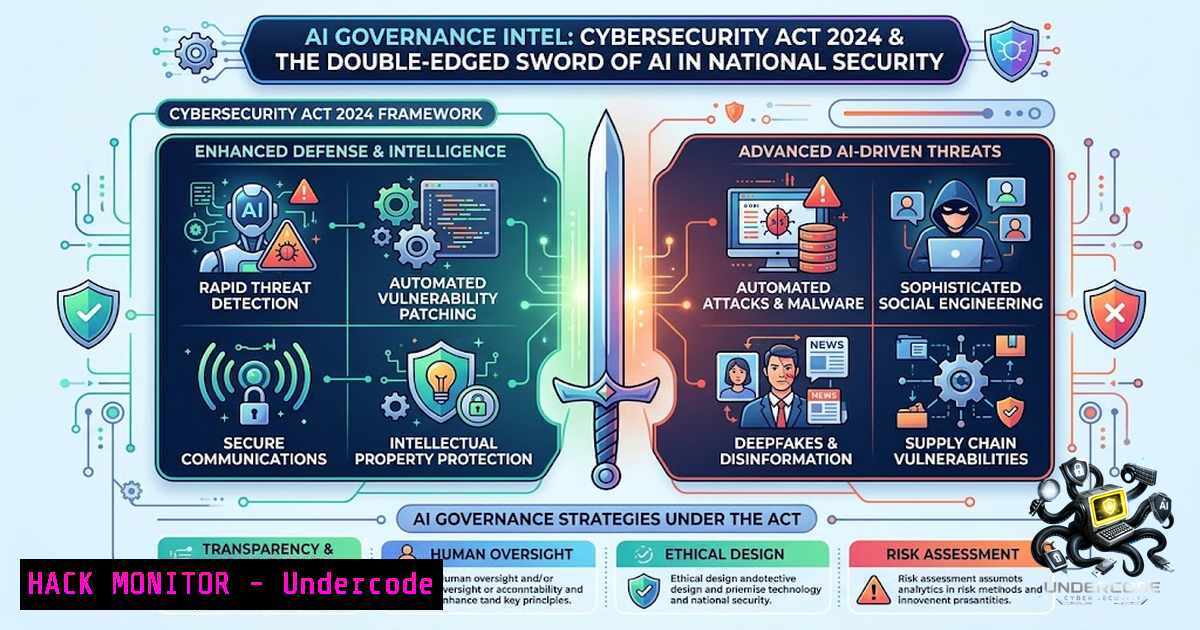
Artificial intelligence has emerged as the central paradox of modern cybersecurity: it serves as both an indispensable shield for digital infrastructure and a highly accessible weapon for threat actors. This duality is particularly pronounced in critical sectors like banking, energy, and healthcare, where the integration of AI into security operations introduces new vulnerabilities even as it enhances defense capabilities. As Malaysia operationalizes the Cybersecurity Act 2024 (Act 854), organizations must move beyond traditional compliance checklists to confront the unique technical challenges of AI-specific threats, including adversarial evasion, data poisoning, and model theft.
Learning Objectives & Secrets:
- Objective 1: Understand the operational scope of Malaysia’s Cybersecurity Act 2024 (Act 854) and its mandatory requirements for Critical National Information Infrastructure (CNII) entities.
- Secret Tip: Leverage automated compliance mapping tools to align existing security frameworks (e.g., NIST CSF, ISO 27001) with Act 854’s specific audit and reporting timelines (6-hour incident reporting).
- Objective 2: Identify the mechanics of AI-enabled cyber threats, including generative AI-driven phishing, deepfake disinformation, and AI-powered malware that adapts in real-time.
- Secret Tip: Deploy honeypots with generative AI to simulate realistic enterprise environments and capture attacker tactics, techniques, and procedures (TTPs) for threat intelligence.
- Objective 3: Acquire practical skills to conduct AI-specific technical audits, testing for model poisoning, adversarial evasion, and API-based model extraction.
- Secret Tip: Use open-source adversarial testing libraries like CleverHans or Foolbox to benchmark your AI models against common evasion techniques before official compliance audits.
You Should Know:
- The Escalating AI Threat Landscape: From Phishing to Autonomous Malware
The democratization of generative AI has drastically lowered the skill barrier for cybercriminals. Large language models now enable hyper-personalized spear-phishing campaigns that mimic individual writing styles, while deepfake technology threatens to undermine public trust in media and institutional communications. Simultaneously, next-generation malware employs reinforcement learning to discover zero-day vulnerabilities and dynamically alter its behavior to bypass signature-based and behavioral detection systems. This creates a landscape where AI-driven attacks are both more sophisticated and more voluminous. To counter this, security teams must adopt AI-augmented defense-in-depth strategies that include behavioral analysis at the endpoint, network-level anomaly detection, and proactive threat hunting.
Step‑by‑step guide for AI‑driven phishing detection:
- Step 1: Implement email filtering with natural language processing (NLP) models trained to detect linguistic anomalies, urgency cues, and impersonation patterns.
- Step 2: Enforce Multi-Factor Authentication (MFA) across all user accounts, specifically requiring phishing-resistant methods like FIDO2 WebAuthn or hardware tokens.
- Step 3: Deploy user and entity behavior analytics (UEBA) to establish baselines of normal communication patterns; trigger alerts when deviations occur, such as emails sent from unusual geographic locations or at abnormal times.
- Step 4: Conduct simulated phishing exercises using generative AI to create realistic campaigns that test employee awareness and response.
- Step 5: Integrate threat intelligence feeds to correlate incoming emails with known malicious domains and indicators of compromise (IoCs).
You Should Know:
- Operationalizing the Cybersecurity Act 2024 (Act 854) and CNII Compliance
Assented to in June 2024, Act 854 mandates rigorous security protocols for 11 designated CNII sectors, including Banking & Finance, Energy, Transportation, Healthcare, and Telecommunications. Under the purview of the National Cyber Security Agency (NACSA), the Act requires mandatory risk management practices, regular compliance audits, and a strict 6-hour window for incident reporting. This regulatory framework compels organizations to move beyond periodic assessments toward continuous security monitoring and real-time incident response readiness. Key technical requirements include implementing Security Operations Centers (SOCs), conducting vulnerability assessments and penetration testing (VAPT), and ensuring secure configuration for all critical assets.
Step‑by‑step compliance audit guide:
- Step 1: Classify your organization’s assets to identify which systems fall under the CNII designation and are subject to Act 854.
- Step 2: Conduct a gap analysis comparing current security controls (e.g., firewalls, IDS/IPS, endpoint detection and response) against Act 854’s requirements for risk management and audit readiness.
- Step 3: Establish a formal incident response plan that includes procedures for detecting, containing, eradicating, and recovering from incidents, with clear protocols for notification to NACSA within the 6-hour timeline.
- Step 4: Implement centralized logging and SIEM (Security Information and Event Management) solutions to aggregate logs from all critical systems for audit purposes and real-time threat detection.
- Step 5: Schedule regular VAPT exercises, using both automated scanners (like Nessus, OpenVAS) and manual penetration testing to identify and remediate vulnerabilities.
- Step 6: Document all policies, procedures, and audit trails in a centralized repository for easy access during regulatory inspections.
You Should Know:
- Defending Against AI-Specific Vulnerabilities: Adversarial Evasion and Data Poisoning
Traditional intrusion detection systems (IDS) are inadequate for environments where machine learning models are deployed. Adversarial evasion techniques involve subtly modifying input data to cause AI classifiers to make incorrect predictions—for example, adding imperceptible noise to an image to fool a facial recognition system. Data poisoning occurs when attackers corrupt training datasets, embedding backdoors or skewing decision boundaries to favor malicious outcomes. Model theft and extraction, meanwhile, involve querying a black-box model with carefully crafted inputs to reconstruct its functionality or exfiltrate proprietary training data. Mitigating these threats requires specialized audit techniques, including adversarial robustness testing, differential privacy mechanisms, and strict access controls on API endpoints.
Step‑by‑step guide for adversarial robustness testing:
- Step 1: Install an adversarial testing library, such as CleverHans or Foolbox, within a controlled Python environment: `pip install cleverhans` or
pip install foolbox. - Step 2: Load your trained model (e.g., a TensorFlow or PyTorch model) into the testing framework.
- Step 3: Select an adversarial attack method, such as the Fast Gradient Sign Method (FGSM) or Projected Gradient Descent (PGD), and configure parameters like perturbation magnitude (epsilon).
- Step 4: Run the attack against a validation dataset to generate adversarial examples and evaluate the model’s accuracy on these perturbed inputs.
- Step 5: Analyze the results to identify classes or features where the model is most vulnerable; document these findings as part of your AI audit report.
- Step 6: Implement defensive measures, including adversarial training (augmenting the training set with adversarial examples), input sanitization (clipping or filtering extreme values), and using ensemble models to increase robustness.
You Should Know:
4. Combating Disinformation and Deepfakes: Transparency and Provenance
AI-generated synthetic media represents a strategic threat to public trust, social cohesion, and national security. Defending against disinformation requires a multi-layered approach that goes beyond traditional content moderation. Cryptographic watermarking and provenance labeling—embedding metadata that traces the origin and editing history of digital content—are emerging as essential tools. Legislation mandating these measures, as proposed in some jurisdictions, would place responsibility on platforms and creators to ensure authenticity. Additionally, organizations must develop internal capabilities to detect deepfakes using forensic analysis tools that examine subtle inconsistencies in audio, video, and text.
Step‑by‑step guide for deepfake detection and content provenance:
- Step 1: Deploy open-source detection tools like DeepFaceLab’s detector or Microsoft’s Video Authenticator to analyze media files for artifacts indicative of AI generation.
- Step 2: Implement Content Credentials (C2PA) standards to attach tamper-evident metadata to all media published by your organization.
- Step 3: Establish a digital forensics team trained to evaluate suspected deepfakes, using both automated tools and manual inspection.
- Step 4: Educate employees and the public on identifying potential disinformation through media literacy campaigns, focusing on verifying sources and cross-referencing information.
- Step 5: For Linux-based analysis, use `ffmpeg` to extract and examine metadata:
ffmpeg -i suspected_video.mp4 -f ffmetadata metadata.txt. - Step 6: Use Python libraries like OpenCV and PyTorch to implement custom deepfake detection scripts that analyze frame-by-frame inconsistencies in facial landmarks or lighting.
You Should Know:
- Securing AI Models via API Security and Cloud Hardening
AI models are increasingly exposed via APIs, making them prime targets for model theft and data extraction attacks. Attackers can exploit API endpoints to query the model, reconstruct its logic, or infer sensitive training data through carefully crafted requests. Cloud hardening is equally critical, as misconfigured storage buckets or overly permissive IAM roles can expose entire datasets to the public. Implementing robust API security involves rate limiting, input validation, authentication and authorization (e.g., OAuth 2.0, API keys), and encryption in transit (TLS 1.3). For cloud environments, continuous configuration auditing and least-privilege access policies are non-1egotiable.
Step‑by‑step guide for securing AI model APIs:
- Step 1: Configure API gateways to enforce rate limiting (e.g., 100 requests per minute per user) to prevent brute-force query attacks.
- Step 2: Implement strong authentication and authorization using OAuth 2.0 or mutual TLS (mTLS) for all API calls.
- Step 3: Log all API requests and responses for security monitoring and forensic analysis, ensuring logs are stored securely and are immutable.
- Step 4: Perform regular security assessments of your API infrastructure, including vulnerability scans (e.g., with OWASP ZAP) and fuzzing tests to identify input handling flaws.
- Step 5: For cloud environments (AWS, Azure, GCP), run automated compliance scanners (e.g., Prowler, ScoutSuite) to identify misconfigurations: `prowler -M csv` to generate a report of AWS security posture.
- Step 6: Apply the principle of least privilege to IAM roles, ensuring that only necessary services and users have access to the model endpoints and training data.
- Step 7: Encrypt data at rest using advanced encryption standards (AES-256) and ensure all data in transit uses TLS 1.3 with strong cipher suites.
You Should Know:
6. AI-Specific Governance, Training, and Incident Response
Effective AI governance requires establishing clear policies for model development, deployment, and monitoring, including ethical guidelines, accountability structures, and ongoing risk assessment. The Cybersecurity Act 2024 (Act 854) sets a precedent for rigorous oversight, but AI governance must extend to technical audits, including adversarial robustness testing, fairness assessments, and explainability. Furthermore, all personnel—from developers to security analysts—must receive training on AI-specific threats and defense mechanisms. Incident response playbooks must evolve to include scenarios like model compromise, data poisoning, or automated attacks, with regular tabletop exercises to validate and improve procedures.
Step‑by‑step guide for establishing AI governance and training:
- Step 1: Form an AI governance committee comprising members from legal, compliance, security, and data science teams to define policies and oversight.
- Step 2: Develop a secure AI development lifecycle (SAIDL) that incorporates security reviews at each stage—data collection, model training, testing, deployment, and monitoring.
- Step 3: Conduct regular training sessions for all employees on AI security risks, including identifying deepfakes, reporting suspicious AI behaviors, and adhering to compliance protocols.
- Step 4: Update your incident response playbook to include AI-specific scenarios, such as prompt injection attacks on LLMs, adversarial evasion of fraud detection, or unauthorized model access.
- Step 5: Schedule tabletop exercises that simulate these AI-centric attack scenarios, involving representatives from IT, security, legal, and PR departments to practice coordinated response.
- Step 6: Maintain a detailed inventory of all AI assets, including models, datasets, and APIs, to facilitate rapid assessment during an incident.
What Undercode Say:
- Key Takeaway 1: Malaysia’s Cybersecurity Act 2024 (Act 854) sets a new benchmark for national digital resilience, but its success hinges on the ability of CNII operators to conduct specialized AI audits that address adversarial and poisoning threats, not just generic compliance checks.
- Key Takeaway 2: Proactive governance, encompassing technical training, transparent content provenance, and robust API security, is essential to leverage AI’s defensive capabilities while mitigating its inherent risks—creating a national cybersecurity posture that is both resilient and forward-looking.
Prediction:
+1: The enforcement of Act 854 will drive rapid innovation in AI security auditing tools and services in Malaysia, positioning it as a regional leader in cybersecurity governance.
+1: Mandatory transparency and provenance regulations for synthetic media could significantly reduce the impact of disinformation campaigns, restoring public trust in digital communication channels.
-1: Without coordinated international cooperation, cross-border AI-driven attacks will continue to exploit gaps between national regulatory frameworks, complicating attribution and response.
-1: The rapid deployment of AI in security without corresponding investment in human expertise will lead to a widening skills gap, leaving critical infrastructure vulnerable to sophisticated adversaries.
+1: The 6-hour incident reporting window mandated by Act 854 will incentivize organizations to adopt automated detection and response systems, accelerating the maturity of national SOC capabilities.
-1: Overly restrictive regulation of AI capabilities, driven by security concerns, may inadvertently stifle research and development in defensive AI, creating a long-term strategic disadvantage.
+1: The continued focus on AI governance and the establishment of standards for model auditing will create a thriving ecosystem of specialized security consultancies and training providers.
▶️ Related Video (78% Match):
🎯Let’s Practice For Free:
🎓 Live Courses & Certifications:
Join Undercode Academy for Verified Certifications
🚀 Request a Custom Project:
Secure, high-velocity infrastructure and disruptive technological engineering. Contact our engineering team for high-tier development and proprietary systems:
[email protected]
💎 Smart Architecture | 🛡️ Secure by Design | ⭐ Trusted by Thousands
IT/Security Reporter URL:
Reported By: https://lnkd.in/p/eGTCKN2C – Hackers Feeds
Extra Hub: Undercode MoN
Basic Verification: Pass ✅


