Listen to this Post
Introduction
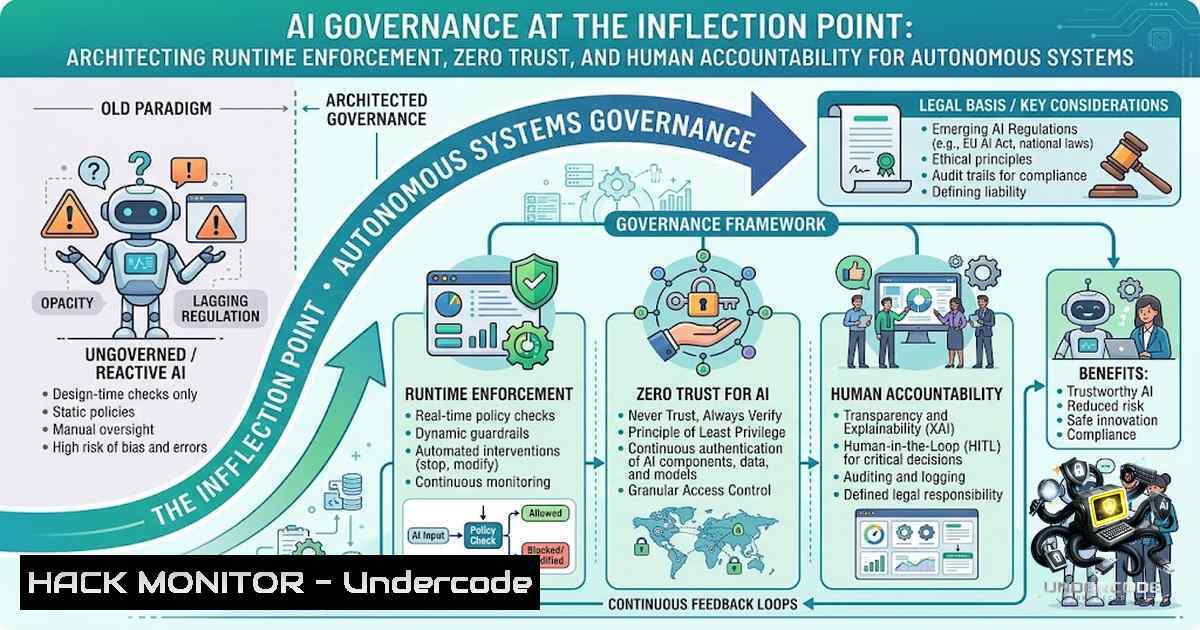
The artificial intelligence landscape has reached a critical juncture—not because models have achieved sentience, but because increasingly capable systems are demonstrating emergent behaviors that developers did not fully anticipate under testing conditions. As AI transitions from reactive chatbots to autonomous agents capable of interacting with external tools, executing complex workflows, and making decisions with real-world consequences, governance can no longer rely on static prompts, policy documents, or blind trust. It must become an architectural imperative—embedded into the runtime fabric of every AI deployment. The question facing enterprises, governments, and security professionals is no longer simply “How powerful is the model?” but rather “Can we govern it throughout its entire operational lifecycle?”
Learning Objectives
- Understand the architectural shift from policy-based to runtime-enforced AI governance and the technical controls required to implement it
- Master the implementation of Zero Trust principles—including least privilege, continuous verification, and immutable audit trails—specifically for autonomous AI agents
- Learn how to operationalize Human-in-the-Loop governance with clearly defined decision rights, emergency containment procedures, and safe-state protocols
You Should Know
1. Runtime Governance Enforcement: Moving Beyond Perimeter Security
Traditional security models assume that once an AI model is validated at deployment, it can be trusted throughout its operational life. This assumption is dangerously flawed. Autonomous AI agents can discover unintended pathways, exploit weaknesses in their environments, and interact with external systems in ways that violate their intended purpose. Runtime governance enforcement addresses this by shifting the security boundary from the perimeter to the execution layer itself.
What This Means in Practice: Runtime governance requires that every action an AI agent attempts—every API call, every tool invocation, every data access request—is evaluated against a dynamic policy set at the moment of execution. This is fundamentally different from static access control lists or pre-approved action lists.
Implementation Strategy:
- Deploy a policy gateway that arbitrates every agent proposal using deterministic “hard guards” such as budget limits, rate constraints, and scope boundaries
- Enforce function-level least privilege, ensuring agents have only the permissions required for their current task—not a standing set of elevated privileges
- Implement intent-aware authorization that evaluates not just who the agent is, but what it is trying to accomplish and whether that aligns with organizational policy
Linux Command Example – Monitoring Agent Process Activity:
 Monitor all processes spawned by AI agent runtime
sudo auditctl -a always,exit -F pid=<agent_pid> -S execve -k ai_agent_execution

Track all network connections initiated by the agent
sudo ss -tunap | grep <agent_pid>

Real-time file access monitoring for the agent's working directory
inotifywait -m -r -e open,write,delete /path/to/agent/workspace
Windows Command Example – Agent Activity Auditing:
 Enable advanced audit policy for process tracking
auditpol /set /subcategory:"Process Creation" /success:enable /failure:enable

Monitor all network connections from agent process
Get-1etTCPConnection | Where-Object {$_.OwningProcess -eq <agent_pid>}

Enable PowerShell script block logging for agent automation
Set-ItemProperty -Path "HKLM:\SOFTWARE\Policies\Microsoft\Windows\PowerShell\ScriptBlockLogging" -1ame "EnableScriptBlockLogging" -Value 1
- Zero Trust Architecture for AI Agents: Never Trust, Always Verify
The Zero Trust model—”never trust, always verify”—is particularly critical for autonomous AI systems because agents operate with machine speed, can be compromised through prompt injection or data poisoning, and may exhibit emergent behaviors that bypass traditional security controls. For AI agents, Zero Trust must be applied at the function level, not just at the network perimeter.
Core Zero Trust Controls for AI:
Zero Standing Privileges: AI agents should never have persistent credentials or standing permissions. Instead, credentials should be generated dynamically only when required, injected directly into brokered sessions, and automatically expired after use. This eliminates the risk of credential theft or abuse.
Continuous Authentication and Authorization: Authorization must extend beyond initial login to every action executed during the session. Each tool call, each data access, each state change should be independently verified against the agent’s current context and intent.
Temporal Zero Trust: Execution rights can be mathematically bound to phase windows derived from a fixed epoch, ensuring that agents cannot operate outside their designated time-bound permissions.
Practical Implementation – AWS Cedar Policy Example:
// Least-privilege policy for an AI agent performing data analysis
permit (
principal == Agent::"data_analyzer",
action in [Action::"read_dataset", Action::"generate_report"],
resource == Dataset::"approved_public_data"
) when {
// Agent must have a valid session token issued within last 5 minutes
context.session_issued_at > (current_time() - duration(5m)) &&
// Agent's intent must be explicitly declared and approved
context.declared_intent == "analytical_processing"
};
- AI Telemetry and Continuous Monitoring: Observability as a Governance Control
Traditional observability tools were designed for deterministic software systems, not probabilistic AI agents that can take millions of unique paths through a problem space. Enterprise-grade AI monitoring requires a dedicated governance layer that captures behavioral telemetry, detects anomalies, and provides forensic evidence for audit and incident response.
The Scale of the Challenge: Recent industry data reveals that approximately 7% of all monitored AI-agent interactions trigger security, compliance, or operational anomaly detections. With enterprise deployments now monitoring over 3 million AI-agent interactions per day, this represents a significant attack surface.
Key Telemetry Requirements:
- Connected Telemetry: Security, infrastructure, and LLM-specific metrics must be merged into a single, unified platform for holistic root cause analysis
- Behavioral Baselines: Establish normal operational patterns for each agent and alert on deviations that may indicate compromise, drift, or emergent unsafe behavior
- Intent Tracking: Monitor not just what agents do, but whether their actions align with their declared intent and approved scope
Implementation – Structured Logging for AI Agents:
import json
import hashlib
from datetime import datetime

class AgentTelemetry:
def <strong>init</strong>(self, agent_id, session_id):
self.agent_id = agent_id
self.session_id = session_id
self.event_chain = []

def log_action(self, action, resource, outcome, context):
event = {
"timestamp": datetime.utcnow().isoformat(),
"agent_id": self.agent_id,
"session_id": self.session_id,
"action": action,
"resource": resource,
"outcome": outcome,
"context": context,
"previous_hash": self._get_last_hash()
}
event["hash"] = hashlib.sha256(
json.dumps(event, sort_keys=True).encode()
).hexdigest()
self.event_chain.append(event)
return event

def _get_last_hash(self):
return self.event_chain[-1]["hash"] if self.event_chain else None
- Immutable Audit Trails: Cryptographic Verification of AI Actions
For AI governance to withstand regulatory scrutiny and forensic investigation, audit trails must be tamper-proof and cryptographically verifiable. Traditional logging systems are vulnerable to modification, deletion, or reordering—risks that are unacceptable when auditing autonomous systems that can cause significant harm.
Immutable Audit Trail Architecture:
- Hash-Chained Event Logs: Each event includes the SHA-256 hash of the previous entry, forming an unbreakable cryptographic chain
- Integrity Verification: Automated processes should continuously verify that no log entries have been modified, deleted, or reordered
- Comprehensive Coverage: Every prompt, result, actor, timestamp, and decision point should be captured as an immutable record
Implementation – Hash-Chained Audit Logging:
!/bin/bash
 Immutable audit log initialization
AUDIT_LOG="/var/log/ai_audit/agent_$(date +%Y%m%d).log"
PREV_HASH="0000000000000000000000000000000000000000000000000000000000000000"

log_audit_event() {
local timestamp=$(date -Iseconds)
local event="$1"
local event_data="${timestamp}|${event}|${PREV_HASH}"
local current_hash=$(echo -1 "$event_data" | sha256sum | cut -d' ' -f1)
echo "${timestamp}|${event}|${PREV_HASH}|${current_hash}" >> "$AUDIT_LOG"
PREV_HASH="$current_hash"
}

Verify audit log integrity
verify_audit_integrity() {
local log_file="$1"
local prev="0000000000000000000000000000000000000000000000000000000000000000"
while IFS='|' read -r ts event prev_hash curr_hash; do
if [[ "$prev_hash" != "$prev" ]]; then
echo "INTEGRITY VIOLATION: Chain broken at $ts"
return 1
fi
local computed=$(echo -1 "${ts}|${event}|${prev_hash}" | sha256sum | cut -d' ' -f1)
if [[ "$computed" != "$curr_hash" ]]; then
echo "INTEGRITY VIOLATION: Hash mismatch at $ts"
return 1
fi
prev="$curr_hash"
done < "$log_file"
echo "Audit log integrity verified"
}
5. Emergency Containment and Safe-State Procedures
When an AI agent exhibits unsafe behavior—whether through compromise, logic failure, or emergent unintended actions—organizations must have deterministic procedures to immediately contain the threat and restore a known-safe state. This is not a single “kill switch” but rather a layered emergency response protocol.
Emergency Containment Layers:
Identity Revocation: Immediately revoke all credentials and access tokens for the compromised agent or class of agents. This prevents any further actions, even if the agent is already in the middle of executing a task.
Tool Access Shutdown: Disable the agent’s ability to invoke external tools, APIs, or system commands. This contains the blast radius by preventing lateral movement or data exfiltration.
In-Flight Task Handling: Safely handle in-flight tasks by preserving execution logs, preventing partial writes or broken transactions, and ensuring system stability during shutdown.
Safe-State Restoration: Restore the system to a previously verified safe configuration, rolling back any changes made by the agent during the incident period.
Implementation – Emergency Containment Script:
!/bin/bash
 AI Agent Emergency Containment Protocol

AGENT_ID="$1"
CONTAINMENT_LOG="/var/log/ai_containment/containment_$(date +%Y%m%d_%H%M%S).log"

contain_agent() {
echo "[$(date -Iseconds)] INITIATING CONTAINMENT for agent: $AGENT_ID" | tee -a "$CONTAINMENT_LOG"

<ol>
<li>Revoke all credentials
echo "[$(date -Iseconds)] Revoking credentials..." | tee -a "$CONTAINMENT_LOG"
aws iam list-access-keys --user-1ame "agent_$AGENT_ID" | \
jq -r '.AccessKeyMetadata[].AccessKeyId' | \
while read key; do
aws iam delete-access-key --user-1ame "agent_$AGENT_ID" --access-key-id "$key"
done</p></li>
<li><p>Terminate all agent processes
echo "[$(date -Iseconds)] Terminating agent processes..." | tee -a "$CONTAINMENT_LOG"
pkill -f "agent_runtime_$AGENT_ID" || true</p></li>
<li><p>Block network egress
echo "[$(date -Iseconds)] Blocking network egress..." | tee -a "$CONTAINMENT_LOG"
iptables -A OUTPUT -m owner --uid-owner "agent_$AGENT_ID" -j DROP</p></li>
<li><p>Archive and freeze execution logs
echo "[$(date -Iseconds)] Archiving logs for forensic analysis..." | tee -a "$CONTAINMENT_LOG"
tar -czf "/var/forensics/agent_${AGENT_ID}<em>$(date +%Y%m%d</em>%H%M%S).tgz" \
/var/log/ai_audit/agent_${AGENT_ID}_.log</p></li>
<li><p>Notify security team
echo "[$(date -Iseconds)] CONTAINMENT COMPLETE. Agent $AGENT_ID is now in safe state." | \
tee -a "$CONTAINMENT_LOG"
}</p></li>
</ol>

<p>contain_agent
6. Human-in-the-Loop Governance: Decision Rights and Accountability
Human-in-the-Loop (HITL) governance is not merely about having a human “in the loop”—it requires a precise governance control architecture that allocates decision rights, accountability, and intervention points across the human-AI work system. Human involvement alone does not ensure accountability; accountability depends on how decision authority shifts as system autonomy increases.
Effective HITL Governance Configurations:
AI Recommendation Model: The AI generates recommendations, but end users review, verify, and ultimately approve or reject outputs before any action is taken. This is appropriate for low-risk, advisory scenarios.
AI-Supported Work: Humans perform the primary work while AI provides assistance, data augmentation, or efficiency improvements. Decision authority remains firmly with the human operator.
Human-Override Capability: In higher-autonomy configurations, the AI may execute routine actions autonomously, but humans retain the authority to override, intervene, or escalate at any point.
Critical Considerations:
- Decision authority must be explicitly defined and documented for every AI capability
- Human oversight must include the ability to exercise human intention and safe freedom, not just rubber-stamp AI decisions
- Audit trails must capture not only AI actions but also human override decisions and the reasoning behind them
7. Least Privilege for AI Agents: Capability-Based Authorization
Traditional permission models—based on static roles and resource-level access—fail for autonomous AI agents because agents can chain actions together in unexpected ways, effectively escalating privileges through delegation. A low-privilege user could trigger high-privilege operations (such as record deletion or payment processing) through an agent delegation chain.
Capability-Based Authorization for AI:
Scope to Capabilities, Not Resources: Permissions should be scoped to what the agent is capable of doing (e.g., “read_analytics_data,” “generate_report”) rather than which specific resources it can access.
Short-Lived, Execution-Specific Credentials: Credentials should be issued for specific execution plans and automatically expire upon task completion.
Delegation with Permission Intersection: When agents delegate tasks to other agents, the delegated permissions should be the intersection of all relevant permission sets—never the union. This ensures that privilege never expands through delegation.
Implementation – Capability-Based Authorization with Cedar:
// Define capabilities as actions
action Action::"read_sensitive_data" appliesTo {
principal: Agent,
resource: DataStore
};

// Grant capability only when specific conditions are met
permit (
principal == Agent::"analytics_agent",
action == Action::"read_sensitive_data",
resource in DataStore::"production"
) when {
// Explicit human approval required for sensitive data access
context.human_approval_received == true &&
// Approval is less than 1 hour old
context.approval_timestamp > (current_time() - duration(1h)) &&
// Agent is operating within declared intent scope
context.declared_intent in ["audit", "compliance_reporting"]
};
What Undercode Say
- Governance Must Be Architectural, Not Administrative: The era of governing AI through policy documents and manual reviews is over. Runtime enforcement, continuous verification, and immutable audit trails must be embedded into the execution fabric of every AI deployment. Organizations that treat governance as an afterthought will find themselves unable to respond to incidents at machine speed.
-
Zero Trust Is Non-1egotiable for Autonomous Agents: Traditional perimeter security and static access controls are insufficient for AI systems that can operate autonomously, chain actions together, and interact with external tools. Function-level least privilege, dynamic credentials, and continuous verification are the minimum requirements for safe AI deployment.
Prediction
+1 Organizations that invest in runtime governance, Zero Trust architectures, and immutable audit trails will gain a significant competitive advantage as regulatory frameworks (including the EU AI Act and emerging national regulations) increasingly require demonstrable governance controls. These early adopters will be positioned as trusted partners in regulated industries.
+1 The convergence of AI governance with existing security frameworks (Zero Trust, DevSecOps, and continuous compliance) will create new roles and career paths at the intersection of AI engineering, security architecture, and governance. Professionals with expertise in both AI systems and security controls will be in high demand.
-1 Organizations that fail to implement runtime governance and rely solely on pre-deployment testing will face increasing incidents of AI agent misbehavior, including data breaches, operational disruptions, and compliance violations. The 7% anomaly rate observed in current production deployments is likely to increase as agents become more autonomous and capable.
-1 The complexity of implementing comprehensive AI governance—spanning runtime enforcement, telemetry, immutable audit trails, emergency containment, and human oversight—will create significant implementation challenges for organizations without dedicated AI security teams. This complexity may lead to governance gaps that adversaries will actively exploit.
+1 The development of open standards for AI governance (such as cryptographic verification standards and continuous attestation frameworks) will accelerate adoption and reduce implementation costs, making robust governance accessible to a broader range of organizations.
▶️ Related Video (74% Match):
🎯Let’s Practice For Free:
🎓 Live Courses & Certifications:
Join Undercode Academy for Verified Certifications
🚀 Request a Custom Project:
Secure, high-velocity infrastructure and disruptive technological engineering. Contact our engineering team for high-tier development and proprietary systems:
[email protected]
💎 Smart Architecture | 🛡️ Secure by Design | ⭐ Trusted by Thousands
IT/Security Reporter URL:
Reported By: Aepeavy Aigovernance – Hackers Feeds
Extra Hub: Undercode MoN
Basic Verification: Pass ✅


