Listen to this Post
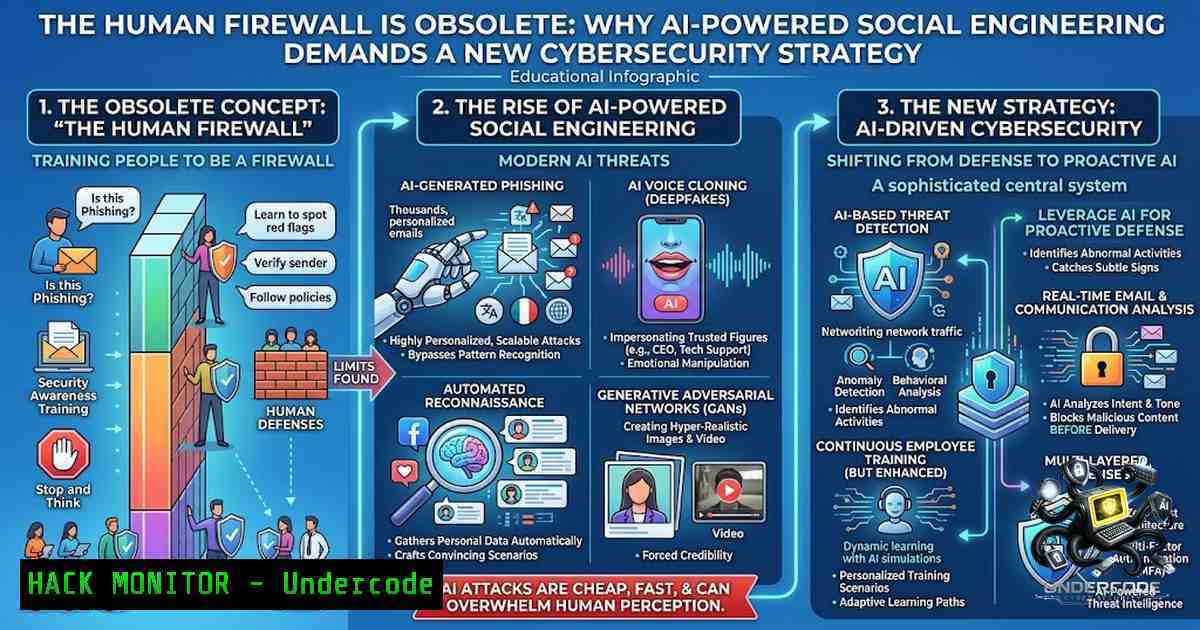
Introduction:
The cybersecurity industry has long operated on a flawed assumption: that technology can outpace human error. Organizations have invested billions in next-generation firewalls, endpoint detection, and zero-trust architectures, yet 80% of organizations now rank social engineering as their number one human-related risk, according to the latest SANS Institute Security Awareness Report. With the emergence of generative AI, attackers can now clone voices from short audio samples, generate hyper-personalized phishing messages at scale, and execute multi-channel deception campaigns that bypass traditional security controls entirely. This article examines the evolving threat landscape, provides actionable technical defenses, and outlines a modernized cybersecurity strategy for the AI era.
Learning Objectives:
- Understand how generative AI has industrialized social engineering and transformed attack economics
- Master technical defenses including intent-based detection, multi-channel correlation, and automated infrastructure takedown
- Implement AI-aware security awareness programs that move beyond checkbox training to behavior-driven culture change
You Should Know:
- The AI Attack Lifecycle: From Reconnaissance to Compromise in Hours
Traditional cyberattacks followed a predictable pattern: reconnaissance, weaponization, delivery, exploitation, installation, command and control, and actions on objectives. Generative AI has compressed this lifecycle dramatically. Reconnaissance that once took days now takes minutes as attackers point large language models at conference recordings, LinkedIn profiles, and public filings to generate target lists and pretexts in a single sitting.
Modern AI-powered social engineering attacks follow a five-stage chain:
- Setup (Stage 01): Lookalike domains, deepfake personas, fake mobile apps, and synthetic social media profiles
- Launch (Stage 02): Malicious ads, scam SMS messages, and Telegram-based lures
- Contact (Stage 03): AI-generated phishing emails, business email compromise (BEC), spoofed senders
- Engagement (Stage 04): Synthetic voice calls, MFA intercepts, credential theft
- Compromise (Stage 05): Corporate data exfiltration, fraudulent wire transfers, ransomware deployment
What makes these attacks particularly dangerous is their multi-channel nature. An attacker might quarantine a phishing email in Microsoft 365, but if the underlying lookalike domain, malicious Telegram channel, and fake LinkedIn persona remain active, they can simply pivot to SMS or WhatsApp to compromise the same user.
Linux Command: Investigating Suspicious Domains
 Query DNS records for lookalike domains
dig +short example-security.com
nslookup -type=MX example-security.com

Check certificate transparency logs for unauthorized certs
curl -s "https://crt.sh/?q=%.example.com&output=json" | jq '.[] | {name: .name_value, issued: .not_before}'

Investigate domain age and registration
whois example-security.com | grep -E "Creation Date|Registrar|Name Server"
Windows Command: Email Header Analysis
 Analyze email headers for spoofing indicators
Get-MessageTrace -MessageId "<a href="mailto:message-id@domain.com">message-id@domain.com</a>" |
Select-Object Received, SenderAddress, RecipientAddress, Subject

Check SPF, DKIM, and DMARC alignment
Resolve-DnsName -1ame domain.com -Type TXT |
Where-Object {$_.Strings -match "v=spf1|dkim|dmarc"}
- Defending at AI Speed: Intent-Based Detection and Multi-Channel Correlation
Legacy security tools fail because they rely on signature-based detection, single-channel monitoring, and manual takedown workflows that cannot keep pace with machine-speed, multi-channel attacks. Security teams must adopt a unified social engineering defense (SED) architecture that correlates cross-channel telemetry into a single intelligence layer.
Key Technical Controls:
Intent-Based Detection: Rather than simply scoring individual messages, intent-based systems analyze the purpose and context of communications. For example, Sinaptic’s AI Intent Firewall checks agent actions at tool boundaries, verifying every action before execution with sub-45ms latency. This runtime verification prevents AI agents from executing unauthorized actions even if they’ve been compromised through prompt injection.
Multi-Channel Correlation: Security operations centers must map entire campaigns rather than analyzing isolated alerts. When an analyst quarantines a phishing email, the system should automatically check for associated lookalike domains, social media impersonations, and SMS campaigns targeting the same user.
Automated Infrastructure Takedown: Defending at AI speed requires automated dismantlement of attacker infrastructure. This includes continuous scanning of domains, social media platforms, and mobile app stores to identify and remove malicious assets.
Tool Configuration: SIEM Correlation Rules
 Example SIEM correlation rule for multi-channel detection
rule:
name: "Multi-Channel Phishing Campaign Detection"
condition: |
(event.type == "email" AND email.phishing_score > 0.8) OR
(event.type == "dns" AND dns.domain IN lookalike_domains) OR
(event.type == "social_media" AND social.profile IN impersonation_profiles)
action: |
create_incident(
severity="high",
description="Multi-channel social engineering campaign detected",
affected_users=union(email.recipients, social.targets)
)
trigger_takedown(dns.domains, social.profiles)
API Security: Detecting AI-Powered Reconnaissance
 Monitor API endpoints for suspicious reconnaissance patterns
from flask import request
import re

def detect_reconnaissance():
user_agent = request.headers.get('User-Agent', '')
ip = request.remote_addr

Check for headless browser or automated tool signatures
if re.search(r'headless|phantom|selenium|puppeteer', user_agent, re.I):
log_alert(f"Suspicious automated access from {ip}")
return True

Check for rapid sequential API calls (rate limiting bypass attempts)
 Implement sliding window rate limiter
return False
3. Cloud Hardening Against AI-Enabled Identity Attacks
AI-powered social engineering increasingly targets cloud identities and privileged access. Attackers use cloned voices and AI-generated messages to trick helpdesk agents into resetting MFA tokens, then leverage the compromised identity to access cloud resources.
Cloud Hardening Checklist:
- Conditional Access Policies: Enforce risk-based authentication that evaluates user behavior, device health, and location before granting access
- Privileged Identity Management: Implement Just-In-Time (JIT) access with approval workflows for all administrative actions
- Entitlement Management: Regularly review and remove unused permissions using tools like AWS IAM Access Analyzer or Azure AD Access Reviews
- MFA Fatigue Protection: Implement number matching in MFA prompts and enforce strict rate limiting on authentication attempts
Azure CLI: Implementing Risk-Based Conditional Access
 Create conditional access policy requiring MFA for risky sign-ins
az rest --method POST \
--uri "https://graph.microsoft.com/v1.0/identity/conditionalAccess/policies" \
--body '{
"displayName": "Require MFA for risky sign-ins",
"state": "enabled",
"conditions": {
"signInRiskLevels": ["medium", "high"],
"applications": {"includeApplications": ["All"]},
"users": {"includeUsers": ["All"]}
},
"grantControls": {
"operator": "OR",
"builtInControls": ["mfa", "compliantDevice"]
}
}'
AWS CLI: Enforcing Least Privilege
 Generate an IAM policy based on actual usage
aws iam generate-service-last-accessed-details \
--arn arn:aws:iam::123456789012:role/AdminRole

Get the report and remove unused permissions
aws iam get-service-last-accessed-details \
--job-id <job-id> | \
jq '.ServicesLastAccessed[] | select(.LastAuthenticated == null) | .ServiceName'
- Vulnerability Exploitation and Mitigation: The AI Amplification Effect
AI doesn’t just enable social engineering—it also accelerates traditional vulnerability exploitation. Attackers use LLMs to identify vulnerable applications, exposed dependencies, misconfigured systems, and unpatched services at machine speed. The economics of exploitation have shifted dramatically: what once required skilled security researchers can now be automated.
Common AI-Exploited Vulnerabilities:
- Prompt Injection in AI-Powered Applications: Attackers craft inputs that cause LLMs to ignore safety guidelines or expose sensitive training data
- Shadow AI: Employees using unauthorized AI tools that lack proper data protection controls
- API Misconfigurations: Exposed API endpoints that allow attackers to enumerate users or extract data
- Credential Stuffing: AI-generated password lists and automated login attempts at scale
Mitigation Strategy: Secure AI Adoption Framework
Sinaptic’s three-pillar approach provides a practical framework:
- Identity & Access Management (IAM): Ensure AI tools are accessed through corporate SSO with proper provisioning
- Data Traceability & Control: Trace data flows to ensure sensitive information is stripped before reaching AI services
- Culture of Security: Use security tools that educate rather than just block—tooltips explaining why actions were flagged build a smarter workforce
Linux Command: Vulnerability Scanning
 Scan for common vulnerabilities
nmap -sV --script=vuln target.com

Check for exposed Kubernetes dashboards
kubectl get svc --all-1amespaces | grep -i dashboard

Audit container images for known vulnerabilities
trivy image --severity HIGH,CRITICAL myapp:latest

Check for exposed S3 buckets
aws s3 ls s3:// --1o-sign-request | grep -i "bucket-1ame"
Windows Command: Security Audit
 Check for insecure services
Get-Service | Where-Object {$<em>.StartType -eq "Automatic" -and $</em>.Status -1e "Running"}

Audit local security policy
secedit /export /cfg C:\security_audit.inf
Get-Content C:\security_audit.inf | Select-String "PasswordComplexity|MinimumPasswordLength"

Check for suspicious scheduled tasks
Get-ScheduledTask | Where-Object {$_.State -1e "Disabled"} |
Select-Object TaskName, TaskPath, State
- Building a Culture of Cyber Resilience: Beyond Checkbox Training
The SANS report emphasizes that it takes at least 2.8 dedicated FTEs to meaningfully influence behavior—and four or more FTEs to begin shifting organizational culture. Security awareness programs must evolve from static modules to dynamic, behavior-driven strategies.
Modern Security Awareness Program Components:
- AI-Specific Threat Education: Train employees on deepfakes, shadow AI, and prompt injection attacks
- Out-of-Band Verification: Require secondary confirmation for all high-risk requests using a different communication channel
- Agentic Simulations: Move beyond annual phishing tests to continuous, adaptive simulations that respond to emerging threats
- Closed-Loop Training: Feed live threat intelligence directly into training content so employees learn from real attacks
Implementing a Security Awareness Program:
 Example: Simulated phishing campaign with AI-generated content
import openai
import smtplib
from email.mime.text import MIMEText

def generate_phishing_template(target_role, company_news):
prompt = f"""
Generate a realistic phishing email targeting a {target_role} at a company.
Reference this recent news: {company_news}
Include a sense of urgency and a call to action to click a link.
"""
response = openai.ChatCompletion.create(
model="gpt-4",
messages=[{"role": "user", "content": prompt}]
)
return response.choices[bash].message.content

def send_training_email(employee_email, content):
 Send simulated phishing email with tracking
msg = MIMEText(content)
msg['Subject'] = "Urgent: Action Required"
msg['From'] = "[email protected]"
msg['To'] = employee_email

Send via SMTP with tracking pixel
 Log click-through rates for training effectiveness
What Undercode Say:
- Key Takeaway 1: The human firewall concept is obsolete. AI has industrialized social engineering, turning one-off scams into mass-personalized, multi-channel campaigns that achieve click-through rates more than four times higher than traditional phishing. Organizations must treat human risk as a technical problem requiring continuous measurement and mitigation.
-
Key Takeaway 2: Defending at AI speed requires a fundamental shift from reactive to proactive security. Legacy defenses—signature-based detection, single-channel tools, periodic training—cannot keep pace. Organizations must adopt intent-based detection, multi-channel correlation, and automated infrastructure takedown as core capabilities.
Analysis: The cybersecurity industry is at an inflection point. For decades, security professionals have operated under the assumption that technology can compensate for human error. AI has inverted this relationship: attackers now use AI to systematically exploit human psychology at scale, while defenders struggle to keep up with machine-speed deception. The organizations that will succeed are those that treat human risk as a first-class security concern, invest in behavior-driven training programs, and deploy AI-1ative defense tools that can operate at the same speed as the attacks they’re defending against. The window for complacency has closed.
Prediction:
- +1 The security awareness training market will consolidate around AI-1ative platforms that deliver personalized, adaptive training at scale, replacing the static, annual training model within 24–36 months.
-
+1 Regulatory frameworks will mandate AI-specific security awareness requirements, creating a compliance-driven demand for modernized training programs and driving investment in human risk management solutions.
-
-1 Organizations that fail to update their security awareness programs will experience a 300%+ increase in successful social engineering attacks over the next 18 months as AI-powered attacks become more sophisticated and accessible to commodity threat actors.
-
-1 The shortage of security professionals capable of defending against AI-powered attacks will worsen significantly, as traditional training programs have not yet adapted to the AI threat landscape, creating a critical skills gap.
-
+1 AI-powered defense tools that can automatically correlate multi-channel threats and initiate takedown actions will become table stakes for enterprise security, driving innovation in the SOC and reducing mean time to respond (MTTR) by 60–80%.
▶️ Related Video (80% Match):
https://www.youtube.com/watch?v=2r7Gb5dg5B8
🎯Let’s Practice For Free:
🎓 Live Courses & Certifications:
Join Undercode Academy for Verified Certifications
🚀 Request a Custom Project:
Secure, high-velocity infrastructure and disruptive technological engineering. Contact our engineering team for high-tier development and proprietary systems:
[email protected]
💎 Smart Architecture | 🛡️ Secure by Design | ⭐ Trusted by Thousands
IT/Security Reporter URL:
Reported By: Michell Bernal – Hackers Feeds
Extra Hub: Undercode MoN
Basic Verification: Pass ✅


