Listen to this Post
Introduction:
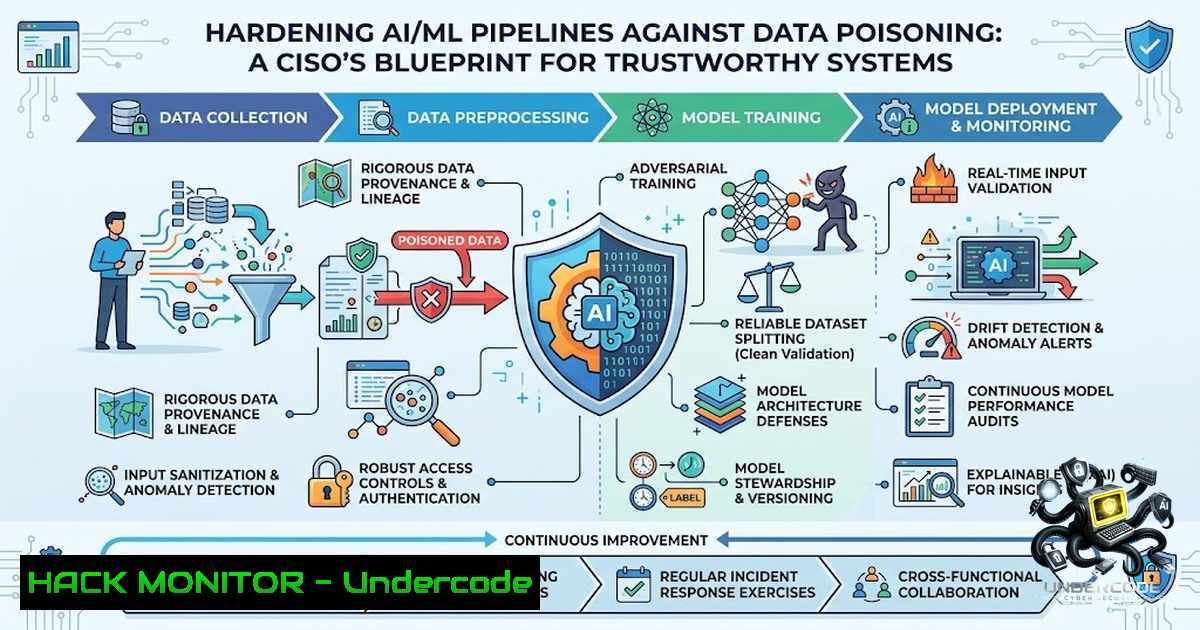
The recognition of leaders like Jennifer Raiford as a Top Cybersecurity Woman of the World 2026 highlights a critical shift in our industry: the move from reactive security to proactive, resilient design. In an era where AI systems are being integrated into every facet of national infrastructure, the integrity of the data feeding these models is paramount. This article provides a technical blueprint for Chief Information Security Officers (CISOs) and security engineers to protect machine learning (ML) pipelines from data poisoning and model inversion attacks, ensuring that the “trustworthy technology” Raiford champions is built on a foundation of verifiable security.
Learning Objectives:
- Implement cryptographic data provenance and integrity checks for training datasets.
- Configure runtime anomaly detection to identify drift and poisoning attempts in production models.
- Establish secure, isolated ML development environments using Linux namespaces and Windows Sandbox.
You Should Know:
- Securing the Data Supply Chain with Cryptographic Signing
Before any data enters your pipeline, its origin and integrity must be verified. Data poisoning often begins with an attacker injecting malicious samples into a public dataset or a third-party data feed. To counter this, we must implement a Zero-Trust architecture for data.
Step‑by‑step guide explaining what this does and how to use it:
Step 1: Generate a checksum manifest for your baseline datasets. This creates a cryptographic “fingerprint” of the clean data.
 Linux command to generate SHA-256 checksums for all files in a dataset directory
find ./training_data/ -type f -exec sha256sum {} \; > baseline_manifest.sha256
Step 2: Verify the manifest integrity before each training job. This ensures the files have not been tampered with.
 Linux command to check the manifest
sha256sum -c baseline_manifest.sha256 --quiet
 If failures occur, the script exits with a non-zero status.
Step 3: For Windows environments, use PowerShell to achieve the same result.
 Windows PowerShell command to generate checksums
Get-ChildItem -Path .\training_data\ -Recurse -File | Get-FileHash -Algorithm SHA256 | Export-Csv -Path baseline_manifest.csv
Step 4: Implement a policy where the training pipeline halts immediately if the integrity check fails. This automated guardrail prevents poisoned data from ever touching the model weights. This is your first line of defense, protecting the model from the very beginning.
2. Runtime Anomaly Detection: Monitoring Model Drift
Even with a secure pipeline, models can drift. Adversarial examples or gradual data shifts can degrade performance or force a model to make incorrect decisions. This section focuses on setting up real-time monitoring using the `Evidently` library.
Step‑by‑step guide explaining what this does and how to use it:
Step 1: Install the `evidently` Python package in your monitoring environment.
pip install evidently
Step 2: Create a Python script that compares the current production data distribution against a reference dataset (the one the model was trained on).
import pandas as pd
from evidently.metric_preset import DataDriftPreset
from evidently.report import Report

Load production data and reference data
prod_data = pd.read_csv('production_data.csv')
ref_data = pd.read_csv('reference_data.csv')

Generate Data Drift report
data_drift_report = Report(metrics=[DataDriftPreset()])
data_drift_report.run(current_data=prod_data, reference_data=ref_data, column_mapping=None)

Extract drift score
result = data_drift_report.as_dict()
drift_detected = result['metrics'][bash]['result']['drift_detected']
Step 3: Integrate this with a SIEM or logging system. If drift is detected, an alert triggers a rollback to a safe model version. This allows you to actively monitor for subtle changes that could indicate an ongoing attack.
3. Isolated Development Environments: Namespaces and Sandboxes
To prevent a compromised developer workstation from infecting the core AI infrastructure, we must isolate the development and training environments. This uses OS-level virtualization to create a bubble around the process.
Step‑by‑step guide explaining what this does and how to use it:
Step 1: On Linux, use `unshare` to create a new mount namespace. This prevents the training process from seeing the host’s actual filesystem, containing potential lateral movement.
 Create a new namespace with an isolated mount point
unshare -m chroot /path/to/isolated/root /bin/bash
Step 2: On Windows, configure Windows Sandbox to run untrusted code or test integrations in a disposable environment.
 Enable Windows Sandbox (requires Windows Pro/Enterprise)
Enable-WindowsOptionalFeature -Online -FeatureName "Containers-DisposableClientVM"
Step 3: Deploy Docker containers with explicit resource limits to handle the heavy computational load of training, ensuring that an attack inside the container cannot consume host resources.
 Docker command to run training with CPU and memory limits
docker run --rm --cpus="2.0" --memory="4g" my-training-image:latest
4. API Security Hardening for Model Endpoints
When deploying your model as a REST API, you must secure it against prompt injection and excessive data extraction. The goal is to prevent attackers from reverse-engineering your model or extracting sensitive training data.
Step‑by‑step guide explaining what this does and how to use it:
Step 1: Implement rate limiting at the load balancer level. This prevents brute-force attacks designed to probe the model’s behavior.
 Nginx configuration for rate limiting
limit_req_zone $binary_remote_addr zone=mylimit:10m rate=10r/s;
Step 2: Always sanitize input payloads. Use a strict JSON schema validator to reject malformed or overly large inputs.
from jsonschema import validate
schema = {
"type": "object",
"properties": {"text": {"type": "string", "maxLength": 500}},
}
validate(instance=request_json, schema=schema)
Step 3: Implement comprehensive logging of all API requests, including request headers and payloads, but ensure you redact PII. Store these logs in a secure, immutable location for forensic analysis in the event of a breach.
5. Cloud Hardening: IAM and Secrets Management
In cloud environments, misconfigured S3 buckets or over-privileged service accounts are the leading causes of data leaks. A compromised model is only as secure as the storage it uses.
Step‑by‑step guide explaining what this does and how to use it:
Step 1: Apply the Principle of Least Privilege. Create a dedicated service account that can only read from the specific dataset bucket and write to the model registry.
 AWS CLI command to create a policy granting read-only access to a specific bucket
aws iam create-policy --policy-1ame MLDataReadOnlyPolicy --policy-document '{"Version":"2012-10-17","Statement":[{"Effect":"Allow","Action":["s3:GetObject"],"Resource":"arn:aws:s3:::my-ml-datasets/"}]}'
Step 2: Never hardcode credentials. Use environment variables or vault services.
 Exporting AWS credentials securely (use your specific cloud provider)
export AWS_ACCESS_KEY_ID=$(aws secretsmanager get-secret-value --secret-id ml-secret --query SecretString --output text | jq -r .access_key)
Step 3: Enable Bucket Versioning and MFA Delete. This ensures that if a bucket is deleted or a model is overwritten, you can restore the previous state, mitigating the impact of ransomware or insider threats.
What Undercode Say:
- Key Takeaway 1: Resilience in cybersecurity is not just about stopping attacks but ensuring graceful degradation and rapid recovery.
- Key Takeaway 2: The human element remains the strongest asset; leadership and mentorship create the culture that enables technical controls to work effectively.
The recognition of Jennifer Raiford is a testament to the power of leadership in shaping a secure digital landscape. However, the underlying message is one of action. Celebrating milestones is only valid if we continue to build systems that are robust, tested, and resilient. The technical controls outlined above—integrity checks, drift monitoring, isolation, API hardening, and cloud governance—are the tangible output of leadership that prioritizes safety over speed. They represent the “renewed commitment to serve, protect, and lead with purpose” that Raiford discusses, translated into code and configurations that defenders can deploy today.
Expected Output:
Introduction:
The integration of AI into critical infrastructure demands a rigorous security posture that extends beyond traditional perimeter defense. CISOs must adopt a data-centric security model to ensure the integrity of AI systems against evolving threats like data poisoning and model inversion.
What Undercode Say:
- Key Takeaway 1: Protecting AI begins with the data supply chain; cryptographic integrity checks are the minimum viable standard for any production system.
- Key Takeaway 2: The confluence of technical isolation and continuous monitoring forms the bedrock of a resilient AI deployment.
Expected Output:
The technical guides provided for securing ML pipelines are essential reading for any security team deploying AI solutions. By implementing these steps, we can build the “trustworthy technology” that leaders like Jennifer Raiford advocate for, ensuring that our digital future remains secure.
Prediction:
+1 Increased adoption of “AI Bill of Materials” (AI BOM) as a standard regulatory requirement.
+1 A surge in “Model Red Teaming” as a standard practice, moving from optional to mandatory for compliance.
-1 A potential increase in “model theft” attacks targeting intellectual property within poorly secured cloud storage buckets.
-1 A widening skills gap as AI security requires expertise in both data science and offensive security, making it harder for small teams to keep up.
▶️ Related Video (84% Match):
🎯Let’s Practice For Free:
🎓 Live Courses & Certifications:
Join Undercode Academy for Verified Certifications
🚀 Request a Custom Project:
Secure, high-velocity infrastructure and disruptive technological engineering. Contact our engineering team for high-tier development and proprietary systems:
[email protected]
💎 Smart Architecture | 🛡️ Secure by Design | ⭐ Trusted by Thousands
IT/Security Reporter URL:
Reported By: Jennifer Raiford – Hackers Feeds
Extra Hub: Undercode MoN
Basic Verification: Pass ✅


