Listen to this Post
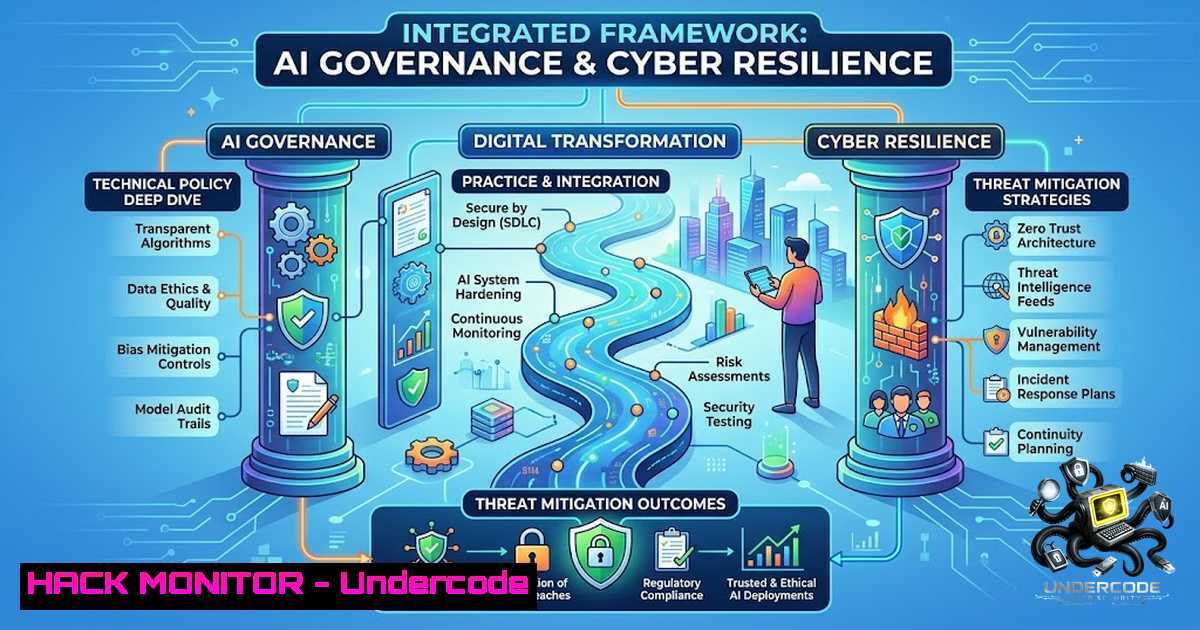
Introduction:
As Nepal accelerates toward its “Digital Nepal” vision, the convergence of Artificial Intelligence and cybersecurity has emerged as a national strategic priority, with the endorsement of the National AI Policy 2025 and the National Cybersecurity Policy 2023 marking a decisive turning point. The upcoming International Conference on AI and Cybersecurity (ICAC 2026), organized by the CAN Federation and featuring Prof. Dr. Sudan Jha as Keynote Speaker, represents a critical platform where global expertise meets local realities to address the pressing challenges of digital banking fraud, data breaches, and social engineering threats. This article provides a comprehensive technical examination of AI governance frameworks, security best practices, and practical implementation strategies essential for building resilient digital ecosystems in 2026 and beyond.
Learning Objectives:
- Understand the three pillars of AI governance—ISO/IEC 42001, NIST AI RMF, and the EU AI Act—and their practical implementation requirements
- Master OWASP Top 10 for LLM Applications (2026 edition) and implement defensive controls against prompt injection, insecure output handling, and other critical AI-specific vulnerabilities
- Deploy Zero Trust Architecture (ZTA) and cloud security hardening techniques to protect against evolving cyber threats in AI-enabled environments
- Configure Linux and Windows security tools for AI workload protection, threat detection, and incident response
- Develop AI governance policies that balance innovation with security, privacy, and ethical considerations
You Should Know:
- AI Governance Frameworks: ISO 42001, NIST AI RMF, and the EU AI Act
The practical landscape of AI governance in 2026 rests on three complementary frameworks that organizations must navigate. ISO/IEC 42001:2023 stands as the only certifiable international AI management system standard, providing independent, auditable proof of AI management maturity to customers and regulators across all jurisdictions. The NIST AI Risk Management Framework offers a voluntary, flexible structure organized around four core functions—Govern, Map, Measure, and Manage—giving teams a concrete way to identify and treat AI risk. The EU AI Act represents the world’s first binding legal framework for artificial intelligence, creating mandatory obligations for organizations that develop or deploy AI systems in EU markets.
To implement these frameworks effectively, organizations should:
- Conduct an AI inventory cataloging all AI systems, their purpose, data sources, and risk classification
- Map each system to the applicable framework requirements (high-risk vs. limited-risk under EU AI Act)
- Establish an AI governance board with cross-functional representation from security, legal, compliance, and engineering
- Document AI risk assessments using NIST AI RMF’s four-function approach
- Pursue ISO 42001 certification for critical AI systems to demonstrate compliance maturity
- OWASP Top 10 for LLM Applications (2026): Critical Vulnerabilities and Mitigations
The OWASP GenAI Security Project has released the 2026 edition of its Top 10 for LLM Applications, marking the first time the list was influenced by real-world incidents, with 7,714 incidents analyzed. The top risks remain Prompt Injection (LLM01) and Insecure Output Handling (LLM02), with the latter consistently converting model-level weaknesses into application-level breaches.
Critical vulnerabilities and mitigation strategies:
| OWASP Risk | Description | Mitigation |
||-||
| LLM01: Prompt Injection | Attackers manipulate model inputs to bypass safeguards | Implement input sanitization, context isolation, and prompt templating |
| LLM02: Insecure Output Handling | Downstream systems trust untrusted model outputs | Validate all model outputs before passing to downstream systems |
| LLM03: Training Data Poisoning | Adversarial data corrupts model behavior | Implement data provenance tracking and integrity checks |
| LLM04: Model Denial of Service | Resource exhaustion via malicious inputs | Rate limiting, input size restrictions, and monitoring |
| LLM05: Supply Chain Vulnerabilities | Compromised dependencies or pre-trained models | SBOM generation, dependency scanning, and model provenance verification |
| LLM06: Sensitive Information Disclosure | Model reveals training data or proprietary info | Differential privacy, output filtering, and access controls |
| LLM07: Insecure Plugin Design | Vulnerable plugins expose systems to attack | Plugin isolation, least privilege, and input validation |
| LLM08: Excessive Agency | Over-permissioned models perform unauthorized actions | Principle of least privilege for model actions |
| LLM09: Overreliance | Excessive trust in model outputs without verification | Human-in-the-loop for critical decisions |
| LLM10: Model Theft | IP theft via extraction attacks | Rate limiting, output monitoring, and watermarking |
Practical implementation commands:
Linux – Implementing input sanitization for LLM APIs:
 Install ModSecurity for API gateway protection
sudo apt-get install libapache2-mod-security2
sudo a2enmod security2

Configure OWASP Core Rule Set for LLM endpoints
git clone https://github.com/coreruleset/coreruleset.git /etc/modsecurity/crs/
cp /etc/modsecurity/crs/crs-setup.conf.example /etc/modsecurity/crs/crs-setup.conf

Add custom rule for prompt injection detection
echo 'SecRule ARGS "@rx (?i)(ignore|forget|system|admin|override)" \
"id:100001,phase:2,deny,status:403,msg:\"Potential prompt injection detected\""' \

<blockquote>
  <blockquote>
    /etc/modsecurity/conf.d/llm-security.conf
Windows PowerShell – Monitoring model output for sensitive data:
 Install Microsoft Purview information protection
Install-Module -1ame Microsoft.InformationProtection.File -Force

Scan model outputs for sensitive data patterns
$sensitivePatterns = @(
"\b\d{3}-\d{2}-\d{4}\b",  SSN
"\b[A-Z0-9._%+-]+@[A-Z0-9.-]+.[A-Z]{2,}\b"  Email
)
foreach ($pattern in $sensitivePatterns) {
if ($modelOutput -match $pattern) {
Write-Warning "Sensitive data detected in model output"
 Implement redaction or blocking
}
}
3. Zero Trust Architecture and Cloud Security Hardening
Zero Trust Architecture (ZTA) has become essential for protecting AI workloads and digital infrastructure, particularly in cloud environments where traditional perimeter-based security is obsolete. The core principle—”never trust, always verify”—requires continuous authentication, authorization, and validation at every access attempt.
Implementing Zero Trust for AI Systems:
Step 1: Identity and Access Management (IAM)
- Implement multi-factor authentication (MFA) for all users and service accounts
- Use conditional access policies based on risk signals (location, device health, behavior)
- Apply least-privilege access to AI model endpoints and training data
Step 2: Network Micro-segmentation
- Segment AI workloads into isolated network zones
- Implement east-west traffic inspection between micro-segments
- Use service mesh (Istio, Linkerd) for fine-grained policy enforcement
Step 3: Continuous Monitoring and Analytics
- Deploy SIEM with UEBA capabilities for anomalous behavior detection
- Implement real-time logging of all API calls to AI models
- Use AI-driven threat detection to identify zero-day attacks
Linux – Implementing network micro-segmentation with iptables:
 Create isolated network namespace for AI workloads
sudo ip netns add ai-workload
sudo ip link add veth0 type veth peer name veth1
sudo ip link set veth1 netns ai-workload

Apply strict firewall rules for the AI namespace
sudo ip netns exec ai-workload iptables -A INPUT -p tcp --dport 443 -s 10.0.0.0/8 -j ACCEPT
sudo ip netns exec ai-workload iptables -A INPUT -p tcp --dport 443 -j DROP
sudo ip netns exec ai-workload iptables -A OUTPUT -p tcp --dport 80 -d 0.0.0.0/0 -j DROP
Windows – Implementing AppLocker for AI application control:
 Enable AppLocker policy for AI application execution control
Set-ExecutionPolicy -ExecutionPolicy RemoteSigned -Scope CurrentUser

Create rule to allow only signed AI executables
$rule = New-AppLockerPolicy -RuleType Executable -User Everyone -Action Allow `
-Path "C:\AI\.exe" -Description "Allow AI application executables"
Set-AppLockerPolicy -Policy $rule -Merge

 Monitor AI application execution
Get-WinEvent -LogName "Microsoft-Windows-AppLocker/EXE and DLL" |
Where-Object { $_.Message -match "AI" }
4. AI-Powered Threat Detection and Cyber Resilience
Advanced AI models are revolutionizing threat detection by enabling adaptive systems that handle both known and zero-day attacks through the integration of deep learning and reinforcement learning. Organizations can leverage AI to monitor network traffic, application logs, and user behaviors to detect zero-day attacks, insider threats, and polymorphic malware in real-time.
Building an AI-Driven Threat Detection Pipeline:
Step 1: Data Collection and Normalization
– Aggregate logs from firewalls, IDS/IPS, endpoints, and cloud platforms
– Normalize data into a consistent schema using tools like Elastic Common Schema (ECS)
– Implement data retention policies compliant with regulatory requirements
Step 2: Feature Engineering and Model Training
– Extract behavioral features from historical security events
– Train isolation forest or autoencoder models for anomaly detection
– Implement continuous learning pipelines to adapt to evolving threats
Step 3: Alert Triage and Response Automation
– Implement alert prioritization based on severity and confidence scores
– Deploy SOAR playbooks for automated containment and remediation
– Maintain human-in-the-loop for high-severity incidents
Linux – Deploying an AI-based intrusion detection system:
 Install and configure Suricata with AI-enhanced rules
sudo apt-get install suricata
sudo suricata-update

 Install Zeek for network traffic analysis with ML
sudo apt-get install zeek
sudo zeekctl deploy

 Configure AI anomaly detection using Python
pip install scikit-learn pandas numpy

 Run anomaly detection on network flows
python -c "
import pandas as pd
from sklearn.ensemble import IsolationForest
 Load network flow data
flows = pd.read_csv('/var/log/zeek/conn.log')
 Train isolation forest for anomaly detection
model = IsolationForest(contamination=0.01)
predictions = model.fit_predict(flows[['duration', 'orig_bytes', 'resp_bytes']])
anomalies = flows[predictions == -1]
print(f'Detected {len(anomalies)} anomalous flows')
"
Windows PowerShell – Implementing UEBA with PowerShell and ML:
 Install ML.NET for anomaly detection
Install-Package Microsoft.ML -Version 3.0.0

 User behavior analytics script
$userActivity = Get-EventLog -LogName Security |
Where-Object { $_.EventID -in @(4624, 4625, 4672) } |
Select-Object TimeGenerated, UserName, EventID

 Detect abnormal login patterns (e.g., off-hours access)
$offHoursLogins = $userActivity |
Where-Object { $_.TimeGenerated.Hour -lt 6 -or $_.TimeGenerated.Hour -gt 22 }
if ($offHoursLogins.Count -gt 10) {
Write-Warning "Potential insider threat: $($offHoursLogins.Count) off-hours logins detected"
 Trigger SOAR playbook
}
5. API Security for AI-Powered Applications
As AI systems are increasingly exposed via APIs, securing these interfaces has become paramount. API security vulnerabilities can expose AI models to prompt injection, data exfiltration, and denial-of-service attacks.
API Security Best Practices for AI Endpoints:
– Authentication and Authorization: Implement OAuth 2.0 or API keys with granular permissions
– Rate Limiting: Restrict API calls to prevent abuse and resource exhaustion
– Input Validation: Validate and sanitize all inputs before processing
– Output Filtering: Scan outputs for sensitive data before returning to clients
– Audit Logging: Log all API requests and responses for forensic analysis
Linux – Implementing API gateway with Kong and rate limiting:
 Install Kong API Gateway
curl -Ls https://konghq.com/install-gateway.sh | bash
sudo apt-get install -y kong

 Configure rate limiting for AI endpoints
curl -X POST http://localhost:8001/services/ai-service/plugins \
--data "name=rate-limiting" \
--data "config.minute=100" \
--data "config.hour=1000" \
--data "config.policy=redis"

 Add API key authentication
curl -X POST http://localhost:8001/services/ai-service/plugins \
--data "name=key-auth"
Windows – Implementing API security with Azure API Management:
 Create API Management instance
New-AzApiManagement -ResourceGroupName "AI-Security-RG" `
-1ame "ai-api-gateway" `
-Location "East US" `
-Organization "SecurityOps" `
-AdminEmail "[email protected]"

Add rate limiting policy
$policy = @'
<policies>
<inbound>
<rate-limit calls="100" renewal-period="60" />
<validate-jwt header-1ame="Authorization" />
</inbound>
</policies>
'@
Set-AzApiManagementPolicy -Context $context -Policy $policy
6. Cloud Security Hardening for AI Workloads
AI workloads deployed in cloud environments require specific security hardening measures to protect against data breaches, model theft, and infrastructure compromise.
Cloud Security Hardening Checklist:
- Encryption: Enable encryption at rest and in transit for all AI data
- Access Controls: Implement IAM roles with least-privilege permissions
- Network Security: Use VPCs, security groups, and private subnets
- Secret Management: Store API keys and credentials in dedicated secret managers
- Vulnerability Scanning: Regularly scan container images and serverless functions
AWS CLI – Hardening S3 buckets for AI training data:
 Enable bucket encryption
aws s3api put-bucket-encryption \
--bucket ai-training-data \
--server-side-encryption-configuration '{
"Rules": [{"ApplyServerSideEncryptionByDefault": {"SSEAlgorithm": "AES256"}}]
}'

Block public access
aws s3api put-public-access-block \
--bucket ai-training-data \
--public-access-block-configuration '{
"BlockPublicAcls": true,
"BlockPublicPolicy": true,
"IgnorePublicAcls": true,
"RestrictPublicBuckets": true
}'

Enable versioning for data recovery
aws s3api put-bucket-versioning \
--bucket ai-training-data \
--versioning-configuration Status=Enabled
Azure CLI – Securing Azure Machine Learning workspaces:
 Create AML workspace with private endpoint
az ml workspace create \
--1ame ai-security-workspace \
--resource-group ai-security-rg \
--vnet-1ame ai-vnet \
--subnet private-subnet

Enable managed identity and disable local auth
az ml workspace update \
--1ame ai-security-workspace \
--resource-group ai-security-rg \
--set identity.type=SystemAssigned \
--set properties.disableLocalAuth=true

Configure network isolation
az ml workspace private-endpoint create \
--1ame ai-workspace-pe \
--workspace-1ame ai-security-workspace \
--resource-group ai-security-rg \
--vnet-1ame ai-vnet \
--subnet private-subnet
What Undercode Say:
The convergence of AI and cybersecurity represents both an unprecedented opportunity and a formidable challenge for nations like Nepal as they pursue digital transformation. The establishment of the National AI Policy 2025 and National Cybersecurity Policy 2023 provides a foundational framework, but the real work lies in translating policy into practice through technical implementation, capacity building, and cross-sector collaboration. The ICAC 2026 conference, with distinguished speakers like Prof. Dr. Sudan Jha, serves as a critical catalyst for this transformation, bridging the gap between global expertise and local realities.
Key takeaways from this analysis include:
- AI governance must move beyond theoretical frameworks to practical implementation, with organizations adopting ISO 42001 certification and NIST AI RMF mapping as baseline requirements
- The OWASP Top 10 for LLM Applications (2026) provides essential guidance for securing AI systems, with prompt injection and insecure output handling remaining the most critical risks
- Zero Trust Architecture is no longer optional—it is essential for protecting AI workloads in cloud and hybrid environments
- AI-powered threat detection systems, leveraging deep learning and reinforcement learning, offer the ability to detect zero-day attacks and insider threats that traditional security tools miss
- API security, cloud hardening, and continuous monitoring form the operational backbone of AI security programs
Prediction:
- +1: AI governance frameworks (ISO 42001, NIST AI RMF, EU AI Act) will become mandatory compliance requirements for organizations deploying AI in regulated sectors by 2028, driving significant investment in AI security tooling and expertise
- +1: AI-powered threat detection will reduce mean time to detection (MTTD) by 60-80% and mean time to response (MTTR) by 40-60% by 2027, fundamentally transforming security operations centers
- -1: The democratization of AI through open-source models and APIs will lead to a surge in AI-specific attacks, including automated vulnerability discovery and exploit generation, outpacing defensive capabilities in the short term
- +1: National and international AI governance initiatives, including G7 Digital and Technology Ministerial declarations, will establish interoperable frameworks that balance innovation with security, reducing regulatory fragmentation
- -1: The skills gap in AI security will widen dramatically, with demand for AI security professionals far exceeding supply, creating critical vulnerabilities in organizations that cannot attract or retain qualified talent
- +1: Zero Trust Architecture adoption will accelerate as organizations recognize that perimeter-based security is obsolete for AI workloads, driving innovation in micro-segmentation and continuous verification technologies
▶️ Related Video (70% Match):
🎯Let’s Practice For Free:
🎓 Live Courses & Certifications:
Join Undercode Academy for Verified Certifications
🚀 Request a Custom Project:
Secure, high-velocity infrastructure and disruptive technological engineering. Contact our engineering team for high-tier development and proprietary systems:
[email protected]
💎 Smart Architecture | 🛡️ Secure by Design | ⭐ Trusted by Thousands
IT/Security Reporter URL:
Reported By: Chiranjibiadhikari Canfederation – Hackers Feeds
Extra Hub: Undercode MoN
Basic Verification: Pass ✅


