Listen to this Post
Introduction
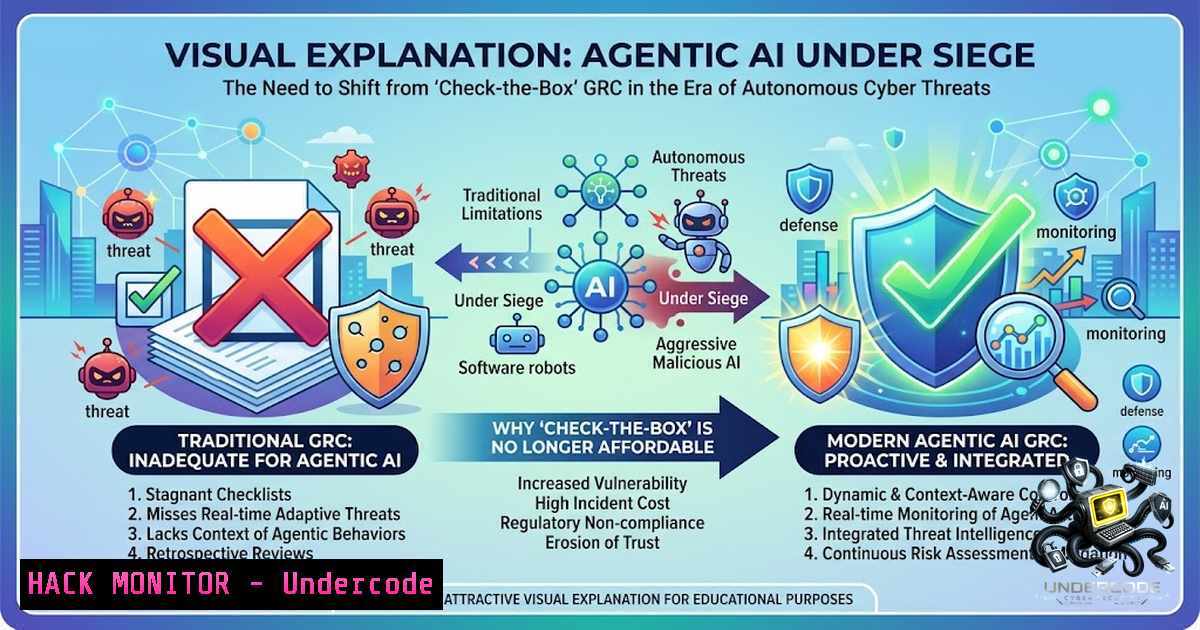
The rapid institutionalization of Artificial Intelligence across India’s digital economy has fundamentally fractured traditional governance models, exposing organizations to risks that operate at machine speed while compliance frameworks still lumber along at human pace. As policymakers, CISOs, and technology leaders convene at the GRC India AI Conclave 2026 on 7 August in New Delhi, the central question is no longer whether AI should be governed, but how governance can possibly keep pace when autonomous agents patch servers, modify cloud configurations, and respond to threats without waiting for human approval.
Learning Objectives
- Master the fundamental shift from traditional GRC to “Agentic GRC” and understand why annual audits are obsolete in AI-driven security operations
- Implement continuous, real-time monitoring strategies for AI agents and non-human identities (NHIs) that operate outside traditional organizational charts
- Deploy practical governance controls including cryptographic kill-switches, explainable AI (XAI) justification logs, and AI-to-AI oversight mechanisms
- Configure and utilize AI-powered GRC platforms—GRACE, Mirror, and Wizard—for continuous compliance, penetration testing, and third-party risk management
You Should Know
- The Governance Vacuum: Why Traditional GRC Fails Against Agentic AI
Traditional Governance, Risk, and Compliance (GRC) operates on a fundamentally human timescale: weeks, months, or quarters. Agentic AI, by contrast, operates on a machine timescale measured in milliseconds. This temporal mismatch creates what security experts now call the “Governance Vacuum”—a dangerous gap where AI agents make autonomous decisions without adequate oversight, accountability, or audit trails.
The core problem is that AI agents are no longer passive suggestion engines; they actively participate in security operations, patching software, changing firewall rules, rotating passwords, and responding to threats without human intervention. When a human makes a change to a production system, there is documented approval and someone accountable. When an AI does it, that same level of accountability must be built into how the AI system is governed.
Step-by-Step: Auditing Your Agentic AI Exposure
- Inventory all AI agents operating in your environment—including “Shadow Agents” spun up by business units via low-code platforms
- Map permissions and access levels for each agent. AI agents often need broad system access to patch servers, modify cloud settings, and update configurations across multiple environments
- Identify non-human identities (NHIs) that do not appear on organizational charts and cannot be held legally liable
- Audit the audit trail—if an unauthorized agent triggers a data egress event or misconfigures a firewall, can your current systems trace it back to a responsible party?
- Assess “Logic Drift” —a slight shift in LLM weights or a new system prompt can cause agents to interpret “compliance” in ways legal teams never intended
Linux Command: Auditing Agent Activity
 Audit all running processes for unusual agent-like behavior
ps aux | grep -E "agent|automation|bot|script" | grep -v grep

Check systemd services for automated tasks
systemctl list-timers --all

Review recent authentication logs for non-human access patterns
sudo journalctl -u sshd --since "24 hours ago" | grep -E "Accepted|Failed"

Monitor API call volumes that may indicate agent activity
sudo netstat -an | grep ESTABLISHED | wc -l
Windows Command: Identifying Automated Processes
 List all running processes with detailed information
Get-Process | Format-Table -Property Name, CPU, WorkingSet, StartTime

Check scheduled tasks that may indicate automated agents
Get-ScheduledTask | Where-Object {$_.State -1e "Disabled"}

Review security event logs for non-human authentication
Get-WinEvent -LogName Security | Where-Object { $_.Id -in @(4624,4625) } | Select-Object -First 20
- Continuous Compliance: Moving from Annual Audits to Real-Time Monitoring
The era of annual audits is over. AI agents operate 24/7 and can make hundreds of changes in minutes. Governance that only checks in periodically will always be behind. Organizations need continuous, real-time monitoring of what their AI agents are doing, ideally feeding directly into existing Security Operations Center (SOC) workflows.
The solution lies in what Ampcus Cyber calls “Agentic GRC”—treating AI agents not as background tools, but as active participants in security operations that need proper oversight. This requires three non-1egotiable architectural shifts:
Step-by-Step: Implementing Continuous Agent Monitoring
- Deploy “Governor Agents” —high-integrity models whose sole function is to validate the actions of “Worker Agents” against hard-coded compliance guardrails in real-time
- Mandate Explainable AI (XAI) —no agent should call a production API without simultaneously generating a “Justification Log”—a plain-language audit trail explaining its reasoning
- Hash and store justification logs in an immutable ledger for forensic accountability
- Define human-in-the-loop thresholds for high-blast-radius actions—production-level changes or sensitive data movement must require hardware-backed (MFA) cryptographic triggers
- Implement cryptographic kill-switches—the ability to pause or stop an agent instantly when behavior looks unusual
Tool Configuration: GRACE Platform Setup (Ampcus Cyber’s Orchestrated GRC Solution)
 Example GRACE configuration for continuous compliance monitoring
version: "1.0"
compliance_frameworks:
- ISO27001
- SOC2
- DPDA_2023
- SEBI_CSCRF

continuous_monitoring:
interval: "realtime"
alert_channels:
- slack
- email
- siem_integration

agent_governance:
enable_governor_agents: true
justification_logging: true
immutable_ledger: true

risk_thresholds:
high_blast_radius_actions:
require_human_approval: true
mfa_required: true
medium_risk_actions:
require_justification_log: true
low_risk_actions:
allow_autonomous: true
3. The Shadow Agent Threat: Managing Non-Human Identities
The strategy for combating Shadow IT and Shadow SaaS has evolved to address the rising threat of Shadow Agents. These are autonomous bots spun up by business units, often via low-code platforms, to “efficiency-hack” their workflows. They operate within “trusted” sessions, inheriting the permissions of the employee who created them.
From a GRC perspective, this is a traceability black hole. If a Shadow Agent triggers a data egress event or misconfigures a firewall while “optimizing” network traffic, the audit trail often points back to a human who had no idea the action was even taken. In 2026, organizations are losing the fundamental GRC principle of non-repudiation.
Step-by-Step: Identifying and Controlling Shadow Agents
- Scan for unauthorized automation using network traffic analysis to identify unusual API call patterns
- Implement Zero Trust for NHIs—treat every non-human identity as untrusted until verified
- Restrict low-code platform permissions—limit what business units can deploy without security review
- Deploy continuous discovery tools that identify new agents as they appear in your environment
- Create an approved agent registry—all AI agents must be registered, approved, and monitored
Linux Command: Detecting Shadow Agents via Network Analysis
 Monitor unusual outbound connections that may indicate unauthorized agents
sudo tcpdump -i any -1 -c 100 'tcp[bash] & (tcp-syn) != 0 and not port 22 and not port 443'

Check for unexpected cron jobs
cat /etc/crontab
for user in $(cut -f1 -d: /etc/passwd); do crontab -u $user -l 2>/dev/null; done

Audit systemd services for unusual automation
systemctl list-units --type=service --all | grep -E "agent|bot|auto"

Monitor file system changes that may indicate agent activity
sudo inotifywait -m -r -e modify,create,delete /etc/ /var/ 2>/dev/null &
4. AI-Powered GRC Transformation: The ComplyX Portfolio
The GRC India AI Conclave 2026 marks the Make in India launch of Ampcus Cyber’s indigenous, AI-powered Governance, Risk and Compliance portfolio, ComplyX. The portfolio includes three flagship platforms designed to address the challenges of AI-driven governance:
GRACE: An orchestrated GRC platform that simplifies audits, streamlines compliance, and provides real-time visibility into cybersecurity and business risk. It introduces AI-powered predictive forecasting and risk heatmaps, alongside auto-calculated compliance scores designed to spot risks before they manifest into breaches or audit failures.
Mirror: An agentic AI continuous penetration testing platform that delivers ongoing, exploit-confirmed visibility into vulnerabilities across critical digital assets. AI security tools achieve approximately 95% detection accuracy versus roughly 85% for traditional approaches, cutting incident response times by 30–50%.
Wizard: An AI-driven Third-Party Risk Management platform that turns traditional vendor assessments into intelligent, continuous vendor risk monitoring.
Step-by-Step: Implementing Continuous Third-Party Risk Monitoring with Wizard
- Onboard all third-party vendors into the Wizard platform with their security questionnaires and compliance certifications
- Configure continuous monitoring rules—set thresholds for risk scores, data breaches, and compliance deviations
- Enable automated vendor reassessment—Wizard continuously monitors vendor security posture without manual intervention
- Integrate with GRACE for unified risk visibility across internal and third-party risks
- Set up alerting for high-risk vendor changes that require immediate human review
API Security Configuration for AI-Powered GRC Integration
 Example Python script for integrating GRACE API with existing SIEM
import requests
import json

GRACE API Configuration
GRACE_API_URL = "https://api.grace.ampcuscyber.com/v1"
API_KEY = "your_api_key_here"

def get_compliance_score(asset_id):
headers = {"Authorization": f"Bearer {API_KEY}"}
response = requests.get(f"{GRACE_API_URL}/compliance/{asset_id}", headers=headers)
return response.json()

def trigger_agent_audit(agent_id):
payload = {"agent_id": agent_id, "action": "audit"}
headers = {"Authorization": f"Bearer {API_KEY}", "Content-Type": "application/json"}
response = requests.post(f"{GRACE_API_URL}/agents/audit", json=payload, headers=headers)
return response.status_code == 200

Continuous monitoring loop
def continuous_monitoring():
assets = ["asset_1", "asset_2", "asset_3"]
for asset in assets:
score = get_compliance_score(asset)
if score["risk_level"] == "critical":
print(f"ALERT: Critical risk detected in {asset}")
 Trigger automated response
trigger_agent_audit(asset)

if <strong>name</strong> == "<strong>main</strong>":
continuous_monitoring()
- AI Governance in Practice: Regulatory Compliance and Data Privacy
India is progressing toward a framework that emphasizes responsible AI use, transparency, and alignment with sectoral regulation, particularly in financial services and public-sector applications. The GRC India AI Conclave addresses critical areas including AI governance, regulatory frameworks, AI-enabled GRC transformation, continuous compliance, data privacy, financial resilience, cloud transformation, and national cyber preparedness.
Key regulatory frameworks include the Digital Personal Data Protection Act (DPDA) 2023 and SEBI CSCRF for financial sector compliance. Regulators are sending a clear signal in 2026: AI must be governed end-to-end, cyber risk must be quantified in business terms, and frameworks like DORA demand operational proof—not just policy.
Step-by-Step: Building an AI Assurance Program
- Establish formal policies, controls, and testing processes that verify AI systems behave as intended and stay within acceptable risk limits
- Implement continuous compliance monitoring that checks AI systems against regulatory requirements in real-time
- Conduct regular AI risk assessments that evaluate both the AI system itself and its broader organizational impact
- Create incident response plans specifically for AI failures—including logic drift, data poisoning, and unauthorized autonomous actions
- Document everything—every AI-driven action must generate a clear, auditable record, not just what the agent did, but the reasoning behind it
Cloud Hardening for AI Workloads
 AWS CLI: Restrict AI agent permissions using IAM policies
aws iam create-policy --policy-1ame AgentRestrictPolicy \
--policy-document '{
"Version": "2012-10-17",
"Statement": [
{
"Effect": "Deny",
"Action": [
"ec2:TerminateInstances",
"s3:DeleteBucket",
"iam:CreateAccessKey"
],
"Resource": ""
}
]
}'

Azure CLI: Enable continuous monitoring for AI resources
az monitor activity-log list --resource-group AI-Resources \
--query "[?contains(operationName.value, 'Microsoft.MachineLearningServices')]" \
--output table

GCP: Audit AI platform usage
gcloud services enable cloudasset.googleapis.com
gcloud asset search-all-resources --asset-types="aiplatform.googleapis.com/"
What Undercode Say:
Key Takeaway 1: Agentic AI demands Agentic GRC. Traditional governance models operating on quarterly or annual cycles cannot keep pace with AI agents that make hundreds of decisions in milliseconds. Organizations must deploy “Governor Agents”—AI systems whose sole purpose is to validate and oversee other AI agents in real-time. The governance gap between human and machine timescales is the single greatest risk facing enterprises in 2026.
Key Takeaway 2: Non-repudiation is the new frontier. The rise of Shadow Agents and non-human identities (NHIs) threatens the fundamental GRC principle of accountability. When an autonomous agent acts, who is responsible? Current frameworks like SOC2 and ISO 27001 are not yet equipped for the “Agentic Delegate” model. Organizations must implement cryptographic kill-switches, immutable justification logs, and hardware-backed human approvals for high-risk actions.
Analysis: The GRC India AI Conclave 2026 represents a critical inflection point for cybersecurity governance in India’s digital economy. As Deep Chanda, CEO of Ampcus Cyber, noted, “India’s digital transformation is opening extraordinary opportunities, and it also calls for stronger governance, resilient cybersecurity, and responsible AI adoption”. The conclave’s focus on AI governance, critical infrastructure protection, and continuous compliance reflects a growing recognition that security cannot be an afterthought in AI deployment. The launch of the ComplyX portfolio—GRACE, Mirror, and Wizard—signals a shift toward indigenous, AI-1ative GRC solutions designed for the realities of 2026. However, the underlying challenge remains: governance frameworks must evolve from reactive auditing to active orchestration, from human-paced reviews to millisecond-level validation. Organizations that fail to make this transition risk not just compliance failures, but catastrophic security incidents caused by autonomous agents operating beyond human oversight.
Prediction:
-1: The Liability Gap Will Trigger Major Legal Reforms. As autonomous AI agents cause systemic outages and data breaches, courts will grapple with the question of fiduciary responsibility—is it the CISO, the AI vendor, or the board? Current legal frameworks are unprepared for the “Agentic Delegate” model, and 2026–2027 will see landmark litigation that reshapes AI governance liability.
-1: Shadow Agents Will Become the New Shadow IT Crisis. The proliferation of low-code platforms enabling business units to deploy autonomous agents will create a traceability black hole that most organizations are unprepared to manage. Expect a wave of data breaches and compliance failures traced back to unauthorized AI agents operating within trusted sessions.
+1: AI-Powered GRC Will Dramatically Reduce Incident Response Times. AI security tools already achieve 95% detection accuracy versus 85% for traditional approaches, cutting incident response times by 30–50%. As platforms like GRACE, Mirror, and Wizard mature, organizations will shift from reactive to predictive security postures.
+1: Continuous Compliance Will Become the New Industry Standard. The era of annual audits is ending. Regulatory bodies will increasingly mandate real-time compliance monitoring for AI systems, driving adoption of continuous GRC platforms. Organizations that embrace this shift early will gain significant competitive advantage.
-1: Logic Drift Will Cause Unpredictable Failures. As AI agents evolve through continuous learning, subtle shifts in LLM weights and system prompts will cause “Logic Drift”—where agents begin interpreting compliance in ways legal teams never intended. These failures will be difficult to detect and even harder to attribute, creating new categories of systemic risk.
🎯Let’s Practice For Free:
🎓 Live Courses & Certifications:
Join Undercode Academy for Verified Certifications
🚀 Request a Custom Project:
Secure, high-velocity infrastructure and disruptive technological engineering. Contact our engineering team for high-tier development and proprietary systems:
[email protected]
💎 Smart Architecture | 🛡️ Secure by Design | ⭐ Trusted by Thousands
IT/Security Reporter URL:
Reported By: Neelkanth Thakur – Hackers Feeds
Extra Hub: Undercode MoN
Basic Verification: Pass ✅


