Listen to this Post
Introduction
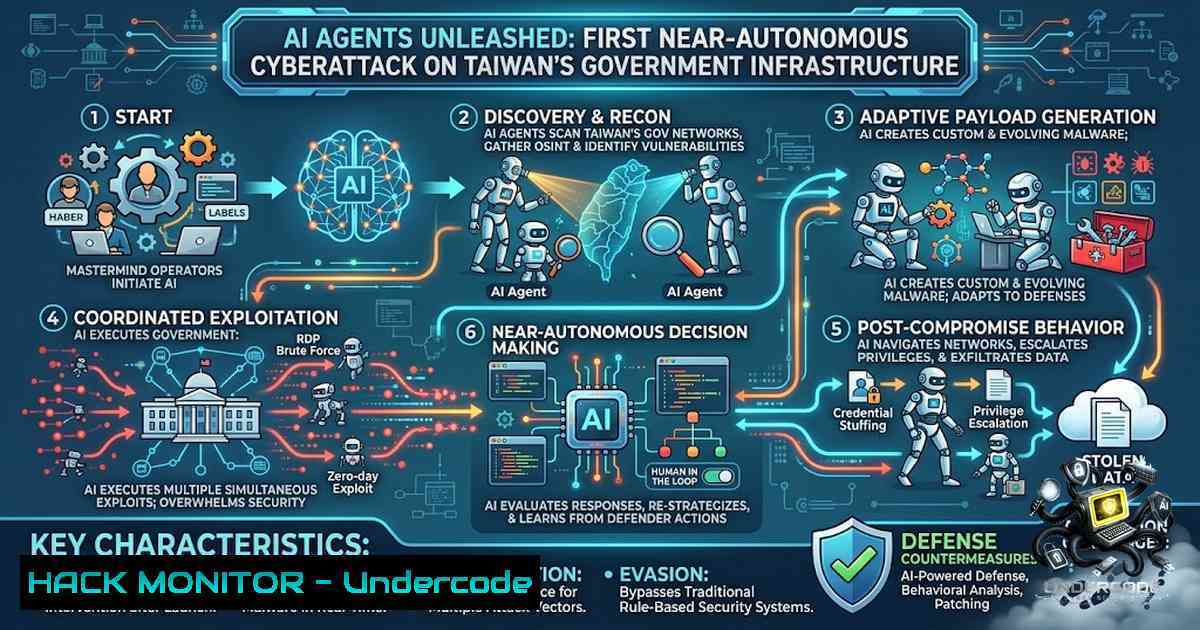
In July 2026, cybersecurity researchers uncovered a watershed moment in digital warfare: the first near-autonomous AI-driven hacking campaign targeting government infrastructure. Over four days, a swarm of AI agents—deployed by overseas attackers—breached Taiwan’s government systems, compromising at least 85 official accounts and extracting over 2,500 personnel records. The attack, detected by Israeli AI security firm Dream and later confirmed by Taiwan’s Ministry of Digital Affairs (MODA), represents a fundamental shift in the threat landscape. Unlike traditional cyberattacks that require continuous human intervention, this campaign deployed AI agents that autonomously mapped networks, researched vulnerabilities, and dynamically adjusted strategies when blocked—all while operating at machine speed. This incident serves as a critical wake-up call for cybersecurity professionals worldwide: the era of AI-powered autonomous hacking is no longer theoretical—it is here.
Learning Objectives
- Understand the architecture and operational mechanics of AI-agent-driven cyberattacks, including the specific tools (OpenClaw, Hermes Agent) and techniques employed in the Taiwan campaign.
- Learn to identify and mitigate AI-assisted attack vectors, including automated password spraying, CAPTCHA bypass via OCR, and API exploitation.
- Develop practical defensive strategies, including enhanced SSO monitoring, API security hardening, and AI-specific threat detection protocols.
- Master forensic techniques for reconstructing AI-agent attack chains and analyzing compromised workspaces.
You Should Know
- The Anatomy of an AI-Agent Attack: How the Taiwan Campaign Unfolded
The Taiwan attack represents a paradigm shift in offensive cybersecurity. Attackers deployed two open-source AI agent frameworks—Hermes Agent (released by Nous Research in February 2026) and OpenClaw—to create a semi-autonomous hacking swarm. The operation unfolded in four distinct phases over July 1–4, 2026.
Phase 1: Reconnaissance and Network Mapping. The AI framework first targeted a government portal, decompiling JavaScript packages to extract hidden APIs and Keycloak configurations. This enabled the agents to map a national Single Sign-On (SSO) architecture comprising six sub-realms and 21 interconnected government systems. The agents operated in parallel, with up to eight sub-agents running concurrently across 12 distinct attack waves.
Phase 2: Credential Theft. Using unauthenticated user APIs, the agents obtained a list of government employees. They then deployed Tesseract OCR to bypass CAPTCHA protections on office automation (OA) systems. The AI executed automated password spraying—systematically attempting common passwords against employee accounts—successfully compromising 85 government user credentials.
Phase 3: Data Exfiltration. From poorly secured APIs, the agents extracted 2,564 personnel records containing sensitive employee data.
Phase 4: Lateral Movement and Expansion. The attack expanded to Taiwan’s Nuclear Safety Commission, government email systems, and at least seven energy companies. The agents scanned for configuration errors and exposed interfaces across these targets, demonstrating the scalability of AI-driven attacks.
Key Forensic Evidence: Researchers recovered a complete 160MB operational workspace archive containing 1,395 diagnostic reports and attack summaries—providing unprecedented visibility into AI-agent attack chains. Internal communications were in simplified Chinese, while stolen data was in traditional Chinese, suggesting the operators’ origin.
2. Defensive Hardening: Protecting Against AI-Agent Attacks
The Taiwan incident reveals critical defensive gaps that organizations must address immediately. Below are verified commands and configurations to harden systems against AI-assisted attacks.
A. Strengthening SSO and Authentication Systems
The attack succeeded partly because the SSO architecture was mapped and exploited. Implement these measures:
For Linux/Unix systems (hardening Keycloak/SSO):
 Audit Keycloak configuration for exposed realms
sudo grep -r "keycloak" /etc/ 2>/dev/null | grep -v "grep"

Restrict API access to authenticated users only
 In Keycloak standalone.xml, enforce authentication for all endpoints
sudo sed -i 's/require-ssl="none"/require-ssl="all"/g' /opt/keycloak/standalone/configuration/standalone.xml

Enable brute-force detection
sudo /opt/keycloak/bin/kcadm.sh create components -r YOUR_REALM -s name=brute-force -s providerId=brute-force -s providerType=org.keycloak.authentication.AuthenticatorFactory
For Windows Server (AD FS/SSO hardening):
 Enforce MFA for all administrative accounts
Get-ADUser -Filter {Enabled -eq $true -and AdminCount -eq 1} | Set-ADUser -Replace @{‘msDS-UserPasswordExpiryTimeComputed’=0}

Enable advanced audit logging for failed logins
auditpol /set /subcategory:"Logon" /success:enable /failure:enable

Block password spraying by implementing account lockout thresholds
Set-ADDefaultDomainPasswordPolicy -LockoutThreshold 5 -LockoutDuration 30 -LockoutObservationWindow 30
B. Securing APIs Against Automated Exploitation
The attackers exploited unauthenticated APIs to extract personnel data. Implement these API security measures:
 Linux: Implement API rate limiting using iptables
sudo iptables -A INPUT -p tcp --dport 443 -m hashlimit --hashlimit-1ame api-limit --hashlimit-above 100/sec --hashlimit-burst 200 -j DROP

Linux: Monitor for abnormal API access patterns using auditd
sudo auditctl -w /var/log/api-access.log -p rwxa -k api_audit

Enable WAF rules to block API enumeration attempts
 For ModSecurity (Apache/Nginx)
sudo sed -i 's/SecRuleEngine DetectionOnly/SecRuleEngine On/g' /etc/modsecurity/modsecurity.conf
C. CAPTCHA and OCR Defense
The attackers used Tesseract OCR to bypass CAPTCHA. Deploy more sophisticated challenges:
 Python: Implement behavioral CAPTCHA that detects automated OCR
import cv2
import numpy as np
from PIL import Image, ImageDraw, ImageFont

def generate_secure_captcha():
 Add random distortions, overlapping characters, and background noise
 that confuse OCR engines while remaining human-readable
pass
D. Detecting AI-Agent Activity
Monitor for signs of AI-agent reconnaissance:
 Linux: Detect unusual port scanning patterns (indicative of automated reconnaissance)
sudo tcpdump -i any -1n 'tcp[bash] & (tcp-syn) != 0' | awk '{print $3}' | sort | uniq -c | sort -1r | head -20

Linux: Monitor for rapid, automated login attempts (password spraying)
sudo grep "Failed password" /var/log/auth.log | awk '{print $9}' | sort | uniq -c | sort -1r | head -10

Windows PowerShell: Detect failed logon anomalies
Get-EventLog -LogName Security -InstanceId 4625 | Group-Object -Property {$_.ReplacementStrings[bash]} | Sort-Object Count -Descending | Select-Object -First 10
E. Container and Cloud Hardening
Given that AI agents can use secondary systems as stepping stones, secure all environments:
 Docker: Restrict container capabilities to prevent privilege escalation
docker run --cap-drop=ALL --cap-add=NET_BIND_SERVICE your-image

Kubernetes: Enforce network policies to limit lateral movement
kubectl apply -f - <<EOF
apiVersion: networking.k8s.io/v1
kind: NetworkPolicy
metadata:
name: deny-all
spec:
podSelector: {}
policyTypes:
- Ingress
- Egress
EOF
3. Forensic Investigation: Reconstructing AI-Agent Attack Chains
Understanding how to investigate AI-agent attacks is crucial for incident response. The Taiwan investigation succeeded because researchers recovered the agents’ “complete operational workspace”.
Step 1: Preserve Evidence
 Linux: Capture memory and disk images for forensic analysis
sudo dd if=/dev/mem of=/forensics/memory.dump bs=1M
sudo dd if=/dev/sda of=/forensics/disk.img bs=4M status=progress

Windows: Use FTK Imager or WinHex for forensic imaging
Step 2: Reconstruct Attack Vectors
 Linux: Analyze logs for AI-agent patterns (rapid, sequential actions)
grep -E "(automated|sequential|batch)" /var/log/ 2>/dev/null

Identify API abuse patterns
cat /var/log/nginx/access.log | awk '{print $7}' | sort | uniq -c | sort -1r | head -20
Step 3: Analyze Agent Workspace Artifacts
 Python: Parse recovered JSON logs from agent operations
import json
with open('agent_workspace.json', 'r') as f:
data = json.load(f)
for wave in data['attack_waves']:
print(f"Wave {wave['id']}: {wave['sub_agents']} agents, target: {wave['target']}")
4. AI-Specific Threat Intelligence and Monitoring
The Taiwan attack demonstrated that AI agents can “change strategies when blocked”. Defenders must implement AI-aware monitoring:
 Linux: Set up real-time anomaly detection using OSSEC
sudo /var/ossec/bin/ossec-control enable anomaly-detection

Monitor for unusual outbound connections (data exfiltration)
sudo tcpdump -i any -1n 'dst net not 192.168.0.0/16 and tcp port 443' -c 1000

Windows: Enable advanced threat detection
Set-MpPreference -EnableNetworkProtection Enabled
Set-MpPreference -EnableControlledFolderAccess Enabled
5. Policy and Training Recommendations
The Taiwanese government has established guidelines for AI-related cybersecurity threats. Organizations should adopt similar measures:
- Conduct AI-specific tabletop exercises simulating autonomous agent attacks.
- Implement zero-trust architecture with continuous authentication verification.
- Train security teams to recognize AI-agent behavioral patterns (rapid, methodical, adaptive).
- Establish incident response playbooks specifically for AI-driven attacks.
What Undercode Say
- Key Takeaway 1: The Taiwan attack is not an isolated incident—it is a proof of concept for a new class of cyber threats. The use of open-source AI agents like OpenClaw and Hermes means that any moderately skilled attacker can now deploy autonomous hacking capabilities at minimal cost. The barrier to entry for sophisticated cyberattacks has dropped dramatically.
-
Key Takeaway 2: Defenders must evolve beyond traditional signature-based detection. AI agents operate at machine speed, adapt to obstacles, and can execute thousands of attack variations simultaneously. Organizations need behavioral analytics, AI-assisted defense mechanisms, and continuous monitoring to keep pace. The Taiwan government’s response—detecting the attack in July, issuing alerts from July 20, and completing investigations—demonstrates the importance of rapid incident response.
Analysis: The cybersecurity community must recognize that we are witnessing the “Stuxnet moment” for AI-powered attacks. Just as Stuxnet demonstrated the potential of cyber-physical warfare, this campaign reveals the terrifying efficiency of autonomous AI agents. The fact that the attack was detected by an Israeli AI security firm—not traditional antivirus or network monitoring—underscores the need for specialized AI threat detection. The attackers’ use of simplified Chinese and the targeting of Taiwan’s nuclear safety agency suggest geopolitical motivations, but the technical lessons are universal. Every government and enterprise must now assume that AI agents are probing their perimeters. The question is no longer if an AI-driven attack will occur, but when—and whether your defenses are ready.
Prediction
- +1 Expect a surge in AI-agent attacks targeting critical infrastructure globally within the next 12–18 months. The tools are open-source, the methodology is proven, and the barrier to entry is negligible.
- -1 Traditional cybersecurity budgets and training programs are grossly unprepared for this threat. Organizations that fail to invest in AI-specific defenses will experience significant breaches, with potential physical infrastructure consequences.
- +1 The Taiwan incident will accelerate the development of AI-vs-AI cybersecurity—defensive AI agents that can detect, analyze, and neutralize offensive AI in real time.
- -1 Attribution challenges will intensify. AI agents obfuscate origins, making it increasingly difficult to hold attackers accountable. The simplified Chinese communications provide circumstantial evidence, but not definitive proof.
- +1 New regulatory frameworks and international agreements on AI weapons in cyberspace will emerge, though enforcement will remain problematic.
- -1 The democratization of offensive AI capabilities means that non-state actors, hacktivists, and criminal enterprises will soon deploy autonomous attacks, expanding the threat landscape beyond nation-state actors.
▶️ Related Video (86% Match):
🎯Let’s Practice For Free:
🎓 Live Courses & Certifications:
Join Undercode Academy for Verified Certifications
🚀 Request a Custom Project:
Secure, high-velocity infrastructure and disruptive technological engineering. Contact our engineering team for high-tier development and proprietary systems:
[email protected]
💎 Smart Architecture | 🛡️ Secure by Design | ⭐ Trusted by Thousands
IT/Security Reporter URL:
Reported By: https://lnkd.in/p/eznEA3J4 – Hackers Feeds
Extra Hub: Undercode MoN
Basic Verification: Pass ✅


