Listen to this Post
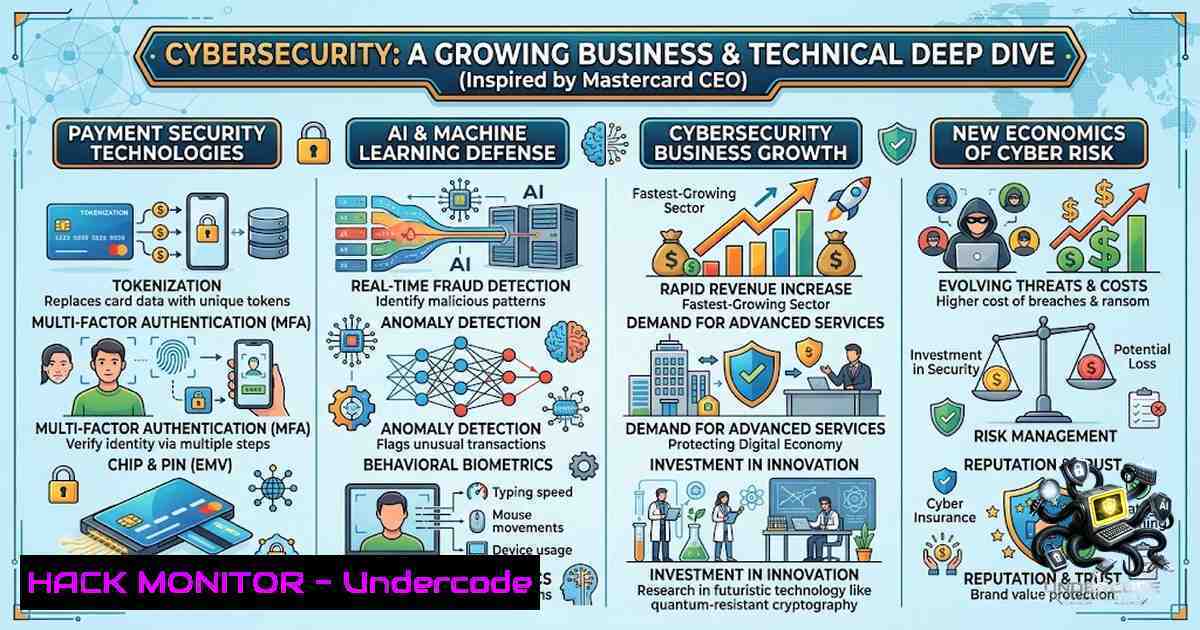
Introduction:
When Mastercard CEO Michael Miebach states that cybersecurity has become the company’s fastest-growing business, it signals a fundamental shift in how the financial services industry views digital defense. With fraud and cyber risk-driven damage projected to reach $15.6 trillion by 2030—a figure that would rank as the world’s third-largest economy if cyber risk were a country—the payment giant’s strategic pivot reflects an industry-wide reckoning: cybersecurity is no longer a cost center but a profit center. This article explores Mastercard’s multi-layered cybersecurity strategy, from AI-powered fraud detection to proprietary data moats, stablecoin infrastructure security, and practical defense measures for security professionals.
Learning Objectives:
- Understand Mastercard’s cybersecurity growth strategy and its implications for the broader payments ecosystem
- Learn how AI and proprietary transaction data are being leveraged for advanced fraud detection and threat intelligence
- Acquire practical skills in API security testing, cloud hardening, and vulnerability mitigation relevant to financial services
- Explore the security implications of stablecoin infrastructure and machine-to-machine payments
You Should Know:
- The AI-Powered Defense Layer: How Mastercard Detects Fraud in Milliseconds
Mastercard processes over 150 billion transactions annually, analyzing each one in less than 50 milliseconds. At this scale, traditional rule-based fraud detection systems are insufficient. The company has deployed generative AI to double the speed at which it can detect potentially compromised cards, reduce false positives, and increase the speed of identifying merchants at risk from fraudsters by 300%.
Mastercard’s generative AI foundation model—trained on billions of anonymized payment transactions—functions as a large tabular model rather than a traditional large language model. Unlike standard machine learning techniques that require data scientists to manually engineer features, this model independently learns which transaction characteristics matter most, identifying legitimate but infrequent transactions (such as a wedding ring purchase) that typically trigger false positives.
Practical Application – API Security Testing for Payment Systems:
For security professionals testing payment APIs, the following commands can help identify common vulnerabilities:
Linux – Testing API Endpoints with cURL:
 Test for rate limiting vulnerabilities
for i in {1..100}; do curl -X POST https://api.payment-gateway.com/v1/authorize \
-H "Content-Type: application/json" \
-d '{"card":"4111111111111111","amount":100}' & done

Check for sensitive data exposure in responses
curl -X GET https://api.payment-gateway.com/v1/transactions/12345 \
-H "Authorization: Bearer $TOKEN" | jq '.'

Test for injection vulnerabilities
curl -X POST https://api.payment-gateway.com/v1/validate \
-d "input=1' OR '1'='1"
Windows – Using PowerShell for Security Testing:
 Test SSL/TLS configuration
Test-1etConnection -ComputerName api.payment-gateway.com -Port 443

Check certificate validity
Invoke-WebRequest -Uri https://api.payment-gateway.com/v1/health

Enumerate API endpoints (basic fuzzing)
$endpoints = @("v1/auth","v1/pay","v1/refund","v1/status")
foreach ($ep in $endpoints) {
try { Invoke-RestMethod -Uri "https://api.payment-gateway.com/$ep" -Method Get -ErrorAction Stop }
catch { Write-Host "Endpoint $ep returned: $($_.Exception.Message)" }
}
- The Data Moat: Proprietary Transaction Data as a Competitive Advantage
Mastercard’s deepest competitive moat is its proprietary transaction data. The company processes billions of transactions annually across a global network, accumulating petabytes of permissioned data including card transaction data, identity data, device data, biometric data, real-time payments data, open banking data, and commercial card transaction data.
This data estate enables Mastercard to train AI models that no LLM creator can replicate. In March 2026, Mastercard announced it was building a generative AI foundation model trained on billions of anonymized payment transactions, positioning it as an insights engine for payments and commerce with applications in cybersecurity, loyalty programs, personalization, portfolio optimization, and data analytics.
Practical Application – Cloud Hardening for Financial Data:
When securing cloud environments that handle sensitive transaction data, implement these measures:
Linux – Cloud Security Hardening Commands:
 Audit IAM roles and permissions
aws iam list-roles | jq '.Roles[] | select(.AssumeRolePolicyDocument | contains("Action"))'

Check for publicly accessible S3 buckets
aws s3 ls | while read bucket; do
aws s3api get-bucket-acl --bucket $bucket | grep -i "AllUsers" && echo "WARNING: $bucket is public"
done

Enable CloudTrail for audit logging
aws cloudtrail create-trail --1ame payment-audit-trail --s3-bucket-1ame audit-logs-bucket
aws cloudtrail start-logging --1ame payment-audit-trail

Set up VPC flow logs for network monitoring
aws ec2 create-flow-logs --resource-ids vpc-12345 --resource-type VPC --traffic-type ALL \
--log-destination-type cloud-watch-logs --log-group-1ame payment-flow-logs
Windows – Azure Security Configuration:
 Enable Azure Defender for SQL
Enable-AzSqlServerAdvancedThreatProtection -ResourceGroupName "payment-rg" -ServerName "payment-sql"

Configure network security groups
$nsg = Get-AzNetworkSecurityGroup -1ame "payment-1sg" -ResourceGroupName "payment-rg"
Add-AzNetworkSecurityRuleConfig -1etworkSecurityGroup $nsg -1ame "DenyAll" -Protocol "" -SourcePortRange "" -DestinationPortRange "" -Access Deny -Priority 4000 -Direction Inbound

Enable diagnostic settings for key vault
Set-AzDiagnosticSetting -ResourceId (Get-AzKeyVault -VaultName "payment-kv").ResourceId -Enabled $true -StorageAccountId (Get-AzStorageAccount -1ame "paymentlogs").Id
3. Stablecoin Infrastructure Security: The BVNK Acquisition
In August 2026, Mastercard completed its acquisition of stablecoin infrastructure firm BVNK in a deal valued at up to $1.8 billion. This makes Mastercard the first major listed payments network to buy directly into stablecoin rails rather than partner for them. BVNK processes roughly $30 billion in annualized payment volume across approximately 200 countries and territories.
BVNK holds regulatory authorization under the European Union’s Markets in Crypto-Assets (MiCA) framework, an electronic money license covering European markets, and recognized security accreditations for its payment systems. This regulatory history allows Mastercard to offer stablecoin services to supervised banks immediately.
Practical Application – Blockchain and Smart Contract Security:
For security professionals auditing stablecoin infrastructure:
Linux – Blockchain Security Scanning:
 Install Slither for smart contract analysis
pip3 install slither-analyzer

Run static analysis on smart contracts
slither ./contracts/Stablecoin.sol --print human-summary

Check for common vulnerabilities
slither ./contracts/Stablecoin.sol --detect reentrancy-eth,unchecked-lowlevel,unchecked-send

Use Mythril for symbolic execution
myth analyze ./contracts/Stablecoin.sol --solc-json solc.json

Monitor blockchain transactions for suspicious activity
curl -s -X POST https://api.etherscan.io/api?module=account&action=txlist&address=0x...&apikey=YOUR_API_KEY | jq '.result[] | select(.value > 1000000000000000000)'
Windows – Node Security Configuration:
 Secure Ethereum node configuration
$config = @"
{
"rpcport": 8545,
"rpccorsdomain": "localhost",
"rpcapi": "eth,net,web3",
"txpool.nolocals": false,
"txpool.journal": "transactions.rlp"
}
"@
$config | Out-File -FilePath "C:\ethereum\config.json"

Enable firewall rules for blockchain nodes
New-1etFirewallRule -DisplayName "Allow Ethereum P2P" -Direction Inbound -Protocol TCP -LocalPort 30303 -Action Allow
New-1etFirewallRule -DisplayName "Allow Ethereum RPC" -Direction Inbound -Protocol TCP -LocalPort 8545 -Action Allow -RemoteAddress 127.0.0.1
4. Machine-to-Machine Payments and Agentic Commerce Security
Mastercard CEO Michael Miebach has identified machine-to-machine payments as a transformative force in B2B commerce. The company’s Agent Pay protocol enables AI shopping agents to complete payments with other agents on behalf of their humans—a new layer of commerce that operates almost continuously at machine speed.
This paradigm introduces novel security challenges: authentication between machines, authorization of agent-initiated transactions, and prevention of agent manipulation or impersonation. Mastercard is addressing these through tokenization technology, which serves as the pillar of digital payments, enabling security without sacrificing user experience.
Practical Application – OAuth 2.0 and JWT Security for Machine-to-Machine Communication:
Linux – JWT Token Security Testing:
 Decode and inspect JWT tokens
jwt_decode() {
echo $1 | cut -d. -f2 | base64 -d 2>/dev/null | jq '.'
}

Check for weak JWT signatures (none algorithm)
echo "eyJhbGciOiJub25lIiwidHlwIjoiSldUIn0.eyJzdWIiOiIxMjM0NTY3ODkwIiwibmFtZSI6IkpvaG4gRG9lIiwiaWF0IjoxNTE2MjM5MDIyfQ." | jwt_decode

Generate strong JWT with RS256
openssl genrsa -out private.pem 2048
openssl rsa -in private.pem -pubout -out public.pem
 Use JWT library to sign with RS256

Test OAuth 2.0 token endpoint
curl -X POST https://auth.payment-gateway.com/oauth/token \
-H "Content-Type: application/x-www-form-urlencoded" \
-d "grant_type=client_credentials&client_id=$CLIENT_ID&client_secret=$CLIENT_SECRET"
Windows – PowerShell JWT Validation:
 Validate JWT token expiration and signature
function Test-JWTToken {
param([bash]$Token)
$parts = $Token.Split('.')
$header = [System.Text.Encoding]::UTF8.GetString([System.Convert]::FromBase64String($parts[bash]))
$payload = [System.Text.Encoding]::UTF8.GetString([System.Convert]::FromBase64String($parts[bash]))
$payloadObj = $payload | ConvertFrom-Json
if ($payloadObj.exp -lt (Get-Date -UFormat %s)) {
Write-Host "Token expired" -ForegroundColor Red
} else {
Write-Host "Token valid until: $(Get-Date -UnixTimeSeconds $payloadObj.exp)" -ForegroundColor Green
}
return $payloadObj
}
5. Vulnerability Exploitation and Mitigation in Payment Systems
The payment industry faces a sophisticated threat landscape. Fraudsters use advanced tactics like deepfakes, infostealers, and AI-driven bots to increase the speed and scale of their attacks. Mastercard’s response includes SafetyNet, which has prevented €70 billion in fraudulent transactions over the past decade, and Mastercard Threat Intelligence, a platform that monitors payment fraud across the ecosystem.
Practical Application – Vulnerability Assessment Commands:
Linux – Network and Application Scanning:
 Nmap scan for open ports and services
nmap -sV -sC -p- -T4 target.payment-gateway.com

Nikto web server vulnerability scanning
nikto -h https://api.payment-gateway.com -ssl -Format html -o scan_report.html

SQLMap for database injection testing
sqlmap -u "https://api.payment-gateway.com/v1/transaction?id=1" --dbs --batch

OpenSCAP for system compliance scanning
oscap xccdf eval --profile xccdf_org.ssgproject.content_profile_stig --results scan_results.xml /usr/share/xml/scap/ssg/content/ssg-rhel9-ds.xml

Log analysis for suspicious patterns
grep -E "failed|denied|attack|malicious" /var/log/nginx/access.log | awk '{print $1}' | sort | uniq -c | sort -1r
Windows – PowerShell Security Scanning:
 Check for vulnerable services using Test-1etConnection
$ports = @(21,22,23,25,80,443,445,1433,3306,3389,8080,8443)
foreach ($port in $ports) {
$result = Test-1etConnection -ComputerName "target-server" -Port $port -WarningAction SilentlyContinue
if ($result.TcpTestSucceeded) { Write-Host "Port $port is open" -ForegroundColor Yellow }
}

Audit Windows event logs for security events
Get-WinEvent -LogName Security | Where-Object { $_.Id -in 4624,4625,4648 } |
Select-Object TimeCreated, Id, Message |
Out-File -FilePath "security_audit.log"

Check for suspicious scheduled tasks
Get-ScheduledTask | Where-Object { $<em>.State -1e "Disabled" } |
ForEach-Object {
$action = ($</em>.Actions | Select-Object -First 1)
if ($action -and $action.Execute -match "powershell|cmd|wscript") {
Write-Host "Suspicious task: $($_.TaskName)" -ForegroundColor Red
}
}
What Undercode Say:
- Key Takeaway 1: Mastercard’s cybersecurity growth validates the shift from cybersecurity as a cost center to a profit center. Security professionals should position themselves at the intersection of AI, data analytics, and threat intelligence—the exact skill sets Mastercard is acquiring and developing.
-
Key Takeaway 2: The BVNK acquisition signals that stablecoin infrastructure security will be a critical growth area. Professionals with expertise in blockchain security, MiCA compliance, and smart contract auditing will find increasing demand as traditional payment networks integrate with decentralized finance.
Analysis: Mastercard’s strategy reveals several trends that security professionals must internalize. First, AI is not replacing security analysts but augmenting them—the generative AI model identifies patterns that humans cannot see at scale, but human judgment remains essential for interpreting results and making strategic decisions. Second, proprietary data is the new oil in cybersecurity; organizations that control unique data sets will have an insurmountable advantage in threat detection. Third, the convergence of traditional payments with blockchain infrastructure creates new attack surfaces that require hybrid security skills—understanding both legacy financial systems and decentralized technologies. Fourth, the scale of cyber risk ($15.6 trillion by 2030) means that security spending will continue to grow, but only for solutions that demonstrate measurable ROI in fraud prevention. Finally, the rise of agentic commerce and machine-to-machine payments will require rethinking authentication and authorization models entirely—traditional user-based security frameworks will not suffice when machines are transacting autonomously.
Prediction:
- +1 Cybersecurity will become a standard line item in corporate P&L statements as a revenue driver, not just an operational expense, accelerating investment in AI-driven defense platforms.
-
+1 The demand for professionals with combined expertise in AI/ML, blockchain security, and traditional network security will outpace supply, driving significant salary growth in these specialized roles over the next 3-5 years.
-
-1 The rapid adoption of agentic commerce without corresponding advances in machine authentication will create a wave of AI-agent exploitation attacks, potentially causing billions in losses before adequate countermeasures are developed.
-
-1 As stablecoin infrastructure integrates with traditional payment rails, regulatory gaps between jurisdictions will create arbitrage opportunities for cybercriminals, leading to increased cross-border fraud incidents.
-
+1 Mastercard’s investment in cybersecurity—over $10 billion EUR in the past five years—will set a benchmark that forces competitors to match, ultimately raising the overall security posture of the entire financial services industry.
▶️ Related Video (60% Match):
https://www.youtube.com/watch?v=0eRq0fwRPew
🎯Let’s Practice For Free:
🎓 Live Courses & Certifications:
Join Undercode Academy for Verified Certifications
🚀 Request a Custom Project:
Secure, high-velocity infrastructure and disruptive technological engineering. Contact our engineering team for high-tier development and proprietary systems:
[email protected]
💎 Smart Architecture | 🛡️ Secure by Design | ⭐ Trusted by Thousands
IT/Security Reporter URL:
Reported By: https://lnkd.in/p/eZvzpiwb – Hackers Feeds
Extra Hub: Undercode MoN
Basic Verification: Pass ✅


