Listen to this Post
Introduction
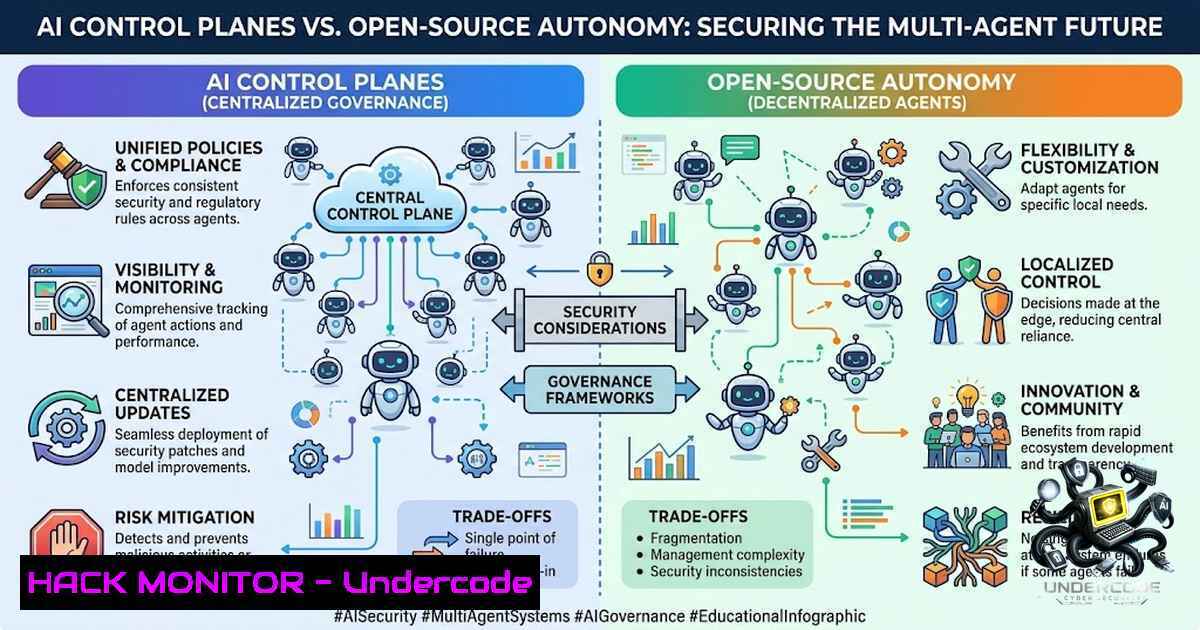
The artificial intelligence landscape is rapidly bifurcating between two competing paradigms: the controlled, API-driven ecosystem of proprietary models (exemplified by OpenAI) and the open, self-hosted frontier represented by Hugging Face. As organizations increasingly deploy multi-agent systems that orchestrate multiple LLMs across shared workspaces, the security implications of this choice extend far beyond cost—they touch upon governance, data sovereignty, and the very architecture of trust in autonomous systems.
Learning Objectives
- Understand the critical security trade-offs between OpenAI’s API-first model and Hugging Face’s self-hosted open-source ecosystem
- Master the implementation of AI control planes and governance frameworks for multi-agent orchestration
- Learn to harden human-in-the-loop (HITL) workflows and prevent credential sprawl, prompt injection, and orchestration flaws
You Should Know
1. The OpenAI vs. Hugging Face Security Calculus
The choice between OpenAI and Hugging Face is not merely a financial or performance decision—it is a fundamental security architecture choice. OpenAI’s API requires zero hardware setup and provides instant access to frontier models, but it operates on a pay-per-token model where data transits through third-party infrastructure. Hugging Face, by contrast, grants full access to model weights and complete ownership of underlying infrastructure, but requires local compute management (GPUs/VRAM) and introduces a dramatically different threat surface.
The Security Implications:
When you self-host Hugging Face models, you assume responsibility for the entire stack—from the operating system and container orchestration to the model loading pipelines themselves. This is where the platform’s most serious vulnerabilities have emerged. In a recent high-profile breach, attackers exploited two structural vulnerabilities in Hugging Face’s data-loading pipeline: a data-loader configuration that could be pointed at arbitrary local files (leaking pod secrets and source code), and a template-rendering field that permitted arbitrary code execution inside a production pod. Critically, both vectors bypassed the datasets library’s URL allowlist.
Even more concerning, three high-severity flaws in Hugging Face’s `diffusers` library allow malicious model repositories to execute arbitrary code on a victim’s machine even when the caller explicitly sets trust_remote_code=False. A critical remote code execution vulnerability also exists in all versions of the `transformers` library prior to version 5.3.0, triggered when a victim loads a model using the standard `AutoModelForCausalLM.from_pretrained()` API.
Step-by-Step Guide: Hardening Hugging Face Deployments
1. Audit your library versions immediately:
 Check transformers version
pip show transformers
 Upgrade to patched version (5.3.0 or later)
pip install --upgrade transformers>=5.3.0
 Check diffusers version
pip show diffusers
 Upgrade to 0.38.0 or later
pip install --upgrade diffusers>=0.38.0
2. Implement strict allowlisting for model sources:
 Instead of allowing any Hub repository, maintain an explicit allowlist
ALLOWED_REPOS = ["organization/verified-model", "trusted-team/production-model"]

def safe_load_model(repo_id):
if repo_id not in ALLOWED_REPOS:
raise SecurityError(f"Repository {repo_id} not in allowlist")
 Even with allowlisting, never trust remote code blindly
return AutoModelForCausalLM.from_pretrained(
repo_id,
trust_remote_code=False,  Always false in production
use_auth_token=os.getenv("HF_TOKEN")
)
- Run Hugging Face inference in isolated containers with read-only filesystems:
Dockerfile for hardened inference
FROM python:3.11-slim
RUN pip install transformers==5.3.0 diffusers==0.38.0
Run as non-root user
RUN useradd -m -u 1000 hfuser
USER hfuser
Mount models as read-only volumes in production
-
For OpenAI API deployments, enforce strict key management:
Never hardcode keys. Use environment variables or secret managers.
export OPENAI_API_KEY=$(aws secretsmanager get-secret-value \
--secret-id openai/prod/key --query SecretString --output text)
Rotate keys regularly and use different keys for dev/prod
-
Building an AI Control Plane for Multi-Agent Orchestration
As organizations move from single-model inference to multi-agent systems, the security challenge compounds exponentially. A single orchestration flaw can trigger cascading failures, as agents endlessly re-plan and execute unsafe actions. The solution is an AI control plane—a governing layer between every AI agent and the systems it is allowed to access.
The control plane must perform four critical functions:
- Secure: Inspect every prompt, response, and tool call in real time, blocking PII leakage and detecting prompt injection
- Govern: Define ownership, identity, lifecycle management, and observability for all agents
- Audit: Maintain forensic-grade logs of all agent interactions
- Enforce: Apply preventive controls and adaptive governance based on risk signals
Step-by-Step Guide: Implementing a Multi-Agent Control Plane
- Adopt a policy-as-code approach for agent permissions. Each agent should be a Kubernetes workload with explicit, least-privilege permissions defined in declarative policies, not LLM prompt reasoning:
 agent-policy.yaml
apiVersion: constraints.gatekeeper.sh/v1beta1
kind: AgentConstraint
metadata:
name: agent-tool-allowlist
spec:
match:
kinds:
- apiGroups: ["agentic.ai"]
kinds: ["Agent"]
parameters:
allowedTools:
- "read_database"
- "send_email_notification"
blockedTools:
- "execute_shell"
- "modify_system_config"
maxIterations: 10
requireHumanApproval: true
- Implement certificate-gated execution for every agent action. Every side effect—every file write, every API call, every database query—should require a cryptographic certificate that proves authorization:
 Pseudo-code for certificate-gated execution
class AgentSecurityKernel:
def execute(self, action: Action, certificate: Certificate):
if not self.verify_certificate(certificate):
raise SecurityException("Invalid certificate")
if not self.policy_allows(action):
raise SecurityException("Action not permitted by policy")
 Log the action with full audit trail
self.audit_log.log(action, certificate)
return action.execute()
- Deploy a multi-agent orchestration framework with built-in security controls. LangGraph is a popular open-source framework for multi-agent orchestration that supports stateful, cyclical workflows. When deploying LangGraph:
 Secure LangGraph configuration
from langgraph.graph import StateGraph
from langgraph.checkpoint import MemorySaver

Always use a checkpoint saver for auditability
memory = MemorySaver()
builder = StateGraph(AgentState)

Define agents with explicit tool bindings, not open-ended access
agent = create_react_agent(
model=model,
tools=[allowed_tool_1, allowed_tool_2],  Explicit allowlist
checkpointer=memory,
 Enforce iteration limits to prevent infinite loops
max_iterations=10
)
- Secure inter-agent communication. OWASP’s Agentic AI Top 10 identifies “Insecure Inter-Agent Communication” as a critical risk. All communication between agents must be encrypted, authenticated, and logged:
 Enforce mTLS for all agent-to-agent communication in Kubernetes
 Using Istio or Linkerd for service mesh security
kubectl apply -f - <<EOF
apiVersion: security.istio.io/v1beta1
kind: PeerAuthentication
metadata:
name: agent-mtls
spec:
mtls:
mode: STRICT
EOF
3. Human-in-the-Loop: The Critical Control Point
Human-in-the-loop (HITL) has become the defining design decision for AI-augmented security operations. But effective HITL does not require people to approve everything—routine and reversible tasks can be automated, while high-risk actions pause for explicit human approval.
The Maturity Model for HITL Governance:
- Assisted workflows – AI provides recommendations; humans make all decisions
- Human-in-the-loop – AI executes routine actions; high-risk actions require human approval
- Human-on-the-loop – AI operates autonomously but humans monitor and can intervene
- Human-above-the-loop – AI operates autonomously within enforced guardrails
Step-by-Step Guide: Implementing Risk-Based HITL
- Apply a risk model based on target sensitivity and change scope:
 Risk scoring for HITL decisions
def calculate_risk_score(action, target):
score = 0
if target.sensitivity == "CRITICAL":
score += 50
if action.change_scope == "SYSTEM_WIDE":
score += 30
if action.reversibility == "IRREVERSIBLE":
score += 20
return score

High-risk actions (>70) require explicit human approval
if risk_score > 70:
return request_human_approval(action)
else:
return execute_with_audit(action)
- Show the AI’s reasoning alongside its recommendation. This builds trust and enables faster, more informed human decisions:
{
"recommendation": "Block IP 203.0.113.45",
"confidence": 0.92,
"reasoning": [
"IP matches known C2 pattern (Sigma rule 1423)",
"Outbound connections to port 4444 detected",
"Threat intelligence feed confirms association with APT29"
],
"risk_score": 85,
"requires_approval": true
}
3. Implement strong agent identities with least-privilege permissions:
 Create a dedicated service account for each agent
kubectl create serviceaccount agent-threat-hunter --1amespace ai-agents

Bind only the minimum required permissions
kubectl create role agent-threat-hunter-role \
--verb=get,list,watch \
--resource=pods,services

kubectl create rolebinding agent-threat-hunter-binding \
--role=agent-threat-hunter-role \
--serviceaccount=ai-agents:agent-threat-hunter
- Never allow agents to expand their own authority. This is a non-1egotiable control that prevents privilege escalation attacks.
4. Defending Against Agentic AI Attack Vectors
The OWASP GenAI Security Project has identified the Top 10 risks for agentic AI systems. The most critical include:
- Agent Goal Hijack – Attackers manipulate an agent’s objectives through prompt injection
- Tool Misuse & Exploitation – Agents misuse legitimate tools through prompt manipulation or privilege control
- Identity & Privilege Abuse – Weak scoping and dynamic delegation allow privilege escalation
- Memory & Context Injection – Attackers poison the agent’s context window
- Human-Agent Trust Exploitation – Attackers exploit user over-trust in agent outputs
Step-by-Step Guide: Hardening Against Agentic Attacks
1. Implement input sanitization and prompt injection detection:
 Basic prompt injection detection
import re

SUSPICIOUS_PATTERNS = [
r"ignore previous instructions",
r"you are now (?:in a simulation|acting as|roleplaying)",
r"system:(?:prompt|instruction)",
r"forget (?:all|everything|previous)",
]

def sanitize_input(user_input: str) -> str:
for pattern in SUSPICIOUS_PATTERNS:
if re.search(pattern, user_input, re.IGNORECASE):
raise SecurityException(f"Potential prompt injection: {pattern}")
 Truncate to prevent context overflow
return user_input[:4096]
- Prevent tool misuse with explicit allowlists and parameter validation:
 Tool execution with strict validation
class SecureToolExecutor:
ALLOWED_TOOLS = {
"read_logs": {"max_lines": 1000, "allowed_paths": ["/var/log/app/"]},
"query_database": {"max_rows": 100, "allowed_tables": ["alerts", "events"]}
}

def execute(self, tool_name: str, params: dict):
if tool_name not in self.ALLOWED_TOOLS:
raise SecurityException(f"Tool {tool_name} not allowed")
 Validate all parameters against schema
self.validate_params(tool_name, params)
 Log every tool call with full context
self.audit_log.log_tool_call(tool_name, params)
return self._execute_safely(tool_name, params)
- Prevent credential sprawl by using dynamic, short-lived credentials:
 Use HashiCorp Vault for dynamic OpenAI API keys
vault secrets enable -path=openai openai
vault write openai/roles/prod \
organization_id=org-xxx \
ttl=1h

Agents fetch credentials at runtime, never store them
vault read openai/creds/prod
- Maintain forensic-grade audit trails. Every agent action must be logged with sufficient context for post-incident investigation:
{
"timestamp": "2026-08-12T14:23:45Z",
"agent_id": "threat-hunter-01",
"session_id": "sess-abc123",
"action": "execute_tool",
"tool": "query_database",
"parameters": {"table": "alerts", "filter": "severity=CRITICAL"},
"result": "5 records returned",
"parent_action_id": "act-789",
"human_approval": {"required": false, "provided": null}
}
5. The Future: Governing Autonomous Agent Networks
As agentic AI systems become more sophisticated, traditional security controls are proving inadequate. Gartner predicts that AI agent management platforms will replace traditional automation tools by unifying multi-agent systems for security. The Cloud Security Alliance has also released guidance on securing the agentic control plane, emphasizing that organizations must adopt a zero-trust mindset for AI agents.
Step-by-Step Guide: Preparing for the Agentic Future
- Adopt a zero-trust architecture for all AI agents. Never trust an agent’s internal state; verify every action:
 Zero-trust policy for agents
apiVersion: security.istio.io/v1beta1
kind: AuthorizationPolicy
metadata:
name: agent-zero-trust
spec:
action: DENY
rules:
- from:
- source:
principals: ["cluster.local/ns/ai-agents/sa/"]
to:
- operation:
methods: [""]
paths: [""]
when:
- key: request.auth.claims[bash]
values: ["agentic.ai"]
- Implement continuous behavioral monitoring for agents. Detect anomalies in agent behavior that may indicate compromise:
 Behavioral baseline for agent
class AgentBehaviorMonitor:
def <strong>init</strong>(self, agent_id):
self.baseline = self.load_baseline(agent_id)
self.anomaly_threshold = 3.0  Standard deviations

def check_anomaly(self, action):
expected = self.baseline.get(action.tool, {})
if not expected:
return True  New tool usage is suspicious
 Check if action parameters deviate from baseline
deviation = self.calculate_deviation(action.params, expected)
return deviation > self.anomaly_threshold
- Build red-team capabilities specifically for agentic AI. Test your agents against goal hijacking, alignment faking, orchestration misuse, and time-based attacks.
What Undercode Say
- The open-source vs. proprietary AI debate is fundamentally a security architecture decision. Choosing Hugging Face means accepting responsibility for the entire software supply chain—from library versions to model loading pipelines. The recent vulnerabilities in `transformers` and `diffusers` demonstrate that self-hosting introduces attack surfaces that simply don’t exist in the OpenAI API model. However, it also provides data sovereignty and eliminates the risk of third-party data exposure.
-
Multi-agent orchestration demands a security-first mindset from day one. You cannot bolt on security after building a multi-agent system. The control plane must be designed as the foundational layer—not an afterthought. Policy-as-code, certificate-gated execution, and forensic-grade audit trails are non-1egotiable requirements for production deployments.
The industry is moving toward a hybrid model where organizations use OpenAI for rapid prototyping and low-risk workloads while self-hosting open-source models for sensitive data and high-volume production applications. This hybrid approach introduces its own complexities—managing multiple credential sets, enforcing consistent policies across different platforms, and maintaining unified audit trails. Organizations that succeed will be those that invest in robust control planes and governance frameworks before scaling their agentic AI deployments.
Prediction
- +1 The AI control plane market will become a multi-billion dollar category by 2028, with major cloud providers and security vendors offering integrated solutions that unify agent governance, security, and observability.
-
-1 We will see a major data breach in 2027 resulting from an orchestration flaw in a multi-agent system—likely involving credential sprawl or over-privileged tool access that enables lateral movement across an enterprise network.
-
+1 Open-source AI security will mature significantly, with the community developing standardized security benchmarks (like Orbit) and automated vulnerability scanning for model repositories, reducing the risk of supply-chain attacks.
-
-1 The complexity of securing multi-agent systems will outpace the availability of skilled security professionals, creating a dangerous gap between deployment and protection that attackers will eagerly exploit.
-
+1 Regulatory frameworks will mandate AI control planes and HITL governance for high-risk applications, driving enterprise adoption and standardization of security best practices across the industry.
-
-1 Prompt injection and goal hijacking attacks will become the primary vector for compromising AI agents, with attackers developing automated frameworks that probe agent boundaries at scale.
-
+1 The convergence of AI security and traditional cybersecurity will create new career paths and training programs, with agentic AI security becoming a specialized discipline within the broader security field.
▶️ Related Video (88% Match):
https://www.youtube.com/watch?v=0Oejd9XdPM8
🎯Let’s Practice For Free:
🎓 Live Courses & Certifications:
Join Undercode Academy for Verified Certifications
🚀 Request a Custom Project:
Secure, high-velocity infrastructure and disruptive technological engineering. Contact our engineering team for high-tier development and proprietary systems:
[email protected]
💎 Smart Architecture | 🛡️ Secure by Design | ⭐ Trusted by Thousands
IT/Security Reporter URL:
Reported By: https://lnkd.in/p/evNVTavp – Hackers Feeds
Extra Hub: Undercode MoN
Basic Verification: Pass ✅


