Listen to this Post
Introduction:
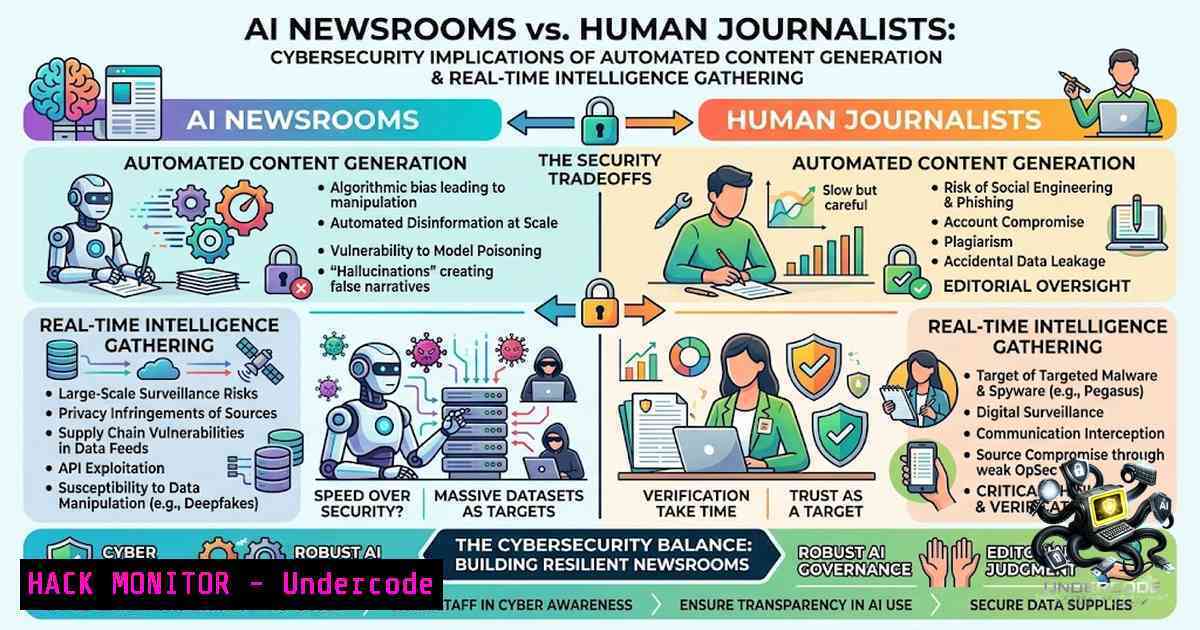
The recent revelation that an AI-operated newsroom, RuntimeWire, beat established outlets like WIRED to a breaking story about OpenAI’s hacking incident signals a paradigm shift in how information is gathered, processed, and disseminated. This event is not merely a media disruption; it is a profound cybersecurity development, as it demonstrates how automated systems can scrape, synthesize, and publish sensitive technical information from live events, court databases, and social feeds at machine speed. For security professionals, this raises critical questions about data leakage, the reliability of AI-sourced intelligence, and the potential for automated systems to be manipulated into spreading misinformation or exposing vulnerabilities before they can be patched.
Learning Objectives:
- Understand the architecture and operational workflow of AI-driven newsrooms and their implications for real-time intelligence gathering.
- Identify the cybersecurity risks associated with automated content generation, including data scraping, legal exposure, and the amplification of misinformation.
- Learn to implement technical controls and monitoring strategies to detect and mitigate the risks posed by AI-generated content and automated data extraction.
You Should Know:
- The Anatomy of an AI Newsroom: Automated Data Scraping and Content Synthesis
RuntimeWire’s operation is a case study in automated intelligence gathering. The system crawls the internet, including court databases, web forums, traditional media, company filings, and social feeds, to identify newsworthy events. When a potential story is detected—such as an OpenAI executive posting about a conference on X—the system ingests the raw data (e.g., a live stream transcript) and feeds it to large language model (LLM) agents that draft, edit, fact-check, and publish the article. This entire process, from detection to publication, can take as little as six minutes.
Step‑by‑step guide explaining what this does and how to use it:
For security researchers and IT professionals, understanding this workflow is crucial for defending against automated data harvesting and for leveraging similar techniques for threat intelligence.
- Data Source Identification: The first step involves defining the sources to monitor. This can include public APIs, RSS feeds, social media streams, and web scraping targets.
- Automated Collection: Use tools like
curl,wget, or Python libraries (requests,BeautifulSoup) to fetch data from these sources. For example, to fetch a webpage:curl -s https://example.com/api/live-feed | jq '.'
- Content Extraction and Parsing: Extract relevant information from the raw data. This often involves parsing HTML, JSON, or XML. For structured data like JSON:
cat data.json | jq '.events[] | {title: .title, timestamp: .time}' - LLM Integration: Feed the extracted, structured data into an LLM via its API (e.g., OpenAI API, Claude API) with a prompt that instructs the model to synthesize a news article or summary.
import openai response = openai.ChatCompletion.create( model="gpt-4", messages=[{"role": "user", "content": f"Write a news article based on: {extracted_data}"}] ) - Automated Publication: Use a Content Management System (CMS) API to automatically publish the generated content. For WordPress, for instance:
wp post create --post_title="AI-Generated Report" --post_content="$(cat article.txt)" --post_status=publish
- Risk Assessment: Implement a legal and factual risk scoring system. This can be a separate AI agent that evaluates the content for defamation, inaccuracies, or sensitive data exposure before publication.
-
The Cybersecurity Blind Spot: Data Leakage and Misinformation Amplification
The speed and scale of AI newsrooms introduce significant cybersecurity risks. First, the automated scraping of court databases, company filings, and social feeds can inadvertently expose sensitive information that was not intended for public consumption. Second, the reliance on LLMs introduces the risk of “hallucinations” or the propagation of inaccuracies. As noted in the WIRED article, AI tools like ChatGPT and Claude surfaced AI-written sources 16 percent of the time when tested across four different topics, creating a feedback loop where AI-generated content is used as source material for other AI systems. This can lead to the rapid amplification of false information, which can have severe consequences for vulnerability disclosure and incident response.
Step‑by‑step guide to mitigating these risks:
- Implement Data Loss Prevention (DLP): Monitor outbound network traffic for signs of automated scraping. Use tools like `snort` or `suricata` to detect and block suspicious patterns.
Example Suricata rule to detect scraping
alert http $HOME_NET any -> $EXTERNAL_NET any (msg:"Possible Web Scraping"; flow:to_server,established; http.request_header; content:"User-Agent|3a| Python-urllib"; sid:1000001;)
- Content Authenticity Verification: For organizations that publish content, implement cryptographic signing or watermarking to verify the authenticity of official communications. This can help distinguish legitimate sources from AI-generated fabrications.
- Source Credibility Scoring: When using AI for intelligence gathering, implement a credibility scoring system for sources. This can be based on domain reputation, historical accuracy, and the presence of human editorial oversight.
- Human-in-the-Loop (HITL) for Critical Information: For high-stakes information, such as zero-day vulnerability disclosures, mandate human review before any action is taken. This can be enforced through a workflow automation tool like Jenkins or Apache Airflow.
Pseudo-code for a HITL workflow
if risk_score > THRESHOLD:
send_alert_to_human_analyst(vulnerability_data)
wait_for_human_approval()
else:
auto_publish(vulnerability_data)
3. Tool Configurations for Monitoring AI-Generated Threats
Security teams can leverage existing tools to monitor for and analyze AI-generated content that may pose a threat. This includes setting up SIEM (Security Information and Event Management) alerts for mentions of your organization in AI-generated articles and using OSINT (Open Source Intelligence) frameworks to track the spread of misinformation.
Step‑by‑step guide:
- Set up RSS/API Monitoring: Use tools like `RSSHub` or `n8n` to create workflows that monitor for new articles from known AI newsrooms.
- Integrate with SIEM: Feed the monitored data into a SIEM like Splunk or Elastic Stack. Use queries to detect mentions of your domain, IP addresses, or proprietary product names.
index=main source="ai_news_feed" "your_domain.com" | stats count by source
- Sentiment and Risk Analysis: Use NLP libraries (e.g.,
spaCy,transformers) to analyze the sentiment and risk level of the detected content.from transformers import pipeline classifier = pipeline("text-classification", model="your-fine-tuned-model") result = classifier("AI-generated article content here") - Automated Takedown Requests: If false or damaging information is detected, set up an automated workflow to generate and send takedown requests to the hosting provider or platform.
- Cloud Hardening: Ensure that your public-facing cloud assets are properly configured to prevent unauthorized scraping. Use AWS WAF, Azure WAF, or Cloudflare to block known scraper user-agents and IP ranges.
Terraform example for AWS WAF rule
resource "aws_wafv2_web_acl" "example" {
name = "block-scrapers"
scope = "REGIONAL"
rule {
name = "block-bad-user-agents"
priority = 1
action {
block {}
}
statement {
byte_match_statement {
field_to_match {
single_header { name = "user-agent" }
}
positional_constraint = "CONTAINS"
search_string = "python-requests"
text_transformation {
priority = 1
type = "NONE"
}
}
}
}
}
4. API Security and the Automation of Intelligence
The operational backbone of AI newsrooms is the extensive use of APIs—both for fetching data (e.g., social media APIs, court database APIs) and for publishing content (e.g., CMS APIs). This dependency introduces API-specific security vulnerabilities, including insecure API keys, lack of rate limiting, and inadequate authentication.
Step‑by‑step guide to securing APIs in an automated environment:
- Secure API Key Management: Never hardcode API keys in scripts or code repositories. Use environment variables or a secrets management tool like HashiCorp Vault.
export OPENAI_API_KEY="your-secure-key"
- Implement Rate Limiting: On the server side, enforce strict rate limiting to prevent abuse. On the client side, implement exponential backoff to avoid being blocked.
import time
def call_api_with_retry(endpoint, max_retries=5):
for i in range(max_retries):
response = requests.get(endpoint)
if response.status_code == 200:
return response
time.sleep(2 i)  Exponential backoff
- Input Validation and Sanitization: When using LLMs, ensure that the prompts and data fed into them are sanitized to prevent prompt injection attacks.
- Audit API Access Logs: Regularly review API access logs to detect unusual patterns, such as a sudden spike in requests from a single IP address.
Linux command to grep API logs for anomalies grep "GET /api/v1/" /var/log/nginx/access.log | awk '{print $1}' | sort | uniq -c | sort -1r -
Vulnerability Exploitation and Mitigation in the AI Supply Chain
The AI newsroom model introduces a new attack vector: the manipulation of the data sources that AI agents rely on. An attacker could inject false information into a court database or social feed, knowing that an AI agent will scrape, synthesize, and publish it, potentially causing stock manipulation or reputational damage.
Step‑by‑step guide to mitigating supply chain attacks:
- Source Verification: Implement cryptographic verification of data sources where possible. For example, use digital signatures to verify the authenticity of SEC filings.
- Anomaly Detection: Use statistical models to detect anomalies in data sources. A sudden, unexpected change in a company’s filing data could indicate manipulation.
- Redundancy and Cross-Validation: Do not rely on a single source. Cross-validate information from multiple, independent sources before taking action.
- Incident Response Plan: Develop an incident response plan specifically for AI-generated misinformation. This should include steps for internal communication, public relations, and legal action.
What Undercode Say:
- Key Takeaway 1: The speed and automation of AI newsrooms present both an opportunity and a threat to cybersecurity, enabling rapid intelligence gathering while also increasing the risk of data leakage and misinformation.
- Key Takeaway 2: Security professionals must adapt by implementing robust monitoring, data validation, and incident response strategies that account for the unique challenges posed by AI-generated content and automated data scraping.
The rise of AI-driven journalism, as exemplified by RuntimeWire and The Dissent, is not a distant future scenario—it is happening now. The ability of these systems to scrape, synthesize, and publish information at machine speed means that the window for organizations to respond to a data leak or a vulnerability disclosure has shrunk from hours to minutes. This demands a shift from reactive to proactive security posture, where continuous monitoring and automated threat intelligence are no longer optional. Furthermore, the legal and ethical gray areas—such as the use of AI agents to find scoops and the subsequent retraction of stories as a “favor” to founders—highlight the need for clear guidelines and regulations governing the use of AI in information gathering and dissemination.
Prediction:
- -1 The proliferation of AI newsrooms will lead to an increase in “flash crashes” and market volatility as automated trading algorithms react to AI-generated news articles before human verification can occur.
- -1 The feedback loop where AI systems consume and regurgitate AI-generated content will accelerate the degradation of information quality, making it increasingly difficult to distinguish fact from fiction, thereby complicating incident response and threat intelligence efforts.
- +1 The need for robust AI-driven threat intelligence and automated incident response will drive innovation in cybersecurity tools, leading to the development of more sophisticated defense mechanisms that can operate at machine speed.
- +1 The rise of AI journalism will create new specialized roles in cybersecurity, such as “AI Content Forensics Analysts,” who are trained to detect and mitigate the impact of AI-generated misinformation.
▶️ Related Video (76% Match):
🎯Let’s Practice For Free:
🎓 Live Courses & Certifications:
Join Undercode Academy for Verified Certifications
🚀 Request a Custom Project:
Secure, high-velocity infrastructure and disruptive technological engineering. Contact our engineering team for high-tier development and proprietary systems:
[email protected]
💎 Smart Architecture | 🛡️ Secure by Design | ⭐ Trusted by Thousands
IT/Security Reporter URL:
Reported By: https://lnkd.in/p/euN8aezk – Hackers Feeds
Extra Hub: Undercode MoN
Basic Verification: Pass ✅


