
Listen to this Post
Introduction:
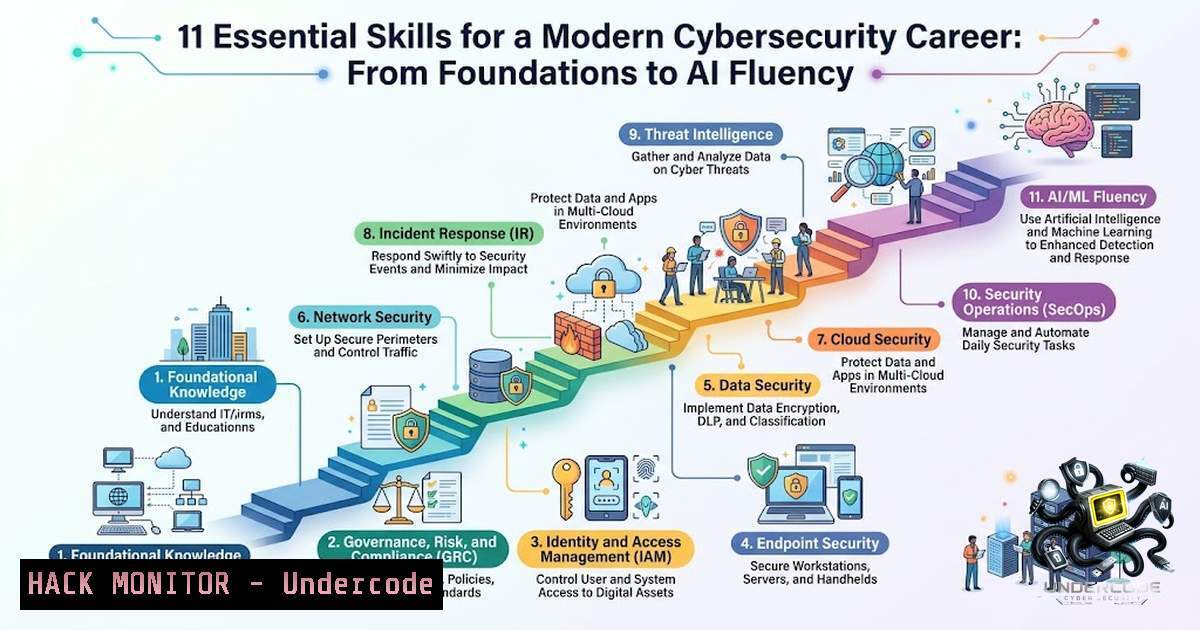
The cybersecurity landscape is evolving rapidly, moving beyond the stereotypical image of a lone hacker in a hoodie. Today, the field demands a holistic blend of deep technical prowess, business acumen, and adaptability. Building a career in this domain requires mastering a diverse set of skills that range from configuring network switches to communicating risk to C-suite executives, all while staying ahead of threats powered by artificial intelligence.
Learning Objectives & Secrets:
- Objective 1: Master the Foundational Trinity (Networking, OS, and Scripting) – Build a solid, unshakeable base. Without understanding how data travels (Networking) and how systems process it (Operating Systems), you cannot effectively defend or attack them. Scripting (Python, Bash, PowerShell) is the force multiplier that automates this knowledge into action.
- Objective 2 Secret Tips: Build a Home Lab – Apply your knowledge immediately. Use virtual machines (VMware/VirtualBox) to set up a domain controller, a Windows 10 workstation, and a Kali Linux machine. Break them, fix them, and break them again. This replicates real-world enterprise complexity and accelerates practical learning.
- Objective 3 Secret Tips: Think Like an Attacker, Act Like an Engineer – For Web Security and IAM, don’t just learn the theory. Practice on platforms like PortSwigger Web Security Academy and HackTheBox. Approach each challenge by asking, “What is the root cause of this vulnerability, and how would an engineer remediate it?” This dual perspective is invaluable.
You Should Know:
1. Foundation Deep Dive: Networking & Operating Systems
This is the bedrock of your career. You need to understand how devices communicate and how operating systems function at a kernel level to both secure and bypass them. A strong foundation allows you to accurately scope attacks, troubleshoot connectivity issues, and harden systems.
Step‑by‑step guide:
- Network Reconnaissance: In a test lab, run `netstat -tulpn` (Linux) or `netstat -an` (Windows) to visualize all active listening ports and established connections. This is a primary command for identifying malicious or unauthorized services.
- OS Hardening: Create a baseline security policy.
- Linux: Implement `chmod 600 /etc/shadow` to restrict access to the shadow password file and use `ufw enable` to activate a basic firewall.
- Windows: Open `secpol.msc` and enforce “Audit Account Logon Events” and “Audit Logon Events” to track authentication attempts. Using `gpupdate /force` applies the new policy immediately.
- Service Identification: Use `nmap -sV -p-
` to perform a version scan on all ports to understand the exact services and their versions running on a system.
2. Automation Powerhouse: Scripting & Tool Configuration
Scripting is not just about writing code; it’s about automating the mundane, eliminating human error, and scaling your security posture. This includes customizing tools to fit specific environments.
Step‑by‑step guide:
- Python Port Scanner: Write a simple Python script to check for open ports. This teaches socket programming and basic automation.
import socket target = "127.0.0.1" for port in range(1, 1025): sock = socket.socket(socket.AF_INET, socket.SOCK_STREAM) sock.settimeout(1) result = sock.connect_ex((target, port)) if result == 0: print(f"Port {port}: Open") sock.close() - Windows Automation with PowerShell: Automate the collection of system logs. `Get-WinEvent -LogName Security -MaxEvents 10 | Format-List` fetches the latest security events, a core task for incident response.
- Tool Customization: For
Burp Suite, configure the upstream proxy settings (User options -> Connections -> Upstream proxy) to route traffic through a specific gateway, enabling you to test applications in complex network architectures.
3. The Battleground: Web Security & Cloud Fundamentals
Web applications are the primary attack vector, and cloud infrastructure is the new data center. Mastering OWASP Top 10 and cloud service models (IaaS, PaaS, SaaS) is non-1egotiable. You must understand how to exploit and mitigate flaws like SQL Injection, XSS, and misconfigurations.
Step‑by‑step guide:
- API Security Check: Use `curl` to test an API endpoint for proper authorization. `curl -X GET -H “Authorization: Bearer
” https://api.example.com/user/123`. If you can change the ID to 124 and receive a response, an IDOR vulnerability exists.
– Cloud Hardening (AWS example): Auditing S3 bucket permissions. Using the AWS CLI, run `aws s3api get-bucket-acl –bucket` to list grants. If `AllUsers` or `AuthenticatedUsers` have `READ` access, it’s a public bucket that needs immediate remediation. - Automated Web Scanning: Integrate `ZAP` (Zed Attack Proxy) into a CI/CD pipeline. A headless scan can be triggered with `zap-cli quick-scan –self-contained –start-options ‘-config api.disablekey=true’ http://testapp.local` to identify baseline vulnerabilities in new builds.
4. Data Forensics: Log Analysis & Intelligence
Logs are the lifeblood of incident response. Proficiency in SIEM tools and command-line log parsing is critical for detecting and investigating threats. You need to filter the noise to find the signal.
Step‑by‑step guide:
- Linux Log Analysis: Investigate SSH brute-force attacks by analyzing
/var/log/auth.log. Use `grep “Failed password” /var/log/auth.log | awk ‘{print $9}’ | sort | uniq -c | sort -1r` to identify the IPs with the most failed login attempts. - Windows Event Logs: Use `wevtutil qe Security /c:20 /f:text /q:”[System[EventID=4625]]”` to query the Security log for the last 20 failed logon events. This is a core command for a DFIR analyst.
- Building a Dashboard: Use the open-source ELK stack (Elasticsearch, Logstash, Kibana) to ingest logs and create visualizations. For instance, a Kibana dashboard can graph real-time HTTP 404/403 errors, quickly pinpointing potential web scanning or directory brute-forcing attempts.
- The Human Element: Business, Risk, and Clear Writing
Technical skills are only half the battle. You must translate technical risks into business language to secure funding and C-level buy-in. Writing clear, concise reports that articulate the ‘what,’ ‘so what,’ and ‘now what’ is a superpower.
Step‑by‑step guide:
- Risk Assessment Framework: When you identify a critical vulnerability (e.g., unpatched Apache Log4j), you must calculate its risk. Use a simple formula:
Risk = (Likelihood Impact). Document this in a Remediation Plan. - Executive Summary: “The unpatched Apache Log4j library in our web application presents a ‘Critical’ risk. An unauthenticated attacker can gain Remote Code Execution (RCE). This could lead to a full data breach, impacting customer trust and resulting in significant regulatory fines.”
- Technical Details: List the vulnerable files and CVE identifier.
- Remediation Steps: Prioritize patching, list the `.jar` files to update, and propose a timeline for the IT team.
- Business Impact Analysis (BIA): For each asset, determine the maximum allowable downtime (RTO) and data loss (RPO). This directly influences the design of the security architecture and backup strategies.
What Undercode Say:
- Key Takeaway 1: The 80/20 Rule for Growth – Focus 20% of your time on theory and 80% on practical application. Start with a base skill like Networking, and immediately apply it in a lab. This creates a cycle of active recall that solidifies knowledge far more effectively than passive reading. The list provided is a curriculum, but the secret is to build a homelab that forces you to learn all of them at once.
- Key Takeaway 2: The “Problem → Cause → Remediation” Mindset – This is the ultimate differentiator. Move beyond simply exploiting a vulnerability. For every security issue you discover, map it back to its root cause (e.g., developer oversight, misconfiguration, lack of input sanitization) and propose a permanent, systemic fix. This holistic approach turns you from a tool-user into a security engineer.
Analysis:
The post succinctly encapsulates the modern cybersecurity landscape. It moves beyond the “pentester” role to include IT, GRC, and AI, reflecting the need for security professionals to be business enablers. The focus on “Problem → Cause → Remediation” is crucial; it shifts the mindset from exploitation to engineering, which is what organizations desperately need. The inclusion of “AI Fluency” is particularly prescient, as this is an emerging threat vector and an area where attackers will weaponize generative AI for sophisticated phishing and malware generation. The core message is about building a “T-shaped” professional—deep in a few areas (like Web & Networking) and broad enough to understand the entire ecosystem.
Prediction:
- +1 The democratization of cybersecurity knowledge, as championed by professionals sharing roadmaps like this, will significantly shrink the global skills gap and lead to more standardized, competent entry-level talent.
- +1 As AI Fluency becomes a basic requirement, security teams will increasingly use AI agents to automate threat hunting and log analysis, allowing human analysts to focus on complex problem-solving and strategic remediation.
- -1 The rapid evolution of cloud and web technologies will outpace traditional education, leading to a surge in “hybrid vulnerabilities” (e.g., misconfigured cloud APIs combined with web flaws) that require this exact multidisciplinary skillset to defend against. Professionals who lack any of these 11 skills will become liabilities.
▶️ Related Video (82% Match):
🎯Let’s Practice For Free:
🎓 Live Courses & Certifications:
Join Undercode Academy for Verified Certifications
🚀 Request a Custom Project:
Secure, high-velocity infrastructure and disruptive technological engineering. Contact our engineering team for high-tier development and proprietary systems:
[email protected]
💎 Smart Architecture | 🛡️ Secure by Design | ⭐ Trusted by Thousands
IT/Security Reporter URL:
Reported By: https://lnkd.in/p/eUqkh-_Q – Hackers Feeds
Extra Hub: Undercode MoN
Basic Verification: Pass ✅


