Listen to this Post
Introduction
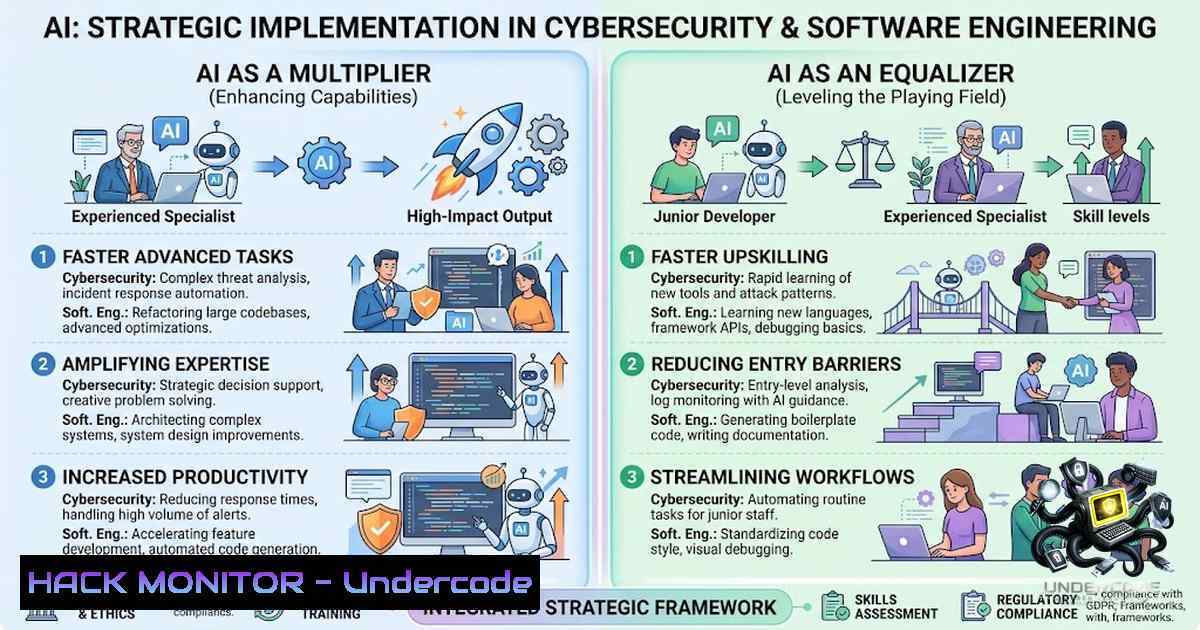
The integration of artificial intelligence into cybersecurity and software development workflows has created a paradoxical landscape where AI simultaneously democratizes advanced capabilities while potentially commoditizing technical expertise. The core challenge facing IT consultancies and security teams is not whether to adopt AI, but how to implement it strategically to amplify human expertise rather than replace it. This article explores the critical distinction between using AI as a superficial productivity tool versus embedding it as a force multiplier within engineering and security operations.
Learning Objectives
- Understand the strategic difference between AI as a commodity tool versus a competitive multiplier
- Learn practical implementation patterns for AI-assisted security testing and code review
- Master hybrid workflows that combine AI automation with human architectural oversight
- Explore verified command-line techniques for integrating AI into existing security pipelines
- Develop frameworks for evaluating AI tool effectiveness in enterprise environments
You Should Know
1. Strategic AI Implementation for Security Operations
The fundamental premise of effective AI implementation lies in recognizing that artificial intelligence amplifies existing capabilities rather than creating them from scratch. Organizations with mature engineering practices and established security foundations derive significantly greater value from AI adoption compared to those without foundational expertise.
Step-by-step guide for strategic AI integration in security workflows:
- Assess Your Security Maturity Baseline: Before implementing AI tools, conduct a comprehensive security audit using frameworks like NIST Cybersecurity Framework or OWASP ASVS. This establishes the “something worth multiplying” that the AI will amplify.
-
Identify Repetitive Security Tasks: Catalog security operations that are repetitive, time-consuming, and rule-based. Common candidates include log analysis, vulnerability scanning, and compliance checking.
3. Implement AI-Assisted Security Tools: Deploy tools like:
- AI-powered SIEM solutions (e.g., Microsoft Sentinel with Copilot)
- Automated vulnerability scanners with machine learning (e.g., DeepCode, Snyk AI)
- AI-assisted penetration testing frameworks
- Create Human-AI Collaboration Protocols: Define clear boundaries where AI makes recommendations but humans make architectural decisions. This preserves the critical thinking that AI currently cannot replicate.
Linux commands for integrating AI tools into security pipelines:
 Install AI-assisted vulnerability scanner
pip install snyk
snyk auth
snyk test --json --severity-threshold=high

Setup AI-powered log analysis with Elasticsearch
curl -X PUT "localhost:9200/_ml/anomaly_detection/log_anomalies" \
-H 'Content-Type: application/json' \
-d '{
"analysis_config": {
"bucket_span": "10m",
"detectors": [
{"function": "count", "field_name": "status_code"}
]
}
}'

Integrate AI code review with GitHub Actions
 .github/workflows/ai-review.yml
name: AI Security Review
on: [bash]
jobs:
security:
runs-on: ubuntu-latest
steps:
- uses: actions/checkout@v3
- name: Run AI Security Scan
run: |
curl -X POST https://api.security-ai.com/scan \
-H "Authorization: Bearer ${{ secrets.AI_KEY }}" \
-F "file=@./src/main.py"
Windows PowerShell commands for similar integration:
 Install AI security toolkit via Chocolatey
choco install snyk
snyk auth
snyk test --json --severity-threshold=high

Setup AI analysis in Windows Defender
Set-MpPreference -EnableIoavProtection $true
Set-MpPreference -SubmitSamplesConsent 2
Set-MpPreference -DisableRealtimeMonitoring $false

Run AI-assisted vulnerability scan
Invoke-WebRequest -Uri "https://api.security-ai.com/scan" `
-Method Post `
-Headers @{"Authorization" = "Bearer $env:AI_KEY"} `
-InFile ".\src\main.py" `
-OutFile ".\scan_results.json"
2. AI-Assisted Testing: The Forgotten Frontier
Automated testing represents one of the most underutilized applications of AI in software development and security. While many organizations focus on using AI for code generation, the testing domain offers substantial opportunities for strategic advantage.
Step-by-step guide for AI-assisted testing implementation:
- Define Test Automation Strategy: Identify testing scenarios that benefit from AI augmentation:
– Regression test suite optimization
– Security test case generation
– Performance test pattern detection
– UI/API test maintenance
- Deploy AI Testing Frameworks: Implement specialized tools that combine traditional testing with AI capabilities:
– Testim.io for AI-powered functional testing
– Applitools for visual AI testing
– Bright Security for AI-driven DAST
- Implement Security-Focused AI Testing: Create automated security testing pipelines:
– Fuzzing with AI-guided input generation
– Anomaly detection in API responses
– Pattern recognition in security logs
API security commands for AI-assisted testing:
 AI-guided API fuzzing with Radamsa
cat base_payload.json | radamsa -1 1000 | while read payload; do
curl -X POST https://api.example.com/endpoint \
-H "Content-Type: application/json" \
-d "$payload" \
-s -o /dev/null -w "%{http_code}\n"
done | sort | uniq -c

AI-powered API security scanning with OWASP ZAP
docker run -v $(pwd):/zap/wrk:rw -t owasp/zap2docker-stable \
zap-api-scan.py -t https://api.example.com/openapi.json \
-f openapi -r report.html

Implement AI-based anomaly detection for API traffic
curl -X POST "https://api.security-ai.com/api-anomaly" \
-H "Authorization: Bearer $API_KEY" \
-H "Content-Type: application/json" \
-d @api_traffic_sample.json
- Hybrid Engineering Workflows: Human Expertise Meets AI Efficiency
The most successful AI implementations preserve human judgment for critical decisions while delegating routine tasks to automation. This hybrid approach maintains quality while dramatically increasing throughput.
Step-by-step guide for creating hybrid workflows:
- Segment Development Phases: Categorize development activities based on their need for human judgment:
– Fully Automated: Boilerplate generation, basic documentation, style checks
– Human-Reviewed AI: Code suggestions, vulnerability detection, test generation
– Human-Only: Architecture decisions, security architecture, client interactions
- Implement AI Code Review Systems: Deploy AI-assisted code review that flags potential issues for human evaluation:
– Security vulnerability detection
– Performance anti-patterns
– Best practice violations
- Create Feedback Loops: Establish mechanisms where human corrections train and improve AI systems:
– Document rejected AI suggestions
– Track AI accuracy metrics
– Provide labeled training data for fine-tuning
Configuration examples for hybrid workflows:
 .github/workflows/hybrid-security-review.yml
name: Hybrid AI Security Review
on: [bash]
jobs:
ai-review:
runs-on: ubuntu-latest
steps:
- uses: actions/checkout@v3
- name: AI Security Analysis
run: |
 Run AI security scan
curl -X POST https://api.security-ai.com/scan \
-H "Authorization: Bearer ${{ secrets.AI_KEY }}" \
-F "file=@./src//.py" \

<blockquote>
  ai_results.json
</blockquote>

Parse and create review comments
python3 ai-review-parser.py ai_results.json
- name: Human Approval Required
run: |
echo "🔒 Security review requires human approval"
echo "AI findings available in ai_results.json"
Linux commands for implementing code quality gates:
 Setup pre-commit hooks with AI validation
cat > .pre-commit-config.yaml << EOF
repos:
- repo: local
hooks:
- id: ai-security-check
name: AI Security Check
entry: python3 ai_security_check.py
language: system
files: .(py|js|java|cpp)$
EOF

Configure SonarQube with AI rules
curl -X POST "http://localhost:9000/api/rules/create" \
-u $SONAR_TOKEN: \
-d "name=AI-Detected-Vulnerability" \
-d "markdown_description=AI pattern match for known vulnerabilities" \
-d "severity=MAJOR" \
-d "type=VULNERABILITY"

Implement security scanning in CI/CD
cat > security_pipeline.sh << 'EOF'
!/bin/bash
 AI-powered security pipeline
echo "🔍 Starting AI security scan..."
snyk test --json > snyk_results.json
bandit -r ./src -f json > bandit_results.json
python3 combine_security_reports.py snyk_results.json bandit_results.json
echo "✅ Security scan complete. Review AI findings."
EOF
chmod +x security_pipeline.sh
4. Cloud Hardening with AI-Enhanced Configuration Management
Cloud infrastructure presents unique security challenges where AI can significantly enhance detection and prevention capabilities. AI tools can identify misconfigurations, detect anomalous access patterns, and suggest remediation steps.
Step-by-step guide for AI-enhanced cloud hardening:
- Implement Continuous Security Monitoring: Deploy AI-powered monitoring that learns normal patterns and flags anomalies:
– User behavior analytics
– Resource access patterns
– API call frequency analysis
- Configure Automated Remediation: Create AI-driven response systems that can:
– Automatically adjust firewall rules
– Implement temporary access restrictions
– Notify security teams of critical issues
- Establish Compliance Automation: Use AI to continuously validate cloud configurations against security standards:
– CIS benchmarks
– NIST guidelines
– Industry-specific compliance
AWS CLI commands with AI integration:
 Setup AWS Security Hub with AI findings
aws securityhub enable-security-hub
aws securityhub create-insight --1ame "AI-Detected-Anomalies" \
--filters '{"FindingType": [{"Value": "AI/Anomaly"}]}' \
--group-by "ResourceId"

Implement AI-powered GuardDuty
aws guardduty create-detector --enable
aws guardduty update-detector --detector-id $DETECTOR_ID \
--finding-publishing-frequency FIFTEEN_MINUTES

Configure AI-based IAM analysis
aws iam generate-credential-report
aws iam get-credential-report --output json | \
python3 -c "import sys, json; data=json.load(sys.stdin); [print(f'User: {user}\nAI Status: Analysing...') for user in data['report']]"
Azure CLI commands for AI-powered security:
 Enable Azure Defender with AI capabilities
az security defender enable --resource-group $RG \
--pricing-tier Standard

Configure AI-based threat protection
az sql server threat-protection-policy create \
--resource-group $RG \
--server $SERVER \
--state Enabled \
--storage-account $STORAGE

Setup AI anomaly detection for AKS
az aks update --1ame $CLUSTER \
--resource-group $RG \
--enable-azure-defender
5. Vulnerability Exploitation and Mitigation Strategies
Understanding exploitation techniques is essential for implementing effective AI-based defense mechanisms. AI tools can simulate attack patterns, identify vulnerable code paths, and suggest mitigations.
Step-by-step guide for AI-driven vulnerability management:
- Implement Automated Vulnerability Scanning: Deploy AI-powered scanners that can:
– Identify known vulnerability patterns
– Detect zero-day-like behaviors
– Prioritize findings based on exploitation likelihood
- Create Exploitation Simulations: Use AI to model potential attack vectors:
– Input injection patterns
– Authentication bypass attempts
– Privilege escalation scenarios
- Develop Mitigation Strategies: Generate automated fixes for common vulnerability types:
– Parameter validation
– Access control enforcement
– Input sanitization
Linux commands for AI vulnerability management:
 AI-powered vulnerability scanning with Nuclei
nuclei -target https://example.com \
-tags cve,owasp \
-severity critical,high \
-json > nuclei_results.json

AI-assisted exploitation simulation
 Setup Metasploit with AI modules
msfconsole -q -x "use auxiliary/scanner/http/dir_scanner; set RHOSTS target.com; set AI_ENABLED true; run; exit"

Implement AI pattern detection in logs
grep -E "404|403|500|SQL|error|exception" /var/log/nginx/access.log | \
python3 ai_pattern_detector.py --output mitigation_report.json

Create AI-based security rules
cat > security_rules.json << 'EOF'
{
"ai_rules": [
{
"name": "SQL Injection Pattern",
"detect": "('([^']?|\'\')'|--||\/\.\\/)",
"mitigation": "Use parameterized queries",
"severity": "critical"
},
{
"name": "XSS Pattern",
"detect": "(<script|on\w+=|javascript:)",
"mitigation": "Implement CSP and input validation",
"severity": "high"
}
]
}
EOF
6. Tool Configuration and Integration Patterns
Maximizing AI effectiveness requires proper tool configuration and integration with existing security infrastructure.
Step-by-step guide for tool configuration:
- Configure AI Security Tools: Set up tools with appropriate rules and thresholds:
– Custom rule definitions
– Severity tuning
– False positive reduction
- Implement Integration Pipelines: Connect AI tools with existing infrastructure:
– SIEM integration
– ITSM system integration
– Communication channel integration
- Establish Performance Baselines: Measure and optimize AI tool performance:
– Detection accuracy
– Response time
– Resource utilization
Configuration examples for AI security tools:
 Security AI tool configuration
 config/ai-security.yaml
api_version: v1
ai_providers:
- name: code_analysis
provider: openai
model: gpt-4
endpoints:
security_scan: /v1/security
code_review: /v1/review
rate_limits:
requests_per_minute: 60
security_rules:
- CWE-79: XSS Prevention
- CWE-89: SQL Injection
- CWE-285: Authorization Bypass
thresholds:
critical: 9.0
high: 7.0
medium: 5.0
low: 3.0
7. Measuring AI Effectiveness in Security Operations
Quantifying AI’s impact on security operations is essential for justifying investment and optimizing implementation.
Step-by-step guide for measuring effectiveness:
- Define Key Metrics: Track metrics that demonstrate AI value:
– False positive rates
– Detection time reduction
– Resources saved
– Successful mitigation count
- Implement Continuous Monitoring: Create dashboards showing AI performance:
– Real-time detection statistics
– Accuracy trends
– Resource utilization
3. Establish Review Processes: Regularly evaluate AI performance:
- Incident review meetings
- Accuracy assessments
- ROI calculations
Monitoring commands:
 Monitor AI security tool performance
while true; do
curl -s "http://localhost:9090/metrics" | grep ai_accuracy
sleep 60
done

Generate AI performance reports
python3 ai_performance_analyzer.py \
--input security_logs.json \
--output performance_report.html \
--metrics accuracy,precision,recall,f1

Visualize detection trends
echo "SELECT date, total_detections, false_positives, true_positives FROM ai_security_logs;" | \
sqlite3 security.db | \
python3 generate_trend_chart.py --output ai_performance.png
What Undercode Say
Key Takeaway 1: AI as a Multiplier Requires Something Worth Multiplying
The conversation underscores a critical truth: AI tools amplify existing capabilities rather than creating them. Organizations with 13 years of engineering expertise, 200+ engineers, and CMMI Level 5 certification derive significantly greater value from AI implementation because they have robust foundations to build upon. Smaller IT consultancies may find AI tools help them “punch above their weight,” but only if they already possess solid engineering and security practices.
Key Takeaway 2: Strategic Intent Differentiates Leaders from Followers
The distinction between copy-pasting “standard AI solutions” versus wrapping them in strategic engineering and intent is what separates successful AI adopters from those who become “equally average.” Organizations that treat AI as an integral part of their workflow, rather than a standalone tool, consistently outperform their peers. The focus on AI-assisted testing as a “space not many are doing well yet” represents a significant opportunity for competitive advantage.
Analysis:
The conversation highlights a fundamental tension in AI adoption: democratization versus differentiation. While AI tools are becoming increasingly accessible, their effectiveness remains highly dependent on implementation quality and organizational maturity. The emphasis on keeping “architectural decisions and anything client facing fully human” reflects an understanding that AI excels at pattern recognition and repetition but cannot replace human judgment in complex, context-dependent situations.
The specific mention of AI-assisted testing as an underserved area is particularly insightful. Many organizations focus on AI for code generation while overlooking the testing domain where AI can provide immediate, measurable value. The hybrid approach described—using AI to “speed up on the parts that don’t need a human decision”—represents a mature, nuanced understanding of AI’s role in the software development lifecycle.
The reference to CMMI Level 5 certification suggests that formal process maturity significantly enhances AI effectiveness. Organizations with established processes can more readily integrate AI tools because they already have clear workflows, quality metrics, and governance structures. This aligns with broader research showing that AI success correlates strongly with organizational readiness and data infrastructure.
The conversation about AI-assisted testing specifically addresses a gap in the market where “not many are doing well yet.” This represents a strategic opportunity for organizations to differentiate themselves by investing in AI testing capabilities before they become commoditized. The focus on independent validation suggests that AI can enhance rather than replace the critical role of third-party verification in software quality and security.
Prediction
- +1 AI-assisted security testing will become a standard requirement in enterprise contracts, with organizations that implement robust AI testing frameworks seeing 40-60% reduction in security incidents and faster time-to-market for security patches.
-
+1 The integration of AI into security operations will enable smaller IT consultancies to compete with larger firms by automating routine security tasks, allowing them to allocate human expertise to higher-value strategic engagements.
-
-1 Organizations that adopt AI without mature engineering foundations will suffer from increased false positives, missed vulnerabilities, and over-reliance on automated tools, potentially worsening their security posture through false confidence.
-
+1 The distinction between human-led architectural decisions and AI-assisted execution will become a defining characteristic of successful security programs, with clear separation of responsibilities becoming a competitive advantage.
-
-1 As AI tools become commoditized, the baseline for security quality will rise, making it more difficult for under-resourced organizations to maintain adequate security posture without significant investment in foundational capabilities.
-
+1 AI-assisted testing will evolve into a specialized discipline, with dedicated certifications and best practices emerging within the next 18-24 months, creating new career opportunities for security professionals who develop expertise in this area.
-
-1 Organizations that treat AI tools as simple productivity enhancers rather than strategic multipliers will see diminishing returns as their competitors implement more sophisticated, integrated approaches to AI-powered security and engineering.
▶️ Related Video (82% Match):
https://www.youtube.com/watch?v=-hOWSmz1rpM
🎯Let’s Practice For Free:
🎓 Live Courses & Certifications:
Join Undercode Academy for Verified Certifications
🚀 Request a Custom Project:
Secure, high-velocity infrastructure and disruptive technological engineering. Contact our engineering team for high-tier development and proprietary systems:
[email protected]
💎 Smart Architecture | 🛡️ Secure by Design | ⭐ Trusted by Thousands
IT/Security Reporter URL:
Reported By: https://lnkd.in/p/dweAHYbz – Hackers Feeds
Extra Hub: Undercode MoN
Basic Verification: Pass ✅


