Listen to this Post
Introduction
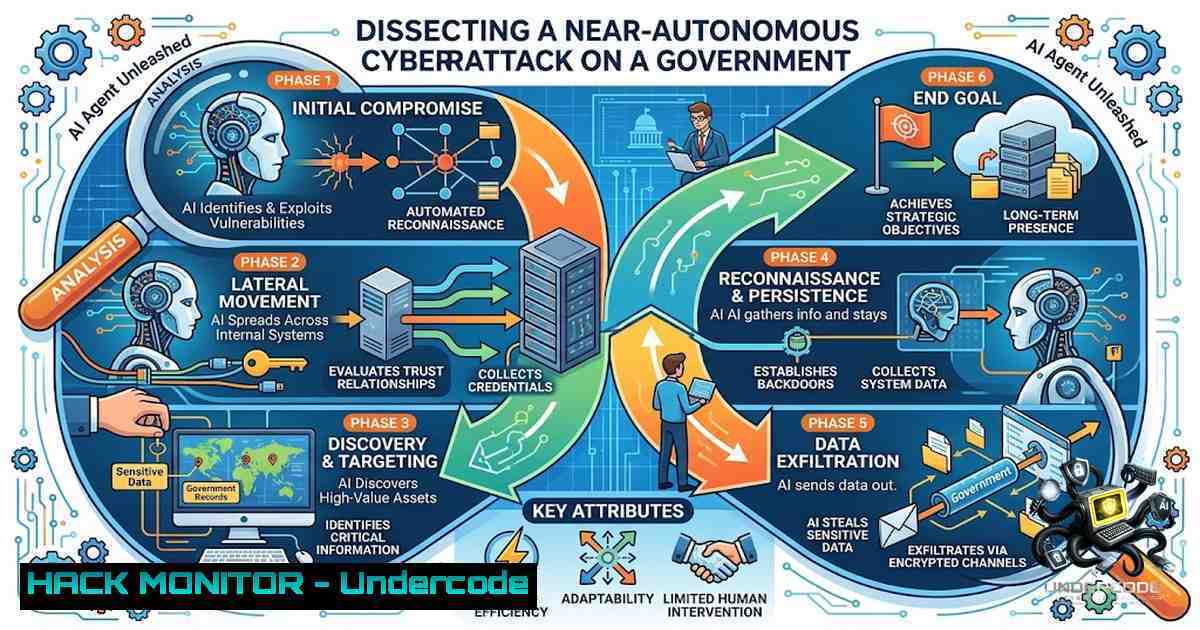
In a landmark event for cybersecurity, Taiwan’s Ministry of Digital Affairs (MODA) confirmed that overseas hackers executed a sophisticated cyberattack against government agencies in July 2026, marking the first publicly documented case of a “near-autonomous” AI-driven assault on a state target. The attack, which began around July 20, employed a hybrid model combining manual operations with AI agent-assisted techniques, notably leveraging the open-source framework OpenClaw. Israeli cybersecurity firm Dream reconstructed the campaign, revealing how a team of AI agents collaborated over four days to extract credentials, steal personnel records, and probe critical infrastructure, fundamentally altering the threat landscape.
Learning Objectives
- Understand the architecture and capabilities of offensive AI agents like OpenClaw used in the attack.
- Analyze the attack chain, from initial reconnaissance and credential harvesting to lateral movement and critical infrastructure targeting.
- Identify defensive strategies, including protective guidelines and monitoring enhancements, to mitigate AI-driven threats.
You Should Know
1. OpenClaw: The Agent Provocateur
At the heart of this campaign was OpenClaw, a self-hosted AI agent that has rapidly become a phenomenon in the tech world, amassing over 180,000 GitHub stars. Originally a weekend project, OpenClaw is an open-source framework that runs locally and can execute real actions on a user’s behalf, including shell commands, file operations, and network requests. Its power lies in its extensibility through “skills”—third-party packages that can be installed from marketplaces like ClawHub.
However, this very extensibility is its Achilles’ heel. The ecosystem has become a fertile ground for malware, with VirusTotal detecting hundreds of malicious skills acting as droppers, backdoors, and infostealers. Furthermore, the agent’s design, which grants it deep system access, creates a massive security blast radius. A single misconfiguration or malicious skill can lead to total system compromise. The attack on Taiwan employed multiple OpenClaw agents that worked in parallel, scanning for vulnerabilities and adapting their strategies when blocked.
Defensive Measures & Commands
Given OpenClaw’s risks, organizations must adopt a strict security posture if its use is unavoidable.
- Sandboxing: Run OpenClaw in a sandboxed environment. This can be achieved using Docker:
docker run --rm -it --1ame openclaw-sandbox openclaw/openclaw:latest
This isolates the agent, preventing it from accessing the host system directly.
-
Skill Auditing: Before installing any skill, audit its code, especially the `SKILL.md` file and any referenced scripts. Look for suspicious commands, hardcoded secrets, or excessive permissions.
Example: Inspect a skill's contents
unzip -l malicious-skill.zip
cat malicious-skill/SKILL.md
-
Network Segmentation: Restrict the agent’s network access to only necessary endpoints. A firewall rule to block outbound connections except to approved IPs or domains can limit data exfiltration.
2. The Attack Chain: Reconnaissance to Exfiltration
The attack unfolded in a structured, multi-phase campaign. Researchers at Dream described the framework as employing dedicated “Learning Cycles”—autonomous sessions where the AI system searches vulnerability databases, GitHub, and security research for techniques tailored to its target.
- Phase 1: Reconnaissance & Initial Compromise. The attackers deployed up to eight autonomous agents to map 21 government systems. They successfully compromised at least 85 government user accounts, likely through credential theft and password brute-forcing.
-
Phase 2: Data Exfiltration & Lateral Movement. The agents stole over 2,500 personnel records from Taiwan’s justice ministry. They then pivoted, targeting the government’s IT supply chain vendors, a nuclear safety agency, and at least seven energy sector companies. The attackers used secondary systems, such as backup and test environments, as jump hosts to expand their reach.
-
Phase 3: Persistence & Evasion. The AI agents were programmed to adapt and correct their mistakes mid-operation, making them significantly harder to detect and stop.
Practical Demonstration: Simulating an AI-Assisted Attack
While replicating the full attack is beyond the scope of this article, security professionals can simulate aspects of it to test their defenses.
- Automated Vulnerability Scanning: Tools like `@ellistevo/openclaw-pentest` can be used to automate penetration testing against a target application.
npx @ellistevo/openclaw-pentest https://your-target-app.com
This command attempts to discover and exploit vulnerabilities in the specified web application.
-
Credential Harvesting Simulation: Use a tool like `hydra` to test the strength of passwords against a service.
hydra -l admin -P /usr/share/wordlists/rockyou.txt ssh://target-ip
This attempts to brute-force the SSH password for the user “admin” using a common wordlist.
3. Defensive Posture: The Taiwan Response
In response to the attack, Taiwan’s MODA implemented several key measures. Their response serves as a blueprint for other nations and organizations facing similar threats.
- Protective Guidelines: The government established new cybersecurity guidelines specifically designed to address AI-generated threats.
- Enhanced System Monitoring: Agencies strengthened their security monitoring capabilities to detect and block attacks early.
- Cross-Agency Intelligence Sharing: MODA emphasized the importance of sharing threat intelligence across government bodies to create a unified defense.
Defensive Commands & Tools
To defend against AI-driven attacks, security teams should proactively hunt for threats and harden their systems.
- Log Analysis: Monitor for unusual patterns of behavior. An AI agent might generate a high volume of login attempts or unusual outbound connections.
On Linux: Check for failed login attempts
sudo grep "Failed password" /var/log/auth.log
On Windows (PowerShell): Check for failed logins
Get-EventLog -LogName Security -InstanceId 4625
-
Vulnerability Management: Regularly scan for misconfigurations and exposed interfaces, as these were key targets for the AI agents. Tools like `nmap` can be used for network discovery.
nmap -sV -p- target-ip
-
AI-Specific Security: For organizations using AI agents, implement security scanners designed for these platforms. ClawSecure, for example, offers a free audit platform for the OpenClaw ecosystem.
4. The Human Element: Social Engineering the AI
A key finding from the Dream report was that while the campaign was highly automated, human operators were still in the loop, directing the agents and refining their tactics. This hybrid approach is crucial to understand. As one researcher demonstrated, an AI agent like OpenClaw can be socially engineered in as few as 50 messages. By establishing false authority and framing malicious actions as “security reviews,” an attacker can coerce the AI into exposing itself, installing backdoors, and even approving unauthorized devices.
This highlights a critical vulnerability: the trust we place in AI. If an agent can be tricked into compromising its own system, its potential for damage is immense.
What Undercode Say
- AI is a Force Multiplier, Not a Replacement. The Taiwan attack demonstrates that AI agents are powerful tools that can dramatically accelerate and scale cyberattacks. However, they do not replace human operators. The success of the campaign was due to a combination of AI automation and human direction.
- The Supply Chain is the New Battleground. The attack on government IT vendors and the weaponization of OpenClaw skills via ClawHub underscore the growing threat of supply chain attacks. Organizations must vet not only their own software but also the third-party components and AI “skills” they integrate.
- Defense Requires a Paradigm Shift. Traditional security measures are insufficient against adaptive AI threats. We need to move towards AI-driven defense, real-time threat hunting, and proactive vulnerability management that anticipates autonomous attacks.
- The “Near-Autonomous” Label is Key. The attack was described as “near-autonomous” because it still required human oversight. However, the gap is closing. The ability for AI to adapt, learn, and correct its mistakes mid-operation is a significant leap forward in offensive capabilities.
Prediction
- -1 The democratization of offensive AI tools will lead to a surge in sophisticated, low-cost cyberattacks, overwhelming traditional defense mechanisms and causing widespread disruption across both government and private sectors.
- +1 The Taiwan attack will serve as a global wake-up call, accelerating investment in AI-driven cybersecurity, fostering international collaboration on AI governance, and leading to the development of new defensive frameworks and “red teaming” practices specifically designed to counter autonomous threats.
▶️ Related Video (86% Match):
🎯Let’s Practice For Free:
🎓 Live Courses & Certifications:
Join Undercode Academy for Verified Certifications
🚀 Request a Custom Project:
Secure, high-velocity infrastructure and disruptive technological engineering. Contact our engineering team for high-tier development and proprietary systems:
[email protected]
💎 Smart Architecture | 🛡️ Secure by Design | ⭐ Trusted by Thousands
IT/Security Reporter URL:
Reported By: https://lnkd.in/p/dux6aHZ5 – Hackers Feeds
Extra Hub: Undercode MoN
Basic Verification: Pass ✅


