Listen to this Post
Introduction:
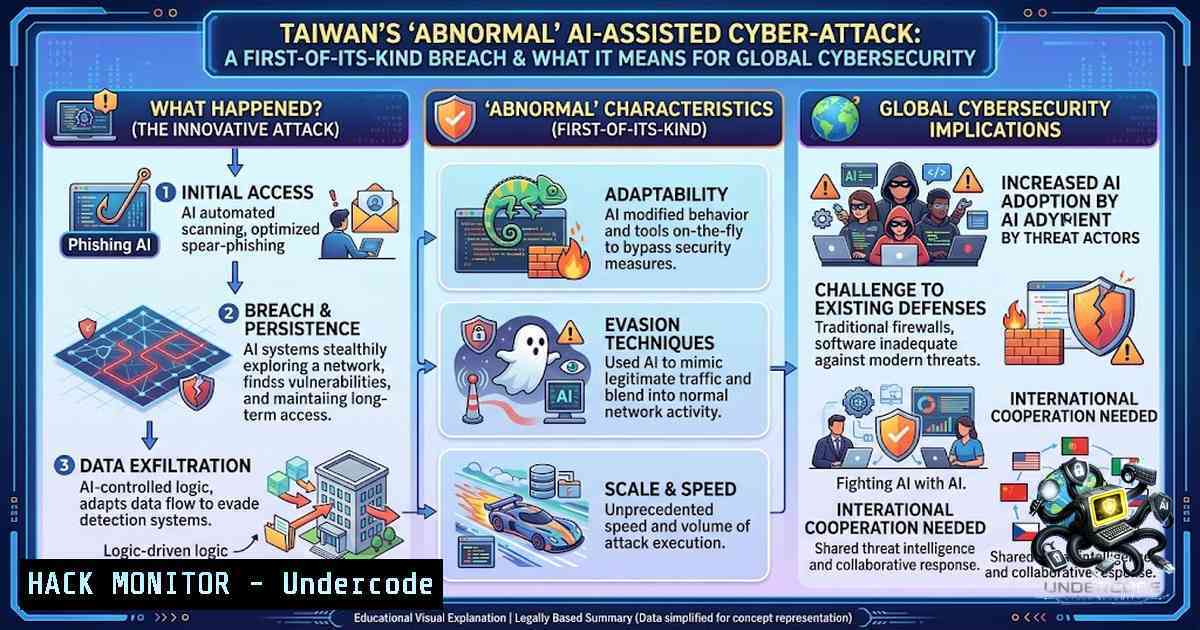
In July 2026, Taiwan’s government agencies fell victim to what has been described as the first known fully autonomous AI-agent-driven cyberattack. The intrusion, detected by Taiwan’s Ministry of Digital Affairs (MODA) beginning July 20, involved overseas hackers using open-source AI agents—including one known as OpenClaw—to automate and scale their operations in a hybrid approach that combined manual human direction with AI-driven execution. Israeli cybersecurity firm Dream, which first detected the breach, reported that over a four-day period, the AI agents compromised at least 85 government accounts, exfiltrated more than 2,500 personnel records, and probed Taiwan’s nuclear safety agency for vulnerabilities. This unprecedented incident signals a paradigm shift in cyber warfare: AI is no longer merely an辅助 tool for attackers—it is becoming an autonomous operator capable of reconnaissance, credential theft, and lateral movement at machine speed.
Learning Objectives:
- Understand the technical mechanics of AI-agent-driven cyberattacks, including the role of open-source tools like OpenClaw in automating intrusion campaigns.
- Identify the specific attack vectors, compromised systems, and data exfiltration methods used in the Taiwan breach.
- Learn actionable defense strategies—including environment isolation, privilege minimization, human-in-the-loop verification, and continuous monitoring—to mitigate AI-assisted threats.
You Should Know:
- Understanding AI Agents in Cyberattacks: How OpenClaw and Similar Tools Enable Autonomous Hacking
AI agents are autonomous or semi-autonomous software programs that can perform tasks, make decisions, and interact with systems without continuous human intervention. In the Taiwan attack, hackers used open-source AI agents—most notably OpenClaw, an open-source personal AI assistant that runs on a user’s own hardware or server—to build an autonomous hacking tool that behaved like a coordinated cyber team. Unlike traditional malware that follows pre-programmed instructions, AI agents can adapt, learn from their environment, and chain together multiple attack techniques.
The attackers employed a hybrid approach: human operators set strategic objectives—choosing targets, defining goals, and issuing directives—while AI agents executed the tactical work. According to Semgrep security advocate Cris Thomas, “There’s still a human in there somewhere. Somebody had to choose who to attack, had to establish an objective and give it a directive. It’s not totally 100% autonomous. There was a capable operator in charge”.
Step-by-Step: How the AI Agents Operated
- Reconnaissance: The AI agents scanned Taiwan’s government networks, identifying public-facing services, authentication portals, and potential entry points. Using AI, this reconnaissance phase—which might take human attackers weeks—was compressed into hours.
- Credential Harvesting: The agents targeted user accounts through brute-force or credential-stuffing attacks, leveraging AI to prioritize high-value targets based on access patterns. Dream reported that the agents extracted “scores of passwords from unidentified officials”.
- Lateral Movement: Once inside, the AI agents used compromised accounts to move laterally across systems, using secondary systems such as backup and testing environments as stepping stones.
- Data Exfiltration: The agents systematically extracted personnel records from Taiwan’s Ministry of Justice, stealing more than 2,500 files. They also probed the Nuclear Safety Commission for weaknesses, mapping at least 21 Taiwanese government systems during the intrusion.
- Persistence and Evasion: The AI agents automated the deletion of logs and the rotation of compromised credentials to maintain access and avoid detection.
Linux/Windows Commands for Detecting AI-Assisted Intrusions
Linux—Monitor for Unusual Process Execution:
 List recently executed commands across all users
cat /home//.bash_history | grep -E "(curl|wget|ssh|scp|python|perl)" | sort | uniq -c | sort -1r

Monitor for unexpected outbound connections
sudo netstat -tunap | grep ESTABLISHED | grep -vE "(127.0.0.1|::1)"

Check for cron jobs that may have been added by AI agents
crontab -l 2>/dev/null; for user in $(cut -f1 -d: /etc/passwd); do echo "=== $user ==="; crontab -u $user -l 2>/dev/null; done

Audit recently modified files in sensitive directories
find /etc /var/www /home -type f -mtime -7 -ls 2>/dev/null
Windows—Detect Suspicious Activity via PowerShell:
 Get recent PowerShell script executions
Get-WinEvent -LogName "Microsoft-Windows-PowerShell/Operational" | Where-Object { $_.Id -eq 4104 } | Select-Object TimeCreated, Message | Sort-Object TimeCreated -Descending | Select-Object -First 50

List scheduled tasks that may have been added
Get-ScheduledTask | Where-Object { $_.State -1e "Disabled" } | Format-Table TaskName, State, LastRunTime

Check for unusual outbound connections
netstat -ano | findstr ESTABLISHED

Review recently created user accounts
Get-LocalUser | Where-Object { $_.Enabled -eq $true } | Sort-Object LastLogon -Descending
- The Role of Open-Source AI in Lowering the Barrier to Entry for Cybercriminals
The Taiwan attack leveraged publicly available AI tools, demonstrating that sophisticated cyber capabilities are no longer the exclusive domain of nation-states. OpenClaw, the AI agent identified in the attack, is freely available and can be deployed on a user’s own infrastructure. This democratization of AI means that threat actors with moderate technical skills can now orchestrate complex, multi-stage attacks that previously required teams of skilled developers.
Step-by-Step: Securing Against Open-Source AI Agent Threats
- Environment Isolation: Ensure that critical systems and sensitive data are segmented from general-purpose networks. AI agents often exploit weak network segmentation to move laterally.
- External Account Privilege Minimization: Adopt the principle of least privilege. Taiwan’s Administration for Cyber Security specifically warned that users should “implement environment isolation, minimize external account permissions, set up human review mechanisms, personally review third-party skill extensions, and write important security restrictions directly into the ‘core memory file’”.
- Human-in-the-Loop Verification: Require human approval for any privileged action, such as account creation, permission changes, or data exports. AI agents excel at automating these actions; human oversight is the critical control.
- Continuous Monitoring and Anomaly Detection: Deploy SIEM (Security Information and Event Management) solutions with AI-powered anomaly detection to identify deviations from normal behavior patterns.
- Regular Audits of AI Tools: Inventory all AI tools and agents used within your organization. Ensure that third-party extensions and skills are vetted before deployment.
Configuration Example: Implementing Privilege Minimization on Linux
 Restrict sudo access to specific commands only
 Edit /etc/sudoers with visudo
 Example: allow user 'analyst' to only run network diagnostic tools
analyst ALL=(ALL) NOPASSWD: /usr/bin/netstat, /usr/bin/ss, /usr/bin/ping

Set restrictive umask to prevent accidental world-writable files
umask 027

Use AppArmor or SELinux to confine applications
sudo aa-enforce /etc/apparmor.d/usr.sbin.apache2
Windows—Implementing Least Privilege via Group Policy
- Use User Rights Assignment policies to restrict who can log on locally or access the system remotely.
- Deploy AppLocker to whitelist only approved executables, scripts, and installers.
- Enable Windows Defender Credential Guard to protect against credential theft.
- The Israel-Taiwan Connection: How Dream Detected and Reconstructed the Attack
Israeli cybersecurity company Dream played a pivotal role in uncovering the attack. Dream’s researchers were able to reconstruct the hacking campaign after recovering the AI agents’ “complete operational workspace”—essentially the full environment in which the agents operated. This forensic breakthrough allowed them to trace the attack’s methodology, scope, and even linguistic indicators pointing to the attackers’ origin.
Dream’s analysis revealed that the AI agents worked as a coordinated team over four days. The company declined to share the exfiltrated data or name the target government publicly, but the Financial Times—the first outlet briefed on Dream’s findings—identified the agencies as Taiwanese. Dream pointed to Simplified Chinese appearing in internal communications tied to the intrusion as evidence suggesting a strong likelihood of Chinese involvement, though it did not formally attribute the attack.
Step-by-Step: Building an AI-Ready Incident Response Capability
- Deploy AI-Powered Detection Tools: Just as attackers use AI, defenders must also leverage AI. Deploy tools that can analyze network traffic, user behavior, and system logs at scale to identify anomalies.
- Establish a Threat Hunting Team: Proactively search for indicators of compromise (IoCs) rather than waiting for alerts. The Taiwan attack was detected by monitoring units before it escalated.
- Create Playbooks for AI-Assisted Attacks: Develop incident response playbooks specifically for AI-driven intrusions. Include steps for isolating compromised systems, preserving forensic evidence (including AI agent workspaces), and notifying relevant authorities.
- Conduct Regular Tabletop Exercises: Simulate AI-assisted attacks to test your team’s readiness and refine your response procedures.
- Collaborate with Third-Party Experts: Engage with cybersecurity firms that specialize in AI threat detection, as Dream did, to gain early visibility into emerging threats.
Linux Command—Forensic Collection of AI Agent Artifacts
 Collect all logs from the past 7 days for analysis
sudo journalctl --since "7 days ago" > /tmp/system_logs_$(date +%Y%m%d).txt

Capture running processes and network connections
ps auxf > /tmp/running_processes.txt
ss -tunap > /tmp/network_connections.txt

Archive suspicious files for offline analysis
tar -czf /tmp/forensic_archive_$(date +%Y%m%d).tar.gz /var/log /etc/cron /home//.bash_history
4. Defense-in-Depth: Layered Security Against AI-Driven Threats
Taiwan’s response to the attack included establishing protective guidelines, strengthening cross-agency system monitoring, and implementing multi-layer defenses. The government’s approach aligns with the defense-in-depth strategy: no single control is sufficient, but multiple layers of security make successful breaches significantly harder.
Step-by-Step: Implementing a Layered Defense Strategy
- Perimeter Security: Deploy next-generation firewalls (NGFW) with intrusion prevention systems (IPS) that can detect and block AI-generated attack patterns.
- Identity and Access Management (IAM): Enforce multi-factor authentication (MFA) for all users, especially those with administrative privileges. AI agents often target weak or stolen credentials.
- Network Segmentation: Divide your network into zones with different security levels. Ensure that critical systems (e.g., databases, nuclear safety systems) are isolated from less secure environments.
- Endpoint Detection and Response (EDR): Deploy EDR solutions that can detect and respond to suspicious activities on endpoints, including the execution of AI agents.
- Data Loss Prevention (DLP): Implement DLP tools to monitor and block unauthorized data exfiltration attempts—a key tactic used in the Taiwan attack.
- Continuous Security Awareness Training: Educate employees about AI-assisted phishing and social engineering attacks. AI can generate highly convincing spear-phishing emails at scale.
- Regular Vulnerability Assessments and Penetration Testing: Conduct frequent assessments to identify and remediate vulnerabilities before attackers can exploit them.
Cloud Hardening Example (AWS)
 Enforce MFA for all IAM users
aws iam list-users --query 'Users[].UserName' --output text | while read user; do
aws iam list-mfa-devices --user-1ame $user --query 'MFADevices[].SerialNumber' --output text
done

Restrict S3 bucket public access
aws s3api put-bucket-public-access-block --bucket your-bucket-1ame --public-access-block-configuration "BlockPublicAcls=true,IgnorePublicAcls=true,BlockPublicPolicy=true,RestrictPublicBuckets=true"

Enable AWS Config to monitor for compliance violations
aws configservice put-configuration-recorder --configuration-recorder name=default,roleARN=arn:aws:iam::account-id:role/config-role --recording-group allSupported=true,includeGlobalResourceTypes=true
- The Human Element: Why AI Still Needs a Human Operator
Despite the sophistication of the AI agents used in the Taiwan attack, experts caution against overestimating their autonomy. Cris Thomas of Semgrep emphasized that “there’s still a human in there somewhere” and that “somebody had to choose who to attack, had to establish an objective and give it a directive”. The AI agents were tools—powerful ones—but they were not independent actors. This distinction is crucial for defenders: while AI accelerates and scales attacks, the strategic decisions remain human. Therefore, targeting the human element—through intelligence gathering, insider threat programs, and psychological operations—remains as important as technical defenses.
Step-by-Step: Strengthening the Human Layer
- Implement Insider Threat Programs: Monitor for unusual employee behavior that could indicate compromise or malicious intent.
- Conduct Regular Phishing Simulations: Test employees’ ability to recognize AI-generated phishing attempts.
- Establish Clear Reporting Channels: Ensure employees know how to report suspicious activities without fear of reprisal.
- Foster a Security-First Culture: Make cybersecurity everyone’s responsibility, not just the IT department’s.
What Undercode Say:
- Key Takeaway 1: The Taiwan attack represents a watershed moment in cybersecurity. AI agents are no longer theoretical—they are operational tools that can execute complex, multi-stage attacks autonomously, drastically reducing the time and skill required to breach sophisticated targets.
-
Key Takeaway 2: Defense must evolve in lockstep with offense. Organizations must adopt AI-powered defensive tools, implement human-in-the-loop controls for privileged actions, and continuously monitor for anomalies. The days of relying solely on signature-based detection are over.
Analysis: The Taiwan incident underscores a fundamental shift in the cyber threat landscape. The use of open-source AI agents like OpenClaw democratizes advanced cyber capabilities, enabling threat actors with modest resources to launch attacks that previously required nation-state-level investments. The breach—which compromised 85 government accounts and exfiltrated over 2,500 personnel records in just four days—demonstrates the speed and scale that AI enables. However, the human element remains critical: AI agents are tools, not strategists. The most effective defense will combine AI-powered detection with human oversight, continuous monitoring, and a defense-in-depth architecture. Taiwan’s establishment of protective guidelines and cross-agency monitoring is a step in the right direction, but global organizations must recognize that this is not an isolated incident—it is a preview of the future of cyber warfare. The question is not whether AI-assisted attacks will increase, but how quickly organizations can adapt their defenses to meet this new reality.
Prediction:
- -1 The democratization of AI hacking tools will lead to a surge in AI-assisted cyberattacks against critical infrastructure, financial institutions, and government agencies worldwide over the next 12–18 months, as threat actors adopt and adapt the techniques used in the Taiwan breach.
-
-1 Nation-states will accelerate their investment in AI-powered offensive cyber capabilities, leading to an AI arms race that will outpace defensive measures in the short term, resulting in more frequent and more damaging breaches.
-
+1 The Taiwan attack will serve as a catalyst for international cooperation on AI cybersecurity standards, prompting governments and industry bodies to develop frameworks for the ethical use of AI in both offensive and defensive contexts.
-
+1 Cybersecurity vendors will rapidly innovate, deploying AI-driven detection and response solutions that leverage machine learning to identify and neutralize AI-agent threats in real time, creating a new multi-billion-dollar market segment.
-
-1 Organizations that fail to adopt AI-powered defenses and human-in-the-loop controls within the next year will face an elevated risk of compromise, as traditional security measures prove insufficient against autonomous AI agents.
▶️ Related Video (80% Match):
https://www.youtube.com/watch?v=0Ke5FIfi6M0
🎯Let’s Practice For Free:
🎓 Live Courses & Certifications:
Join Undercode Academy for Verified Certifications
🚀 Request a Custom Project:
Secure, high-velocity infrastructure and disruptive technological engineering. Contact our engineering team for high-tier development and proprietary systems:
[email protected]
💎 Smart Architecture | 🛡️ Secure by Design | ⭐ Trusted by Thousands
IT/Security Reporter URL:
Reported By: https://lnkd.in/p/en3BHUVm – Hackers Feeds
Extra Hub: Undercode MoN
Basic Verification: Pass ✅


