Listen to this Post
Introduction
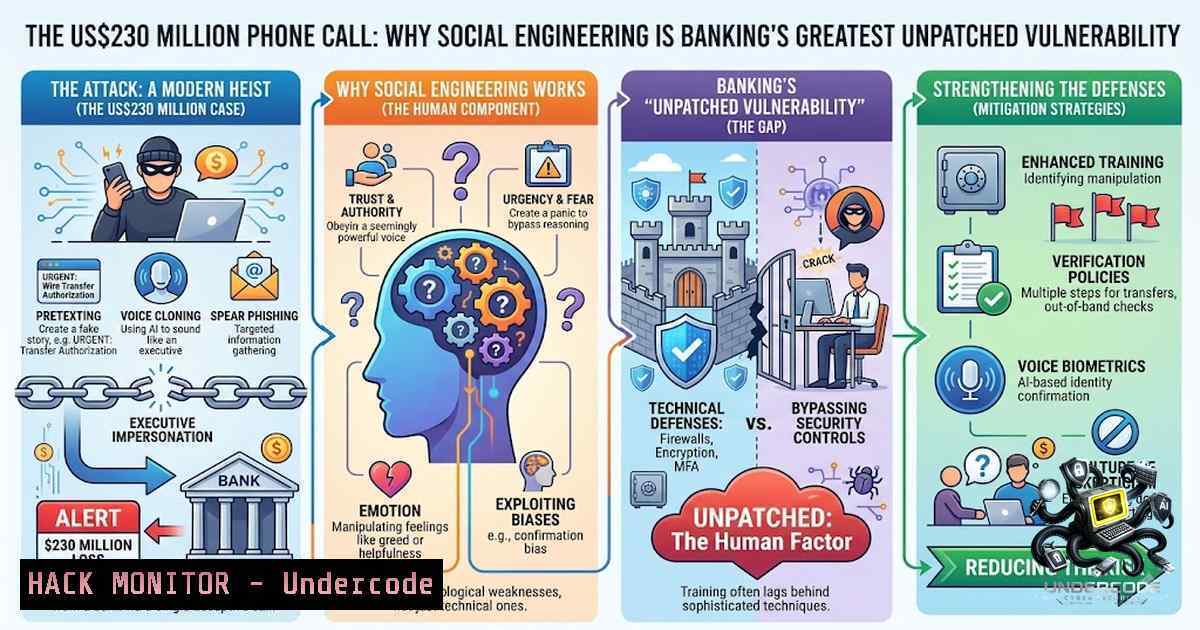
In a landmark heist that has sent shockwaves through the financial sector, attackers walked away with more than US$230 million without breaking a single line of encryption, deploying zero malware, or exploiting any technical vulnerability. The breach wasn’t executed through code—it was orchestrated through a phone call and the meticulous engineering of human trust. As Ajaay Verma, Vice President of Financial Crime Prevention at BPC, articulated in Episode 7 of Banking Beyond Tomorrow, this incident forces the industry to confront a deeply uncomfortable question: in an era where AI can clone voices from as little as three seconds of audio, can we still tell when the person on the other end of the interaction is real?
The attackers never defeated Bitcoin, encryption, or firewalls. They defeated trust—and that makes this crime not merely a cryptocurrency heist, but a preview of the future of financial fraud. The next generation of attackers will not break your systems; they will convince your customers and employees to open them.
Learning Objectives
- Understand the technical mechanics of AI-driven voice cloning and vishing (voice phishing) attacks targeting financial institutions.
- Master the configuration and deployment of real-time deepfake audio detection APIs and voice biometrics systems.
- Acquire practical Linux and Windows command-line skills for social engineering penetration testing, OSINT gathering, and security auditing.
- Implement NIST-aligned countermeasures and Zero Trust verification protocols to mitigate identity-based fraud.
You Should Know
- The Technical Anatomy of an AI Voice Clone Attack
The US$230 million heist exemplifies a new class of attack where the adversary’s primary tool is not an exploit kit but a synthetic voice. Generative AI models such as WaveNet and Tacotron have made it possible to replicate a person’s voice from a short audio clip. Attackers harvest these samples from public sources like social media videos, voicemail greetings, or recorded conference calls. Using low-latency voice cloning services—available to criminals for as little as a $50 monthly subscription—they can generate real-time, conversational audio that mimics a trusted executive, colleague, or family member.
This is not theoretical. The CrowdStrike 2026 Financial Services Threat Landscape Report identified Mutant Spider as the single most active threat to the financial services sector, with the group’s primary technique being voice phishing over Microsoft Teams. Operators impersonated internal IT support, convinced employees to reset their credentials and multifactor authentication, then registered their own devices on corporate networks. As Adam Meyers, senior vice president of counter adversary operations at CrowdStrike, put it: “Who needs a zero day if all you have to do is call the help desk and say, ‘I forgot my password’?”
Step‑by‑Step Guide: Simulating a Voice Cloning Attack
To understand the threat, security teams should simulate a voice cloning attack in a controlled lab environment. Below is a conceptual workflow using open-source tools and API-based detection services.
Step 1: Audio Harvesting (OSINT)
Attackers begin by collecting audio samples. As a defender, you can audit your organization’s digital footprint:
 Linux: Extract audio from social media or public sources using yt-dlp
yt-dlp -f bestaudio --extract-audio --audio-format mp3 --audio-quality 0 https://www.youtube.com/watch?v=EXAMPLE
 Windows (PowerShell): Download and convert using ffmpeg
Invoke-WebRequest -Uri "https://www.example.com/audio.wav" -OutFile "sample.wav"
ffmpeg -i sample.wav -ar 16000 -ac 1 sample_16k.wav
Step 2: Voice Cloning (Attack Simulation)
Use open-source voice cloning tools like Coqui TTS or Real-Time-Voice-Cloning in an isolated lab environment:
 Linux: Clone a voice using Coqui TTS
git clone https://github.com/coqui-ai/TTS
cd TTS
python TTS/bin/synthesize.py --text "Please transfer the funds to account 987654321" --model_path path/to/model.pth --config_path path/to/config.json --out_path output.wav
Step 3: Real-Time Deepfake Detection
Deploy AI-based detection models to identify cloned voices during calls:
 Linux: Using a deepfake detection API (example with Python)
pip install deepfake-detection
python -c "from deepfake_detection import VoiceAnalyzer; va = VoiceAnalyzer(); result = va.analyze('suspicious_call.wav'); print(result)"
Financial institutions are now implementing methods like adding random questions during verification—questions that are not the usual phrases asked during authentication—and deploying AI-based models to detect such cases in real time with 24/7 monitoring.
- Why MFA Is Not Enough: The Token Reset Attack
The attack dominating financial services doesn’t steal passwords. It resets MFA and steals the token. The attacker calls an IT support line, convinces an employee to reset their MFA, and registers their own device on the network. The security control works exactly as designed—and that is the problem.
The FBI has warned about Kali365, a phishing-as-a-service platform sold on Telegram for as little as $250 a month. Kali365 captures Microsoft 365 OAuth tokens through the legitimate device code authentication flow. MFA fires on the victim’s device, not the attacker’s. The token grants persistent access to Outlook, Teams, and OneDrive without triggering another MFA prompt.
The Verizon 2026 Data Breach Investigations Report confirmed that credential theft dropped to 13% of breach initial access vectors, while vulnerability exploitation took the top position at 31%. Three independent sources—CrowdStrike, FBI, and Verizon—all point to the same structural finding: MFA protects password-based authentication, but the attacks dominating financial services increasingly bypass password theft through resets, token grants, and exploitation.
Step‑by‑Step Guide: Auditing MFA Bypass Surfaces
Step 1: Audit Help Desk Procedures
Review and harden identity verification protocols for password resets and MFA re-registration:
 Windows: Audit Active Directory for recent MFA changes
Get-ADUser -Filter  -Properties WhenChanged | Where-Object {$_.WhenChanged -gt (Get-Date).AddDays(-30)} | Select-Object Name, WhenChanged
Step 2: Monitor for Suspicious Device Registrations
 Linux: Check Azure AD logs for new device registrations (using Azure CLI)
az login
az ad device-registration --query "[?createdDateTime > '2026-07-01']" --output table
Step 3: Implement Call-Back Verification
Establish a mandatory procedure: any MFA reset request must be followed by an outbound call to a known, verified number for the user—not the number that called in.
- The Wall Street Warning: Social Engineering at Scale
In August 2026, hackers targeted dozens of prominent US financial institutions including Blackstone, Bridgewater Associates, Apollo Global Management, Bain Capital, KKR, and CME Group. The attackers used a simple phone trick: calling employees directly on their personal cellphones, pretending to represent the corporate IT help desk. They manipulated caller ID systems to display the legitimate internal help desk phone number, building immediate trust with the victim.
The attackers instructed workers to update their passkeys or multifactor authentication settings, steering them toward malicious websites using domain names such as “passkeyhelpdesk”. Point72 Asset Management confirmed it had been targeted, though no customer information was stolen. Millennium Management, Two Sigma Investments, and Citadel were also targeted.
Cybersecurity experts told Reuters that these attacks are routine because of the valuable information held by financial firms. However, the latest incidents underscore how attackers are increasingly combining social engineering techniques with artificial intelligence to make phishing and impersonation attempts more convincing.
Step‑by‑Step Guide: Defending Against Help Desk Social Engineering
Step 1: Educate Employees on the “Windows+R” Attack Vector
Attackers often instruct victims to press Windows+R (opening the Windows Run dialog), paste a command, and press Enter. This simple sequence can execute anything, from downloading malware to adding new admin accounts.
Step 2: Implement Out-of-Band Verification
Any request involving credential changes, fund transfers, or sensitive data access must trigger an out-of-band verification through a separate communication channel.
Step 3: Deploy Caller ID Spoofing Detection
 Linux: Using STIR/SHAKEN verification tools
apt-get install stir-shaken
stir-shaken-verify --caller-id " +1-212-555-0199" --audio-file call_recording.wav
4. AI-Powered Social Engineering: The Scale Problem
AI has added scale and sophistication to phishing and impersonation techniques. With the help of publicly available data, AI systems can now produce highly personalized communications—emails, text messages, voice calls, and even video calls. FinCEN has highlighted an uptick in suspicious activity reports involving deepfake media, signaling that generative AI is being actively weaponized in fraud schemes.
Key developments include:
- Spear phishing: Previously manual and labor-intensive, spear phishing is now automated. AI tools select targets, adapt language styles, and even refine responses in real-time.
- Vishing with voice cloning: Short audio clips are sufficient for AI to clone a person’s voice, deceiving colleagues, relatives, or financial staff into transferring funds or revealing sensitive data.
- Deepfake CEO fraud: Realistic video or audio deepfakes of executives are being used to rush through financial approvals or gain access to internal systems.
Perhaps the most concerning trend is the accessibility of AI tools to non-experts. From pre-built phishing kits to plug-and-play voice cloning apps, even novice attackers can execute complex fraud schemes. These technologies automate entire fraud cycles—from luring victims to bypassing multi-factor authentication with stolen tokens—transforming financial crime into a scalable enterprise.
Step‑by‑Step Guide: Deploying AI-Powered Detection
Step 1: Implement Behavioral Biometrics
Behavioral biometrics—analyzing patterns in how users interact digitally—is being highlighted as a critical tool. The ability to distinguish real human intent from AI-generated or manipulated interactions will become the defining battleground.
Step 2: Deploy Real-Time Voice Analysis
 Linux: Using Pytorch for voice liveness detection
pip install torchaudio liveness-detection
python -c "from liveness import VoiceLiveness; vl = VoiceLiveness(); result = vl.check('call_audio.wav'); print('Live voice:', result)"
Step 3: Implement Multi-Factor Authentication for Phone Calls
Add random, contextual questions during verification that are not the usual phrases asked during authentication.
- API Security and Cloud Hardening for Social Engineering Mitigation
Social engineering attacks often target API endpoints and cloud infrastructure. Attackers who gain credentials through vishing can then use legitimate API calls to exfiltrate data or move laterally within cloud environments.
The OWASP API Security Top 10 highlights several vulnerabilities that become critical when combined with social engineering:
- Broken Object Level Authorization (BOLA): Attackers with stolen tokens can access unauthorized resources.
- Broken Authentication: MFA resets obtained through social engineering compromise authentication flows.
- Excessive Data Exposure: APIs that return more data than necessary become goldmines for attackers.
Step‑by‑Step Guide: Hardening API Security
Step 1: Implement Rate Limiting
 Linux: Configure rate limiting with NGINX
limit_req_zone $binary_remote_addr zone=api_limit:10m rate=10r/s;
location /api/ {
limit_req zone=api_limit burst=20 nodelay;
}
Step 2: Enforce Strict Authentication Flows
 Linux: Using Open Policy Agent (OPA) for centralized authorization
opa eval --data policies.rego --input input.json "data.auth.allow"
Password recovery and credential reset endpoints must be treated with the same rigor as login endpoints, including brute-force resistance, rate limiting, and lockout protections.
Step 3: Audit Cloud IAM for Social Engineering Risks
 AWS CLI: Audit IAM for recently changed credentials
aws iam list-users --query "Users[?CreateDate > '2026-07-01']" --output table
aws iam list-mfa-devices --user-1ame "suspicious_user"
6. Zero Trust Verification Protocols
The NIST-aligned Zero Trust model assumes that trust is never implicit and must be continuously verified. In the context of social engineering, this means:
- Never trust caller ID: Implement STIR/SHAKEN verification for all incoming calls.
- Verify through out-of-band channels: Any sensitive request must be confirmed through a separate communication channel (e.g., a verified mobile number or in-person confirmation).
- Implement continuous authentication: Use behavioral biometrics and device fingerprinting throughout the session, not just at login.
- Adopt least-privilege access: Even authenticated users should only have access to the minimum resources required for their role.
Step‑by‑Step Guide: Implementing Zero Trust for Voice Channels
Step 1: Deploy Call Authentication
 Linux: Configure SIP with STIR/SHAKEN
apt-get install opensips-stir-shaken
opensipsctl fifo stir_shaken_verify --call-id "abc123" --from "+12125550199"
Step 2: Implement Continuous Authentication
 Windows: Monitor for anomalous user behavior with PowerShell
Get-WinEvent -LogName Security -FilterXPath "[System[(EventID=4624)]]" |
Where-Object {$<em>.TimeCreated -gt (Get-Date).AddHours(-1)} |
Select-Object TimeCreated, @{Name="User";Expression={$</em>.Properties[bash].Value}}, @{Name="IP";Expression={$_.Properties[bash].Value}}
Step 3: Establish a “Break the Glass” Protocol
Create a documented procedure for emergency access that requires multiple approvals and triggers an immediate security alert.
What Undercode Say
- Trust is the new attack surface: The US$230 million heist proves that the most sophisticated security controls are useless if attackers can manipulate human psychology. Every bank executive should recognize that social engineering has become more dangerous than many technical attacks.
-
AI is the force multiplier: Voice cloning, deepfakes, and automated phishing are making fraud increasingly convincing and scalable. Financial institutions must fight AI with AI—deploying behavioral biometrics, real-time voice analysis, and anomaly detection systems that can distinguish between genuine human behavior and AI-generated interactions.
-
MFA is not a silver bullet: The attacks dominating financial services bypass MFA through resets, token grants, and social engineering. Organizations must move beyond MFA to continuous authentication and Zero Trust architectures.
-
The human firewall must be fortified: Technology alone cannot solve this problem. Banks must invest in customer education, employee training, and verification protocols that assume every caller could be an attacker.
-
The regulatory response is lagging: While fraudsters rapidly adopt AI, regulations risk being reactive rather than proactive. Financial institutions must not wait for regulation—they must act now to protect their customers and their reputations.
Prediction
-
+1 The US$230 million heist will serve as a watershed moment, finally forcing financial institutions to prioritize social engineering defenses alongside technical controls. This will accelerate investment in behavioral biometrics, AI-powered fraud detection, and Zero Trust architectures.
-
-1 AI-powered social engineering attacks will become increasingly common and sophisticated, with voice cloning and deepfake technology becoming accessible to even low-skilled criminals. The cost of entry for these attacks will continue to drop, leading to a surge in vishing and impersonation fraud.
-
-1 The financial sector will face a “trust crisis” as customers become unable to distinguish between legitimate bank communications and AI-generated impersonations. This could erode customer confidence and drive a shift toward in-person banking and alternative financial platforms.
-
+1 The rise of AI-driven fraud will accelerate the adoption of behavioral biometrics and continuous authentication, creating a new generation of security technologies that can detect anomalies in real-time and adapt to evolving threat patterns.
-
-1 Despite increased awareness, many financial institutions will remain vulnerable due to legacy systems, siloed security teams, and the fundamental challenge of securing human behavior. The next US$230 million heist is not a question of if, but when.
-
+1 Regulatory bodies will respond with updated frameworks that mandate Zero Trust principles, out-of-band verification, and AI-powered fraud detection, creating a more resilient financial ecosystem over the long term.
The attackers in the US$230 million heist never defeated encryption, firewalls, or intrusion detection systems. They defeated trust—and that is the most difficult vulnerability to patch. In the AI era, the question for every bank executive is not whether your systems are secure, but whether you can still tell when the person on the other end of the phone is real. The answer will determine the future of digital banking.
🎯Let’s Practice For Free:
🎓 Live Courses & Certifications:
Join Undercode Academy for Verified Certifications
🚀 Request a Custom Project:
Secure, high-velocity infrastructure and disruptive technological engineering. Contact our engineering team for high-tier development and proprietary systems:
[email protected]
💎 Smart Architecture | 🛡️ Secure by Design | ⭐ Trusted by Thousands
IT/Security Reporter URL:
Reported By: https://lnkd.in/p/ee5wuVYX – Hackers Feeds
Extra Hub: Undercode MoN
Basic Verification: Pass ✅


