Listen to this Post
Introduction
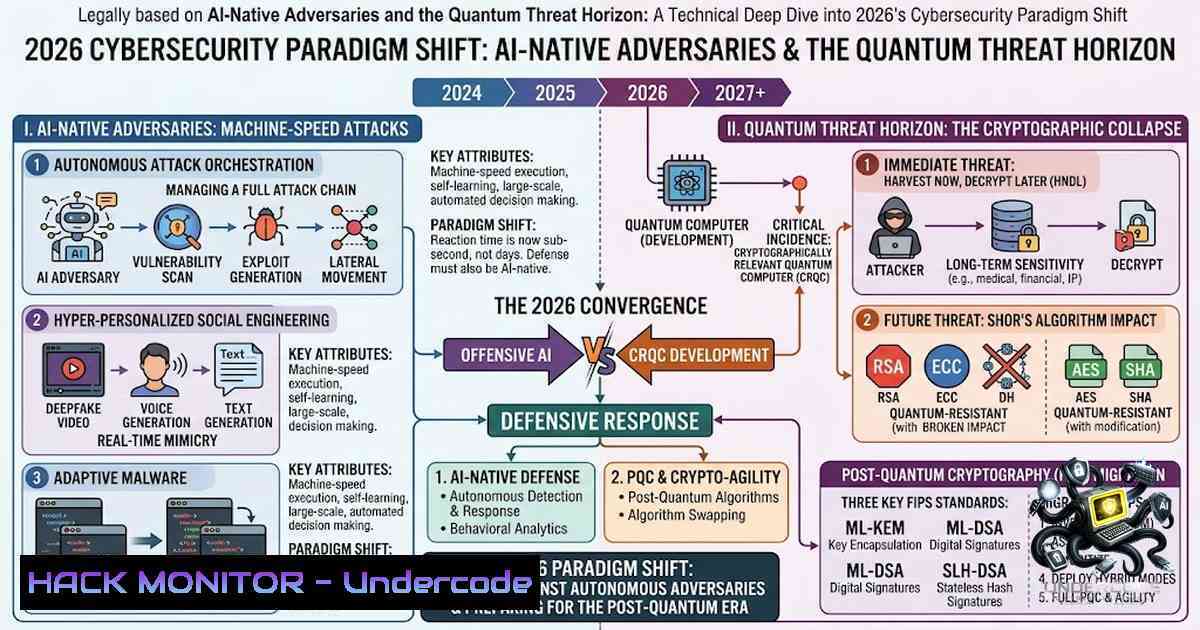
The cybersecurity landscape of 2026 is defined by two converging technological forces: the weaponization of artificial intelligence by adversaries and the impending cryptographic obsolescence driven by quantum computing. As AI transforms both offensive capabilities and defensive postures, and as quantum computers edge closer to breaking RSA and ECC encryption, organizations must fundamentally reassess their security architectures. This article synthesizes the latest threat intelligence, post-quantum cryptographic standards, and actionable defensive strategies to equip security professionals with the knowledge needed to navigate this new paradigm.
Learning Objectives
- Understand the operational mechanics of AI-driven cyberattacks, including autonomous reconnaissance, AI-generated phishing, and adaptive exploit workflows.
- Grasp the asymmetric impact of quantum computing on symmetric and asymmetric encryption, and the timeline for post-quantum migration.
- Implement practical defensive measures, including Zero Trust architecture, AI-1ative security tools, and post-quantum cryptographic readiness.
You Should Know
- The Rise of AI-1ative Adversaries: Attack Automation at Machine Speed
The adversary has gone “AI-1ative.” This is not a future projection but a documented operational reality. In the first half of 2026, Google’s Threat Intelligence Group confirmed the first zero-day exploit developed using artificial intelligence—a Python-scripted two-factor authentication bypass. Simultaneously, the financially motivated syndicate TeamPCP executed a cascading supply chain attack, compromising widely deployed open-source security tools and exfiltrating over 300 gigabytes of data and 500,000 cloud credentials. The CrowdStrike 2026 Global Threat Report documented an 89 percent year-over-year increase in AI-enabled threat actor operations.
What This Means Operationally: AI is collapsing attack timelines from weeks to days. Sophos uncovered a campaign, STAC6994, where a threat actor used approximately 12 AI agents to write and test attacks against endpoint agents, producing nearly 80 modules and 70 evasion techniques in days rather than weeks. Attackers are using AI for automated reconnaissance against internet-facing infrastructure, APIs, and cloud services; credential harvesting; and autonomous multi-stage attack orchestration.
Step‑by‑Step: Detecting AI-Driven Attack Activity
- Adjust Monitoring Thresholds: Configure your SIEM to alert on unusually fast activity patterns—rapid automated scanning, abnormal access request frequencies, and unfamiliar scripts or commands running on systems.
- Implement AI-Enabled Defensive Tools: Deploy AI-driven security solutions for automated vulnerability detection and attack surface analysis. Tools like DeepTempo’s Intelligent Defense Platform use deep learning for behavioral threat detection. Microsoft’s Project Perception and MAI-Cyber-1-Flash model are specifically built for software vulnerability analysis.
- Enforce Phishing-Resistant MFA: Require hardware-based identity for access. Stolen credentials alone must never grant entry. Sensitive internal tools should only be reachable from managed employee devices with attested hardware identity, reinforced by phishing-resistant two-factor authentication.
- Apply Zero Trust Principles: Treat every access request as untrusted by default. Grant users and systems only the minimum access they need, and assume a breach may already have occurred.
- Implement Advanced Micro-Segmentation: Divide internal networks into smaller, isolated segments so that an attacker who compromises one part cannot easily move laterally.
Linux Command Example – Rapid Log Analysis for Anomalies:
To detect unusual login patterns or automated scanning, use `awk` and `sort` to parse authentication logs:
 Check for failed SSH attempts from single IP in a short time window
sudo grep "Failed password" /var/log/auth.log | awk '{print $11}' | sort | uniq -c | sort -1r | head -20

Check for brute-force patterns (more than 10 failures per minute)
sudo grep "Failed password" /var/log/auth.log | awk '{print $1, $2, $3, $11}' | uniq -c | awk '$1 > 10'
2. Quantum Computing: The Cryptographic Countdown
Quantum computing poses an asymmetric threat to modern cryptography. Public-key schemes such as RSA and ECC are theoretically vulnerable to Shor’s algorithm, which can factor large numbers and compute discrete logarithms in polynomial time. Symmetric primitives like AES are affected more moderately through Grover’s quadratic speedup, effectively halving their key strength—AES-128 becomes as secure as AES-64 against a quantum adversary. AES-256, however, remains robust against quantum attacks.
The “Harvest Now, Decrypt Later” Threat: Adversaries are already exfiltrating encrypted data today with the intent to decrypt it once quantum computers become viable. This makes post-quantum cryptography (PQC) an urgent priority, not a distant concern.
NIST Post-Quantum Cryptography Standards: NIST has finalized three PQC algorithms:
– FIPS 203 (ML-KEM): Module-Lattice-Based Key-Encapsulation Mechanism for key exchange.
– FIPS 204 (ML-DSA): Module-Lattice-Based Digital Signature Algorithm.
– FIPS 205 (SLH-DSA): Stateless Hash-Based Digital Signature Algorithm.
In May 2026, NIST advanced nine additional digital signature algorithms to the third round of its PQC standardization process, including FAEST, HAWK, MAYO, and SQIsign. NIST plans to deprecate legacy public-key algorithms by 2035.
Step‑by‑Step: Preparing for Post-Quantum Migration
- Inventory Cryptographic Assets: Conduct a comprehensive inventory of all cryptographic solutions across your operations, identifying where RSA, ECC, and AES are used.
- Prioritize Critical Systems: Identify Critical Information Infrastructure (CII) and systems that handle long-lived data requiring confidentiality beyond 2030.
- Adopt Hybrid Cryptographic Schemes: Begin implementing hybrid schemes that combine classical and post-quantum primitives. For example, use ML-KEM alongside ECDHE in TLS 1.3 to ensure backward compatibility while gaining quantum resistance.
- Utilize Quantum Readiness Tools: Leverage Singapore’s CSA Quantum Readiness Index (QRI) to assess your organization’s preparedness. Follow the Quantum-Safe Handbook for practical migration guidance. Singapore mandates that CII operators submit post-quantum readiness plans by March 2027, with new systems quantum-ready by January 2028.
- Implement NIST PQC in Development: Use open-source implementations of NIST PQC standards across programming languages. GitHub repositories provide pure implementations of FIPS 203, 204, and 205 in Go, Rust, Python, and Java.
Linux Command Example – Checking OpenSSL for PQC Support:
 Verify OpenSSL version and PQC support
openssl version -a

List available post-quantum algorithms (if using oqsprovider)
openssl list -kem-algorithms | grep -E "ML-KEM|Kyber"
openssl list -signature-algorithms | grep -E "ML-DSA|SLH-DSA"
- Securing AI Identities and the Expanding Attack Surface
Enterprise AI adoption is the fastest-growing source of new exposure. As coding agents, assistants, and open-weight models take on privileged access to core systems, attackers are targeting the trust, credentials, and access permissions surrounding these systems. AI identities, OAuth connections, and API keys are increasingly becoming a high-value attack surface.
The OWASP LLM Top 10 2026: For the third year in a row, prompt injection tops the list. Other critical risks include sensitive information disclosure, supply chain vulnerabilities, data and model poisoning, and excessive agency—particularly critical for autonomous agents.
MITRE ATLAS Framework: The MITRE ATLAS (Adversarial Threat Landscape for Artificial-Intelligence Systems) framework catalogs 16 tactics, 84 techniques, and 56 sub-techniques specifically targeting AI and machine learning systems. It extends the MITRE ATT&CK framework into the AI domain, providing a structured taxonomy for adversarial threats.
Step‑by‑Step: Hardening AI Infrastructure
- Implement AI Bills of Materials (AI BOM): Maintain a structured inventory of all AI components, including models, datasets, and dependencies, to track supply chain risks.
- Enforce Least Privilege for AI Agents: Apply the restricted Pod Security Admission (PSA) profile on every agent namespace in Kubernetes.
- Use Signed-Image Policies: Enforce signed-image policies with Binary Authorization to ensure only verified AI models and containers are deployed.
- Conduct AI Red Teaming: Use AI red-teaming tools like garak, PyRIT, Giskard, and promptfoo to test for prompt injection, jailbreaks, and data leakage. Map findings to OWASP-LLM and MITRE-ATLAS classifications.
- Secure OAuth Tokens and API Keys: Implement geo/IP allow-listing and least-privilege-based access restrictions for all AI service credentials. Rotate credentials frequently and monitor for anomalous usage.
Kubernetes Command Example – Enforcing Pod Security:
 Apply restricted Pod Security Standard to an AI agent namespace
apiVersion: v1
kind: Namespace
metadata:
name: ai-agents
labels:
pod-security.kubernetes.io/enforce: restricted
pod-security.kubernetes.io/audit: restricted
pod-security.kubernetes.io/warn: restricted
Apply with:
kubectl apply -f namespace.yaml
4. Defending Critical Infrastructure: The OT-ISAC Model
Operational Technology (OT) environments are particularly vulnerable to AI-driven and quantum threats. The Operational Technology Information Sharing and Analysis Center (OT-ISAC) is a secure threat information sharing community for OT-using companies headquartered in Asia Pacific. OT-ISAC facilitates sharing of tactical and strategic security details, providing early insight into emerging threats, detection techniques, and containment measures.
Singapore’s Cyber Security Agency (CSA) has enhanced OT cyber resiliency through the OT Cybersecurity Masterplan and the establishment of OT-ISAC, bringing together over 40 government agencies, critical infrastructure owners, and industry providers. OT-ISAC has partnered with Protos Labs, a Singapore-based Agentic AI platform for cyber threat management, to integrate AI-driven insights with its intelligence-sharing ecosystem.
Step‑by‑Step: OT/ICS Security Hardening
- Adopt the Purdue Model: Segment OT networks using the Purdue Enterprise Reference Architecture. Place critical control systems in the lower levels and enforce strict communication policies between levels.
- Implement Network Segmentation: Use industrial firewalls and one-way data diodes to isolate OT networks from IT networks and the internet.
- Deploy OT-Specific Threat Detection: Use OT-1ative intrusion detection systems that understand industrial protocols (Modbus, DNP3, IEC 61850).
- Participate in Threat Intelligence Sharing: Join ISACs like OT-ISAC to receive timely threat intelligence and contribute to community defense.
- Conduct Regular OT Security Drills: Participate in exercises like Singapore’s Critical Infrastructure Defence Exercise (CIDEX) to test incident response capabilities.
5. Building a Quantum-Resilient and AI-Resilient Security Architecture
The convergence of AI-1ative threats and quantum vulnerabilities demands a holistic, layered defense strategy. This includes:
Zero Trust Architecture (ZTA): NIST SP 800-207 provides the framework. Core principles include: all data sources and services are resources; communication is secured regardless of network location; access is granted per-session; and access decisions are dynamic and policy-based.
AI-1ative Defense: Deploy AI-driven security tools that can match the speed of AI-powered attacks. Sophos Fusion, an AI-1ative cybersecurity defense system, helps organizations detect, investigate, and respond to increasingly complex threats. ESET’s AI Behavioral Monitoring uses processor-level execution telemetry and AI models to identify sophisticated threats.
Post-Quantum Cryptographic Agility: Design systems with cryptographic agility—the ability to swap out algorithms without significant re-engineering. Implement hybrid key exchanges in TLS 1.3 that combine classical ECDHE with ML-KEM.
Step‑by‑Step: Implementing a Unified Defense Architecture
- Conduct a Risk Assessment: Identify crown jewels—the data and systems that would cause the most damage if compromised.
- Map Data Flows: Understand how data moves across your hybrid cloud and on-premises environment.
- Implement Micro-Segmentation: Use network virtualization to create granular security zones.
- Deploy Continuous Monitoring: Implement 24/7 threat hunting using AI-driven tools like Dropzone AI Threat Hunter.
- Develop an Incident Response Playbook: Create playbooks specifically for AI-driven attacks and quantum-related cryptographic failures.
- Train Your Team: Ensure security staff are trained in AI red teaming, post-quantum cryptography, and OT security.
What Undercode Say
- The speed of AI-driven attacks is the new critical variable. Attackers are using AI to compress attack timelines from weeks to days, making traditional detection and response workflows obsolete. Defenders must adopt AI-1ative tools to match this speed.
- Post-quantum migration is not a future problem—it is a present imperative. With NIST standards finalized and Singapore mandating quantum-readiness plans by 2027, organizations must inventory cryptographic assets, adopt hybrid schemes, and begin migration now.
Analysis: The convergence of AI and quantum threats represents a fundamental shift in cybersecurity. AI lowers the barrier for sophisticated attacks, enabling adversaries to operate at machine speed and scale. Quantum computing threatens the cryptographic foundations of digital trust. Organizations that fail to adapt risk being overwhelmed by automated attacks or having their encrypted data decrypted retroactively. The solution lies in a layered defense: Zero Trust architecture to limit lateral movement, AI-1ative detection to match adversarial speed, and post-quantum cryptography to ensure long-term confidentiality. Singapore’s proactive approach—through the CSA’s Quantum-Safe Handbook, OT-ISAC, and partnerships with AI security vendors—provides a model for other nations and enterprises to follow.
Prediction
- +1 By 2028, AI-1ative security operations centers (SOCs) will become the standard, with autonomous AI agents handling tier-1 and tier-2 alert triage, reducing mean time to detect (MTTD) by over 90%.
- +1 The global post-quantum cryptography market will exceed $5 billion by 2030 as enterprises rush to comply with regulatory mandates and protect against “harvest now, decrypt later” attacks.
- -1 Organizations that delay post-quantum migration face a high risk of catastrophic data breaches by 2035, as quantum computers capable of breaking RSA-2048 are expected to emerge.
- -1 AI-powered supply chain attacks, like the TeamPCP campaign, will become more frequent and sophisticated, targeting AI development infrastructure and open-source dependencies.
- +1 The integration of Agentic AI platforms, like Protos Labs, with threat intelligence sharing communities (ISACs) will significantly enhance collective defense and situational awareness for critical infrastructure.
▶️ Related Video (76% Match):
🎯Let’s Practice For Free:
🎓 Live Courses & Certifications:
Join Undercode Academy for Verified Certifications
🚀 Request a Custom Project:
Secure, high-velocity infrastructure and disruptive technological engineering. Contact our engineering team for high-tier development and proprietary systems:
[email protected]
💎 Smart Architecture | 🛡️ Secure by Design | ⭐ Trusted by Thousands
IT/Security Reporter URL:
Reported By: Lim Kopi – Hackers Feeds
Extra Hub: Undercode MoN
Basic Verification: Pass ✅


