
Listen to this Post
Introduction:
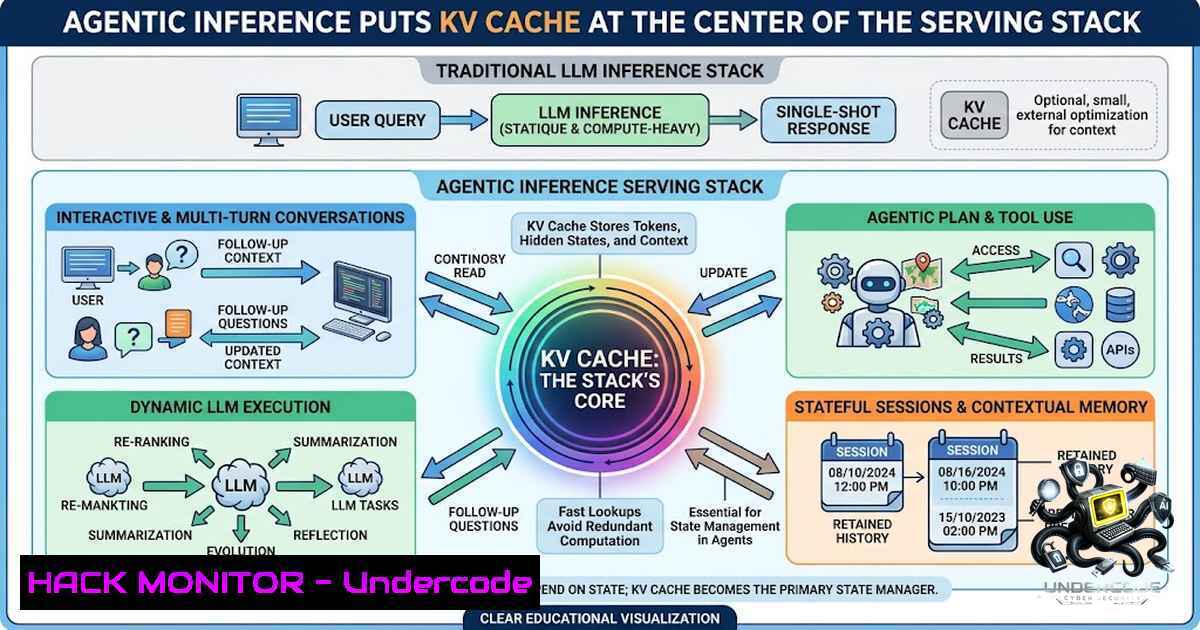
The rise of agentic AI workflows—multi-turn, long-context inference with tool calls and sub-agent coordination—has fundamentally altered the performance bottleneck in large language model (LLM) serving. Traditional inference optimization focused on compute FLOPs, but agentic workloads operate differently: they maintain expansive conversation histories, constantly re-read accumulated KV cache, and generate memory access patterns that single-turn serving stacks were never designed to handle. SemiAnalysis reports that KV cache management and data movement have become the primary constraints in the serving stack, making memory bandwidth—not raw compute—the new scaling frontier. This shift is driving architectural innovation from both software frameworks and hardware vendors, with NVIDIA’s Vera Rubin NVL72 platform already claiming 30x higher agentic throughput per megawatt on the newly released AgentX benchmark.
Learning Objectives & Secrets:
- Objective 1: Understand the KV Cache Bottleneck in Agentic Workloads — Learn why multi-turn agentic inference shifts the bottleneck from compute to memory, and how KV cache pressure limits concurrency and long-context serving. Master the distinction between traditional single-turn inference and agentic traffic patterns.
-
Objective 2: Master AgentX Benchmarking for Real-World Agentic Performance — Secret tip: AgentX replays production-style Claude Code sessions with preserved context growth, tool-call gaps, and KV-cache reuse patterns—not synthetic fixed-length sequences. Always demand latency-per-token, cache-hit-rate, and throughput metrics on long-context benchmarks; without these numbers, treat performance claims as marketing.
-
Objective 3: Implement KV Cache Optimization Techniques — Secret tip: Deploy prefix caching to reuse KV state across requests with shared system prompts. Use paged attention (vLLM) and KV cache offloading to heterogeneous memory tiers to maximize HBM utilization and minimize data movement overhead.
You Should Know:
1. Understanding the KV Cache Bottleneck
The KV cache stores attention key and value states for tokens already processed, allowing each decode step to reuse them instead of recomputing. In traditional single-turn inference, input sequences typically range from 1K to 8K tokens. Agentic sessions, however, accumulate context across multiple turns and can reach hundreds of thousands of input tokens, with each turn re-reading the accumulated KV cache. This creates a memory-bound workload where data movement—not FLOPs—becomes the binding constraint. OpenRouter data shows single agentic requests consume 15 times the tokens of ordinary chat. Memory bandwidth, not GPU compute, is now the key to unlocking AI performance.
2. AgentX: The New Benchmark for Agentic Inference
SemiAnalysis recently open-sourced AgentX 1.0, the world’s first fully open-source, multi-turn agentic coding inference benchmark at 1 million context, released under Apache 2.0. The dataset cost over $3M to build and is now publicly available. Unlike legacy benchmarks that measure fixed sequence lengths (e.g., 8K input, 1K output), AgentX replays production-style coding agent sessions with:
- Long-context prefill and KV-cache reuse
- Tool-call gaps and interactive decode
- Dynamic concurrency and sub-agent bursts
- Preserved context and input/output sequence lengths from original trajectories
The benchmark runs across over 1000 chips spanning MI355X, GB300 NVL72, B200, H200, and more. Over 70+ upstream pull requests for optimizing production agentic workloads across vLLM, SGLang, TensorRT-LLM, Dynamo, LMCache, and Mooncake already use AgentX as the north star benchmark proxy.
3. KV Cache Management Techniques and Commands
Linux – Monitor GPU Memory and KV Cache Pressure
 Monitor GPU memory usage and identify KV cache pressure
nvidia-smi --query-gpu=index,name,memory.total,memory.used,memory.free --format=csv

Watch memory usage in real-time
watch -1 1 nvidia-smi

Check HBM bandwidth utilization
nvidia-smi dmon -s m -c 10

For AMD GPUs
rocm-smi --showmeminfo vram
vLLM – Configure KV Cache for Agentic Workloads
 Start vLLM with optimized KV cache settings for long-context
python -m vllm.entrypoints.openai.api_server \
--model meta-llama/Llama-3.1-70B-Instruct \
--max-model-len 131072 \
--gpu-memory-utilization 0.85 \
--kv-cache-dtype fp8 \
--enable-prefix-caching \
--max-1um-batched-tokens 65536

Enable block size tuning for agentic workloads
--block-size 64  Larger blocks reduce fragmentation for long contexts
NVIDIA Dynamo – Session-Aware KV Cache Routing
NVIDIA Dynamo provides a distributed inference framework with KV-cache-aware routing and disaggregated serving. The Flash Indexer tracks every cached KV block across all inference workers at over 100M operations per second.
4. Hardware Evolution: NVIDIA Vera Rubin NVL72
NVIDIA is responding to the KV cache bottleneck with dedicated hardware. The Vera Rubin NVL72 platform features 72 Rubin GPUs and 36 Vera CPUs, with 20.7 TB of total GPU memory at up to 28.8 TB/s bandwidth. Key performance claims on AgentX workloads:
- 30x higher throughput per megawatt than GB300 NVL72 on DeepSeek-V4-PRO
- 35x lower token costs
- NVFP4 inference at 3,600 PFLOPS with adaptive compression
These results come from full-stack co-design including PD disaggregation, WideEP, KV offload, and Dynamo. The Vera Rubin NVL72 remains NVIDIA’s general compute foundation for training and inference.
5. Open-Source Inference Engines for Agentic Workloads
vLLM – High-throughput scheduling with memory-efficient KV-cache management
 Install vLLM with agentic optimizations
pip install vllm

Example: Serve with prefix caching and large context
python -m vllm.entrypoints.api_server \
--model Qwen/Qwen2.5-72B-Instruct \
--tensor-parallel-size 4 \
--max-1um-seqs 256 \
--enable-prefix-caching
SGLang – Structured generation language for efficient LLM serving
 Install SGLang
pip install sglang

Serve with RadixAttention for prefix caching
python -m sglang.launch_server \
--model-path meta-llama/Llama-3.1-405B-Instruct \
--tp 8 \
--mem-fraction-static 0.8 \
--disable-radix-cache  Disable for agentic to avoid thrashing
6. Security Implications of Agentic Inference
Agentic inference introduces new attack surfaces that security teams must address:
Prompt Injection Across Turns – Malicious inputs can persist in the KV cache across multiple turns, embedding attacks that survive context accumulation. Implement per-turn input sanitization and context isolation.
KV Cache Poisoning – Shared KV cache pools across sessions create cross-tenant risks. Use session-aware KV routing and isolation.
Tool Call Exploitation – Agents invoke tools with growing context; an attacker could manipulate tool outputs to influence subsequent reasoning. Implement output validation and tool-call auditing.
Side-Channel Attacks – Memory access patterns in KV cache can reveal information about processed tokens. Consider cache encryption for sensitive workloads.
Mitigation Commands:
 Enable memory encryption if supported
 For NVIDIA GPUs with confidential computing
nvidia-smi --confidential-computing=on

Isolate KV cache per tenant in multi-tenant deployments
 Configure vLLM with --disable-log-stats for production
python -m vllm.entrypoints.api_server \
--disable-log-stats \
--max-log-len 0
What Undercode Say:
- Key Takeaway 1: Memory is the new compute. Agentic inference has permanently shifted the bottleneck from FLOPs to memory bandwidth and KV cache management. Organizations investing in AI infrastructure must prioritize memory capacity and bandwidth over raw compute density. The data shows agentic requests consume 15x more tokens than chat, and memory prices have 2-3x more upside as inference demand for KV cache creates a multi-year structural shortage.
-
Key Takeaway 2: Benchmarking must evolve to reflect reality. Legacy fixed-sequence benchmarks are increasingly irrelevant for agentic workloads. AgentX represents a paradigm shift—open-sourcing a $3M dataset to measure how infrastructure actually performs under production agentic traffic. Without latency-per-token, cache-hit-rate, and throughput on long-context benchmarks, treat vendor claims as marketing. The industry now has a standardized way to measure agentic performance, and early results show NVIDIA leading with 30x efficiency gains on Vera Rubin NVL72.
The KV cache bottleneck is not a temporary challenge—it is the defining constraint of the agentic AI era. Software frameworks (vLLM, SGLang, Dynamo) and hardware platforms (Vera Rubin NVL72) are racing to solve it through full-stack co-design. Security teams must simultaneously address new attack surfaces introduced by persistent, stateful agentic inference. The next 12-24 months will separate platforms that genuinely solve the memory bottleneck from those that merely claim to.
Prediction:
- +1 AgentX will become the industry-standard benchmark for agentic inference within 12 months, driving measurable performance improvements across all major inference engines as over 70+ upstream PRs already demonstrate.
-
+1 NVIDIA Vera Rubin NVL72’s 30x throughput-per-megawatt advantage will accelerate AI factory build-outs, making agentic AI economically viable at scale for enterprises currently constrained by power budgets.
-
-1 Vendors without transparent AgentX benchmarks will face increasing skepticism from enterprise buyers; marketing claims without cache-hit-rate and latency-per-token data will be dismissed within 60 days.
-
-1 The KV cache memory shortage will drive hardware costs higher as supply growth of 20-30% per year cannot match surging inference demand, creating consolidation pressure in the AI infrastructure market.
-
+1 Open-source inference engines (vLLM, SGLang) will rapidly incorporate AgentX-derived optimizations, democratizing access to high-performance agentic inference and reducing dependency on proprietary serving stacks.
▶️ Related Video (84% Match):
https://www.youtube.com/watch?v=-kiOWUJQk6w
🎯Let’s Practice For Free:
🎓 Live Courses & Certifications:
Join Undercode Academy for Verified Certifications
🚀 Request a Custom Project:
Secure, high-velocity infrastructure and disruptive technological engineering. Contact our engineering team for high-tier development and proprietary systems:
[email protected]
💎 Smart Architecture | 🛡️ Secure by Design | ⭐ Trusted by Thousands
IT/Security Reporter URL:
Reported By: https://lnkd.in/p/eZmRaXtq – Hackers Feeds
Extra Hub: Undercode MoN
Basic Verification: Pass ✅


