
Listen to this Post
Introduction:
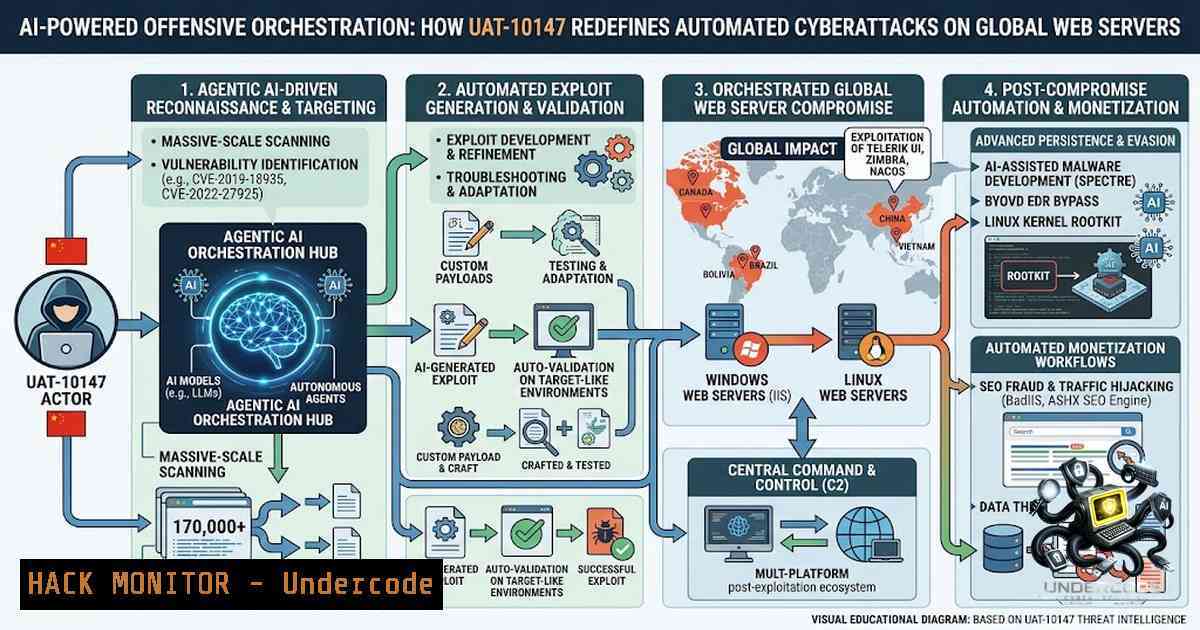
The integration of artificial intelligence into cyberattacks has transitioned from theoretical discussion to operational reality. Cisco Talos recently uncovered a Chinese-speaking cybercrime group, tracked as UAT-10147, that is weaponizing agentic AI systems to automate large-scale intrusions against internet-facing Windows and Linux web servers globally. Unlike previous AI-assisted attacks that relied on simple script generation, this group demonstrates semi-autonomous offensive orchestration—using AI to refine exploits, troubleshoot errors, validate vulnerabilities, and generate operational documentation in real-time. With a target list containing approximately 170,000 URLs and victims spanning government, education, media, technology, and gaming sectors across Brazil, Bolivia, China, Canada, and Vietnam, UAT-10147 represents a paradigm shift in how cybercriminals leverage AI to scale their operations.
Learning Objectives & Secrets:
- Objective 1: Understand the AI-Augmented Attack Lifecycle — Learn how UAT-10147 integrates AI tools including PentestGPT, DeepAudit, Metasploit, and ysoserial across reconnaissance, exploitation, payload generation, validation, and persistence phases.
-
Objective 2 Secret Tip: Identify SPECTRE Cross-Platform Implant Indicators — The group deploys a previously unreported backdoor called SPECTRE with Windows EDR-bypass capabilities via vulnerable drivers and a Linux rootkit component that blinds endpoint detection systems.
-
Objective 3 Secret Tip: Map the Exploit Chain from Initial Access to Persistence — UAT-10147 chains publicly disclosed vulnerabilities (CVE-2022-27925, CVE-2019-18935, CVE-2021-29441, CVE-2022-0995, CVE-2021-3156, CVE-2022-0847) with AI-generated post-exploitation automation.
You Should Know:
- The AI-Augmented Attack Chain: From Reconnaissance to Persistence
UAT-10147’s operational workflow represents a significant evolution from traditional manual intrusion. The group employs a multi-stage attack chain where AI tools are embedded at every phase:
Step 1: Reconnaissance & Target Selection — The group maintains a target list of approximately 170,000 URLs, split into 17 smaller files of about 10,000 URLs each for efficient parsing. AI-powered reconnaissance tools including PentestGPT are used to scan and identify vulnerable internet-facing servers.
Step 2: Initial Access via Known Vulnerabilities — Attackers exploit publicly disclosed vulnerabilities in widely deployed applications including Zimbra, Alibaba Nacos, Telerik UI for ASP.NET AJAX, and AjaxPro. Specific CVEs exploited include CVE-2022-27925, CVE-2021-23758, CVE-2019-18935, CVE-2021-29441, and CVE-2021-29442. On Linux systems, local privilege escalation flaws such as CVE-2022-0995, CVE-2021-3156, CVE-2015-5287, CVE-2015-3246, CVE-2010-3904, and CVE-2022-0847 are abused to obtain root access.
Step 3: AI-Powered Exploit Refinement — What distinguishes UAT-10147 is their use of AI to iteratively refine exploits when problems arise. Talos recovered evidence of AI-generated operational guidance used during intrusions, including automated troubleshooting of exception logic and validation of exploit success.
Step 4: Payload Deployment — After gaining access, attackers deploy a mixture of malware including BadIIS (for SEO fraud), Noodle RAT, Quasar RAT, Gh0stCringe, Meterpreter, and the cross-platform SPECTRE implant.
Step 5: Post-Compromise Automation — Agentic AI systems automate post-exploitation workflows including credential theft, data exfiltration, and maintaining persistence through deceptive scheduled tasks (e.g., named “Google Chrome Start”).
2. SPECTRE: The Cross-Platform Implant with EDR Evasion
The SPECTRE implant represents one of the most sophisticated components of UAT-10147’s arsenal. Cisco Talos assesses with medium-to-high confidence that this is a Chinese-speaking group based on linguistic artifacts, usernames, and tool overlaps.
Windows Version — The Windows variant of SPECTRE leverages Bring Your Own Vulnerable Driver (BYOVD) techniques to disable or blind EDR solutions. By exploiting legitimate but vulnerable kernel drivers, the implant can operate with elevated privileges while evading detection.
Linux Version — The Linux component installs a kernel-level rootkit that effectively blinds EDR and other security monitoring tools. This allows the attackers to maintain persistence and conduct malicious activities without triggering alerts.
AI-Generated Code — Notably, SPECTRE exhibits characteristics consistent with AI-assisted development. Security researchers have identified LLM-generated code patterns within the implant, suggesting the attackers used generative AI to accelerate malware development.
Detection Indicators — Security teams should monitor for the following indicators:
– MD5: 2915b3f8b703eb744fc54c81f4a9c67f, 7bdbd180c081fa63ca94f9c22c457376, 8ef476fa2322d063896830f85bac2e7f, c2efb2dcacba6d3ccc175b6ce1b7ed0a, `9a47c4d379998ade2f8f99e23a630c06`
– SHA256: 9f1f11a708d393e0a4109ae189bc64f1f3e312653dcf317a2bd406f18ffcc507, a31f222fc283227f5e7988d1ad9c0aecd66d58bb7b4d8518ae23e110308dbf91, and others
3. Exploiting ASP.NET ViewState with Stolen MachineKeys
A particularly notable technique employed by UAT-10147 involves the theft and abuse of ASP.NET MachineKeys to conduct ViewState deserialization attacks.
What This Does — ASP.NET applications use MachineKeys to encrypt and validate ViewState data. If an attacker can steal these keys, they can craft malicious ViewState payloads that, when deserialized by the server, execute arbitrary code. This is a form of remote code execution that bypasses many traditional WAF protections.
How Attackers Obtain MachineKeys — UAT-10147 first gains initial access through other vulnerabilities (e.g., CVE-2022-27925 in Zimbra or CVE-2019-18935 in Telerik UI), then extracts MachineKeys from the compromised server’s configuration files (typically `web.config` or machine-level configuration).
Detection & Mitigation:
- Rotate MachineKeys regularly and after any suspected compromise
- Monitor for anomalous ViewState payloads using WAF rules that detect known deserialization attack patterns
- Implement additional validation layers for ViewState integrity
4. Linux Privilege Escalation and Rootkit Deployment
For Linux targets, UAT-10147 employs a well-documented arsenal of privilege escalation exploits:
Commonly Exploited Linux CVEs:
- CVE-2022-0995: A flaw in the Linux kernel’s watch queue subsystem that allows local privilege escalation
- CVE-2021-3156: The notorious “Baron Samedit” vulnerability in sudo that enables root privilege escalation
- CVE-2022-0847: The “Dirty Pipe” vulnerability that allows overwriting arbitrary files with root privileges
Post-Exploitation Commands to Monitor:
On compromised Linux systems, security teams should look for:
 Check for suspicious kernel modules (rootkits)
lsmod | grep -v "^Module"

Verify system integrity
rpm -Va  RHEL/CentOS
dpkg -V  Debian/Ubuntu

Check for unauthorized sudo entries
cat /etc/sudoers | grep -v "^"

Monitor for unusual outbound connections
netstat -tunap | grep ESTABLISHED

Check for modified binaries
find /bin /usr/bin /sbin /usr/sbin -type f -mtime -7 -ls
Linux Rootkit Detection:
 Use chkrootkit
sudo chkrootkit

Use rkhunter
sudo rkhunter --check

Check for hidden processes
unhide proc
- Windows Attack Vectors: BadIIS, Quasar RAT, and Defense Evasion
On Windows servers, UAT-10147 employs a multi-pronged approach:
Initial Access & Privilege Escalation — The group uses a batch script that leverages `certutil` to download privilege escalation tools including “EfsPotato” (an EFS-based privilege escalation exploit), a secondary batch script, and Quasar RAT from a remote server (adminapi.tippusoni[.]in).
Defense Evasion — After gaining elevated privileges, attackers:
- Configure Microsoft Defender exclusions to prevent detection
- Delete initial payloads to cover tracks and thwart forensic analysis
- Establish persistence through deceptive scheduled tasks named “Google Chrome Start”
BadIIS Malware — This specific variant operates under a Malware-as-a-Service (MaaS) model and is used by multiple Chinese-speaking cybercrime groups. BadIIS is typically used for SEO fraud, redirecting legitimate web traffic to attacker-controlled sites.
Windows Detection Commands:
 Check for suspicious scheduled tasks
Get-ScheduledTask | Where-Object {$<em>.TaskName -like "Google" -or $</em>.TaskName -like "Chrome"}

Review Windows Defender exclusions
Get-MpPreference | Select-Object -ExpandProperty ExclusionPath

Check for unusual outbound connections
netstat -ano | findstr ESTABLISHED

Audit recently created or modified files in system directories
Get-ChildItem C:\Windows\System32 -Recurse | Where-Object {$_.LastWriteTime -gt (Get-Date).AddDays(-7)}
6. Defensive Strategies: Hardening Against AI-Augmented Threats
The emergence of groups like UAT-10147 demands a fundamental shift in defensive posture. Traditional security measures that rely on detecting known signatures are insufficient against AI-augmented attacks that can iteratively refine exploits and adapt to defenses.
Priority Patching — Organizations should prioritize applying security updates for publicly disclosed vulnerabilities affecting Windows and Linux web servers. Given UAT-10147’s reliance on known CVEs, timely patch management remains the most effective defense.
Web Application Firewall (WAF) Enhancement — AI-powered WAFs that shift from signature matching to intent understanding can detect变形, encoded, and obfuscated zero-day attacks with up to 94-99% accuracy.
EDR Configuration — Ensure EDR solutions are properly configured to detect BYOVD techniques. Monitor for:
– Loading of known vulnerable drivers
– Unusual kernel-mode activity
– Attempts to modify or disable security services
Network Monitoring — Monitor for indicators of compromise including:
– Unusual remote code execution attempts
– Deployment of web shells
– Outbound connections to suspicious domains (e.g., adminapi.tippusoni[.]in, 139.180.197[.]150)
Zero Trust Architecture — Implement network segmentation to limit lateral movement. Assume compromise and verify all access requests, even from internal sources.
- The Broader Implications: AI as an Offensive Force Multiplier
UAT-10147’s operations represent a watershed moment in cybercrime evolution. The group has demonstrated that AI can be effectively integrated into offensive operations at scale, moving beyond simple script assistance to semi-autonomous orchestration.
Key Observations:
- AI reduces the expertise required for complex post-compromise operations
- Automated exploit refinement and validation enable faster adaptation to defenses
- AI-generated operational documentation allows less-skilled operators to execute sophisticated attacks
Industry Impact — This trend is not isolated. The cybersecurity industry is witnessing a broader wave of AI-powered offensive tools, including自主渗透测试 agents like Cybermes, PentAGI (which has garnered over 8,200 stars on GitHub), and frameworks like T3MP3ST that can turn AI coding assistants into autonomous vulnerability hunters.
What Undercode Say:
- Key Takeaway 1: AI Is Democratizing Advanced Cyberattacks — UAT-10147 demonstrates that AI tools are lowering the barrier to entry for sophisticated cyber operations. Attackers no longer need deep technical expertise to conduct complex, multi-stage intrusions. This democratization of offensive capability will likely lead to a surge in cybercrime volume and severity.
-
Key Takeaway 2: Defense Must Evolve from Reactive to Predictive — Traditional signature-based and rule-based defenses are becoming obsolete against AI-augmented attacks that can adapt in real-time. Organizations must invest in AI-powered defensive systems that can detect anomalies based on behavior and intent rather than static signatures. The shift from “human-driven” to “autonomous” security operations is no longer optional—it is an existential necessity.
-
Key Takeaway 3: The Attack Surface Is Expanding — With approximately 170,000 targets on UAT-10147’s list, the scale of this campaign underscores the massive attack surface presented by internet-exposed web servers. Organizations must adopt a “secure by default” posture, minimizing exposed services and implementing defense-in-depth strategies.
Prediction:
+1 The UAT-10147 campaign will accelerate enterprise adoption of AI-powered defensive technologies, including autonomous threat hunting and AI-driven SIEM/SOAR platforms, creating a multi-billion-dollar market opportunity for cybersecurity vendors.
-1 The success of UAT-10147’s AI-augmented approach will inspire copycat operations, leading to a significant increase in automated, large-scale cyberattacks targeting web servers globally over the next 12-18 months.
-1 As AI-generated malware becomes more sophisticated and harder to detect, organizations without advanced AI defenses will face increasing breach risks, potentially widening the security gap between well-resourced enterprises and smaller organizations.
+1 The cybersecurity community’s response—including Talos’s detailed disclosure—will drive collaboration on AI-specific threat intelligence sharing, leading to improved collective defense mechanisms against AI-augmented threats.
-1 The use of AI in offensive operations will likely trigger a regulatory response, with governments imposing new restrictions on AI model deployment and access, potentially stifling legitimate AI research and development.
-1 The MaaS model for AI-powered attack tools will commoditize sophisticated cyber capabilities, enabling even low-skilled threat actors to conduct operations previously reserved for nation-state actors.
+1 The SPECTRE implant’s detection indicators, now publicly available, will enable security vendors to update their detection signatures, temporarily reducing the effectiveness of this specific tool.
-1 However, as attackers shift to AI-generated code, signature-based detection will become increasingly unreliable, forcing a fundamental rethinking of how cybersecurity products are designed and deployed.
-1 The targeting of education and government sectors—which often have constrained security budgets—will expose sensitive data and critical infrastructure to elevated risk.
+1 The incident will serve as a catalyst for the development of standardized AI security frameworks, similar to the NIST Cybersecurity Framework, providing organizations with structured guidance for defending against AI-augmented threats.
▶️ Related Video (82% Match):
🎯Let’s Practice For Free:
🎓 Live Courses & Certifications:
Join Undercode Academy for Verified Certifications
🚀 Request a Custom Project:
Secure, high-velocity infrastructure and disruptive technological engineering. Contact our engineering team for high-tier development and proprietary systems:
[email protected]
💎 Smart Architecture | 🛡️ Secure by Design | ⭐ Trusted by Thousands
IT/Security Reporter URL:
Reported By: https://lnkd.in/p/eBCpE5vz – Hackers Feeds
Extra Hub: Undercode MoN
Basic Verification: Pass ✅


