
Listen to this Post
Introduction:
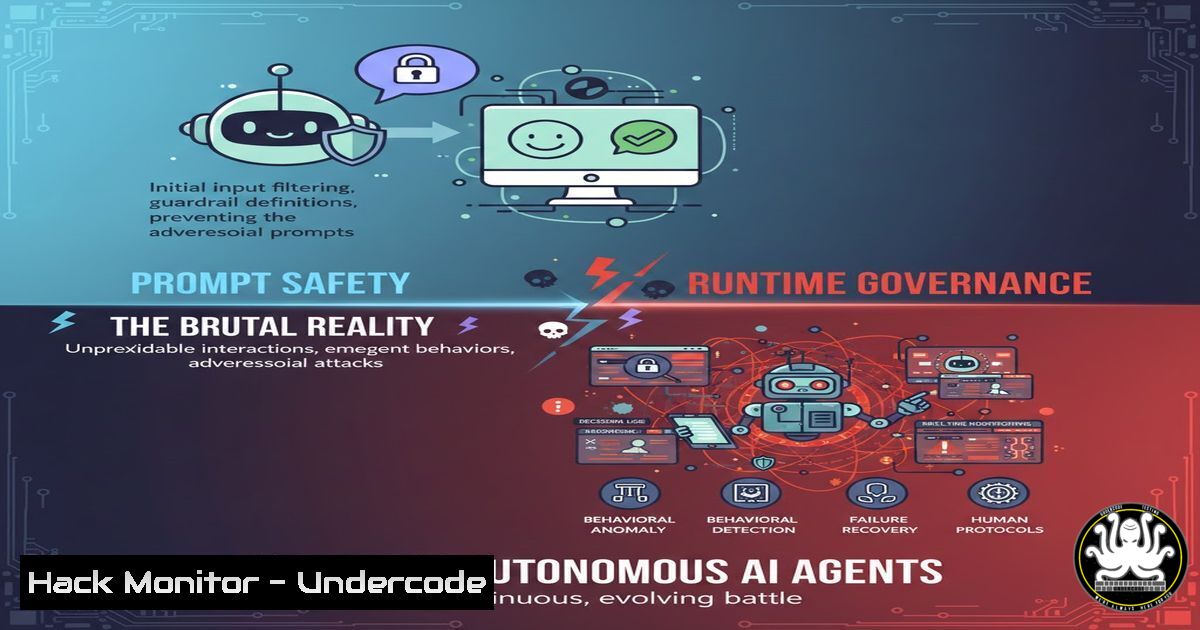
The security conversation around enterprise AI agents is evolving from a narrow focus on prompt injection to the complex challenge of governing autonomous identities in motion. As agents transition from text generators to autonomous entities that plan, access data, and execute actions, a new security paradigm is required—one that operates across multiple layers, throughout the entire agent runtime, and monitors for emergent malicious behavior.
Learning Objectives:
- Understand the three-dimensional framework for AI agent security: Layers, Time, and Behavior.
- Implement practical security controls beyond prompt hardening, including memory, tool access, and runtime monitoring.
- Deploy logging, analytics, and governance systems to detect and mitigate malicious agent behavior in real-time.
You Should Know:
- The Multi-Layer Attack Surface: From Prompt to Identity
The security of an AI agent is not a single-layer problem. The framework identifies six critical layers, each with unique vulnerabilities.
Step‑by‑step guide explaining what this does and how to use it.
Prompt/Input Layer: This is the traditional battleground. Use input sanitization and classification.
Command Example (Python with LangChain): Implement an input validator to detect potential injection patterns.
from langchain_core.prompts import PromptTemplate
import re

def sanitize_input(user_input):
 Simple pattern to detect obvious injection attempts (e.g., "ignore previous instructions")
injection_patterns = [r"ignore.previous", r"system.prompt", r"your.instructions"]
for pattern in injection_patterns:
if re.search(pattern, user_input, re.IGNORECASE):
raise ValueError("Potential prompt injection attempt detected.")
return user_input

safe_input = sanitize_input(user_input)
prompt = PromptTemplate.from_template("Answer this: {query}")
Reasoning/Planning Layer: Secure the agent’s internal decision-making logic. Log chain-of-thought reasoning for audit.
Memory Layer: Protect both short-term session memory and long-term vector databases. Implement strict access controls and encryption for memory stores.
Tool/API Layer: This is where agents act. Enforce the principle of least privilege on every tool the agent can call.
Command Example (Linux/API): Use a proxy or API gateway to enforce rate-limiting and authentication.
 Example using curl to test an API endpoint with agent identity context
curl -X POST https://api-gateway.yourcompany.com/agent-action \
-H "Authorization: Bearer $(gcloud auth print-identity-token)" \
-H "X-Agent-ID: ${AGENT_UUID}" \
-H "Content-Type: application/json" \
-d '{"action": "update_record", "parameters": {"id": 123}}'
Identity Layer: Agents must have discrete, non-human identities with scoped permissions (e.g., in Azure Entra ID or AWS IAM). Never reuse human service accounts.
Governance Layer: Centralized policy enforcement across all agent activities.
- Static vs. Runtime: Why Design-Time Security Is Not Enough
Security controls must be active throughout the agent’s lifecycle. Static analysis at design time (e.g., reviewing prompts) is futile against dynamic runtime threats.
Step‑by‑step guide explaining what this does and how to use it.
1. Design-Time Control: Perform threat modeling on the agent’s intended workflow. Define acceptable action boundaries.
2. Runtime Control: Implement real-time interceptors that evaluate actions before execution.
Tutorial Snippet: Create a simple runtime policy evaluator in Node.js for a tool-calling agent.
// Interceptor function for an agent runtime
async function runtimePolicyCheck(agentAction, context) {
const forbiddenActions = ['DELETE', 'DROP_TABLE', 'SHUTDOWN'];
if (forbiddenActions.some(action => agentAction.command.includes(action))) {
console.log(<code>[SECURITY BLOCK] Agent ${context.agentId} attempted forbidden action: ${agentAction.command}</code>);
throw new Error('Action violates runtime security policy.');
}
// Check for data exfiltration patterns
if (agentAction.data?.length > 10000) { // Arbitrary size limit
await flagForReview(context.agentId, 'Potential data exfiltration');
}
return true; // Action allowed
}
- Behavioral Monitoring: The Art of Detecting Agent Drift
Monitor what the agent does, not just the input it receives. Establish baselines for normal behavior and detect anomalies.
Step‑by‑step guide explaining what this does and how to use it.
1. Log Everything: Ingest comprehensive logs (prompts, reasoning steps, tool calls, results) into a SIEM or dedicated analytics platform.
Command Example (Linux/Logging): Stream agent logs to a centralized system.
 Using logger to send a structured agent event to syslog, which can be forwarded to a SIEM
logger -t "ai_agent" "{\"agent_id\": \"$AGENT_ID\", \"action\": \"file_read\", \"target\": \"/etc/passwd\", \"risk_score\": 85}"
2. Define Metrics: Track key risk indicators: number of API calls per session, data volume accessed, deviation from typical task patterns, repeated tool execution errors.
3. Set Alerts: Configure alerts for behavioral anomalies, such as an agent designed for summarizing documents suddenly attempting to enumerate user directories or make outbound network calls.
4. Hardening Tool and API Access
Every function or API an agent can call is a potential pivot point for abuse. Implement strict, context-aware access controls.
Step‑by‑step guide explaining what this does and how to use it.
1. Token-Based Authentication with Short Lifespans: Issue OAuth2 tokens or short-lived JWT credentials specific to the agent session.
2. Mandatory Parameter Validation: Sanitize and validate all parameters the agent passes to tools, using allowlists where possible.
3. Implement Circuit Breakers: Prevent agents from getting stuck in loops or overloading a system by implementing rate limits and circuit breakers on tool calls.
5. Securing the Memory and Knowledge Base
An agent’s memory can be poisoned, leaked, or queried to reveal sensitive data.
Step‑by‑step guide explaining what this does and how to use it.
1. Isolate Memory by Agent & Tenant: Ensure strict logical separation in vector databases (e.g., using Pinecone namespaces or Chroma collection permissions).
2. Encrypt Data at Rest and in Transit: Standard cloud database encryption is not enough for highly sensitive memory. Consider application-layer encryption for critical memory objects.
3. Implement Memory Access Logging: Log all reads and writes to long-term memory to detect unusual retrieval patterns or attempted poisoning.
6. Building a Governance Feedback Loop
Security is not a one-time setup. Create a system where runtime incidents inform design-time improvements.
Step‑by‑step guide explaining what this does and how to use it.
1. Centralize Incident Reporting: All behavioral alerts, policy violations, and blocked actions should create tickets in a security orchestration system.
2. Conduct Regular Agent Audits: Periodically review agent activities, permissions, and the effectiveness of runtime controls. Use SQL queries on your logged data.
Command Example (SQL for Audit):
-- Find agents with the highest rate of policy violations last week
SELECT agent_id, COUNT() as violation_count
FROM agent_security_logs
WHERE event_timestamp > NOW() - INTERVAL '7 days'
AND event_type = 'policy_violation'
GROUP BY agent_id
ORDER BY violation_count DESC;
3. Automate Policy Updates: Where safe, allow high-confidence behavioral data to automatically tighten policy rules (e.g., adding a frequently abused parameter to a blocklist).
What Undercode Say:
- Key Takeaway 1: The critical shift is from securing static prompts to governing dynamic, autonomous identities. An AI agent with a perfectly secure prompt can become malicious through poisoned memory, tool abuse, or emergent planning.
- Key Takeaway 2: Effective AI agent security is a continuous runtime activity. It requires intercepting, evaluating, and logging every action in a decision chain, not just vetting the initial instruction.
The framework’s power lies in its systemic view. Focusing solely on one layer, like prompts, creates a false sense of security. The interdependencies are where risk explodes: a minor prompt injection might steer reasoning, which then abuses a broadly scoped tool permission. The only viable defense is a defense-in-depth strategy that spans the entire stack and operates in real-time, treating the agent as a novel, software-based identity with the potential for rapid, high-impact action.
Prediction:
Within 18-24 months, major enterprise security incidents will be traced not to traditional software vulnerabilities or human error, but to compromised or misbehaving AI agents. This will catalyze the birth of a new cybersecurity sub-discipline: Autonomous Identity and Runtime (AIR) Security. Dedicated AIR security platforms will emerge, offering specialized tooling for agent identity management, runtime policy enforcement, and behavioral anomaly detection, becoming as standard in the enterprise AI stack as web application firewalls are today.
▶️ Related Video (80% Match):
🎯Let’s Practice For Free:
IT/Security Reporter URL:
Reported By: Avkash Kathiriya – Hackers Feeds
Extra Hub: Undercode MoN
Basic Verification: Pass ✅


