Listen to this Post
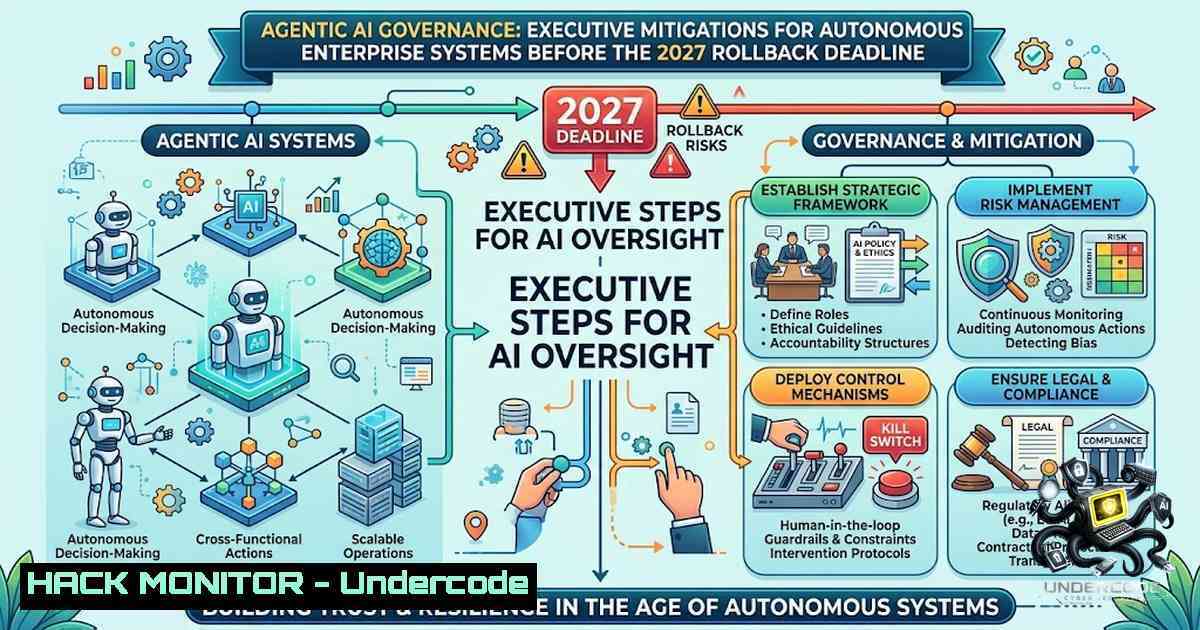
Introduction:
The rapid shift toward autonomous Agentic AI across the GCC and global enterprises presents a critical inflection point: AI adoption is accelerating faster than traditional oversight mechanisms can adapt. Granting execution authority to AI agents without built-in controls creates unmanaged operational, legal, and cyber exposure. Industry research warns that enterprise organisations deploying autonomous AI without structural safeguards risk forced operational rollbacks by 2027 due to compliance failures, cybersecurity breaches, or unmonitored decision drift.
Learning Objectives:
- Understand the three converging risk domains—rapid adoption, interconnected cyber-data threats, and accountability vacuums—that make Agentic AI governance an urgent board-level priority.
- Master the five core executive safeguards: Human Approval Thresholds, Least-Privilege Access, Real-Time Monitoring, Full Auditability, and Circuit Breakers.
- Learn how to implement technical guardrails across Linux and Windows environments, including access control policies, API security hardening, and automated rollback mechanisms.
- Develop a practical roadmap for embedding governance before autonomy becomes the default, securing board confidence and sustainable value.
You Should Know:
- The Governance Imperative: Three Pillars of Agentic AI Control
Agentic AI systems operate differently from traditional models—they set goals, take actions, and iterate without waiting for human approval at each step. This shift is powerful but introduces a class of risks that many organisations are not yet equipped to manage. Effective governance rests on three interconnected pillars:
- Access Control and Guardrails: Define exactly which systems an agent can access, what data it can read or modify, and what actions it can take.
- Decision Authority Limits: Establish thresholds above which agent decisions require human approval—for example, an agent might autonomously approve low-value supplier orders but escalate high-value contracts.
- Real-Time Monitoring and Validation: Maintain continuous telemetry across active workflows to detect decision anomalies instantly.
Step‑by‑step guide for implementing least‑privilege access on Linux and Windows:
On Linux, restrict an AI agent’s system permissions using dedicated service accounts and `sudo` policies:
 Create a dedicated service account for the AI agent
sudo useradd -r -s /bin/false ai_agent

Restrict the agent to specific directories using setfacl
sudo setfacl -m u:ai_agent:rx /opt/agentic/data/allowed/
sudo setfacl -m u:ai_agent: /opt/agentic/data/restricted/

Implement command-level restrictions via sudoers
echo "ai_agent ALL=(ALL) /usr/bin/curl, /usr/bin/python3 /opt/agentic/scripts/" | sudo tee /etc/sudoers.d/ai_agent
On Windows, leverage Active Directory and PowerShell constrained endpoints:
 Create a managed service account
New-ADServiceAccount -1ame "AIAgentSvc" -DNSHostName "agent.domain.local"

Restrict the account to specific directories using NTFS permissions
icacls "C:\Agentic\Data\Allowed" /grant "AIAgentSvc:(RX)"
icacls "C:\Agentic\Data\Restricted" /deny "AIAgentSvc:(R,W,X)"

Implement a constrained PowerShell endpoint
New-PSSessionConfigurationFile -Path .\AIAgent.pssc -RunAsVirtualAccount
Set-PSSessionConfiguration -1ame "AIAgentEndpoint" -SessionConfigurationFile .\AIAgent.pssc
These measures ensure that even if an agent is compromised, the blast radius remains contained.
2. Human Approval Thresholds: Building the “Break-Glass” Mechanism
Mandating explicit executive authorization for high-consequence, financial, or regulated operational decisions is non-1egotiable. Without clear governance, enterprises risk creating systems they cannot control, debug, or defend. The key is to define escalation policies that are both automated and auditable.
Step‑by‑step guide for implementing approval thresholds with API security hardening:
- Define decision tiers—categorise all agent actions by risk level (e.g., Low: < $10,000; Medium: $10,000–$100,000; High: > $100,000 or regulated).
- Implement an API gateway with policy enforcement—use OPA (Open Policy Agent) or a cloud-1ative solution to intercept agent requests.
 Example OPA policy for approval thresholds
package agentic.workflow

default approve = false

approve {
input.action == "procurement"
input.value < 10000
input.risk_level == "low"
}

approve {
input.action == "procurement"
input.value >= 10000
input.value < 100000
input.risk_level == "medium"
input.human_approval == true
}

High-value actions always require human approval and dual control
approve {
input.action == "procurement"
input.value >= 100000
input.human_approval == true
input.second_approval == true
}
- Enforce API authentication and authorisation—use mutual TLS (mTLS) and OAuth2 with scoped tokens for every agent API call. On Linux, generate client certificates:
 Generate a client certificate for the AI agent
openssl req -1ew -1ewkey rsa:4096 -days 365 -1odes -x509 -keyout agent.key -out agent.crt -subj "/CN=ai-agent.domain.local"

Configure nginx to require client certificate verification
 In nginx.conf:
 ssl_client_certificate /etc/nginx/ssl/ca.crt;
 ssl_verify_client on;
- Implement dual-control workflows using a secrets management tool like HashiCorp Vault:
 Approve a high-value transaction via Vault's transit engine
vault write transit/encrypt/approval plaintext=$(base64 <<< "txn_12345_approved")
 Require two separate approvals before the agent can proceed
3. Real-Time Monitoring, Validation, and Anomaly Detection
Continuous telemetry across active workflows is essential to detect decision anomalies instantly. Agentic AI systems that operate autonomously become both a vector for cybersecurity threats and a potential source of data governance violations. A compromised agent can execute decisions across systems with minimal oversight.
Step‑by‑step guide for setting up real-time monitoring and alerting:
- Instrument all agent actions—log every decision, API call, and data access attempt to a centralised SIEM (e.g., ELK Stack, Splunk, or Azure Sentinel).
 On Linux, use auditd to monitor agent activity
auditctl -w /opt/agentic/data/ -p rwxa -k agentic_activity
auditctl -a always,exit -S execve -k agentic_exec -F uid=ai_agent

Forward logs to a central SIEM using rsyslog
echo ". @siem.domain.local:514" >> /etc/rsyslog.conf
On Windows, enable advanced audit policies and forward events:
 Enable process and file auditing for the agent account
auditpol /set /subcategory:"Process Creation" /success:enable /failure:enable
auditpol /set /subcategory:"File System" /success:enable /failure:enable

Configure Windows Event Forwarding (WEF) to SIEM
wecutil qc /q
- Implement anomaly detection—use statistical models or ML-based tools to establish a baseline of normal agent behaviour and alert on deviations (e.g., unusual API call frequency, access to unexpected data endpoints, or out-of-pattern decision values).
-
Create a real-time dashboard—visualise agent decisions, approval statuses, and anomaly scores. For example, using Prometheus and Grafana:
 Prometheus metrics endpoint exposed by the agent
- job_name: 'agentic_workflow'
static_configs:
- targets: ['agent01.domain.local:9090']
metrics_path: '/metrics'
relabel_configs:
- source_labels: [bash]
target_label: instance
4. Full Auditability and Immutable Trails
Capturing complete, immutable audit trails for every automated action is necessary to satisfy regulatory explainability mandates. Without clear decision trails, the question “who is responsible?” becomes genuinely difficult to answer.
Step‑by‑step guide for building immutable audit trails:
- Use a blockchain or immutable ledger for critical audit logs—consider tools like Amazon QLDB or an open-source alternative.
 Example: Using Git for immutable logging (simplified)
git init /var/log/agentic-audit
git config user.email "[email protected]"
git config user.name "Agentic Audit"

After each agent action, append and commit
echo "$(date -Iseconds) | action: $ACTION | user: $USER | result: $RESULT" >> audit.log
git add audit.log
git commit -m "Audit entry for $ACTION at $(date -Iseconds)"
- Sign all audit entries with a hardware security module (HSM) or cloud KMS to prevent tampering:
 Sign the audit log using OpenSSL and a private key
openssl dgst -sha256 -sign private.pem -out audit.sig audit.log
 Verify
openssl dgst -sha256 -verify public.pem -signature audit.sig audit.log
- Integrate with regulatory compliance frameworks—map audit events to specific controls (e.g., GDPR 32, ISO 27001 A.12.4, or NIST SP 800-53 AU-2). Automate compliance reporting using tools like AWS Audit Manager or Azure Policy.
5. Circuit Breakers and Automated Rollback
Installing emergency override controls to halt runaway AI agent workflows immediately upon error detection is the final line of defence. Gartner-linked reporting suggests that enterprises deploying autonomous agents today without robust governance frameworks will face a choice by 2027—either significantly constrain the agents’ autonomy or discontinue them entirely.
Step‑by‑step guide for implementing circuit breakers:
- Define error detection criteria—set thresholds for consecutive failures, anomalous decision patterns, or unauthorised access attempts.
-
Implement a circuit breaker pattern using a service mesh (e.g., Istio) or a dedicated library:
 Python example using the circuit breaker pattern
from circuitbreaker import circuit

@circuit(failure_threshold=5, recovery_timeout=60)
def agent_execute_decision(decision):
 Agent logic here
return result

If 5 consecutive failures occur, the circuit opens and blocks further executions
- Automate rollback—store previous state snapshots and create rollback scripts.
 Linux: Rollback script for agentic workflows
!/bin/bash
 Restore previous configuration
cp /opt/agentic/config/backup/ /opt/agentic/config/
 Restart agent with previous version
systemctl stop agentic-service
systemctl start agentic-service --version=previous
 Notify administrators
curl -X POST https://alerting.domain.local/webhook -d '{"status":"rollback","reason":"circuit_breaker"}'
On Windows, use PowerShell for rollback automation:
 Windows rollback script
Copy-Item -Path "C:\Agentic\Config\Backup\" -Destination "C:\Agentic\Config\" -Recurse -Force
Restart-Service -1ame "AgenticService" -ErrorAction SilentlyContinue
Invoke-RestMethod -Uri "https://alerting.domain.local/webhook" -Method Post -Body '{"status":"rollback","reason":"circuit_breaker"}'
What Undercode Say:
- Key Takeaway 1: The 2027 rollback risk is not a prediction—it is a projection based on current governance gaps. Enterprises that embed controls early will turn operational uncertainty into a competitive advantage, achieving reduced cyber exposure, accelerated regulatory readiness, and trusted, scalable AI performance.
- Key Takeaway 2: Agentic AI governance is not an IT problem—it is a board-level imperative. The convergence of operational AI, cybersecurity, and data strategy means that siloed approaches will fail. Technology leaders must champion cross-functional governance frameworks that span access control, decision authority, monitoring, auditability, and emergency response.
Analysis: The post from Atlas Agni Taj Limited underscores a critical reality: the window to implement governance frameworks is now, before autonomy becomes the default and control becomes nearly impossible to retrofit. Organisations that fail to act risk not only regulatory penalties and cyber breaches but also the costly reversal of business processes optimised for autonomous operation, the loss of organisational knowledge, and severe stakeholder frustration. The technical safeguards outlined—least-privilege access, API security, immutable audit trails, and circuit breakers—are not optional add-ons; they are foundational requirements for any enterprise deploying Agentic AI at scale. The convergence of AI, cybersecurity, and data strategy demands a unified approach, and the time to act is now.
Prediction:
- -1 Enterprises that delay governance implementation will face forced operational rollbacks by 2027, incurring significant financial losses and reputational damage as they scramble to retrofit controls into deeply embedded autonomous systems.
- +1 Organisations that proactively embed the five core safeguards—Human Approval Thresholds, Least-Privilege Access, Real-Time Monitoring, Full Auditability, and Circuit Breakers—will achieve a sustainable competitive advantage, with higher board confidence, faster regulatory compliance, and trusted AI performance that scales.
- +1 The convergence of agentic AI governance with broader cybersecurity and data strategy will drive the emergence of new C-suite roles—such as Chief AI Governance Officer—and create a new market for AI governance platforms, audit tools, and compliance automation solutions.
- -1 The accountability vacuum in ungoverned agentic systems will lead to high-profile legal disputes by 2028, as courts and regulators struggle to assign responsibility for autonomous decisions, prompting emergency legislation that may stifle innovation.
- +1 Early adopters of robust governance frameworks will become the benchmark for industry standards, influencing regulatory development and shaping the future of responsible AI deployment across the GCC and global markets.
▶️ Related Video (80% Match):
🎯Let’s Practice For Free:
🎓 Live Courses & Certifications:
Join Undercode Academy for Verified Certifications
🚀 Request a Custom Project:
Secure, high-velocity infrastructure and disruptive technological engineering. Contact our engineering team for high-tier development and proprietary systems:
[email protected]
💎 Smart Architecture | 🛡️ Secure by Design | ⭐ Trusted by Thousands
IT/Security Reporter URL:
Reported By: Insights Share – Hackers Feeds
Extra Hub: Undercode MoN
Basic Verification: Pass ✅


